

Key Takeaways
- Entities incorporating in Aruba must register with the Aruba Chamber of Commerce and Industry (Kamer van Koophandel en Nijverheid Aruba), which administers the commercial register under the Civil Code of Aruba (Burgerlijk Wetboek Aruba).
- Beneficial ownership disclosure is a mandatory compliance obligation enforced by the Financial Intelligence Unit, requiring entities to report UBO information in accordance with Aruba's beneficial ownership framework.
- Both a locally maintained registered office and a licensed registered agent are ongoing structural requirements, not one-time formation formalities, meaning they must be sustained throughout the life of the entity.
- The applicable capital thresholds, director qualifications, and shareholder rules vary depending on whether the chosen legal form is a private limited liability company (VBA), a public company (NV), or another recognized structure under Aruban law.
Entity formation in Aruba is governed by the Civil Code of Aruba (Burgerlijk Wetboek Aruba) and administered through the Aruba Chamber of Commerce and Industry (Kamer van Koophandel en Nijverheid Aruba), which maintains the commercial register. Compliance with incorporation requirements in Aruba spans several distinct categories, from capital thresholds to director qualifications and beneficial ownership disclosure.
Failure to satisfy these requirements results in rejection of the registration application or, where an entity is operating without proper registration, exposure to legal penalties under local law.
Requirements also differ based on the legal form chosen, whether a private limited liability company (VBA), a public company (NV), or another recognized structure, and may be further shaped by the industry sector or the nature of the investor's involvement. Foreign investors, multinational firms establishing a regional presence, and entrepreneurs structuring holding arrangements will find this article most directly applicable to their situation.
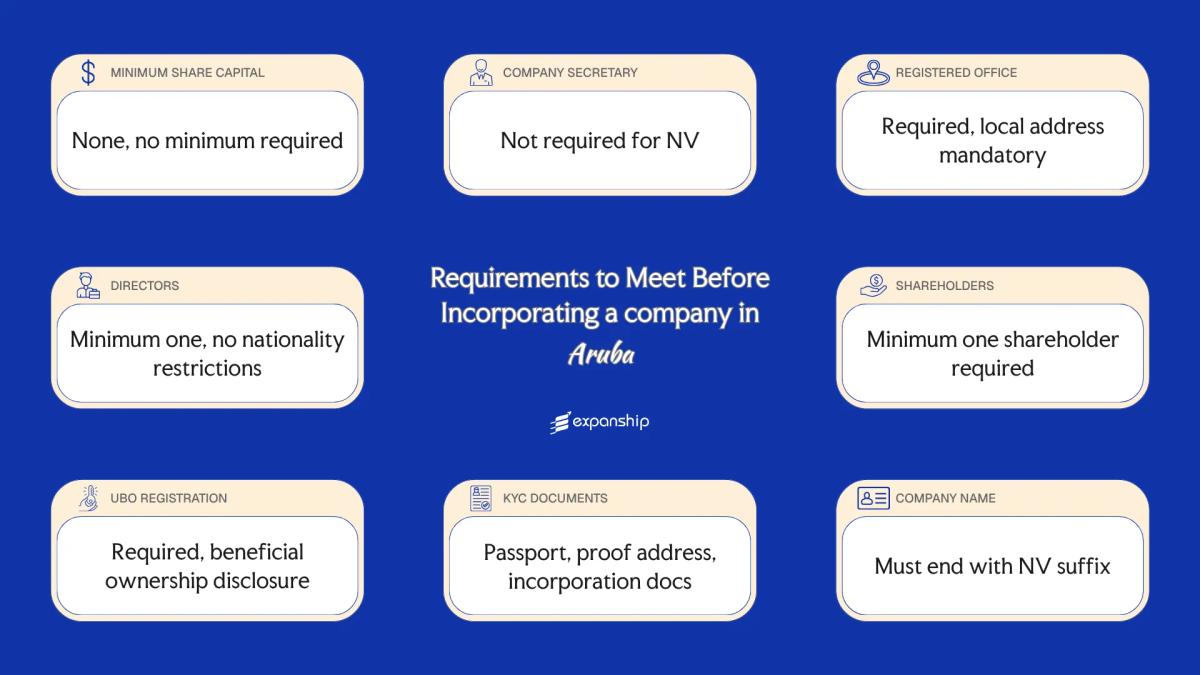
Minimum Share Capital Requirements in Aruba

Aruba minimum share capital requirements vary depending on the legal entity type being incorporated, with the two principal structures being the Naamloze Vennootschap (NV) and the Aruba Vrijgestelde Vennootschap (AVV). Both operate under a par value share system, governed by the Aruba Civil Code and administered through the Aruba Chamber of Commerce and Industry (Kamer van Koophandel en Nijverheid Aruba).
No independent bank confirmation or notarial capital deposit certificate is required at the point of registration, though a civil law notary must execute the deed of incorporation. Share capital obligations are structural requirements embedded in the deed, not ongoing annual thresholds subject to regulatory review.
| Parameter | Detail |
|---|---|
| Minimum Authorized Share Capital | AWG 10,000 for an NV; no statutory minimum for an AVV |
| Maximum Authorized Share Capital | No statutory maximum |
| Minimum Paid-Up Capital | AWG 10,000 for an NV at incorporation; no statutory minimum for an AVV |
| Paid-Up Requirement at Incorporation | Full minimum must be subscribed and paid up upon incorporation for an NV |
| Accepted Currency | Aruban Florin (AWG); foreign currency permissible if stated in the deed |
| Accepted Forms of Contribution | Cash or non-cash contributions; non-cash must be described in the deed |
| Timeframe to Deposit Capital | At the time of incorporation; no deferred payment period under the Civil Code |
An AVV has no statutory minimum capital, but the authorized share capital and par value of each share must still be explicitly defined in the notarial deed of incorporation.
Registered Agent Requirements in Aruba
Under Aruba corporate law, registered agent requirements apply to all entities incorporated under the Aruba Civil Code, including the naamloze vennootschap (NV) and the vennootschap met beperkte aansprakelijkheid (VBA). A licensed civil-law notary typically fulfills the agent function during incorporation, as deed execution before a notary is required for formation.
Your entity must maintain an appointed agent or representative capable of receiving official correspondence and acting as a point of contact for the Departamento di Impuesto (the Aruban tax authority) and other regulatory bodies.
Qualification criteria for who may serve as a registered agent in Aruba:
- The agent must be resident or formally established in Aruba.
- Licensed civil-law notaries are the primary qualified professionals for this role.
- Corporate service providers operating under Aruba's financial supervision framework may also qualify.
- The agent must be a legal person or licensed natural person; informal arrangements are not recognized.
- Foreign individuals without local establishment or licensing do not meet the eligibility threshold.

Incorporate a Company in Aruba
Set up your legal entity in Aruba with guidance on notarial requirements, agent obligations, and regulatory compliance.
Registered Office Requirements in Aruba
Registered office requirements in Aruba are governed under the Aruban Civil Code, which mandates that every legally incorporated entity maintain a statutory address within the territory of Aruba. Failure to maintain a compliant address can result in the company being struck off the Commercial Register held by the Aruba Chamber of Commerce (Kamer van Koophandel en Nijverheid Aruba).
- A physical address in Aruba is required; P.O. boxes alone do not satisfy the statutory domicile requirement.
- Virtual office addresses may be used, provided the address corresponds to a physical location that can receive official correspondence.
- The address must be locally based within Aruba; a foreign address does not satisfy corporate domicile obligations.
- No ownership of the premises is required; a lease or service agreement covering use of the address is sufficient.
- The registered address is publicly listed in the Commercial Register and is accessible to third parties.
- Any change to the registered office address must be formally notified to the Aruba Chamber of Commerce, and the updated information must be reflected in the Commercial Register within the legally prescribed period.
Director Requirements in Aruba

Under the Aruba Civil Code and the National Ordinance on Formally Foreign Companies, directors of an Aruba NV (Naamloze Vennootschap) or BV (Besloten Vennootschap) assume statutory duties of care, loyalty, and proper administration upon appointment. Personal liability can attach where directors act in breach of their fiduciary obligations or where the company fails to meet its obligations due to gross mismanagement.
| Parameter | Detail |
|---|---|
| Minimum Number of Directors | One director is required. |
| Maximum Number of Directors | No statutory maximum is prescribed. |
| Local/Resident Director Required | No local or resident director is required. |
| Nationality Restrictions | No nationality restrictions apply. |
| Minimum Age Requirement | Directors must be at least 18 years of age. |
| Corporate Directors Permitted | Corporate directors are permitted under Aruban law. |
| Director Must Be a Shareholder | No requirement for a director to hold shares. |
| Publicly Listed on Registry | Director information is filed with the Aruba Chamber of Commerce but is generally accessible on the public register. |
| Disqualification Conditions | Directors may be disqualified following a court ruling related to fraud, insolvency mismanagement, or serious breach of fiduciary duty. |
Despite having no residency requirement, Aruba-incorporated companies must still appoint their directors through a notarial deed executed before an Aruban civil law notary, meaning even a fully foreign-managed NV requires a formal in-jurisdiction procedural step at formation.
Shareholder Requirements in Aruba
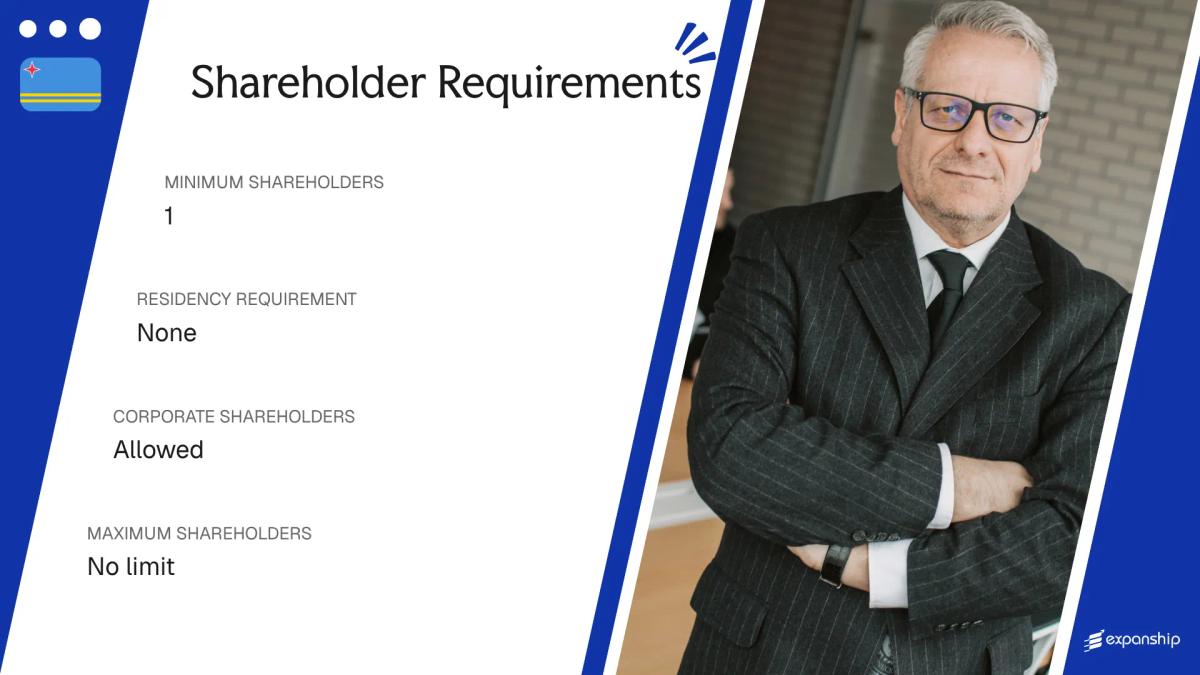
An Aruba N.V. (Naamloze Vennootschap) can be incorporated with a single shareholder, making a sole shareholder structure fully permissible. There is no statutory maximum on the number of shareholders.
Nationality and Residency Restrictions
Shareholder requirements in Aruba impose no nationality or residency conditions on shareholders. Foreign nationals and non-resident individuals may hold shares without restriction on ownership percentage.
Corporate Shareholders
Corporate entities are permitted to act as shareholders in an Aruba company. No special conditions are attached to corporate shareholding beyond the standard KYC and due diligence obligations applied during incorporation.
Shareholder Liability
Under the N.V. structure, Aruba NV shareholder obligations with respect to liability are limited to the amount unpaid on their shares. Extended personal liability does not generally arise unless a court pierces the corporate veil in cases of fraud or abuse.
Register of Shareholders
A register of shareholders must be maintained at the registered office. This register is not publicly accessible, though the entity is required to keep it current and make it available to competent authorities upon request.
Guidance on Shareholder Structuring for Your Aruba Incorporation
Speak with our team about meeting the shareholder criteria for your Aruba entity, from structuring corporate shareholding to maintaining a compliant register.
UBO / Beneficial Ownership Registration Requirements in Aruba
Aruba UBO registration requirements are governed by the National Ordinance on the Identification of Clients (Landsverordening Identificatie bij Dienstverlening) and related AML legislation, which define a beneficial owner as any natural person who ultimately owns or controls 25% or more of a legal entity.
- Identify all natural persons holding, directly or indirectly, 25% or more of shares or voting rights in the entity.
- Submit UBO information to the Aruba Chamber of Commerce (Kamer van Koophandel en Nijverheid Aruba) at the time of registration.
- Report any changes to beneficial ownership to the Chamber within a prescribed period following the change.
| Parameter | Detail |
|---|---|
| Ownership Threshold for UBO Status | 25% of shares or voting rights |
| Filing Authority | Aruba Chamber of Commerce (Kamer van Koophandel en Nijverheid Aruba) |
| Disclosure Deadline at Incorporation | At the time of registration |
| Publicly Accessible Register | No statutory requirement for public access |
| Penalties for Non-Disclosure | Administrative sanctions under AML legislation; specific penalty amounts subject to regulatory determination |
| Ongoing Update Obligation | Yes; changes must be reported to the Chamber |
KYC / Document Requirements in Aruba

KYC requirements for Aruba company formation are governed by the National Ordinance on the Identification of Clients (Landsverordening Identificatie bij Dienstverlening) and the National Ordinance on the Reporting of Unusual Transactions, both enforced by the FIU Aruba.
Individual / Personal Documents
- Valid government-issued passport or national identity card for each director, shareholder, and beneficial owner
- Recent proof of residential address dated within three months, such as a utility bill or bank statement
- Completed and signed KYC intake form as required by the local service provider or notary
- A recent passport-sized photograph may be requested depending on the notary's internal procedures
Corporate Documents
- Certificate of incorporation or equivalent formation document for any corporate shareholder or director
- Constitutional documents, including articles of association or equivalent
- Current register of directors and register of shareholders for the corporate entity
- Proof of registered office address for the corporate entity
Source of Funds Documentation
- Recent bank statements covering a minimum of three to six months evidencing available capital
- Audited financial statements where the introducing entity is an established operating business
- A written source of funds declaration signed by the relevant party
Notarisation and Apostille Requirements
- Foreign documents must generally be apostilled under the 1961 Hague Convention before submission
- Documents not in Dutch or English typically require a certified translation
- Notarisation by a civil law notary (notaris) in Aruba is required for the deed of incorporation itself
Incomplete or unverified source of funds documentation is the most frequent cause of incorporation delays in Aruba.
Company Name Requirements in Aruba
Aruba company name requirements are assessed during the incorporation process, with proposed names reviewed for uniqueness and public order compliance before registration is confirmed. Each submission is evaluated on a case-by-case basis, and identical or confusingly similar names to existing entities are rejected.
Names must be in any language, though they must include a legal suffix reflecting the chosen entity type, such as "N.V." for a Naamloze Vennootschap or "V.B.A." for a limited liability company. No specific character limit is publicly prescribed, but the name must be unambiguous.
Certain words are restricted or prohibited. Terms implying government affiliation, banking, insurance, or royal patronage generally require prior approval from the relevant supervisory authority before your business may use them.
Name reservation is available prior to formal incorporation. Reservations are submitted to the commercial registry and hold the name for a fixed period while documentation is prepared, preventing other applicants from registering the same name in the interim.
Compliance Services for Companies in Aruba
Maintain good standing in Aruba with ongoing compliance support, including annual filings, regulatory reporting, and UBO registration obligations.
Conclusion
Aruba company incorporation requirements span several regulated areas, from minimum share capital thresholds to UBO registration under the country's beneficial ownership framework. Among the more consequential obligations is the requirement to maintain a local registered office and appoint a licensed registered agent, both of which tie your entity to ongoing administrative infrastructure on the island. The Civil Code of Aruba governs the structural formation of entities such as the NV and AVV, while the Financial Intelligence Unit oversees compliance on the beneficial ownership side. Once these requirements are understood, foreign investors move into the operational phase of establishing banking relationships and meeting post-incorporation filing obligations.
Expanship's Corporate Services for Aruba Expansion
Aruba corporate services expansion involves meeting a specific set of structural and compliance requirements, from notarial deed execution under Aruban civil law to UBO registration with the Chamber of Commerce. Expanship's role is to manage the administrative workload these obligations create, so your business can focus on operations rather than procedural coordination.
Beyond formation, Expanship supports your entity across its full corporate lifecycle in Aruba. Our services cover:
- Preparing and filing incorporation documents, including notarial deed coordination
- Providing a registered agent and a compliant registered office address in Aruba
- Liaising with the Aruban Chamber of Commerce and relevant government authorities on your behalf
- Managing post-incorporation obligations, including annual filings and UBO record maintenance
- Facilitating introductions to local banking institutions suited to your business structure
- Handling tax registration and coordination with the Departamento di Impuesto
Reach out to Expanship Aruba to discuss your incorporation requirements.
Frequently Asked Questions (FAQ)
You are required to update the UBO register held at the Aruba Chamber of Commerce within a prescribed period of any change in beneficial ownership or controlling interest. Failure to keep this information current can result in administrative sanctions under Aruban anti-money laundering regulations. The obligation to maintain accurate UBO records is ongoing, not a one-time filing requirement at incorporation.
Yes, Aruba does not impose a residency requirement for directors, meaning a foreign national can serve as the sole director of an NV or VBA. There is no statutory minimum on director nationality either. That said, your corporate service provider or registered agent may have internal policies that affect the practical management arrangements for the entity.
A registered office address physically located in Aruba is mandatory for all locally incorporated entities. The address must be a functional address capable of receiving official correspondence and service of legal documents, and it must be recorded with the Aruba Chamber of Commerce. A post office box alone does not satisfy this requirement under Aruban corporate law.
Foreign shareholders are required to provide certified copies of government-issued identification, proof of residential address, and source-of-funds documentation as part of the KYC process governed by Aruba's National Ordinance on the Identification of Clients when Rendering Financial Services. Corporate shareholders must supply certified constitutional documents, including a certificate of good standing from their jurisdiction of incorporation. The completeness and certification standard of these documents directly affects how quickly the incorporation process can proceed.
Yes, company names that suggest banking, insurance, trust, or other licensed financial activities are subject to additional scrutiny and may require prior approval from the Centrale Bank van Aruba before the Chamber of Commerce will register them. Using a restricted term without the relevant license can result in the rejection of your incorporation application. The word "Bank" in a company name, for example, is not available to unlicensed entities regardless of how it is contextualised in the full name.
Non-compliance with UBO registration obligations under Aruban law can result in fines and, in cases of wilful concealment, criminal liability for the directors and beneficial owners involved. The Aruba Chamber of Commerce and supervisory authorities have the authority to impose administrative penalties for incomplete or inaccurate filings. Registering with incorrect or incomplete beneficial ownership information carries the same risk as failing to register altogether.
Legal Disclaimer
The information provided in this article is for general informational purposes only and does not constitute legal, tax, or professional advice. While we strive to ensure the accuracy and timeliness of the content, laws and regulations are subject to change, and the application of laws can vary widely based on specific facts and circumstances.
Readers should not act upon this information without seeking professional counsel tailored to their individual situation. Expanship and its authors disclaim any liability for actions taken or not taken based on the content of this article.
For specific advice regarding your business setup, compliance requirements, or any legal matters, please consult with qualified legal and tax professionals in the relevant jurisdiction.