

Key Takeaways
- Aruba's corporate tax framework under the Landsverordening op de Winstbelasting imposes compliance obligations that require ongoing engagement with the Departamento di Impuesto, adding administrative burden for foreign-owned entities without local operational expertise.
- The island's limited double taxation treaty network leaves foreign investors exposed to withholding tax inefficiencies that comparable offshore or mid-shore jurisdictions with broader treaty coverage can structurally avoid.
- A domestic population of under 120,000 people constrains local market revenue potential to the point where most foreign incorporators must rely entirely on cross-border or export-oriented activity to justify the cost of entity maintenance.
- The AVV (Aruba Vrijgestelde Vennootschap) and VBA structures carry eligibility conditions and operational restrictions that reduce structural flexibility for businesses whose activity profile does not align precisely with those defined legal forms.
Aruba operates under a structured regulatory environment governed by the Landsverordening op de Winstbelasting and supervised through entities such as the Departamento di Impuesto. Foreign investors considering company formation here will encounter a distinct set of disadvantages spanning taxation, structural limitations, workforce constraints, and market scale.
The specific drawbacks discussed in this article span operational, legal, and financial dimensions that are directly tied to Aruba's regulatory framework and economic profile.
Not all disadvantages carry equal weight for every business. A firm targeting international holding structures will face different friction points than one pursuing local commercial activity, so the relevance of each issue depends on your intended structure and industry.
The Landsverordening and related corporate statutes form the legal basis for company registration and ongoing compliance obligations. This article is most relevant to foreign entrepreneurs, holding company promoters, and small-to-mid-size enterprises evaluating Aruba incorporation risks before committing to a registration strategy.
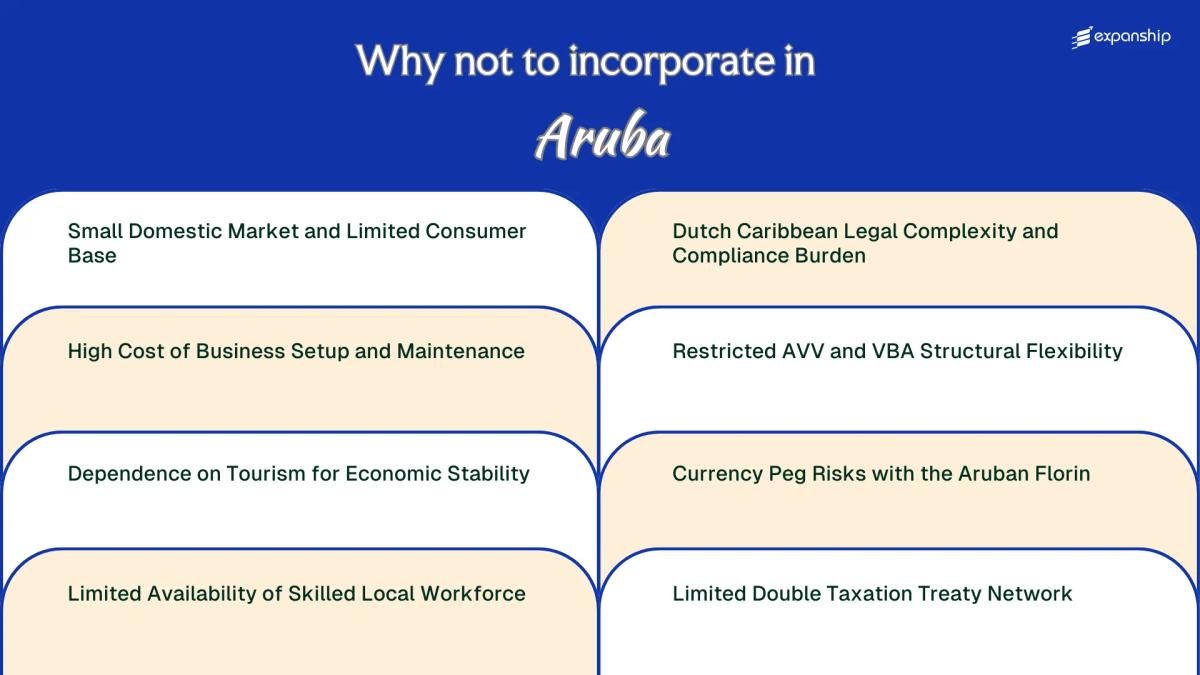
Small Domestic Market and Limited Consumer Base
Aruba small market business limitations surface immediately when you assess the addressable consumer pool. With a resident population of approximately 106,000 people, the domestic market offers little room to build sustainable revenue through local sales alone.
Population Size and Purchasing Depth
The island's small headcount translates directly into a shallow demand base across nearly every sector outside tourism. Even businesses targeting mid-to-high income earners face a ceiling that most international firms would consider a pre-launch threshold, not a growth market.
Reaching full market penetration can happen rapidly, leaving no organic expansion path without moving beyond the island.
Import Dependency and Retail Constraints
Aruba imports the vast majority of its consumer goods, which means local retailers and distributors face elevated input costs that compress margins before a single unit sells. Your business cannot rely on local supply chains to offset pricing pressure in a market already constrained by limited consumer base Aruba conditions.
For product-based companies, the combination of high import costs and low volume makes unit economics structurally difficult to justify.
A foreign business incorporated in Aruba solely to serve the domestic market will almost certainly be unable to recover setup and operational costs through local sales given the population ceiling of approximately 106,000 residents.
High Cost of Business Setup and Maintenance
High business setup costs in Aruba begin before your entity opens its doors. Incorporating a Naamloze Vennootschap (NV) requires a minimum share capital of AWG 10,000, and notarial deed preparation through a civil-law notary adds professional fees that are not optional under Aruban corporate law.
Government fees, notarial charges, and mandatory registration with the Aruba Chamber of Commerce (KvK) create a combined upfront cost that is disproportionate relative to the island's market size. Annual maintenance obligations compound this burden considerably.
Ongoing Aruba company maintenance cost drawbacks include:
- Annual KvK registration renewal fees that accumulate even when the entity generates no revenue, creating a fixed liability regardless of business performance
- Mandatory use of locally licensed notaries for structural changes, meaning each amendment to articles of association triggers a separate professional fee
- Compliance filings with the Directie Fiscale Zaken (Tax Department) require local accountants or tax advisors, as remote self-filing is not practically viable for foreign-registered owners
- Registered local agent or representative requirements add a recurring annual cost with no operational return
Foreign firms with lean structures feel this most acutely. The fixed cost floor in Aruba does not scale down for smaller entities.

Company Incorporation in Aruba
Understand the full cost structure and regulatory requirements before establishing a legal entity in Aruba.
Dependence on Tourism for Economic Stability
Aruba tourism dependence economic risks are impossible to separate from how the island's broader commercial environment functions. Tourism accounts for roughly 70 to 90 percent of GDP depending on the measurement period, which means any disruption to visitor arrivals directly compresses the revenue base that local businesses and service providers depend on.
That concentration creates a structural vulnerability. When arrivals dropped sharply during the COVID-19 period, the government was forced into emergency fiscal measures, and private sector liquidity tightened significantly. For a foreign entity operating here, demand forecasts built on normal conditions can collapse within a single quarter.
| Economic Factor | Indicator | Implication for Foreign Business |
|---|---|---|
| Tourism share of GDP | ~70–90% | Revenue base tied to a single sector |
| Unemployment spike (2020) | Exceeded 25% | Consumer spending collapses rapidly in downturns |
| Foreign exchange earnings | Predominantly tourism-derived | Non-tourism firms face indirect liquidity exposure |
| Economic recovery lag | Multi-year post-shock | Business planning cycles disrupted beyond the initial crisis |
Seasonal demand patterns compound this instability. High-season concentration between December and April means businesses outside the direct hospitality sector still experience significant revenue variability across the calendar year.
Your firm's exposure is not limited to direct tourism operations. Suppliers, professional service providers, and even corporate tenants of commercial property feel the downstream effects when hotel occupancy and visitor spending contract.
Limited Availability of Skilled Local Workforce
Aruba skilled workforce limitations present a concrete operational constraint for foreign businesses that require specialized talent on the ground. With a population of approximately 107,000, the local labor pool is structurally narrow, and the supply of professionals in fields such as financial services, software development, and advanced engineering falls short of what most internationally oriented companies need.
Hiring from abroad is not straightforward. Under the Landsverordening Toelating en Uitzetting (LTU), the immigration framework governing Aruba, foreign workers require work permits issued through the Directie Economische Zaken, Handel en Industrie (DEZHI), a process that adds administrative time and cost to each hire.
Permit processing timelines vary, and approvals are not guaranteed. Your business may face delays in staffing that directly affect your operational start date.
- Work permits for non-resident employees must be applied for through DEZHI under the LTU framework
- Local labor market testing may be required before foreign hires are approved
- Each permit application is position-specific, meaning a change in role can trigger a new filing
- Permit-dependent hires create ongoing HR administrative obligations tied to permit renewal cycles
Despite its Dutch Kingdom ties, Aruba does not have automatic access to the EU's freedom of movement provisions, meaning even Dutch nationals require separate work authorization to be employed there under local immigration rules.
For a full overview of labor regulations, DEZHI publishes the applicable permit categories and procedural requirements on its official site.
Dutch Caribbean Legal Complexity and Compliance Burden
The Dutch Caribbean legal compliance burden in Aruba stems from a layered framework that combines autonomous Aruban legislation with Kingdom of the Netherlands oversight, creating a multi-tiered regulatory environment that foreign incorporators often underestimate.
Structural Complexity of the Legal Framework
Aruba operates under its own civil code and corporate legislation distinct from the Netherlands, yet remains subject to Kingdom-level regulation in areas including financial supervision and anti-money laundering compliance. The Central Bank of Aruba (CBA), which enforces the State Ordinance on the Supervision of Banking and Credit Institutions, requires ongoing filings that demand local legal counsel to interpret and execute accurately. Foreign directors unfamiliar with Papiamento-language documentation or Dutch-derived legal conventions face meaningful administrative friction from the outset.
Compliance Obligations and Their Practical Cost
The CBA's AML/CFT supervision framework, aligned with FATF standards but administered locally, imposes due diligence obligations that go beyond what many offshore-oriented jurisdictions require. For a foreign-owned entity, meeting these requirements typically necessitates retaining local compliance officers or law firms, adding recurring operational costs with no equivalent in lower-scrutiny Caribbean jurisdictions. Smaller corporate structures without dedicated legal resources are disproportionately affected by these obligations.
Managing Compliance Obligations for Your Aruba Entity
Get structured guidance on meeting Aruba's regulatory and legal compliance requirements as a foreign business owner.
Restricted AVV and VBA Structural Flexibility
Both the AVV (Aruba vrijgestelde vennootschap) and the VBA (vennootschap met beperkte aansprakelijkheid) carry structural restrictions that reduce their utility for foreign business owners seeking operational flexibility. Aruba AVV VBA structural restrictions are governed under the Aruba Civil Code and the National Ordinance on Exempt Companies, which impose specific conditions on how these entities can be used.
- The AVV is prohibited from conducting active commercial business or generating income from Aruba-sourced operations, which disqualifies it for any trading or service business targeting local or regional markets.
- Maintaining AVV exempt status requires strict compliance with the substance and activity restrictions set by the Aruban tax authorities, and any breach risks reclassification and full corporate tax exposure.
- The VBA, while more flexible than the AVV, still requires notarial deed formation and registration with the Aruba Chamber of Commerce (KvK), adding procedural costs that simpler offshore structures in competing jurisdictions do not impose.
- Neither entity offers the director nominee privacy protections available in comparable jurisdictions, as beneficial ownership disclosure obligations apply under Aruba's AML framework.
Currency Peg Risks with the Aruban Florin
Aruban florin currency peg risks are a structural concern for any foreign business earning or holding AWG. The florin has been pegged to the US dollar at a fixed rate of 1.79 AWG per USD since 1986, administered by the Centrale Bank van Aruba (CBA).
That fixed rate removes exchange flexibility. If your business operates across multiple currencies, you absorb all conversion losses on the non-USD side without any mechanism to benefit from florin depreciation.
The peg's stability depends on the CBA maintaining adequate foreign exchange reserves. A tourism-driven economy with concentrated revenue sources creates periodic reserve pressure, which can affect the CBA's capacity to defend the peg during external shocks.
AWG currency risks for businesses become acute when the US Federal Reserve adjusts interest rates. Because the peg ties monetary policy to USD, the CBA has limited independent monetary tools, meaning interest rate conditions may not align with local economic cycles.
Hypothetical scenario: A European firm invoicing clients in EUR converts receipts to AWG, then repatriates profits in USD. With EUR/USD fluctuation absorbed entirely outside the peg mechanism, a 10% EUR depreciation against the dollar translates directly into a 10% reduction in repatriated value, with no offsetting florin adjustment available.
Limited Double Taxation Treaty Network
Aruba's double taxation treaty limitations stem from a thin bilateral agreement network that leaves most cross-border income flows exposed to dual taxation. The Kingdom of the Netherlands has concluded numerous tax treaties, but these do not automatically extend to Aruba as a constituent country within the Kingdom.
As of current records, Aruba has only a limited set of tax information exchange agreements (TIEAs) rather than full double taxation treaties with major trading partners. This means dividend, royalty, and interest payments between your Aruban entity and foreign counterparties may be taxed in both jurisdictions without relief mechanisms.
For businesses routing income through or out of the territory, the absence of broad DTT coverage creates a structural cost disadvantage compared to jurisdictions like the Netherlands or Singapore, which maintain extensive treaty networks with withholding tax reductions.
- No full DTT with the United States
- No full DTT with major EU member states as independent agreements
- TIEAs do not reduce withholding tax rates or provide residence-based taxation relief
The limited DTT coverage in Aruba business structures disproportionately affects holding companies and IP-holding entities that depend on reduced withholding rates to maintain tax efficiency.
If your business structure relies on reduced withholding tax rates on dividends or royalties flowing out of the territory, you cannot assume any such relief applies without independently verifying whether a qualifying agreement exists with your specific counterparty jurisdiction.
Strategies to Overcome These Challenges
Overcoming Aruba incorporation challenges requires deliberate structural planning rather than reactive compliance fixes. The disadvantages outlined across this blog share common roots: a narrow economic base, limited treaty access, and a layered Dutch Caribbean legal framework.
- Register your entity under the correct legal form from the outset by reviewing the structural limitations of the AVV and VBA under the Aruban Civil Code before committing to either.
- Account for Chambers of Commerce registration fees, notarial deed costs, and annual maintenance obligations in your initial financial projections to avoid underestimating setup expenditure.
- Offset the limited tax treaty network by structuring cross-border arrangements through jurisdictions that hold relevant bilateral agreements, reviewed against the OECD Model Convention.
- Address workforce gaps by engaging the Aruban labor authority for work permit procedures under the applicable immigration regulations before hiring foreign staff.
- Build currency exposure into treasury planning given the Aruban florin's fixed peg to the US dollar and its structural dependency on tourism-linked foreign exchange inflows.
These steps operate within a regulatory environment overseen by the Aruban Financial Supervisory Authority (AFSA) and the Department of Economic Affairs. Structural decisions made at formation are difficult to reverse under local corporate law.
Aruba's Overall Business Viability
Aruba presents a credible incorporation destination for foreign businesses with specific structural or regional objectives. The disadvantages covered in this blog are real constraints, not theoretical ones, and they shape the practical calculus of forming an entity here.
| Pros | Cons |
|---|---|
| The Aruban florin's peg to the USD provides predictable exchange rates for USD-denominated transactions. | That same peg removes monetary policy flexibility and exposes businesses to imported inflation. |
| The AVV structure offers a recognized vehicle for asset holding and investment activity. | AVV and VBA structures carry statutory restrictions that limit operational and structural flexibility. |
| Aruba operates under a stable Dutch-derived legal framework with established commercial legislation. | Dutch Caribbean regulatory layering creates compliance obligations across multiple jurisdictions simultaneously. |
| The island's geographic position supports access to Caribbean and Latin American markets. | The domestic consumer base is too small to sustain most commercially oriented businesses independently. |
| Political stability under the Kingdom of the Netherlands reduces sovereign risk. | A narrow double taxation treaty network increases the tax exposure of cross-border operations. |
Tourism dependence remains a structural vulnerability that affects broader economic conditions, including local workforce depth and infrastructure capacity. That reality does not disqualify the jurisdiction, but it does mean your business must be structured to function despite it, not because of it.
Corporate Compliance Services in Aruba
Manage your ongoing compliance obligations under Aruban law, including annual filings, registered office requirements, and regulatory reporting for AVV and VBA structures.
Conclusion
This Aruba incorporation disadvantages summary reflects a jurisdiction with genuine structural constraints. The treaty network is narrow, limiting tax efficiency for cross-border operations. The AVV framework, once a flexible offshore tool, now carries tighter compliance obligations that raise ongoing administrative costs. Dependence on a single economic sector compounds exposure to external shocks outside your control. These are not superficial concerns. Professional guidance specific to Dutch Caribbean corporate law and the regulatory expectations of the Departamento di Impuesto remains a practical necessity for any firm intending to operate or hold assets through an Aruban structure.
Expanship's Role in Your Aruba Expansion
Expanship Aruba company formation support covers the specific friction points this jurisdiction creates for foreign businesses. Working with the Departamento di Impuesto (tax authority) and the Aruba Chamber of Commerce involves procedural requirements that take time and local knowledge to execute correctly. Expanship's role is to reduce that operational burden, not to change the underlying obligations.
Our services cover the full incorporation and post-registration cycle across both AVV and NV structures.
- Your company registration documents are prepared in accordance with Aruban civil law requirements.
- A registered agent and local office address are provided to satisfy statutory presence obligations.
- Government filings and liaison with the Chamber of Commerce and tax authorities are handled on your behalf.
- Ongoing compliance management keeps your entity in good standing after incorporation.
- Banking introduction assistance connects your business with suitable Aruban financial institutions.
- Tax registration and coordination with the Departamento di Impuesto are managed as part of the process.
Reach out to Expanship Aruba to discuss your incorporation requirements directly.
Frequently Asked Questions (FAQ)
The Aruba Vrijgestelde Vennootschap's restrictions apply broadly, not selectively by sector. The AVV is exempt from profit tax but is prohibited from conducting active business with Aruban residents, which means any firm that needs local commercial flexibility will find this structure unsuitable. Pivoting to a standard NV or VBA introduces a different compliance burden without necessarily resolving the underlying limitation.
Non-compliance with filing and maintenance requirements under Aruban civil and commercial law can result in penalties, forced deregistration, or loss of good standing with the Aruba Chamber of Commerce. Reinstatement after deregistration is procedurally burdensome and may require demonstrating full historical compliance. For entities using the AVV structure, any breach of its permitted activity rules can trigger retroactive tax liability.
Aruba's setup and annual maintenance costs run materially higher than jurisdictions such as the British Virgin Islands or Panama. Notarial deed requirements for NV formation, mandatory local registered agents, and auditing thresholds that apply at relatively low revenue levels all contribute to the cost base. For a holding or asset-protection structure with minimal transactional activity, the cost-to-benefit ratio in Aruba is less favorable than several regional alternatives.
The peg itself is not the primary risk; the concern is what happens if the peg comes under pressure. Aruba's economy is heavily dependent on tourism revenue, and a prolonged downturn can strain foreign currency reserves, creating uncertainty around the florin's long-term convertibility. Businesses that hold florin-denominated assets or settle contracts locally carry indirect exposure to any future peg adjustment.
For most technical, financial, or specialized professional roles, international hiring is effectively unavoidable. Aruba's labor pool is constrained by population size, and work permit requirements under the Landsverordening Toelating en Uitzetting add cost and processing time to each foreign hire. Companies that need to build a local team quickly will find that timeline and cost projections almost always underestimate the friction involved.
Yes, meaningfully so. Aruban corporate law derives from the Dutch legal tradition and operates under its own autonomous framework within the Kingdom of the Netherlands, distinct from Curaçao and Bonaire. Foreign investors accustomed to common law jurisdictions or simplified offshore structures will encounter notarial requirements, civil-law governance norms, and a regulatory environment administered through Aruban-specific ordinances that require local legal counsel to interpret correctly.
Legal Disclaimer
The information provided in this article is for general informational purposes only and does not constitute legal, tax, or professional advice. While we strive to ensure the accuracy and timeliness of the content, laws and regulations are subject to change, and the application of laws can vary widely based on specific facts and circumstances.
Readers should not act upon this information without seeking professional counsel tailored to their individual situation. Expanship and its authors disclaim any liability for actions taken or not taken based on the content of this article.
For specific advice regarding your business setup, compliance requirements, or any legal matters, please consult with qualified legal and tax professionals in the relevant jurisdiction.