

Key Takeaways
- Aruba's territorial tax system restricts local income tax liability to Aruba-sourced earnings, meaning internationally oriented businesses can hold and manage foreign income outside the scope of Aruban taxation.
- The Aruba Vrijgestelde Vennootschap (AVV) separates asset ownership from operational risk under a Dutch-derived legal framework, providing foreign investors with a level of legal predictability that is uncommon across smaller Caribbean jurisdictions.
- Because Aruba carries no capital gains tax on qualifying investments, the cost of holding and exiting assets through an Aruban entity remains materially lower than in many comparable offshore structures.
- Registration oversight by the Aruba Chamber of Commerce and the island's constitutional position within the Kingdom of the Netherlands adds institutional credibility that influences how counterparties, banks, and third-country regulators assess the entity.
Aruba is a constituent country of the Kingdom of the Netherlands, situated in the southern Caribbean approximately 29 kilometers north of Venezuela. This political arrangement gives the territory a distinct constitutional status separate from the Netherlands proper, while maintaining ties to Dutch legal and institutional frameworks. The Aruba Chamber of Commerce serves as the primary body overseeing business registration on the island.
Foreign businesses incorporating here most commonly do so through an Aruba Vrijgestelde Vennootschap, or AVV. The jurisdiction operates a territorial tax system, meaning foreign-sourced income is generally outside the scope of local taxation. There are no restrictions on foreign ownership of locally registered entities, and foreign direct investment faces no nationality-based barriers under current legislation.
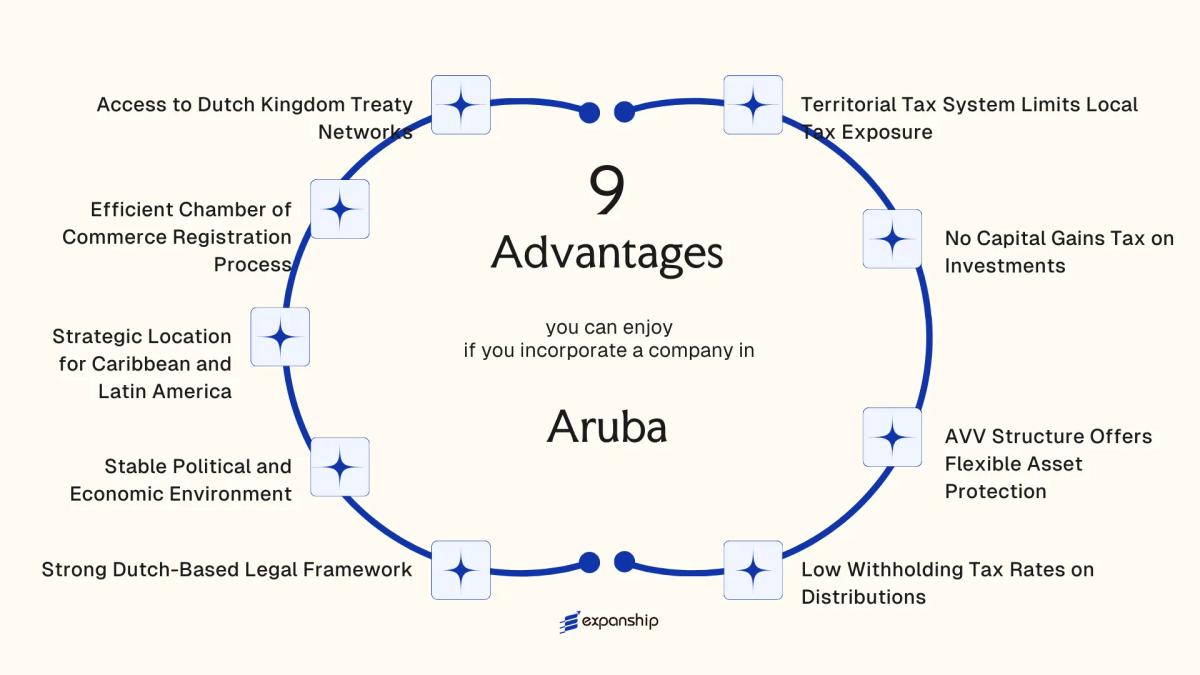
The benefits of incorporating in Aruba extend across tax structure, legal predictability, and geographic positioning. This article examines those advantages in factual terms, drawing on the regulatory and legal framework that governs business formation on the island.
Territorial Tax System Limits Local Tax Exposure
Aruba operates a territorial tax system, meaning resident companies are taxed only on income sourced within the island. Foreign-sourced income falls outside the scope of local corporate income tax, which is levied under the National Ordinance on Profit Tax (Landsverordening Winstbelasting).
What the Territorial Scope Actually Excludes
Profits generated through foreign operations, overseas subsidiaries, or international investment activity are not included in the Aruban taxable base. For a holding company or an entity with cross-border revenue streams, this structural exclusion can substantially reduce overall tax exposure without requiring complex planning arrangements.
Why the Corporate Rate Context Matters
The standard corporate income tax rate sits at 25%. Applied only to locally sourced income, that rate affects a narrower base than it would under a worldwide tax system. Your business retains foreign earnings without triggering a local tax event, which makes the entity particularly relevant for structuring international income flows through a jurisdiction that does not tax them at source.
Foreign income earned outside Aruba is not subject to local corporate tax, keeping your offshore revenue structurally insulated from the domestic tax base.
No Capital Gains Tax on Investments
Aruba does not impose a capital gains tax on investment disposals. For foreign investors holding shares, real estate, or other assets through an Aruban entity, gains realized on the sale of those assets are not subject to tax at the company level under the general provisions of the Landsverordening Winstbelasting (the profit tax ordinance). This means the full realized gain remains within the structure, rather than being reduced at the point of exit.
That treatment carries a direct consequence for investment structuring. An investor who sells a shareholding or exits a position does not face a tax erosion event that would otherwise require pre-exit planning or treaty analysis to mitigate.
The practical advantages for foreign investors include:
- Gains on share disposals are not treated as taxable profit under standard profit tax rules, so no complex exemption claim is required
- Real estate held through a qualifying structure can be sold without triggering a separate capital gains charge distinct from ordinary tax assessment
- Exit planning is simplified because there is no capital gains rate to account for in return modeling
Eligibility for this treatment generally depends on the income being recognized outside the scope of ordinary business profit subject to the standard corporate profit tax rate. Structuring the holding correctly from incorporation is therefore material to preserving this outcome.

Company Incorporation in Aruba
Set up your Aruban company with Expanship and structure your investment vehicle to operate within the correct tax framework from day one.
AVV Structure Offers Flexible Asset Protection
The Arubaanse Vrijgestelde Vennootschap, or AVV, is a statutory exempt company structure introduced under the Landsverordening Vrijgestelde Vennootschap. For foreign investors focused on Aruba AVV structure asset protection benefits, the mechanism is straightforward: assets held within an AVV are legally segregated from the personal estate of shareholders, and the entity itself operates under a defined exemption regime that limits exposure to local taxation on qualifying foreign-sourced income.
Separation of ownership from liability is the structural core of the AVV. Because the entity holds assets in its own name, creditors pursuing claims against shareholders generally cannot reach assets held at the corporate level, provided the structure has been properly established and maintained under Aruban law.
| Feature | Detail |
|---|---|
| Legal basis | Landsverordening Vrijgestelde Vennootschap |
| Asset segregation | Corporate assets held separately from shareholders' personal estate |
| Permitted asset types | Shares, receivables, intellectual property, real estate |
| Minimum paid-up capital | AWG 10,000 (subject to regulatory confirmation) |
| Supervision | Aruban Chamber of Commerce and notarial deed requirement |
Asset types eligible for holding within an AVV include shares in other companies, receivables, intellectual property rights, and real estate interests. This range means the structure suits holding arrangements across different asset classes without requiring separate legal vehicles for each category. Your business can consolidate diverse holdings under a single Aruban entity, which simplifies administration and keeps the ownership chain transparent for banking and compliance purposes.
Low Withholding Tax Rates on Distributions
Aruba low withholding tax on distributions sits at a general statutory rate of 10% under the National Ordinance on Profit Tax (Landsverordening Winstbelasting). For foreign investors repatriating profits, this rate is meaningfully lower than the 15–25% dividend withholding tax rates common across many OECD and EU member states.
The practical effect is direct: a larger share of distributed profits reaches the parent company or shareholder without being eroded at source. For holding structures or intermediary entities, this difference compounds over multiple distribution cycles.
Certain structures, particularly those qualifying under the participation exemption, may reduce the effective tax burden further, though specific conditions apply depending on the shareholder's residency and ownership threshold.
Keep the following in mind when relying on this benefit:
- Confirm the applicable rate under the National Ordinance for your specific entity type
- Verify whether your jurisdiction of residence has arrangements with Aruba that affect the net withholding rate
- Document ownership percentages accurately, as thresholds affect eligibility for reduced rates
- Ensure distributions are properly classified under Aruban tax law to avoid reclassification risk
- Rates applicable to non-resident shareholders may differ from those in the general regime
Aruba operates its own autonomous tax authority, the Departamento di Impuesto, entirely separate from the Dutch Tax and Customs Administration, meaning Dutch domestic tax rules do not automatically apply to your Aruban entity.
Strong Dutch-Based Legal Framework
Aruba's legal system is rooted in Dutch civil law, and the Aruba Dutch-based legal framework advantages this creates for foreign businesses are substantive rather than incidental. The Civil Code of Aruba (Burgerlijk Wetboek van Aruba) governs contracts, corporate obligations, and property rights under a codified structure inherited from the Netherlands, giving your business a predictable and well-documented legal foundation.
Codified Protections for Corporate Structures
Civil law codification means that the rules governing your entity's formation, shareholder rights, and director liability are written into statute rather than derived from judicial precedent alone. This reduces interpretive uncertainty. Foreign investors can review the applicable code directly, without needing to trace a body of case law to understand what protections apply to their business.
Corporate governance rules under the Aruban Civil Code set out clear obligations for directors and supervisory boards, with defined liability standards. That level of statutory specificity gives institutional investors and legal counsel a reliable basis for due diligence, which accelerates the process of structuring cross-border transactions through an Aruban entity.
Judicial Consistency and Enforcement
The Kingdom of the Netherlands maintains judicial oversight that extends to Aruba, with the Joint Court of Justice of Aruba, Curaçao, Sint Maarten, and of Bonaire, Sint Eustatius and Saba serving as the appellate court. Judgments are enforceable and issued by a court operating within Dutch Kingdom legal traditions. Contract enforcement and dispute resolution therefore follow a legal culture with well-established procedural norms, which matters when your firm is managing obligations with international counterparties.
Get Guidance on Aruba's Legal Framework for Your Business
Speak with an Expanship specialist about how Aruba's Dutch-based legal structure applies to your incorporation and ongoing compliance requirements.
Stable Political and Economic Environment
Aruba's stable political environment for business stems from its status as a constituent country within the Kingdom of the Netherlands. That relationship, established under the Charter for the Kingdom of the Netherlands, means Aruba operates under a democratic parliamentary system backed by Dutch constitutional oversight. Political transitions follow established parliamentary procedures, which limits the risk of abrupt regulatory shifts that can disrupt business planning in other Caribbean territories.
- The island has maintained its own autonomous status since 1986 under the Status Aparte arrangement, giving it legislative independence while retaining the constitutional protections of the Kingdom framework. For foreign investors, this means local corporate law can evolve without Dutch interference, yet the foundational legal and institutional structure remains anchored to a stable European monarchy.
- The Central Bank of Aruba (Centrale Bank van Aruba) governs monetary policy and maintains the Aruban florin's fixed peg to the US dollar at a rate of AWG 1.79 per USD. That fixed exchange rate has been in place for decades, eliminating currency conversion risk that investors typically face in jurisdictions with floating or managed currencies.
- The financial regulatory environment is supervised through the Centrale Bank van Aruba, which applies prudential standards aligned with international norms. Consistent oversight reduces the likelihood of sudden compliance regime changes that could affect the operational standing of your entity.
Strategic Location for Caribbean and Latin America
Aruba sits at the southern edge of the Caribbean, roughly 29 kilometers off the Venezuelan coast. That proximity to South America is not incidental — it positions a company incorporated here within practical reach of both Caribbean trade routes and major Latin American economies, without the operational complications tied to mainland jurisdictions.
For businesses targeting regional distribution, holding structures, or service operations across the Americas, Aruba's strategic location in the Caribbean and Latin America context carries real logistical weight. Willemstad and Miami are both within short flight distances, and the island's port and airport infrastructure supports regular commercial connections to North America, South America, and Europe.
Aruba operates within the Kingdom of the Netherlands, which gives businesses registered here a degree of institutional credibility that free-zone jurisdictions in the region often lack. That status affects how banks, counterparties, and regulatory bodies in other countries assess the firm.
A hypothetical trading company structured through an Aruba entity and sourcing goods from Colombia for distribution across the Dutch Caribbean islands could manage regional logistics, invoicing, and holding functions from a single jurisdiction — without needing separate entities in multiple Caribbean territories.
Efficient Chamber of Commerce Registration Process
Aruba Chamber of Commerce registration benefits foreign business owners largely through compressed timelines and administrative simplicity. The Kamer van Koophandel en Nijverheid Aruba (KvK Aruba) handles commercial registrations, and most standard company formations can be completed within days rather than weeks, reducing the cost of standing up operations.
Registration requirements are straightforward:
- A deed of incorporation executed by a notary licensed in Aruba
- Submission of the deed to the KvK Aruba for entry into the Commercial Register
- A trade name that complies with the Landsverordening op de Handelsregister
Once registered, your business receives an official registration number that serves as the primary identifier across all regulatory interactions, including tax filings with the Departamento di Impuesto. There is no separate licensing body for general commercial activity, which removes a layer of bureaucratic duplication common in multi-agency jurisdictions.
For foreign founders, the ability to appoint a local representative to handle filings on your behalf means physical presence during registration is not a fixed requirement, keeping setup costs contained.
Notarial involvement is mandatory for the incorporation deed, meaning notary fees form a fixed cost component regardless of company size or activity type.
Access to Dutch Kingdom Treaty Networks
Aruba's position as a constituent country within the Kingdom of the Netherlands gives businesses incorporated there a distinct structural advantage: access to Aruba Dutch Kingdom tax treaty benefits that most independent Caribbean jurisdictions cannot replicate.
The Kingdom Framework and What It Covers
The Kingdom of the Netherlands operates as a single entity under international law. Tax treaties concluded by the Netherlands have, in certain cases, been extended to include the Kingdom's constituent countries through the Belastingregeling voor het Koninkrijk (BRK), the tax regulation governing fiscal relations within the Kingdom itself. This internal arrangement prevents double taxation on income flowing between Aruba, the Netherlands, Curaçao, and Sint Maarten.
Practical Implications for Cross-Kingdom Operations
For a business that maintains operations in both Aruba and the Netherlands, the BRK provides a defined framework for allocating taxing rights on dividends, interest, and royalties. Without this arrangement, income moving between entities in different parts of the Kingdom could face taxation at multiple levels.
The benefit is particularly relevant for holding structures and intra-group financing arrangements, where income flows between related entities are predictable and recurring. Defined withholding rates under the BRK give your finance and tax teams a stable basis for structuring intercompany transactions.
Scope and Limitations
Access through the BRK is specific to intra-Kingdom flows. It does not automatically extend Netherlands bilateral treaties with third countries to Aruba-incorporated entities. Your tax advisor should verify treaty applicability on a jurisdiction-by-jurisdiction basis before relying on any third-country treaty position.
Why Aruba Stands Out Among Caribbean Jurisdictions
Compared to other Caribbean incorporation destinations, the Aruba advantages over other Caribbean jurisdictions become clearest when examined through the lens of legal predictability and treaty access. Most offshore Caribbean centres operate under common law frameworks with limited diplomatic ties to major economic blocs. Aruba, as a constituent country of the Kingdom of the Netherlands, sits within a different category entirely, one that carries Dutch civil law heritage, access to Kingdom-level tax arrangements, and a supervisory structure rooted in the Aruba Civil Code.
Jurisdictions such as the British Virgin Islands and Cayman Islands are frequently considered by the same category of international investor. Both offer confidentiality and low direct taxation, but neither carries the institutional depth of a Dutch Kingdom jurisdiction, nor do they provide the same civil law contractual predictability that European counterparts expect. Panama, often evaluated for Latin American market access, lacks comparable monetary stability given its dollarized but externally exposed economy. The table below isolates parameters where the comparison is most instructive for foreign business owners weighing their options.
| Parameter | Aruba | British Virgin Islands | Cayman Islands | Panama |
|---|---|---|---|---|
| Legal System | Dutch Civil Law | English Common Law | English Common Law | Civil Law (mixed) |
| Kingdom Treaty Access | Yes (Dutch Kingdom) | No | No | No |
| Capital Gains Tax | None | None | None | None |
| Currency Stability | Florin pegged to USD | USD | USD | USD (dollarized) |
| AVV / Flexible Asset Entity | Yes (AVV) | BVI BC structure | Exempted Company | Private Interest Foundation |
| Supervisory Framework | Central Bank of Aruba (CBA) | BVI FSC | CIMA | Superintendency of Banks |
| Incorporation Registry | Chamber of Commerce Aruba | BVI Registry | Cayman Registrar | Public Registry of Panama |
Compliance Services for Companies in Aruba
Maintain good standing with the Chamber of Commerce Aruba and the Central Bank of Aruba. Expanship manages your annual filings, registered agent obligations, and ongoing regulatory requirements.
Conclusion
Aruba's case as an incorporation destination rests on a coherent set of structural advantages rather than a single headline feature. The territorial tax system, which confines local income tax liability to Aruba-sourced earnings, directly reduces the tax burden on internationally oriented businesses. Combined with the absence of capital gains tax on qualifying investments, the overall cost of holding and exiting assets through an Aruban entity remains materially lower than in many comparable jurisdictions.
The AVV structure reinforces this position by separating asset ownership from operational risk under a Dutch-derived legal framework, giving foreign investors a degree of legal predictability that is uncommon in smaller Caribbean jurisdictions. Oversight by the Aruba Chamber of Commerce and the island's position within the Kingdom of the Netherlands adds a layer of institutional credibility that affects how counterparties, banks, and regulators in third countries perceive your entity.
Whether these advantages translate into a material benefit depends on your business model, the nature of your income flows, and how your home jurisdiction treats foreign-held entities. A holding structure with passive international income will interact with these features differently than an operating company serving Latin American markets. Clarifying that fit before formation determines whether the structure performs as intended. That process of matching your specific circumstances to the right entity type, tax position, and compliance framework is where informed professional guidance makes a measurable difference.
Let Expanship Handle Your Aruba Company Formation
Expanship's Aruba company formation services cover the full incorporation lifecycle, from selecting the appropriate structure under the Civil Code of Aruba to filing with the Kamer van Koophandel en Nijverheid (Chamber of Commerce and Industry). Each entity type discussed in this blog, including the NV, VBA, and AVV, carries distinct registration requirements and ongoing compliance obligations that Expanship manages directly on your behalf.
Our service scope for Aruba business incorporation assistance includes:
- Preparation and notarial legalization of constitutional documents, including deeds of incorporation
- Registered agent and registered office provision as required under Aruban law
- Filing coordination with the Kamer van Koophandel en Nijverheid and relevant government departments
- Post-incorporation compliance management, including annual reporting and statutory maintenance
- Coordination with the Centrale Bank van Aruba where regulated activity or foreign exchange approvals apply
- Banking introduction assistance with local and regional financial institutions
Incorporating in Aruba with expert support means your structure is set up in accordance with the legal and regulatory framework outlined throughout this blog, without gaps in documentation or missed compliance deadlines.
Reach out to Expanship Aruba to discuss your incorporation requirements.
Frequently Asked Questions (FAQ)
Under Aruba's territorial tax system, income generated outside the jurisdiction is not subject to local profit tax. The standard corporate profit tax rate applies only to locally sourced income, which means a holding or investment firm that earns exclusively from foreign operations can have a significantly reduced local tax liability. Your accountant should confirm the sourcing rules under the Landsverordening Winstbelasting to ensure your specific income streams qualify for territorial treatment.
No capital gains tax is levied on the disposal of shares or investment assets held through an Aruba-registered structure. This applies to both residents and non-residents operating through qualifying entities. The absence of a capital gains regime is established under Aruban fiscal law rather than a temporary exemption, so it reflects the general tax architecture rather than a time-limited incentive.
Registration with the Kamer van Koophandel en Nijverheid Aruba, the body responsible for commercial registration, can typically be completed within a few business days once all required documents are submitted in proper order. The timeline assumes that a civil law notary has already executed the deed of incorporation, which is a prerequisite for NV and AVV formations. Delays generally arise from document apostille requirements or incomplete notarial filings rather than from the Chamber itself.
An AVV is required to maintain a registered office address in Aruba, and in practice this means engaging a licensed local agent or service provider. A local director is not always legally mandated for every structure, but the registered office requirement effectively necessitates a local presence at minimum. Specific governance requirements vary depending on the entity type and the nature of its activities under the applicable Landsverordening.
Aruba is a constituent country of the Kingdom of the Netherlands, which gives it access to the Tax Arrangement for the Kingdom (Belastingregeling voor het Koninkrijk, BRK). This arrangement governs tax relations between Aruba, the Netherlands, and other parts of the Kingdom, and can affect the withholding tax rates applicable to dividends and other distributions within that network. Bilateral treaty access beyond the Kingdom framework is more limited compared to the Netherlands proper, so your tax adviser should map the specific payment flows before relying on treaty relief.
Structural changes to Aruban fiscal law would affect AVVs in the same way they affect any locally registered entity, as no permanent legislative guarantee exists against future amendments. Historically, Aruba's status as an autonomous country within the Kingdom of the Netherlands has produced a relatively stable regulatory environment, with changes following a formal legislative process through the Staten van Aruba. Monitoring amendments to the Landsverordening Winstbelasting and the Landsverordening AVV is advisable for any business relying on the current tax treatment.
The answer depends on the specific operational and treaty requirements of your business. Aruba's geographic position in the southern Caribbean, close to Venezuela and Colombia, gives it a logistical and time-zone advantage over the Cayman Islands or British Virgin Islands for businesses with physical Latin American operations. However, for pure holding structures where treaty access and regulatory recognition are the deciding factors, each jurisdiction presents distinct trade-offs that require a jurisdiction-specific legal and tax analysis.
Legal Disclaimer
The information provided in this article is for general informational purposes only and does not constitute legal, tax, or professional advice. While we strive to ensure the accuracy and timeliness of the content, laws and regulations are subject to change, and the application of laws can vary widely based on specific facts and circumstances.
Readers should not act upon this information without seeking professional counsel tailored to their individual situation. Expanship and its authors disclaim any liability for actions taken or not taken based on the content of this article.
For specific advice regarding your business setup, compliance requirements, or any legal matters, please consult with qualified legal and tax professionals in the relevant jurisdiction.