

Key Takeaways
- Under the Corporations Act 2001, at least one director of an Australian company must ordinarily reside in Australia, a condition that ASIC enforces at the point of registration and on an ongoing basis.
- Foreign nationals incorporating in Australia must satisfy ASIC's beneficial ownership disclosure obligations, requiring accurate and current records of ultimate beneficial owners to be maintained on the register.
- Every Australian company must maintain a registered office address within Australia that is open and accessible during specified business hours, and this address must be notified to ASIC.
- Companies registered in Australia are required to appoint a company secretary who meets the eligibility criteria set out under the Corporations Act 2001, including residency in Australia for at least one appointed secretary.
Incorporation requirements in Australia are governed by the Corporations Act 2001, administered by the Australian Securities and Investments Commission (ASIC), which serves as the national registry and regulator for company formation. This article covers the structural, documentary, and compliance requirements that apply when registering a company in Australia.
Failure to satisfy these requirements results in rejection of the application by ASIC, or in post-registration enforcement action if ongoing obligations are not maintained.
Specific requirements differ depending on the entity type selected, the industry in which the business operates, and whether the applicant is a foreign national or Australian resident. Foreign investors establishing operations through an Australian entity will find this article most directly applicable to their circumstances.
Minimum Share Capital Requirements in Australia

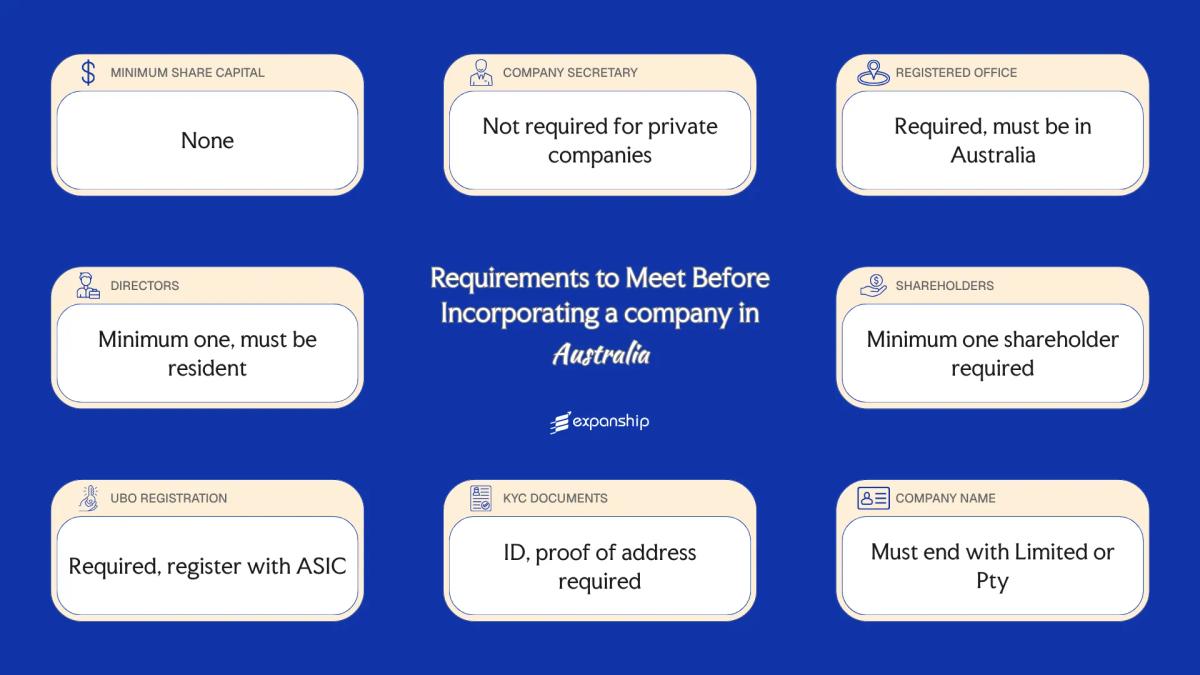
Under the Corporations Act 2001, there are no Australia share capital requirements that impose a statutory minimum. A proprietary limited company (Pty Ltd) can be incorporated with as little as one share at any nominal value, and the Australian Securities and Investments Commission (ASIC) does not require proof of capital deposit before registration is approved.
Shares in Australian companies are issued on a no-par value basis, meaning there is no prescribed face value attached to each share. The amount paid, or agreed to be paid, is recorded as the issue price, and any unpaid portion remains a liability of the shareholder until called upon by the company.
| Parameter | Detail |
|---|---|
| Minimum Authorized Share Capital | No statutory requirement |
| Maximum Authorized Share Capital | No statutory requirement |
| Minimum Paid-Up Capital | No statutory requirement |
| Paid-Up Requirement at Incorporation | No statutory requirement |
| Accepted Currency | Australian Dollar (AUD); foreign currency permissible |
| Accepted Forms of Contribution | Cash or non-cash consideration (property, services) |
| Timeframe to Deposit Capital | No statutory timeframe prescribed |
Even without a statutory minimum, your company must issue at least one share at incorporation. ASIC requires share details to be recorded on the application, so a capital structure must exist from day one, even if the total paid-up amount is nominal.
Company Secretary Requirements in Australia
Under the Corporations Act 2001, proprietary companies with a sole director who is also the sole shareholder are exempt from the company secretary requirement. All other proprietary companies must appoint at least one, and public companies are required to have a secretary at all times. Meeting Australia's company secretary requirements is a baseline obligation, not a discretionary governance choice.
A company secretary holds defined statutory responsibilities under ASIC's regulatory framework. These include maintaining the company's registers, ensuring minutes of meetings are recorded, and filing prescribed documents with ASIC within statutory timeframes.
Qualification criteria for serving as a company secretary:
- Must be a natural person; a corporate entity cannot hold the role.
- Must be at least 18 years of age.
- At least one secretary must ordinarily reside in Australia.
- Must not be disqualified from managing corporations under the Corporations Act 2001.
- No mandatory professional qualification is prescribed by statute, though public companies often appoint qualified governance professionals.

Incorporate Your Business in Australia
Set up your Australian company with the correct structure and meet all statutory requirements from day one.
Registered Office Requirements in Australia
Registered office requirements in Australia are governed by the Corporations Act 2001, which mandates that every company registered with the Australian Securities and Investments Commission (ASIC) maintains a registered office address at all times. Failure to maintain a compliant address can result in ASIC issuing a compliance notice or, in more serious cases, deregistering the entity.
- A physical street address is required; a PO Box alone does not satisfy the obligation.
- Virtual office addresses are permitted, provided the location is a real, accessible premises.
- The address must be situated within Australia; an overseas address does not meet ASIC's requirements.
- No ownership of the premises is required, but the company must have consent to use the address.
- The registered office address is publicly listed on the ASIC register and accessible to any person conducting a company search.
- Any change to the registered office must be formally notified to ASIC, typically by lodging a Form 484 within 28 days of the change.
- The office must be open and accessible to the public during specified business hours, or during hours agreed upon with ASIC.
Director Requirements in Australia

Under the Corporations Act 2001, meeting the director requirements Australia company formations must satisfy is a foundational step before registration with the Australian Securities and Investments Commission (ASIC). Upon appointment, directors assume statutory duties including acting in good faith, avoiding conflicts of interest, preventing insolvent trading under section 588G, and exercising care and diligence as required by section 180.
| Parameter | Detail |
|---|---|
| Minimum Number of Directors | A proprietary company requires at least one director; a public company requires at least three directors. |
| Maximum Number of Directors | No statutory maximum applies under the Corporations Act 2001. |
| Local/Resident Director Required | At least one director of a proprietary company must ordinarily reside in Australia, satisfying the Australia resident director obligations under section 201A. |
| Nationality Restrictions | No nationality restrictions are imposed; residency is the operative requirement. |
| Minimum Age Requirement | Directors must be at least 18 years of age. |
| Corporate Directors Permitted | Corporate directors are not permitted; only individuals may be appointed as directors. |
| Director Must Be a Shareholder | No statutory requirement exists for a director to hold shares. |
| Publicly Listed on Registry | Director details are recorded on the ASIC register and are publicly accessible. |
| Disqualification Conditions | A person is disqualified if bankrupt, convicted of certain offences, or formally disqualified by ASIC or a court under Part 2D.6 of the Corporations Act 2001. |
Unlike many comparable jurisdictions, Australia does not permit a corporate entity to serve as a company director — only a living individual can hold the position, regardless of the company's structure or ownership.
Shareholder Requirements in Australia
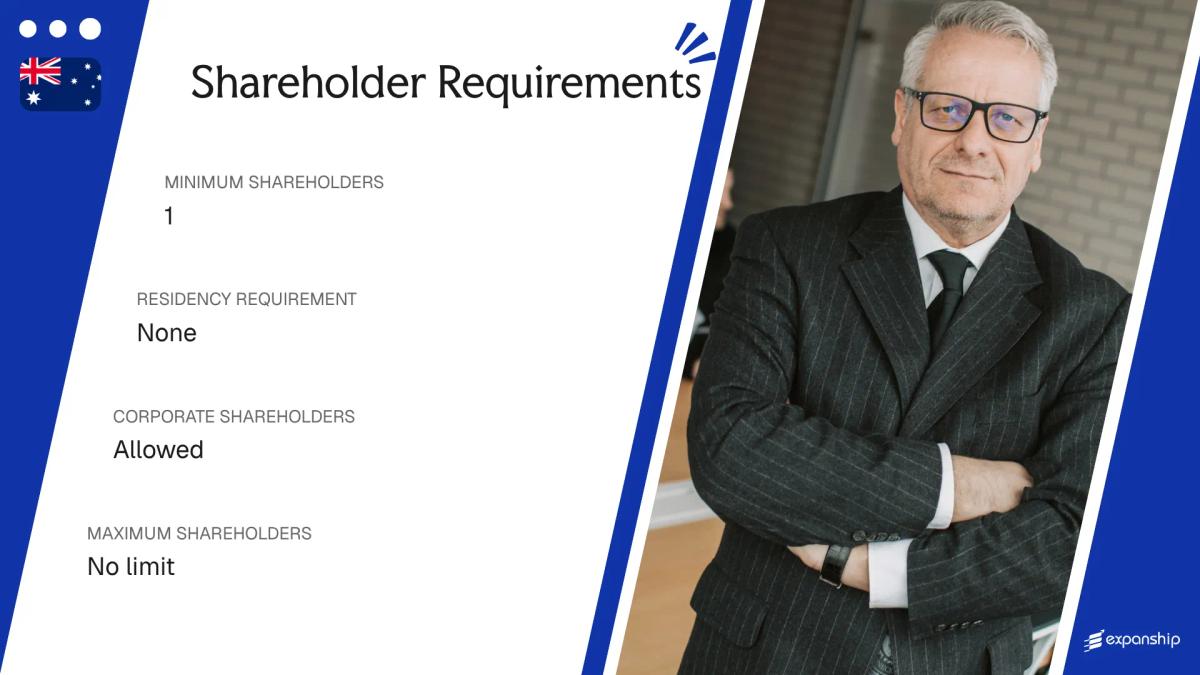
A proprietary limited company in Australia requires at least one shareholder and may have no more than 50 non-employee shareholders, as set out under the Corporations Act 2001. A sole shareholder structure is permitted, making single-member companies a viable option.
Nationality and Residency Restrictions
Shareholder requirements in Australia impose no nationality or residency conditions on shareholders of a proprietary limited company. Foreign individuals and entities may hold shares without restriction on ownership percentage.
Corporate Shareholders
Corporate entities are permitted to act as shareholders in an Australian proprietary limited company. No special conditions are imposed solely by virtue of the shareholder being a corporate body rather than a natural person.
Shareholder Liability
Liability is limited to the amount unpaid on a member's shares. In limited circumstances, courts may pierce the corporate veil, exposing shareholders to liability beyond their capital contribution.
Register of Shareholders
Under the Corporations Act 2001, every company must maintain a register of members. This register is not publicly accessible through ASIC by default, though it must be available for inspection and updated within the timeframes prescribed by law.
Shareholder Structuring Support for Your Australian Company
Get guidance on structuring your shareholding in line with Australian corporate law requirements before and after incorporation.
UBO / Beneficial Ownership Disclosure Requirements in Australia
Under Australia's Corporations Act 2001, a beneficial owner is generally a person who ultimately owns or controls 25% or more of a company's shares or voting rights. Beneficial ownership disclosure Australia obligations are administered by the Australian Securities and Investments Commission (ASIC).
- Identify all individuals who hold significant ownership or control above the 25% threshold.
- Record this information in the company's internal register of members and beneficial owners.
- Lodge required disclosures with ASIC through the company's annual review or relevant change notification forms.
- Update records within 28 days of any change in beneficial ownership or control.
| Parameter | Detail |
|---|---|
| Ownership Threshold for UBO Status | 25% of shares or voting rights |
| Filing Authority | Australian Securities and Investments Commission (ASIC) |
| Disclosure Deadline at Incorporation | No statutory requirement for a separate UBO filing at incorporation |
| Publicly Accessible Register | No publicly accessible beneficial ownership register currently in operation |
| Penalties for Non-Disclosure | Civil and criminal penalties under the Corporations Act 2001 |
| Ongoing Update Obligation | Within 28 days of any change |
KYC / Document Requirements in Australia
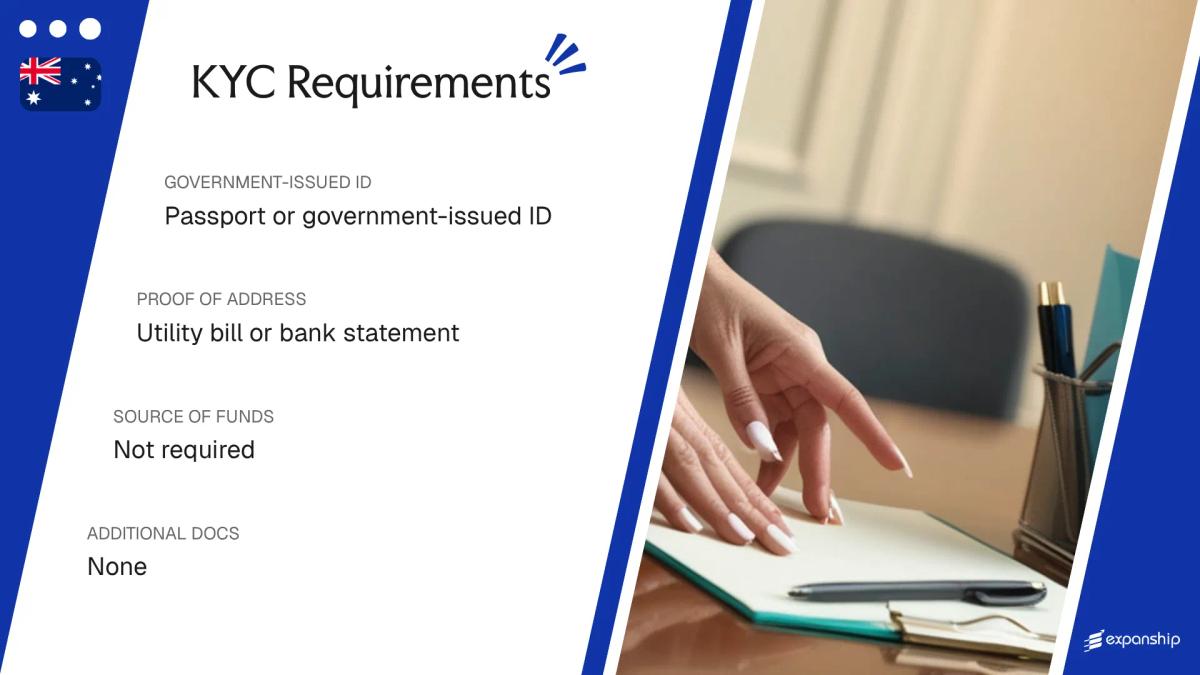
KYC requirements Australia company formation are governed primarily by the Anti-Money Laundering and Counter-Terrorism Financing Act 2006 (AML/CTF Act), administered by AUSTRAC, Australia's financial intelligence unit and AML/CTF regulator.
Individual / Personal Documents
- Government-issued photo ID such as a passport or Australian driver's licence
- Proof of residential address dated within three months, such as a utility bill or bank statement
- Full legal name, date of birth, and residential address must be verifiable against an approved document
- For foreign nationals, a certified copy of a valid passport is the standard accepted form of identification
Corporate Documents
- Certificate of incorporation or equivalent formation document from the entity's home jurisdiction
- Constitutional documents such as articles of association or a company constitution
- Current register of directors confirming the identity of those controlling the corporate shareholder
- Proof of the registered office address of the corporate entity
Source of Funds Documentation
- Recent bank statements showing the origin of capital contributed to the entity
- Audited financial statements where the shareholder is an established operating business
- A written source of funds declaration may be required where bank records are insufficient
Notarisation and Apostille Requirements
- Foreign documents submitted to ASIC or a registered agent must generally be certified as true copies
- Documents originating from Hague Convention member states should carry an apostille from the competent authority
- Certified translations into English are required for any document not originally in English
Incorporation applications are frequently delayed when foreign identity documents are submitted without a certified English translation or a valid apostille.
Company Name Requirements in Australia
Company name requirements Australia are assessed by ASIC at the point of incorporation, which checks proposed names against its national register to confirm availability and compliance. A name identical or deceptively similar to an existing registered entity will be rejected.
Names must be in English, end with "Pty Ltd" for proprietary limited companies or "Ltd" for public companies, and must not be excessively long or constitute a single character.
Certain words, including "bank," "trust," "royal," and "government," require ministerial or regulatory consent before use. Some terms are outright prohibited under ASIC guidelines if they are offensive or misleading.
ASIC company name rules Australia permit name reservation for a limited period prior to formal registration, applied for through the ASIC portal. This holds the name exclusively during the reservation window while incorporation documents are prepared.
Compliance Services for Companies in Australia
Stay aligned with ASIC reporting obligations, annual review fees, and ongoing regulatory requirements for your Australian entity.
Conclusion
Meeting the incorporation requirements in Australia means working within a framework governed by the Corporations Act 2001 and administered by the Australian Securities and Investments Commission. Among the requirements covered, the residency rules for directors carry particular weight for foreign investors, as at least one director must ordinarily reside in Australia. Beneficial ownership disclosure obligations under ASIC's register also warrant close attention. Once these requirements are understood, the practical next step is engaging the formation process itself.
Expanship's Company Formation Services in Australia
Expanship's Australia company formation services are structured around the specific obligations set by ASIC, from director residency requirements to registered office maintenance and ongoing compliance filings. Your business carries the accountability for meeting these standards; Expanship's role is to reduce the operational weight of doing so accurately and on time.
Beyond initial registration, our service scope covers the full formation and post-incorporation cycle:
- Preparing and lodging all company registration documents with ASIC
- Providing a registered office address and acting as your local registered agent
- Handling government filings and liaising directly with the relevant regulatory authorities
- Managing your post-incorporation compliance obligations as they arise
- Facilitating introductions to banking partners suited to your business structure
- Registering for applicable taxes and coordinating with local authorities on your behalf
To discuss your requirements, contact Expanship Australia.
Frequently Asked Questions (FAQ)
A proprietary limited company must have at least one director who ordinarily resides in Australia, as required under section 201A of the Corporations Act 2001. A foreign national can be appointed as an additional director, but that residency requirement cannot be satisfied by a non-resident alone. If your proposed directorial structure does not include an Australian-resident individual, you will need to appoint a local director to comply.
Failing to maintain accurate beneficial ownership records or lodge required disclosures with the Australian Securities and Investments Commission can result in civil and criminal penalties under the Corporations Act 2001. Individual officers may face personal liability, and the company itself can be subject to financial penalties. The severity depends on whether the breach is treated as a strict liability offence or involves an element of dishonesty.
Proprietary companies are no longer required to appoint a company secretary under the Corporations Act 2001, though they may choose to do so. Public companies, however, must appoint at least one company secretary who ordinarily resides in Australia. The distinction between company types is therefore material when assessing this obligation.
Registering a company name with ASIC does not confer trademark protection or prevent another party from operating under a similar business or trading name. Protection of a name against commercial use by competitors requires a separate trademark application through IP Australia under the Trade Marks Act 1995. Company name registration and trademark registration serve different legal purposes and are administered by different bodies.
KYC obligations do not end at incorporation. If your company engages with regulated service providers such as banks, registered agents, or financial institutions, those entities are required under the Anti-Money Laundering and Counter-Terrorism Financing Act 2006 to conduct and periodically update customer due diligence. Material changes to ownership or control structures may also trigger fresh disclosure obligations to ASIC.
Legal Disclaimer
The information provided in this article is for general informational purposes only and does not constitute legal, tax, or professional advice. While we strive to ensure the accuracy and timeliness of the content, laws and regulations are subject to change, and the application of laws can vary widely based on specific facts and circumstances.
Readers should not act upon this information without seeking professional counsel tailored to their individual situation. Expanship and its authors disclaim any liability for actions taken or not taken based on the content of this article.
For specific advice regarding your business setup, compliance requirements, or any legal matters, please consult with qualified legal and tax professionals in the relevant jurisdiction.