

Key Takeaways
- Australia's 30% corporate tax rate (25% for base rate entities) applies without the territorial exemptions or IP box regimes available in competing Asia-Pacific jurisdictions, increasing the effective tax burden on foreign-owned subsidiaries.
- Under the Corporations Act 2001, every proprietary company must appoint at least one director ordinarily resident in Australia, a structural requirement that creates ongoing recruitment and governance costs for non-resident founders.
- ASIC's continuous disclosure and annual review obligations impose recurring lodgement fees and reporting timelines that apply regardless of company size or revenue, adding a fixed compliance cost layer that disproportionately affects early-stage foreign entrants.
- Directors of Australian companies face personal liability exposure under the Corporations Act 2001 for insolvent trading, breaches of fiduciary duty, and GST-related shortfalls, making directorship appointments in Australia a materially higher-risk undertaking than in many comparable common law jurisdictions.
Australia operates under a heavily regulated corporate framework governed primarily by the Corporations Act 2001. For foreign investors assessing the drawbacks of Australian company registration, the regulatory obligations extend well beyond the incorporation process itself.
The disadvantages of incorporating in Australia span taxation, director requirements, ongoing compliance costs, and disclosure obligations across multiple regulatory bodies.
How significantly these disadvantages affect your business depends on the structure you choose, the industry you operate in, and whether your entity qualifies as a proprietary or public company under the Act. A sole foreign founder establishing a subsidiary faces a materially different compliance burden than a large multinational registering a branch.
This article is most relevant to foreign entrepreneurs, offshore holding companies, and non-resident investors exploring the cons of setting up a company in Australia for the first time.
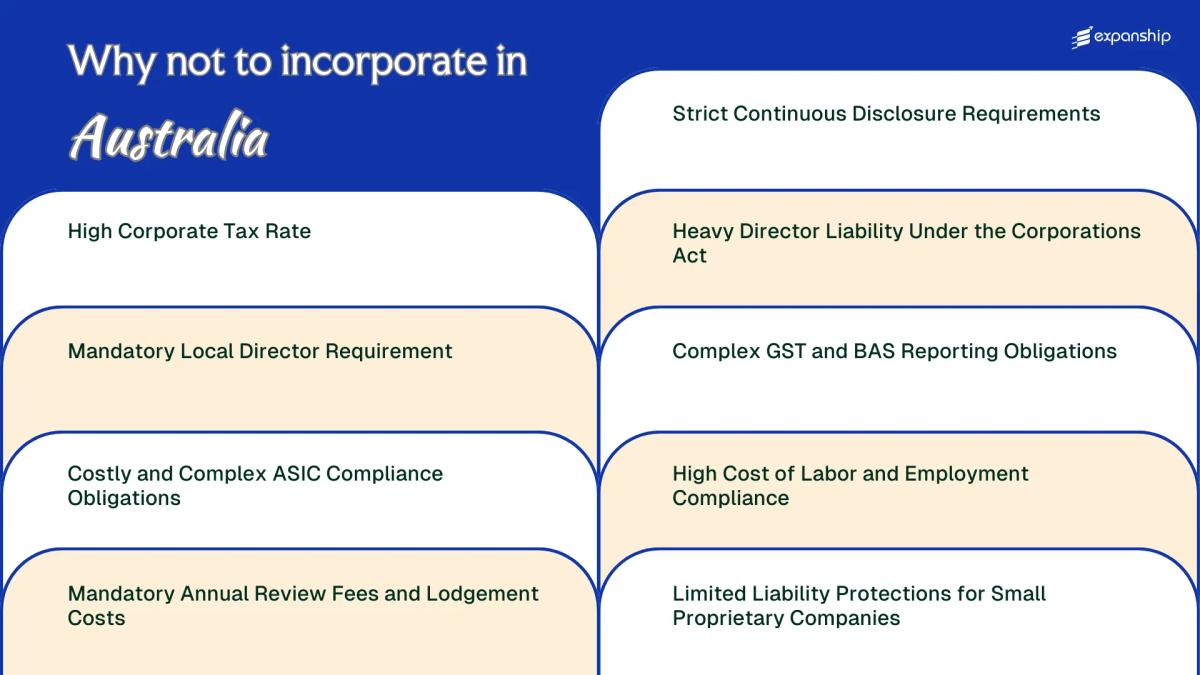
High Corporate Tax Rate
At 30%, Australia's corporate tax rate stands among the higher statutory rates in the Asia-Pacific region, and that figure directly affects the after-tax returns your business can generate from Australian operations.
What the Rate Means in Practice
For large companies, the standard 30% rate applies under the Income Tax Assessment Act 1997. Small business entities meeting the aggregated turnover threshold may qualify for a reduced rate, but most foreign-owned subsidiaries entering the market will not qualify, making the full rate the operative benchmark for financial planning.
Profit repatriation compounds this burden. Dividends paid to foreign shareholders are typically subject to dividend withholding tax, meaning the effective tax cost on distributed earnings can exceed the headline rate depending on the applicable tax treaty between Australia and your home jurisdiction.
The Competitive Disadvantage for Foreign Investors
Singapore's headline corporate rate sits at 17%, and Ireland's standard rate is 12.5%. Against those benchmarks, the high company tax rate in Australia materially reduces the financial case for structuring regional holding or operating entities through an Australian company.
Foreign-owned companies incorporated in Australia will face a 30% corporate tax liability plus potential dividend withholding tax on profit distributions, creating a layered tax cost that significantly erodes the net return on investment compared to lower-rate jurisdictions in the same region.
Mandatory Local Director Requirement
Under section 201A of the Corporations Act 2001, every proprietary company registered in Australia must have at least one director who ordinarily resides in the country. For public companies, the threshold rises to at least two resident directors. This Australia local director requirement restrictions creates an immediate structural problem for foreign founders who have no pre-existing presence or personal network within the jurisdiction.
Sourcing a compliant resident director is not straightforward. Qualified individuals willing to accept the role carry personal legal exposure under the Corporations Act, which means they typically charge ongoing fees ranging from several hundred to several thousand Australian dollars annually.
The mandatory Australian resident director rule generates friction across several operational dimensions:
- Finding a nominee director through a third-party provider adds recurring overhead that does not exist in jurisdictions without residency mandates.
- The resident director holds legal signing authority, which can slow internal decisions when time zones or availability create delays.
- If the appointed director resigns or loses residency status, the company faces an immediate compliance breach with ASIC, requiring urgent replacement to avoid deregistration risk.
- Vetting and onboarding a resident director demands legal due diligence, adding professional services costs before the business generates any revenue.
Sole traders and single-member structures are not exempt from this obligation.

Company Incorporation in Australia
Register your Australian proprietary company with full Corporations Act compliance, including resident director requirements.
Costly and Complex ASIC Compliance Obligations
ASIC compliance obligations in Australia create a persistent administrative burden that begins the moment your company is registered. The Australian Securities and Investments Commission governs all corporate entities under the Corporations Act 2001, and the volume of mandatory lodgements, disclosures, and record-keeping requirements imposes recurring costs that foreign operators frequently underestimate.
Every proprietary limited company must lodge changes to its registered details, officeholder appointments, and constitutional amendments within strict timeframes. Missing these deadlines triggers late fees, and repeated failures can expose directors to enforcement action by ASIC itself.
| Obligation | Lodgement Form | Late Lodgement Penalty (approx.) |
|---|---|---|
| Change of company address | Form 484 | Up to AUD 333 (within 12 months) |
| Appointment/cessation of director | Form 484 | Up to AUD 333 |
| Change to company constitution | Form 205 | Up to AUD 333 |
| Annual company statement review | N/A | Escalating fees if unpaid |
Foreign-owned entities cannot simply appoint a nominee and step back. Under the Corporations Act 2001, your company must maintain accurate records and respond to ASIC correspondence directly, which requires either a local agent or a dedicated compliance function. That structural dependency adds cost that smaller foreign firms cannot easily absorb.
Proprietary companies are subject to somewhat lighter disclosure requirements than public companies, but the baseline lodgement and record-keeping obligations still apply universally, regardless of company size or revenue.
Mandatory Annual Review Fees and Lodgement Costs
Australia annual review fees imposed by ASIC apply to every registered company, regardless of whether the business traded during the year. ASIC issues an annual review notice on the anniversary of a company's registration, and the associated fee must be paid within two months of that date.
For a proprietary limited company, the annual review fee sits at AUD 310 (small proprietary) or AUD 1,538 (large proprietary) as of the current ASIC fee schedule. These charges recur every year without exception, meaning a dormant foreign-owned subsidiary still incurs the same obligation as an actively trading firm.
Beyond the review fee, individual document lodgements with ASIC carry their own costs. Notifying a change of director, updating a registered address, or filing a change to the company constitution each attracts a separate lodgement fee. For a foreign business managing multiple structural changes in a single year, these costs compound quickly.
- Annual review fee is triggered on the company's registration anniversary, not a fixed calendar date
- Payment must be made within two months of the review notice to avoid a late fee surcharge
- Each discrete change lodged with ASIC carries an independent fee outside the annual review charge
- Large proprietary companies face a significantly higher annual review fee than small proprietary companies
- Fees apply even if the company conducted no business activity during the review period
A company that fails to pay its ASIC annual review fee within the prescribed period does not simply incur a fine — ASIC can move to deregister the entity entirely, stripping it of its legal existence without a court order.
Strict Continuous Disclosure Requirements
Listed companies in Australia face australia continuous disclosure requirements risks that are more demanding than most comparable common-law jurisdictions, creating ongoing exposure that foreign-owned entities often underestimate before listing.
The Scope of the Obligation Under ASX Listing Rules and the Corporations Act
Under ASX Listing Rule 3.1 and section 674 of the Corporations Act 2001, a listed entity must immediately disclose any information a reasonable person would expect to have a material effect on share price. There is no fixed reporting window — the obligation is effectively continuous, meaning your company must assess materiality in real time, without delay.
Practical Exposure for Foreign-Controlled Listed Entities
The ASX continuous disclosure obligations burden falls particularly hard on foreign parent structures, where information may originate offshore but trigger disclosure duties on the Australian-listed subsidiary. ASIC can pursue civil penalties against the entity, and since the 2021 Treasury Laws Amendment reforms temporarily lowered and then reinstated fault-based liability thresholds, the enforcement position has remained unsettled. A single compliance failure — even an inadvertent delay — can trigger ASX queries, trading halts, or regulatory action that damages your entity's market standing far beyond the immediate fine.
Managing Continuous Disclosure Challenges for Your Australian Listed Entity
Understand how Australia's real-time disclosure obligations may affect your listed structure and what compliance gaps foreign-controlled companies commonly face.
Heavy Director Liability Under the Corporations Act
Director liability risks under Australia's Corporations Act 2001 are extensive, and personal exposure applies well beyond insolvency scenarios.
- Under section 588G, you face personal liability for insolvent trading if your company incurs debts while insolvent, with no requirement for deliberate wrongdoing — negligence alone is sufficient to trigger liability.
- Directors can be held personally liable for unpaid employee entitlements under the Director Penalty Notice regime administered by the Australian Taxation Office, covering PAYG withholding, superannuation guarantee charges, and GST.
- The business judgment rule under section 180(2) provides a limited defence, but it requires documented evidence of informed, good-faith decision-making, placing the evidentiary burden on you.
- Contravention of civil penalty provisions — including those governing related-party transactions under Chapter 2E — can result in fines exceeding AUD 1.1 million per contravention.
- Foreign directors unfamiliar with Australian director duty obligations under sections 180 to 184 face compounding risk, as ASIC enforces these duties independently of whether the company suffers financial loss.
Complex GST and BAS Reporting Obligations
Australia GST and BAS reporting challenges begin at the registration threshold. Entities with a GST turnover of AUD 75,000 or more must register for Goods and Services Tax under the A New Tax System (Goods and Services Tax) Act 1999, triggering a recurring compliance cycle that carries real administrative weight for foreign-owned firms without established local finance teams.
Once registered, your business must lodge a Business Activity Statement with the Australian Taxation Office on a monthly, quarterly, or annual basis, depending on turnover. Each BAS consolidates GST, PAYG withholding, and PAYG instalment obligations into a single return, meaning errors in one component can trigger ATO audit flags across all three.
Foreign companies operating across multiple states face additional complexity when GST applies differently to imported services, mixed supplies, or input-taxed transactions, classifications that require ongoing legal and accounting review to apply correctly.
A foreign-owned proprietary company with AUD 2 million in annual revenue, lodging BAS quarterly, would typically require a registered tax agent for each lodgement cycle. At an average cost of AUD 400–800 per BAS preparation, annual compliance costs for GST reporting alone can reach AUD 3,200, before factoring in any ATO correspondence or amendments.
High Cost of Labor and Employment Compliance
Australia employment compliance costs drawbacks are among the most significant operational burdens facing foreign businesses that incorporate locally. The Fair Work Act 2009 sets a dense framework of minimum entitlements, and non-compliance exposes your business to claims before the Fair Work Commission or civil penalties under the Act.
Under the National Employment Standards, employees are entitled to 11 minimum conditions including paid annual leave, personal/carer's leave, and redundancy pay. Each entitlement carries specific accrual rates and payment obligations that require ongoing payroll administration rather than a one-time setup.
Modern Awards add another compliance layer. Over 120 industry and occupation-specific awards govern minimum pay rates, penalty rates for weekend and overtime work, and allowances. Misclassifying a worker's award coverage is a common and costly error for foreign operators unfamiliar with the system.
Mandatory superannuation contributions currently sit at 11.5% of ordinary time earnings per employee, rising incrementally toward 12% by 2025. This is a direct labour cost addition with no equivalent in many Asian and North American markets where employer-funded retirement contributions are lower or discretionary.
Unfair dismissal provisions under the Fair Work Act apply after a minimum employment period, meaning terminating underperforming staff involves procedural obligations that can generate tribunal proceedings if not followed precisely.
Modern Award coverage applies automatically based on the nature of work performed, regardless of what your employment contract states, meaning a foreign business cannot opt out of Award conditions simply by issuing contracts that omit them.
Limited Liability Protections for Small Proprietary Companies
Limited liability risks for small proprietary companies in Australia are more significant than the Pty Ltd structure implies. Under the Corporations Act 2001, shareholder liability is generally capped at unpaid share capital, but this protection erodes in several circumstances that directly affect how your business operates.
Australian courts will pierce the corporate veil where a company is found to be a sham, where fraud is involved, or where the entity is deemed an alter ego of its controllers. For a foreign owner managing a local subsidiary from overseas, maintaining genuine operational separation between yourself and the company is harder to demonstrate, raising exposure to personal liability claims.
Directors of small proprietary companies also face personal liability under sections 588G and 588H for insolvent trading, regardless of limited liability status. This means the Pty Ltd structure offers no shield if the firm continues incurring debts after becoming insolvent, a risk that falls directly on any director of record.
Overcoming the Key Incorporation Challenges
Overcoming the Key Incorporation Challenges
Overcoming Australia incorporation challenges requires structural planning before registration, not after problems arise. The regulatory obligations under the Corporations Act 2001 and ASIC's ongoing requirements create cumulative pressure that compounds if addressed reactively.
- Appoint a resident Australian director at the time of incorporation to satisfy the requirement under section 201A of the Corporations Act 2001.
- Register for GST and configure quarterly BAS reporting cycles through the ATO portal before commencing taxable supplies.
- Lodge an annual review fee and confirm company details with ASIC within the statutory deadline each year to avoid late fees.
- Establish a written employment framework that aligns with the Fair Work Act 2009 and the applicable Modern Award from the outset.
- Adopt a continuous disclosure policy if listing on the ASX, referencing ASX Listing Rule 3.1 directly.
These steps address the most structurally significant obligations a foreign business faces when operating an Australian entity. None of them eliminate the underlying costs, but each reduces the risk of compounding penalties or non-compliance.
Australia's Overall Investment Appeal
Australia carries a well-established reputation as a stable, transparent, and rules-based destination for foreign capital. The Australia business investment risks and appeal question does not resolve neatly in either direction — the compliance burden is real, the costs are measurable, and the structural requirements impose genuine constraints on foreign operators.
| Pros | Cons |
|---|---|
| AAA-rated sovereign economy with a strong, independent legal system based on English common law | The 30% corporate tax rate is among the higher rates in the Asia-Pacific region |
| No restrictions on 100% foreign ownership in most sectors | At least one resident director ordinarily residing in Australia is required under the Corporations Act 2001 |
| A large domestic consumer market with high purchasing power | ASIC imposes ongoing compliance obligations, annual review fees, and lodgement costs that increase operational overhead |
| Straightforward company registration through ASIC's online systems | GST registration and quarterly BAS reporting create a recurring administrative cycle for most foreign-owned entities |
| Strong protections for intellectual property and contract enforcement | Directors face personal liability exposure under the Corporations Act 2001, including for insolvent trading |
Hiring locally comes at a cost that few other developed markets match, with minimum wage floors, mandatory superannuation contributions, and Fair Work Act obligations all applying from day one.
Corporate Compliance Services in Australia
Manage your Australian company's ongoing ASIC obligations, annual review fees, BAS reporting, and director compliance requirements with structured support.
Conclusion
The cons of registering a company in Australia are real and material. The 30% corporate tax rate, the resident director requirement under the Corporations Act 2001, and the ongoing ASIC compliance burden represent structural costs that affect how a foreign-owned entity operates from day one. These are not incidental friction points but built-in features of Australian corporate law. Understanding them fully before incorporation allows you to plan entity structure, director appointments, and reporting obligations with accuracy. External specialists familiar with ASIC requirements and the Australian regulatory framework can help you meet those obligations without missteps.
Expanship's Australia Expansion Services
Expanship works with businesses managing the specific compliance obligations that come with incorporating in Australia — from satisfying the resident director requirement and maintaining ASIC registration to meeting continuous disclosure obligations and BAS reporting cycles. The firm's role is to reduce the operational weight of these requirements, not to make them disappear.
Beyond formation, Expanship supports your business across the full incorporation lifecycle. Services available include:
- Preparing and lodging company registration documents with ASIC on your behalf.
- Providing a registered office address and acting as your local registered agent in Australia.
- Handling government filings and liaising directly with ASIC and the ATO as required.
- Managing post-incorporation compliance obligations to keep your entity in good standing.
- Facilitating introductions to Australian banking institutions suited to your structure.
- Registering your business for GST, PAYG, and other applicable taxes with the ATO.
To discuss how Expanship can support your entry into the Australian market, contact Expanship Australia.
Frequently Asked Questions (FAQ)
ASIC will issue late fees, and continued non-compliance can result in the company being deregistered. Beyond financial penalties, deregistration means your entity legally ceases to exist, which can void contracts, freeze bank accounts, and expose directors to personal liability for debts incurred after that point. Reinstatement is possible but requires a formal application and payment of all outstanding fees.
The 30% rate applies to companies that do not qualify as a base rate entity. Small businesses with an aggregated annual turnover below AUD 50 million may access the reduced 25% rate, provided that no more than 80% of their assessable income is passive. Foreign-owned entities and holding structures often fall outside the lower rate threshold, making the standard 30% rate the default in practice.
The direct cost of GST registration is nil, but the compliance burden is material. Businesses with a GST turnover of AUD 75,000 or more must register, charge 10% GST, and lodge a Business Activity Statement either monthly, quarterly, or annually. Engaging a registered tax agent to prepare and lodge BAS statements typically costs between AUD 200 and AUD 600 per lodgement, depending on transaction volume and complexity.
Australian director liability provisions are among the more demanding in the Asia-Pacific region. The Corporations Act 2001 imposes positive duties on directors, including the duty to prevent insolvent trading under section 588G, which can result in personal liability for company debts if a director allows the business to incur obligations while insolvent. Unlike some jurisdictions where liability attaches only after a court finding of fraud, Australian law can impose civil and criminal penalties on directors who simply failed to act on warning signs.
Continuous disclosure rules primarily target listed public companies under the ASX Listing Rules and the Corporations Act 2001. ASIC can pursue civil penalties of up to AUD 1.565 million per contravention for a body corporate, and individual officers face personal penalties as well. The 2021 amendments to the continuous disclosure regime shifted the fault standard, but the potential financial exposure remains significant for any listed entity operating in Australia.
Contractor arrangements do not reliably insulate a business from employment obligations under Australian law. The Fair Work Act 2009 and decisions from the High Court of Australia apply a multi-factor test to determine whether a worker is genuinely an independent contractor or a misclassified employee. If a worker is reclassified as an employee, your business becomes liable for unpaid superannuation contributions, leave entitlements, and potentially significant back-pay obligations.
On a pure cost basis, Australia sits at the higher end of the Asia-Pacific spectrum. ASIC charges an annual review fee for proprietary companies, and registered agent, accounting, and director costs add to the baseline. Jurisdictions such as Singapore offer a flat annual filing fee with lower corporate tax rates and no mandatory resident director requirement for foreign-owned structures in the same way, making Australia comparatively more expensive to maintain for a holding or regional operating entity.
Legal Disclaimer
The information provided in this article is for general informational purposes only and does not constitute legal, tax, or professional advice. While we strive to ensure the accuracy and timeliness of the content, laws and regulations are subject to change, and the application of laws can vary widely based on specific facts and circumstances.
Readers should not act upon this information without seeking professional counsel tailored to their individual situation. Expanship and its authors disclaim any liability for actions taken or not taken based on the content of this article.
For specific advice regarding your business setup, compliance requirements, or any legal matters, please consult with qualified legal and tax professionals in the relevant jurisdiction.