

Key Takeaways
- Companies incorporating in Austria as a GmbH must contribute a minimum share capital of EUR 35,000, a threshold enforced at the point of registration with the Firmenbuch.
- Beneficial ownership information must be reported to the WiEReG register under the Wirtschaftliche Eigentümer Registergesetz, with this obligation taking effect from the date of incorporation.
- At least one natural person must serve on the management board, a structural governance requirement that directly affects how foreign investors design their Austrian entity's leadership.
- Registration of any Austrian business entity requires filing with the Firmenbuch, the official commercial register administered by the competent regional courts (Landesgerichte) under the Firmenbuchgesetz.
Incorporation requirements in Austria are governed primarily by the Unternehmensgesetzbuch (UGB), the commercial code that regulates business entities, alongside the Firmenbuchgesetz, which establishes the Firmenbuch as the official commercial register maintained by the competent regional courts (Landesgerichte).
This article covers the structural, capital, personnel, and documentation requirements that apply when registering a company in Austria through the Firmenbuch.
Failure to satisfy these requirements results in rejection of the registration application or, where non-compliance is discovered post-registration, potential legal penalties and restrictions on operating the entity.
Specific requirements differ depending on the legal form chosen, whether a GmbH, AG, or another structure, as well as the industry sector and the investor's residency status.
The Austrian Commercial Code (UGB) is the primary legislative reference for company formation requirements. Foreign investors establishing a subsidiary, joint venture, or wholly owned entity under Austrian law will find this article most directly applicable to their situation.
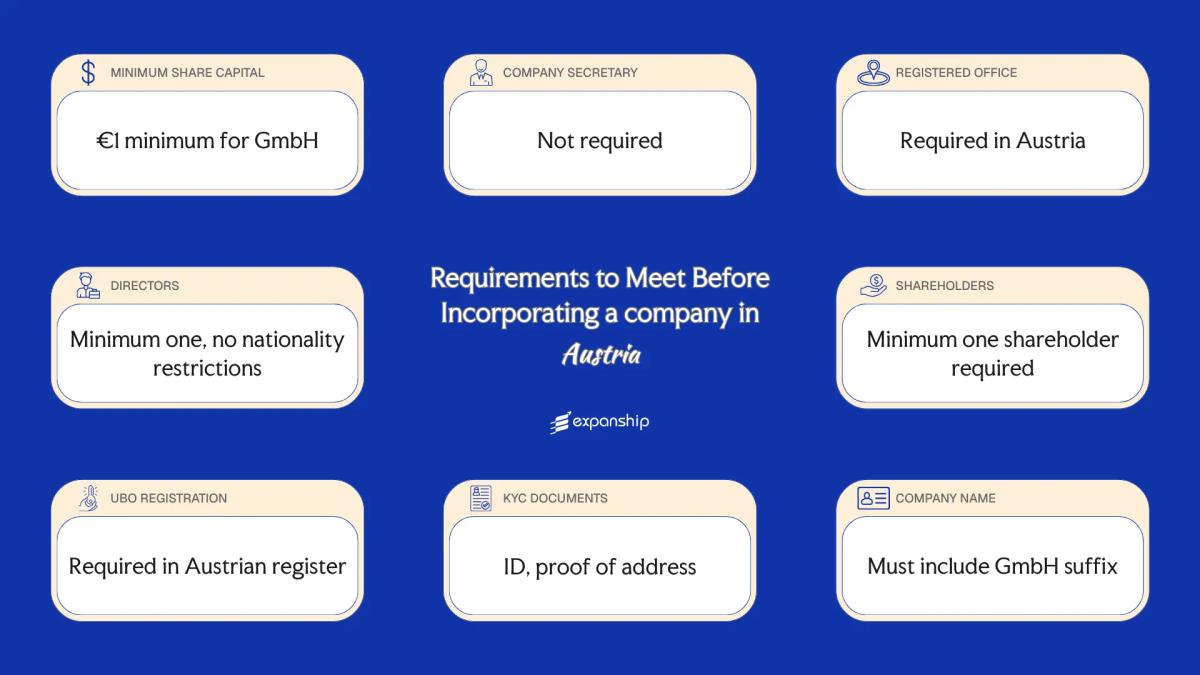
Minimum Share Capital Requirements in Austria
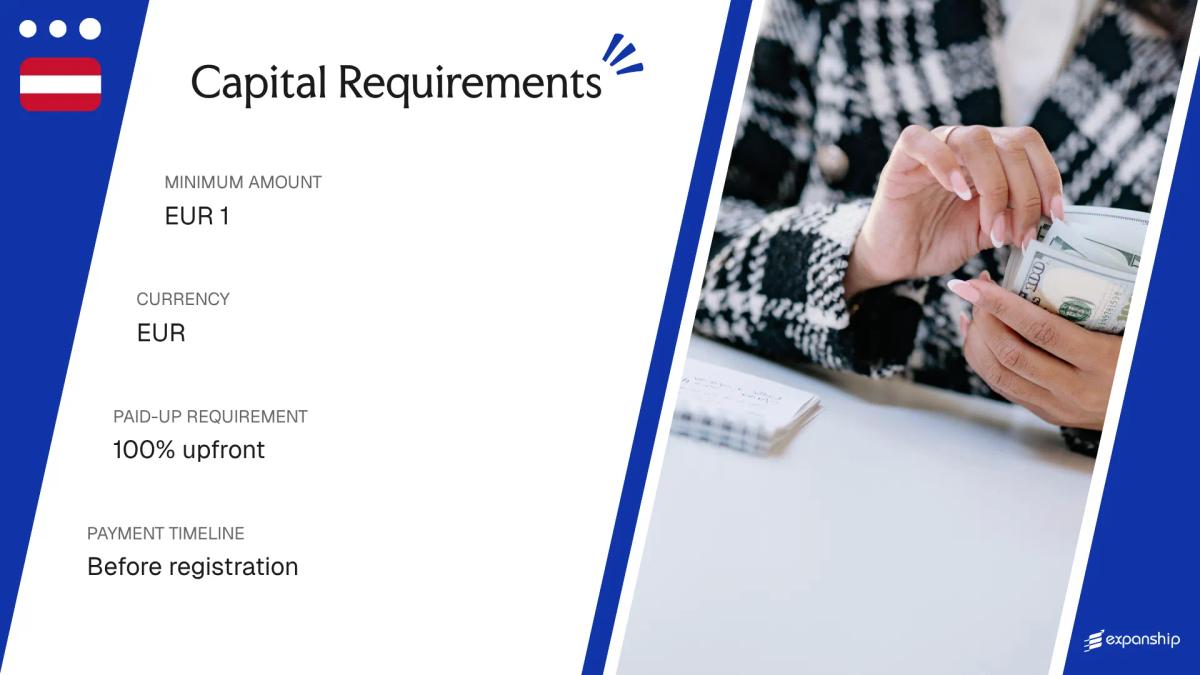
Austria minimum share capital requirements differ by entity type and are governed by the Unternehmensgesetzbuch (UGB) alongside entity-specific statutes. For a Gesellschaft mit beschränkter Haftung (GmbH), the GmbH-Gesetz sets the statutory minimum, while the Aktiengesellschaft (AG) is regulated under the Aktiengesetz.
Both entity types operate on a par value share system. Capital verification at incorporation is handled through the Firmenbuch, Austria's commercial register maintained by the regional courts (Landesgerichte), which requires documented proof of capital deposit before registration is completed.
| Parameter | Detail |
|---|---|
| Minimum Authorized Share Capital | EUR 35,000 for a GmbH; EUR 70,000 for an AG |
| Maximum Authorized Share Capital | No statutory requirement |
| Minimum Paid-Up Capital | EUR 17,500 for a GmbH (50% of minimum); EUR 70,000 for an AG (100%) |
| Paid-Up Requirement at Incorporation | At least 50% of each cash contribution must be paid up for a GmbH prior to registration |
| Accepted Currency | Euro (EUR) |
| Accepted Forms of Contribution | Cash contributions; non-cash contributions (Sacheinlagen) subject to valuation requirements |
| Timeframe to Deposit Capital | Prior to submission of incorporation documents to the Firmenbuch |
The Firmenbuch will not register a GmbH until proof of the minimum paid-up amount has been confirmed by a bank. Registration and capital deposit are not sequential — the deposit must precede the application.
Company Secretary Requirements in Austria
Under Austrian corporate law, there is no statutory requirement for a GmbH or AG to appoint a company secretary. The company secretary requirements Austria businesses encounter differ from common law systems, where the role carries formal legal standing.
Governance functions are instead allocated to the managing directors (Geschäftsführer) and, where applicable, the supervisory board (Aufsichtsrat). Austria corporate secretary obligations, as understood in Anglo-Saxon jurisdictions, do not have a direct equivalent under the Unternehmensgesetzbuch or GmbH-Gesetz.
That said, certain administrative and compliance functions must still be performed. Those responsibilities typically fall to the Geschäftsführer, who bears legal accountability for the firm's regulatory filings and record-keeping.
Criteria for who may fulfill these governance and compliance functions:
- Natural persons appointed as Geschäftsführer must have full legal capacity under Austrian law.
- No professional licensing or sector-specific qualification is required to act in this role.
- Both Austrian residents and non-residents may serve, subject to general director eligibility rules.
- Corporate entities cannot be appointed as Geschäftsführer; only natural persons are eligible.
- No minimum age is prescribed beyond general legal capacity requirements.

Incorporate a Company in Austria
Set up your Austrian GmbH or AG with full support on structure, filings, and ongoing compliance obligations.
Registered Office Requirements in Austria
Registered office requirements in Austria are governed by the Unternehmensgesetzbuch (UGB) and the GmbH-Gesetz, which mandate that every registered company maintain a designated business address within the country. Failure to maintain a compliant address can result in the Firmenbuch (the commercial register) initiating ex officio corrections or, in serious cases, the court ordering dissolution proceedings against the entity.
- A physical, reachable address within Austria is required; a P.O. box does not satisfy this requirement.
- Virtual office addresses are generally permissible provided they allow for effective service of legal documents and correspondence.
- The address must be located in Austria; a foreign address cannot serve as the registered office of an Austrian entity.
- A lease agreement or proof of entitlement to use the premises is typically required to support the address registration.
- The registered office address is publicly listed in the Firmenbuch and accessible to third parties.
- Any change to the registered address must be formally notified to the Firmenbuch through a notarised filing without undue delay.
Director Requirements in Austria
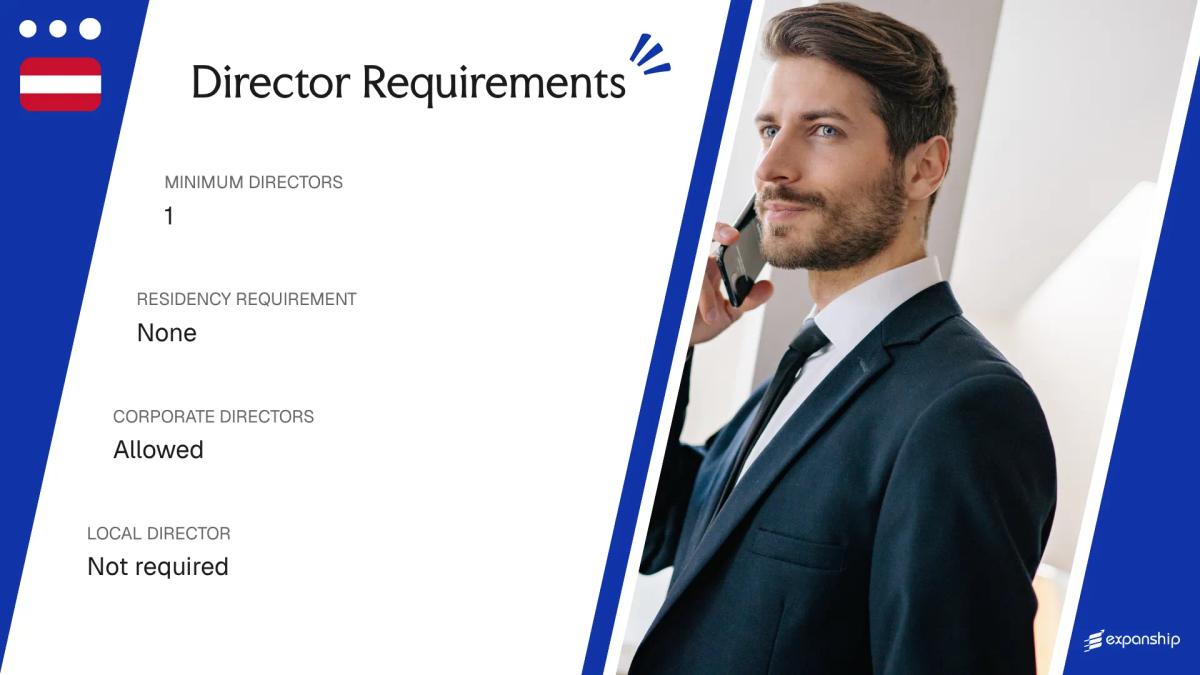
Under the Gesetz über Gesellschaften mit beschränkter Haftung (GmbHG), director requirements in Austria place direct personal liability on appointed Geschäftsführer for breaches of fiduciary duty, tax obligations, and compliance failures during their tenure. Austria GmbH director obligations include acting with the diligence of a prudent businessperson, maintaining proper accounting records, and filing annual financial statements with the Firmenbuch.
| Parameter | Detail |
|---|---|
| Minimum Number of Directors | One director is required. |
| Maximum Number of Directors | No statutory maximum is prescribed under the GmbHG. |
| Local/Resident Director Required | No statutory residency requirement exists, though practical considerations around tax residency may apply. |
| Nationality Restrictions | No nationality restrictions are imposed under Austrian corporate law. |
| Minimum Age Requirement | Directors must have reached the age of majority, which is 18 years. |
| Corporate Directors Permitted | Corporate directors are not permitted; only natural persons may serve as Geschäftsführer. |
| Director Must Be a Shareholder | No requirement exists for a director to hold shares in the company. |
| Publicly Listed on Registry | Directors are publicly listed in the Firmenbuch, Austria's commercial register. |
| Disqualification Conditions | Persons convicted of certain criminal offences or subject to insolvency-related prohibitions may be disqualified from serving. |
Despite no residency requirement on paper, Austrian tax authorities may attribute domestic tax nexus to the company if its sole director resides and exercises management functions in Austria, regardless of where the entity is formally registered.
Shareholder Requirements in Austria
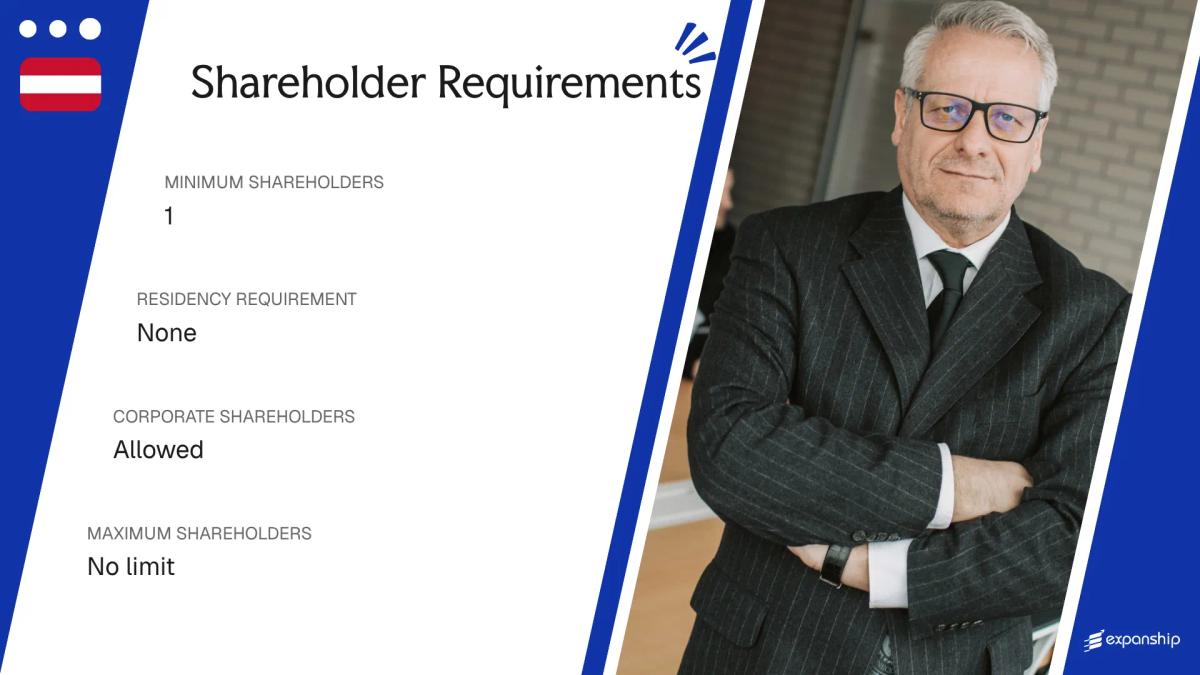
A GmbH (Gesellschaft mit beschränkter Haftung) requires at least one shareholder, meaning a sole shareholder structure is fully permitted under Austrian law. There is no statutory maximum on the number of shareholders.
Nationality and Residency Restrictions
Shareholder requirements in Austria impose no nationality or residency conditions on individuals holding shares in a GmbH. Foreign nationals and non-residents may hold shares without restriction, and there are no limits on the percentage of foreign ownership.
Corporate Shareholders
Corporate entities are permitted to act as shareholders in an Austrian GmbH. No special conditions are attached solely on the basis of the shareholder being a legal entity rather than a natural person.
Shareholder Liability
Liability is limited to each shareholder's capital contribution as recorded in the company's articles of association. Austrian corporate law does not generally extend liability beyond this amount, though piercing of the corporate veil may apply in cases of abuse.
Register of Shareholders
A list of shareholders must be filed with the Firmenbuch, Austria's commercial register, and is publicly accessible. Any change in shareholding must be reported and updated through a notarially authenticated document.
Guidance on Shareholder Structuring for Your Austrian Entity
Get tailored advice on meeting ownership and shareholding obligations when setting up a company in Austria.
UBO / Beneficial Ownership Registration Requirements in Austria
Austria UBO registration requirements are governed by the Wirtschaftliche Eigentümer Registergesetz (WiEReG), which defines a beneficial owner as any natural person holding, directly or indirectly, more than 25% of shares or voting rights, or otherwise exercising control over a legal entity.
- Identify all natural persons who meet the WiEReG ownership or control threshold within your entity.
- Register beneficial ownership data in the Wirtschaftliche Eigentümer Register (WiEReG register) via Finanz Online or through a professional representative.
- Submit the initial declaration within four weeks of incorporation or registration.
- Update the register within four weeks of any change in beneficial ownership.
- Confirm the registered data annually, even where no changes have occurred.
| Parameter | Detail |
|---|---|
| Ownership Threshold for UBO Status | More than 25% of shares, voting rights, or equivalent control |
| Filing Authority | Wirtschaftliche Eigentümer Register (WiEReG), administered by the Federal Ministry of Finance |
| Disclosure Deadline at Incorporation | Within four weeks of incorporation |
| Publicly Accessible Register | Yes, partially; certain data is accessible to entities with a legitimate interest |
| Penalties for Non-Disclosure | Administrative fines of up to EUR 200,000 for wilful non-compliance |
| Ongoing Update Obligation | Yes; updates required within four weeks of any change, plus annual confirmation |
KYC / Document Requirements in Austria
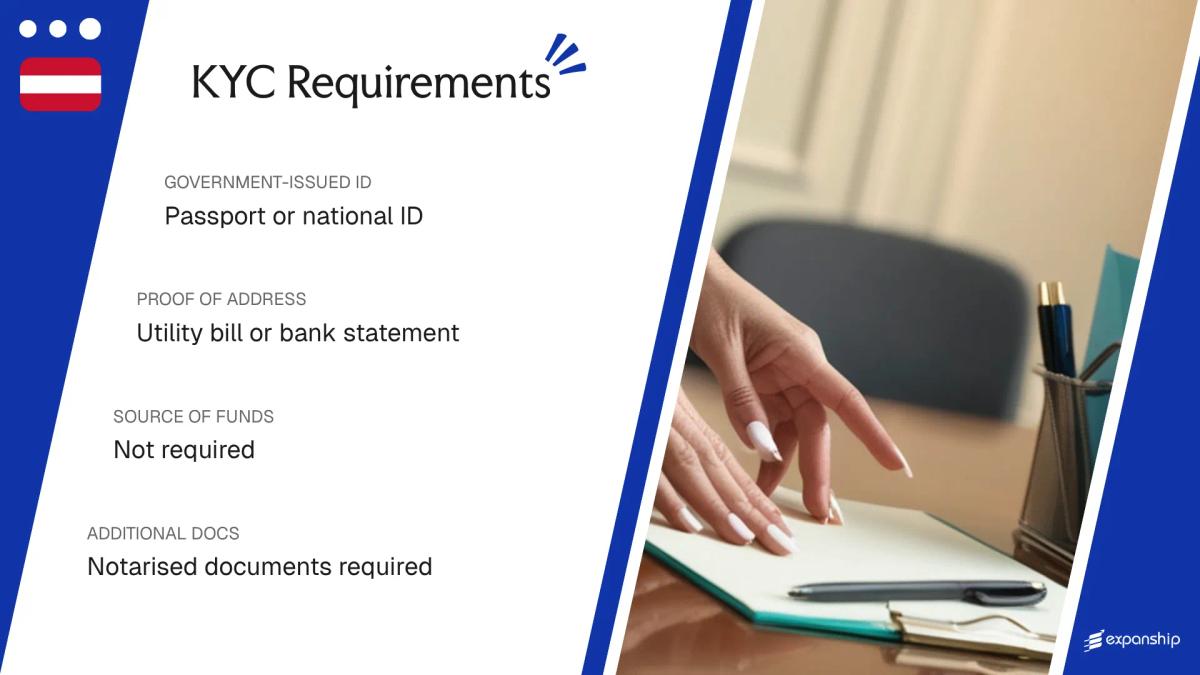
KYC document requirements Austria applies under the Financial Markets Anti-Money Laundering Act (FM-GwG), which governs identity verification obligations at the point of incorporation for all entity types registered with the Firmenbuch.
Individual / Personal Documents
- Valid government-issued photo ID (passport or national identity card) for each director, shareholder, and beneficial owner
- Proof of residential address dated within three months, such as a utility bill or official bank statement
- Completed and signed self-disclosure form declaring the individual's role and beneficial ownership status
- Tax identification number where applicable under Austrian due diligence requirements
Corporate Documents
- Certified copy of the certificate of incorporation for any corporate shareholder or director
- Current articles of association or equivalent constitutional document
- Extract from the relevant commercial register dated within six months
- Proof of the corporate entity's registered address
Source of Funds Documentation
- Recent bank statements covering a minimum of three months prior to incorporation
- Audited financial accounts where the subscribing entity has an established trading history
- Written declaration explaining the origin of the share capital being introduced
Notarisation and Apostille Requirements
- Foreign public documents must carry an Apostille under the Hague Convention of 1961
- All non-German documents require certified translation by a sworn translator recognised in Austria
- Notarisation of the GmbH articles of association is mandatory before an Austrian notary
Incomplete or expired proof of residential address is the most common reason for KYC rejection during Austrian incorporation.
Company Name Requirements in Austria
Austria company name requirements are assessed by the Firmenbuch, the official commercial register maintained by the regional courts. A proposed name must be sufficiently distinctive to avoid confusion with existing registered entities, and must not mislead the public about the nature or scope of the business.
Firms must append a legal suffix corresponding to the chosen entity type, such as "GmbH" for a Gesellschaft mit beschränkter Haftung. The name must be written in Latin script, and German is the standard language used, though foreign-language names are not outright prohibited provided they meet distinctiveness criteria.
Certain words implying state affiliation, regulated activities, or professional designations require prior approval from the relevant authority before registration can proceed. Words suggesting banking, insurance, or auditing functions are subject to sector-specific clearance.
Name reservation is available through the Firmenbuch prior to formal incorporation. The reservation secures the name for a limited period, giving your business time to complete the registration process without risk of another entity claiming the same designation in the interim.
Compliance Services for Companies in Austria
Ongoing compliance support for Austrian entities, including Firmenbuch filings, annual obligations, and regulatory reporting.
Conclusion
Meeting the incorporation requirements in Austria structures your entry into one of the EU's more formally regulated corporate environments. The EUR 35,000 minimum share capital for a GmbH and the mandatory UBO registration with the Wirtschaftliche Eigentümer Registergesetz (WiEReG) register represent obligations that carry legal weight from day one. Directorship rules, including the requirement for at least one natural person on the management board, also shape how foreign investors structure governance. Once these requirements are understood, the practical work of executing each step begins.
Expanship's Corporate Services for Austria Expansion
Austria's requirements around share capital validation, UBO registration with the Wirtschaftskammer, and directorship structures place real administrative demands on incoming businesses. Expanship's Austria corporate services expansion support is designed to reduce the operational burden of meeting those requirements, so your team can focus on the business itself rather than the mechanics of compliance.
Our service scope covers the full incorporation journey and beyond:
- We prepare and file all company registration documentation with the Austrian Commercial Court (Firmenbuch).
- A registered office and local agent are provided to satisfy Austrian address requirements.
- We handle all government submissions and liaise directly with relevant Austrian regulatory bodies on your behalf.
- Post-incorporation obligations, including annual filings and compliance deadlines, are actively managed for your entity.
- Banking introduction support is available to help connect your business with suitable Austrian financial institutions.
- Tax registration and coordination with the Finanzamt are included as part of the setup process.
To discuss your requirements, contact Expanship Austria.
Frequently Asked Questions (FAQ)
Foreign nationals can serve as managing directors (Geschäftsführer) of an Austrian GmbH without a residency requirement. However, at least one managing director must hold a valid power to represent the company in Austria, and all directors must be registered in the Firmenbuch along with specimen signatures. Practical compliance, including signing obligations and availability for Austrian authorities, may still require a local presence or a designated representative.
Failure to register or update beneficial ownership information under the WiEReG can result in administrative fines of up to EUR 200,000 for the company and its officers. The register is maintained by the Oesterreichische Nationalbank and cross-referenced with other compliance databases, meaning discrepancies are actively monitored. Continued non-compliance can also trigger enhanced scrutiny from Austrian financial intelligence authorities.
Corporate shareholders are permitted in an Austrian GmbH, but their inclusion extends the KYC requirements up the ownership chain. Each intermediate corporate entity must be documented until the natural person or persons who qualify as ultimate beneficial owners under the WiEReG are identified, typically defined as individuals holding more than 25% of shares or voting rights. Where no such individual can be identified, the senior managing official of the Austrian entity is recorded as the beneficial owner by default.
A registered office address in Austria must be a physical address within the country where official correspondence and legal notices can be received, and it must be recorded in the Firmenbuch. Virtual or service addresses are used by some providers, but the address must be genuinely reachable and capable of receiving service of process. Using a non-functional or fictitious address can expose the company to deregistration proceedings or regulatory action.
The Firmenbuch will reject a company name that is identical or deceptively similar to an already registered entity under Austrian commercial law. Beyond registration refusal, operating under a confusingly similar name can give rise to claims under the Unternehmensgesetzbuch (UGB) and the Austrian Unfair Competition Act (UWG), including injunctions and damages. Conducting a name search through the Firmenbuch prior to submission is the standard practice to avoid rejection.
Austrian law imposes no general nationality-based restrictions on who may hold shares in a GmbH or AG. Foreign individuals and foreign-incorporated entities can be shareholders, subject to applicable EU and international sanctions screening and the full KYC and WiEReG beneficial ownership disclosure obligations. Certain regulated sectors, such as media or defence-adjacent activities, may carry additional ownership restrictions under sector-specific legislation.
Legal Disclaimer
The information provided in this article is for general informational purposes only and does not constitute legal, tax, or professional advice. While we strive to ensure the accuracy and timeliness of the content, laws and regulations are subject to change, and the application of laws can vary widely based on specific facts and circumstances.
Readers should not act upon this information without seeking professional counsel tailored to their individual situation. Expanship and its authors disclaim any liability for actions taken or not taken based on the content of this article.
For specific advice regarding your business setup, compliance requirements, or any legal matters, please consult with qualified legal and tax professionals in the relevant jurisdiction.