
Key Takeaways
- Austria's 23% flat corporate tax rate, combined with the 14% Forschungsprämie R&D premium, creates a stacked fiscal advantage that directly lowers the effective cost base for knowledge-intensive businesses operating through a GmbH.
- The Unternehmensgesetzbuch provides a codified statutory framework for commercial and corporate matters, reducing exposure to discretionary legal interpretation in a way that many common law jurisdictions cannot match.
- With over 90 binding double tax treaties in force, Austrian entities can structurally reduce withholding tax on cross-border income flows — a concrete financial consideration for foreign investors routing international operations through a European holding structure.
- Because Austria is a full EU member state, a locally registered GmbH carries single market access rights across all EU jurisdictions, eliminating the need to establish separate legal presences for intra-European operations.
Sitting at the heart of continental Europe, Austria is an independent republic and a full European Union member state. Company registration falls under the jurisdiction of the Firmenbuch, the commercial register administered through the court system. Foreign investors most commonly establish a GmbH when setting up a local presence.
Austria operates a treaty-based tax regime, with an extensive network of double taxation agreements shaping how cross-border income is treated. The country places no material restrictions on foreign ownership of domestic entities, and foreign direct investment is openly permitted across most sectors under the Außenwirtschaftsgesetz framework. This article examines the key benefits of incorporating in Austria and what they mean for your business structurally and financially. Whether you're establishing a regional holding structure or entering EU markets directly, understanding the Austria company formation advantages requires a clear look at the legal, fiscal, and operational factors at play.
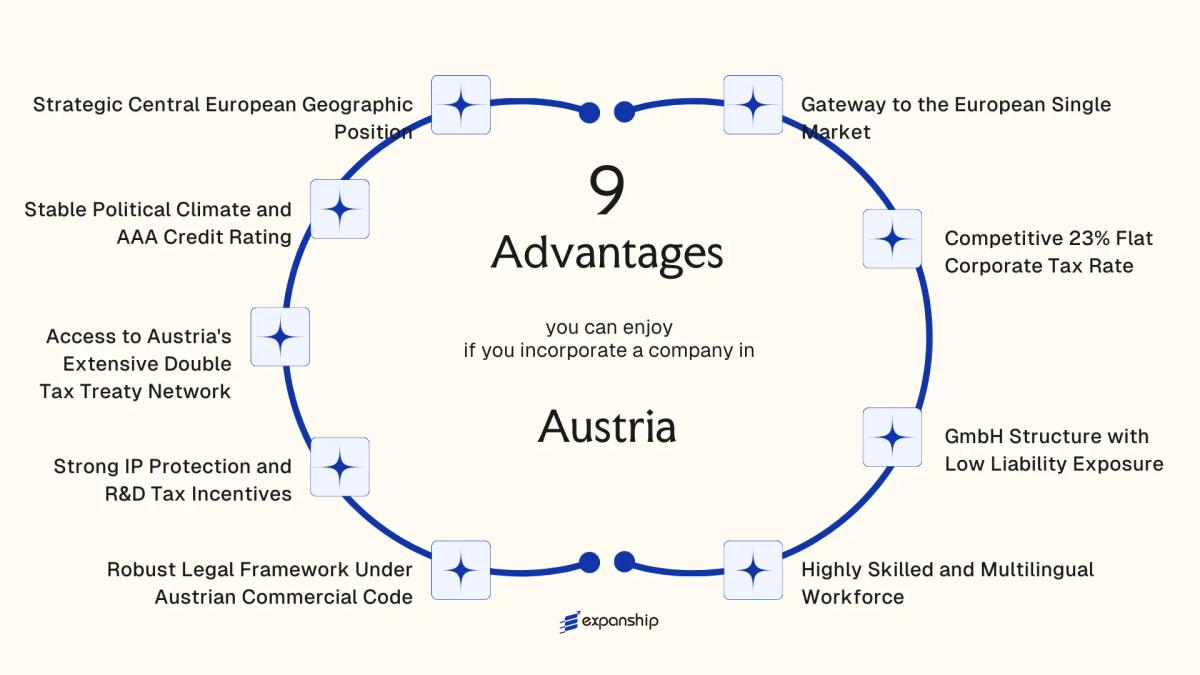
Gateway to the European Single Market
Incorporating in Austria grants your business direct, unrestricted access to the EU single market — a trading bloc of over 440 million consumers governed by harmonised rules under EU law. Austria EU single market access benefits are structural, not circumstantial, flowing from the country's full EU membership since 1995.
Free Movement of Goods, Services, and Capital
An Austrian-registered entity can sell goods and services across all 27 EU member states without customs declarations, tariffs, or country-specific import licences between member states. This eliminates a layer of cross-border friction that non-EU entities must absorb through separate market-entry arrangements in each jurisdiction.
EU passporting rights also apply across regulated sectors, meaning a financial services firm authorised under Austrian law by the Finanzmarktaufsicht (FMA) can operate in other member states under a single licence. The alternative — establishing separate regulated entities per country — carries significantly higher compliance costs and operational overhead.
Eurozone Membership and Currency Stability
Austria adopted the euro in 1999, which removes foreign exchange risk for businesses trading across the eurozone. Transactional and accounting simplicity follows directly from operating within a single currency across your largest potential customer base.
An Austrian entity gives you EU-wide commercial reach from a single point of incorporation, without replicating legal structures across member states.
Competitive 23% Flat Corporate Tax Rate
Austria's corporate tax rate for legal entities, known as the Körperschaftsteuer, sits at a flat 23%. This figure compares favourably against the EU average, which the European Commission has measured at approximately 21.3% on a statutory basis — though many comparable Western European economies impose rates considerably higher. Germany applies a combined federal and trade tax burden that routinely exceeds 30%, and France's standard rate stands at 25%. For a foreign business owner, the Austria 23% corporate tax rate advantages become tangible in straightforward profit repatriation calculations and predictable effective tax liability.
The flat structure is particularly significant. Unlike progressive systems that penalise growth at higher income thresholds, every euro of taxable profit is taxed at the same rate regardless of the entity's size or turnover. Austrian flat corporate tax benefits for businesses operating across multiple income levels are therefore consistent from year one.
Under the Körperschaftsteuergesetz 1988 (KStG), taxable income is determined after deducting allowable business expenses, which keeps the effective rate competitive in practice. For foreign investors structuring a GmbH or AG, the rate applies uniformly to resident corporate income.
Conditions that make the tax framework accessible:
- The minimum corporate tax obligation previously required under older KStG rules has been abolished, removing a burden that once applied regardless of profitability
- Tax filings are processed through FinanzOnline, the Austrian tax authority's digital portal, reducing administrative friction
- Dividend distributions to qualifying EU parent entities can fall under the EU Parent-Subsidiary Directive, reducing withholding tax to zero under specific ownership thresholds

Incorporate Your Company in Austria
Set up a compliant Austrian legal entity with Expanship's end-to-end incorporation service, covering registration, documentation, and ongoing compliance.
GmbH Structure with Low Liability Exposure
One of the principal Austria GmbH limited liability advantages is structural: shareholders are only liable up to the amount of their capital contribution. Personal assets remain outside the reach of company creditors, regardless of the firm's financial position.
This protection is codified in the GmbH-Gesetz (GmbHG), the federal statute governing limited liability companies. Under this law, the minimum share capital is EUR 35,000, of which at least half must be paid in at incorporation. Once that threshold is met, your exposure as a shareholder is capped. No further calls on personal wealth can arise from ordinary business losses or contractual obligations incurred by the entity.
| Feature | Detail |
|---|---|
| Governing Statute | GmbH-Gesetz (GmbHG) |
| Minimum Share Capital | EUR 35,000 |
| Minimum Paid-in at Formation | EUR 17,500 |
| Shareholder Liability Cap | Limited to capital contribution |
| Personal Asset Exposure | None under standard operations |
For a foreign investor holding shares through a parent company or as an individual, this separation is meaningful. It allows your business to operate, contract, and employ staff in Austria without those obligations attaching to assets held outside the entity.
Piercing of the corporate veil under Austrian law is reserved for exceptional circumstances, primarily fraud or deliberate abuse of the legal form. Routine business risk does not trigger personal liability, giving the structure predictable boundaries that matter when planning capital allocation across multiple jurisdictions.
Highly Skilled and Multilingual Workforce
Austria's skilled multilingual workforce advantages become immediately tangible when you consider that over 90% of the country's population speaks German as a first language, while English proficiency ranks consistently high across Central Europe — particularly within urban professional environments like Vienna and Graz.
University output reinforces this. Institutions such as the University of Vienna and the Vienna University of Economics and Business (WU Wien) produce graduates trained in law, finance, engineering, and international business. This academic infrastructure reduces onboarding costs for foreign companies that require specialist knowledge from day one.
Geographical position adds a linguistic dimension many businesses underestimate. A meaningful share of the workforce holds working proficiency in Czech, Slovak, Hungarian, or Slovenian — a direct result of Austria's location at the intersection of Western and Central Europe. For a firm targeting multiple EU markets from a single base, that coverage has operational value without requiring separate regional hires.
Under the Rot-Weiß-Rot Karte scheme, Austria also permits skilled non-EU nationals to work within the country based on a points-based assessment tied to qualification and salary thresholds.
- Verify that target roles qualify under the Rot-Weiß-Rot Karte criteria before planning hires
- Confirm language requirements with local HR or legal counsel if hiring for client-facing positions
- Check WU Wien's executive education programs if management-level talent pipelines are relevant to your sector
Austria has one of the highest shares of apprenticeship-trained technical workers in the EU, meaning vocational skills in engineering and manufacturing are embedded at workforce level, not just at graduate level.
Robust Legal Framework Under Austrian Commercial Code
The Austrian Commercial Code legal framework benefits foreign businesses in ways that are structural, not incidental. The Unternehmensgesetzbuch (UGB), which replaced the older Handelsgesetzbuch in 2007, governs commercial relationships with a level of codified precision that reduces legal ambiguity for incoming entities. Predictability in contract enforcement and dispute resolution is a direct outcome of this codification, and that predictability has measurable value when structuring cross-border transactions.
Codified Commercial Rules That Reduce Contractual Risk
Under the UGB, obligations between commercial parties, known as Unternehmer, follow clearly defined rules on accounting standards, agency relationships, and commercial transactions. This means your contracts operate within a well-established interpretive framework, reducing the risk of outcomes that diverge from commercial intent.
Austrian courts apply UGB provisions consistently, and the country's civil procedure rules under the Zivilprozessordnung (ZPO) support efficient enforcement of judgments. For a foreign investor, this matters because enforceable contracts are the foundation of any reliable operating structure.
Legal Certainty for Corporate Governance
The UGB, read alongside the GmbH-Gesetz (GmbHG) for limited liability companies, sets out director duties, shareholder rights, and disclosure obligations with specificity. Austria UGB legal protections for companies are not discretionary, they are statutory, which means governance standards apply uniformly regardless of the size or origin of the business.
Disputes between shareholders or with third parties fall under the jurisdiction of the Handelsgericht Wien for Vienna-based entities, a specialist commercial court. Access to a dedicated commercial judiciary reduces the uncertainty that generalist court systems can introduce in complex business disputes.
Structuring Your Austrian Entity for Maximum Legal Advantage
Speak with Expanship's specialists about how the UGB framework applies to your specific corporate structure and investor protections in Austria.
Strong IP Protection and R&D Tax Incentives
Austria IP protection and R&D tax incentives are among the most defined and commercially significant benefits available to businesses incorporated there. Two distinct mechanisms create this advantage: the country's alignment with EU intellectual property law and a direct cash-equivalent tax incentive for qualifying research expenditure.
- The Forschungsprämie (research premium) allows companies to claim a 14% tax credit on eligible R&D expenditure conducted domestically. This applies to both in-house research and contracted external research, up to defined ceilings. Because the credit is refundable, early-stage firms with no current tax liability still receive a cash payout from the Austrian tax authority (Finanzamt), making it accessible regardless of profitability.
- IP ownership held by an Austrian entity benefits from EU-level protections, including enforcement under Regulation (EU) 2017/1001 for EU trademarks and the European Patent Convention framework. Your firm's registered rights are legally enforceable across member states without re-registration.
- The Austrian Research Promotion Agency (FFG) administers additional grant programs that can supplement the Forschungsprämie for qualifying technology and innovation projects, creating a second layer of public support for R&D-active businesses.
- Eligibility for the research premium requires that activities meet the FRASCATI Manual definition of research and experimental development, which the Finanzamt applies during assessment.
Access to Austria's Extensive Double Tax Treaty Network
Austria's double tax treaty network benefits foreign businesses through one of the widest treaty portfolios in the EU, covering over 90 countries. These agreements, negotiated under the OECD Model Tax Convention, reduce or eliminate withholding taxes on dividends, interest, and royalties paid across borders. For a foreign-owned GmbH or AG, this directly lowers the tax cost of repatriating profits to a parent company abroad.
Many of Austrian DTTs set withholding tax rates on dividends as low as 0% to 5% for qualifying corporate shareholders, compared to the standard domestic withholding rate of 27.5%. The treaty with the United States, for instance, reduces dividend withholding to 15% for general holdings and 5% for substantial corporate shareholdings.
Treaty eligibility typically requires that the Austrian entity has genuine economic substance, which aligns with the country's general anti-abuse provisions under the Austrian Income Tax Act (Einkommensteuergesetz) and EU directives.
A foreign holding company routing regional profits through an Austrian subsidiary could reduce withholding tax on outbound royalties from a standard 20% to as low as 0% under applicable treaties with jurisdictions such as the UAE or Singapore, resulting in material annual savings at scale.
Stable Political Climate and AAA Credit Rating
Austria's political stability and AAA credit rating benefits translate directly into lower risk exposure for foreign businesses operating or holding assets through an Austrian entity. Moody's, S&P, and Fitch have each assigned Austria their highest sovereign rating, reflecting consistent fiscal discipline and deep institutional integrity.
For your business, this matters at the contractual and financial level. Counterparties, lenders, and institutional partners assess sovereign risk when structuring cross-border agreements. Operating through an entity domiciled in a AAA-rated jurisdiction reduces perceived credit exposure and can improve the terms on financing or trade credit arrangements.
Austria's government operates under the Bundesverfassung (Federal Constitution), which establishes a stable separation of powers and a predictable legislative process. This means regulatory changes affecting corporate structures, tax obligations, or commercial operations move through formal parliamentary channels, giving your business advance notice rather than abrupt policy shifts.
Continuity of the legal and regulatory environment also reduces compliance uncertainty. Austrian membership in the OECD and its adherence to EU regulatory standards means the framework your company operates within is internationally recognized and regularly reviewed.
Austria's AAA rating reflects sovereign fiscal health, not a guarantee of fixed corporate regulatory conditions, which remain subject to EU-level directives and domestic legislative amendments.
Strategic Central European Geographic Position
Austria's geographic position at the crossroads of Western and Eastern Europe is a structural advantage, not a symbolic one. The country shares borders with eight nations, including Germany, Switzerland, Hungary, the Czech Republic, and Slovenia, placing your business within direct reach of markets spanning the EU's economic core and its newer eastern member states.
Vienna sits within a two-hour flight of roughly 25 European capitals. For firms managing operations across multiple jurisdictions, this proximity reduces the cost and friction of maintaining regional oversight without the logistical overhead of operating from a more peripheral EU location.
The Central European geographic position also has practical legal implications. Austria's bilateral investment treaties and trade agreements are largely governed under EU law, meaning your entity benefits from EU single market access while being physically positioned to coordinate supply chains, regional sales, and cross-border service delivery across the DACH region and Central and Eastern Europe simultaneously.
Infrastructure quality reinforces the geographic argument. The country is served by the Vienna International Airport (Flughafen Wien), a major central European transit hub, along with an extensive rail network that connects directly to major commercial centers including Munich, Zurich, Budapest, and Prague. For firms in logistics, distribution, or professional services, this connectivity has direct cost implications.
- Borders eight EU and non-EU states, enabling multi-market access from a single registered base
- Vienna is within two hours of approximately 25 European capitals by air
- Direct rail connections to Munich, Zurich, Budapest, Prague, and other commercial centers
Why Austria Stands Out Against Other European Incorporations
Foreign investors evaluating Central European incorporation typically weigh Austria against Germany, the Netherlands, and Switzerland. Germany shares a language and legal tradition rooted in civil law, making it a natural comparator. The Netherlands attracts holding structures and international headquartering. Switzerland, though outside the EU, competes for similar investor profiles given its geographic and economic proximity. Against these three, Austria's combination of treaty access, corporate tax structure, and regulatory predictability positions it distinctly, particularly for businesses that require EU membership without the administrative scale of larger markets.
What the comparison reveals is less about headline rates and more about cumulative conditions. The Netherlands offers a participation exemption that rivals Austria's, but at higher substance requirements for non-EU entities. Germany's corporate tax burden, when trade tax is included, often exceeds 30%. Switzerland's corporate rate can be lower at cantonal level, but EU Single Market access and VAT registration requirements differ fundamentally for non-resident firms. Austria's Unternehmensgesetzbuch (UGB) imposes no cantonal variation, meaning compliance costs are predictable regardless of where your entity is registered within the country.
| Parameter | Austria | Germany | Netherlands | Switzerland |
|---|---|---|---|---|
| Standard Corporate Tax Rate | 23% | ~30% (incl. trade tax) | 25.8% | 11.9–21.2% (cantonal) |
| EU Single Market Access | Yes | Yes | Yes | No |
| GmbH Minimum Share Capital | €35,000 | €25,000 | €0.01 (BV) | CHF 20,000 (GmbH) |
| Double Tax Treaties (approx.) | 90+ | 90+ | 90+ | 100+ |
| R&D Tax Incentive | 14% cash premium | Volume-based credit | Innovation box (9%) | Cantonal deductions |
| Legal Framework | UGB (civil law) | HGB (civil law) | BW/BV Act (civil law) | OR (civil law) |
| CFC Rules | Limited application | Strict | Moderate | Limited |
Compliance Services for Austrian Companies
Stay aligned with Austria's UGB reporting obligations, annual filing deadlines, and corporate governance requirements through structured compliance support.
Conclusion
Austria's position as a European incorporation destination rests on a combination of structural and fiscal features that are difficult to replicate in isolation. The 23% flat corporate tax rate, combined with the 14% R&D premium available under the Forschungsprämie, creates a measurable cost advantage for knowledge-intensive businesses. Pair that with full access to EU single market rights through the GmbH structure, and the practical case becomes clear without requiring embellishment.
The binding double tax treaty network, covering over 90 countries, directly reduces withholding tax exposure on cross-border income flows — a material consideration for any foreign investor structuring international operations through a European entity. The Unternehmensgesetzbuch provides a codified, predictable legal environment, which means contractual and corporate matters are governed by statute rather than discretionary interpretation.
Whether this structure fits your business depends on your industry, ownership model, and the jurisdictions you transact with. A technology firm seeking R&D incentives arrives at a different calculus than a holding company managing regional subsidiaries. The advantages of Austrian business incorporation are real, but their value is proportional to how well your operational profile aligns with what the framework offers.
The next step is translating these structural features into a formation plan that reflects your specific requirements.
Start Your Austrian Company Formation with Expanship
Austria company formation with Expanship covers the full incorporation lifecycle of an Österreichische Gesellschaft mit beschränkter Haftung (GmbH), from drafting notarially certified articles of association to registration with the Firmenbuch, the official commercial register maintained by the regional courts. The compliance obligations tied to Austrian corporate law, the tax registration requirements under the Bundesabgabenordnung, and the ongoing reporting duties under the Unternehmensgesetzbuch each demand precise execution from day one.
Expanship's service scope for Austrian incorporations includes:
- Preparation and notarial legalization of incorporation documents
- Registered office and resident agent provision in Austria
- Filing with the Firmenbuch and liaison with the Wirtschaftskammer Österreich
- Post-incorporation compliance management, including annual financial statement obligations
- Tax registration coordination with the Finanzamt
- Banking introduction assistance for corporate account opening
Reach out to Expanship Austria to discuss your incorporation requirements.
Frequently Asked Questions (FAQ)
The statutory minimum share capital for an Austrian GmbH is EUR 35,000 under the GmbH-Gesetz. At the time of registration, at least half of this amount, EUR 17,500, must be paid in. The remaining balance can be called up by the managing directors as the business requires it, giving founders some initial flexibility with capital deployment.
Austria's flat corporate income tax rate of 23% sits below the EU average, which hovers near 21-22% when weighted by economic size, though several larger economies charge considerably more. There is no municipal business tax surcharge on corporate profits in the way some other jurisdictions apply it, but companies should account for any applicable trade income components depending on their structure. The rate was reduced from 25% as part of the Ökosozialesteuerreformgesetz 2022, with a further reduction to 21% scheduled for 2024.
Foreign-owned companies incorporated in Austria qualify for the Forschungsprämie, the R&D premium, on the same basis as domestically owned entities, provided the research activity is conducted within Austria. The premium allows a 14% cash refund on qualifying research and development expenditures, which include personnel costs, materials, and contracted external research up to a defined ceiling. Claims are submitted through the Austrian Research Promotion Agency (FFG), which issues a confirmation certificate before the tax authority processes the refund.
Limited liability under the GmbH-Gesetz can be pierced in specific circumstances, primarily where directors breach their fiduciary duties under Section 25 of the GmbH-Gesetz or where the corporate form is abused to circumvent creditor rights. In such cases, Austrian courts may hold individual directors or shareholders personally liable for damages arising from that conduct. Routine business losses, however, do not expose shareholders beyond their capital contribution, so the liability shield holds in ordinary commercial operations.
Austria has concluded over 90 double tax treaties, one of the more extensive networks among EU member states. Treaty benefits are not automatic; under both domestic anti-avoidance rules and the OECD's BEPS-aligned provisions incorporated into Austria's treaty policy, a company must demonstrate genuine economic substance to access reduced withholding rates or exemptions. A letterbox entity with no real management, staff, or operational activity in Austria would risk treaty benefit denial by the Finanzamt, the Austrian tax authority.
Once the notarial deed of incorporation is executed and all required documents are filed, the Firmenbuch registration typically takes between one and three weeks, depending on the volume of filings at the relevant regional commercial court. Incomplete submissions or queries from the court regarding director identity verification or share capital deposits can extend this timeline. There is no expedited processing track for foreign applicants, so early preparation of all notarized and apostilled documents is the practical way to avoid delays.
Legal Disclaimer
The information provided in this article is for general informational purposes only and does not constitute legal, tax, or professional advice. While we strive to ensure the accuracy and timeliness of the content, laws and regulations are subject to change, and the application of laws can vary widely based on specific facts and circumstances.
Readers should not act upon this information without seeking professional counsel tailored to their individual situation. Expanship and its authors disclaim any liability for actions taken or not taken based on the content of this article.
For specific advice regarding your business setup, compliance requirements, or any legal matters, please consult with qualified legal and tax professionals in the relevant jurisdiction.