
Key Takeaways
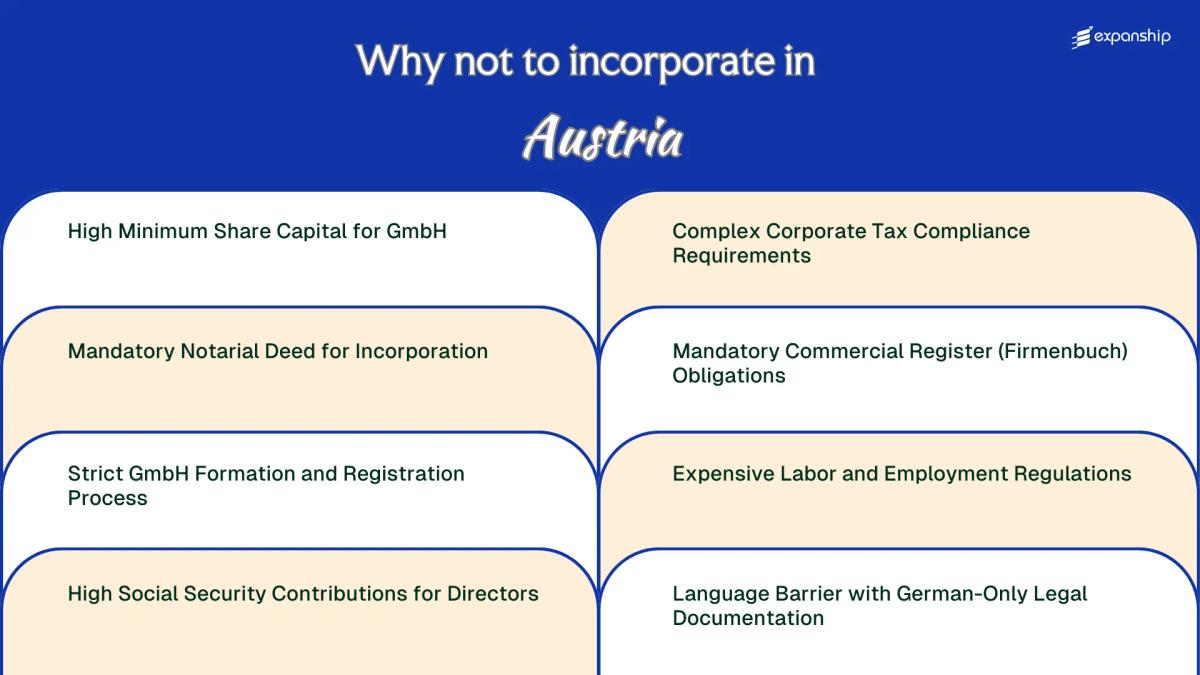
- Under the GmbH-Gesetz, Austria's GmbH requires a minimum share capital of €35,000, of which at least half must be paid up at incorporation, creating an immediate liquidity burden that lighter-touch EU jurisdictions do not impose.
- Incorporation of an Austrian GmbH cannot proceed without a mandatory notarial deed, adding both cost and procedural delay before a company can be entered into the Firmenbuch.
- Directors of an Austrian GmbH are subject to compulsory social security contributions regardless of whether they draw a salary, generating fixed overhead costs from the moment of appointment.
- German is the sole legally recognized language for corporate documentation and Firmenbuch filings, meaning foreign founders without German-language legal support face a structural dependency on local intermediaries throughout the compliance lifecycle.
Austria operates under a heavily regulated corporate framework, and the disadvantages of incorporating in Austria span procedural, financial, and compliance dimensions that can create friction for foreign investors. The GmbH-Gesetz — Austria's primary legislation governing the limited liability company — sets out requirements that differ materially from those in lighter-touch jurisdictions.
The drawbacks covered in this article range across capital requirements, notarial procedures, tax obligations, and employment costs. Not all of these will apply equally to every business. A small consulting firm, for example, faces a different compliance burden than a manufacturing entity or a regulated financial services business.
This article is most relevant to non-EU founders and foreign-owned holding structures considering Austria GmbH incorporation for the first time, particularly those without existing German-language legal or accounting support in place.
High Minimum Share Capital for GmbH
Austria GmbH minimum share capital requirements impose a direct financial barrier before your business can legally operate. Under the GmbH-Gesetz (GmbHG), the governing statute for limited liability companies, a minimum Stammkapital of €35,000 is mandatory.
A Fixed Capital Threshold With Real Upfront Costs
At incorporation, at least half of that amount, €17,500, must be paid in cash before the Firmenbuch registers the entity. For a foreign entrepreneur testing a new market, this capital sits locked within the company structure rather than funding operations or market entry.
Compared to several EU member states where minimum share capital requirements have been reduced to symbolic amounts, Austria's threshold remains substantially higher, creating an unequal starting position for cost-sensitive businesses.
How the Requirement Limits Flexibility
Founders cannot substitute in-kind contributions to meet the full cash requirement at formation without additional procedural steps. This restriction compounds the liquidity pressure on early-stage foreign entities that may already carry formation and notarial costs.
Foreign business owners must have €17,500 in verified cash available at the point of registration, meaning insufficient liquid capital will block company formation entirely regardless of other business readiness.
Mandatory Notarial Deed for Incorporation
The Austria notarial deed incorporation requirement adds a structural cost layer that most EU jurisdictions no longer impose. Under the GmbH Act (GmbH-Gesetz), the articles of association for a Gesellschaft mit beschränkter Haftung must be executed before a licensed Austrian notary. This is not an administrative formality — it is a statutory prerequisite that directly increases the cost and complexity of formation for foreign founders.
Notary fees are calculated according to the Austrian Notary Tariff Act (Notariatstarifgesetz) and scale with the registered share capital. For a firm incorporating at the minimum capital threshold, notarial costs alone can reach several hundred euros before accounting for registration fees.
For a foreign business owner, this requirement creates friction at multiple points:
- You must engage a local Austrian notary, which is difficult to coordinate remotely without a local representative or registered agent
- Notarial scheduling delays can extend your incorporation timeline by days or weeks, delaying your ability to open corporate bank accounts or sign contracts
- All documentation must comply with specific formal standards, meaning errors trigger repeat notarial appointments and additional fees
- Translation and certification of foreign identity documents to satisfy notarial standards adds cost that domestic founders do not face
Online or simplified incorporation procedures available in countries like Estonia or Germany (for UGs) are not available for Austrian GmbH formation in the same manner, making the process comparatively rigid.

Company Incorporation in Austria
Understand the full cost and process of incorporating a GmbH in Austria, including notarial deed requirements and Firmenbuch registration.
Strict GmbH Formation and Registration Process
Forming a GmbH involves a sequence of mandatory procedural steps that collectively extend the Austria GmbH registration process well beyond what founders from less bureaucratic jurisdictions typically expect. Each stage is legally prescribed and cannot be compressed or reordered.
The process begins with the drafting of a notarial deed, which must then be submitted to the Firmenbuch, the Austrian commercial register maintained by the regional court (Landesgericht) with commercial jurisdiction. Founding documents must satisfy specific formal requirements under the GmbH-Gesetz (GmbHG), and any deficiency triggers a court rejection rather than a correction request.
| Stage | Requirement | Burden for Foreign Founders |
|---|---|---|
| Articles of Association | Notarized in German only | Translation and notarial fees add cost before registration |
| Capital deposit verification | Bank confirmation of paid-in capital required | Delays registration if bank processing is slow |
| Firmenbuch submission | Filed via notary or legal representative | Direct self-filing is not available to foreign founders |
| Court review period | Firmenbuch examines for legal compliance | Rejections restart the timeline with no set resolution window |
Registration cannot proceed until the minimum share capital deposit is confirmed by a domestic bank, tying the timeline to an institution that has no obligation to expedite the process. For a foreign founder without an existing Austrian banking relationship, opening that account adds a separate procedural layer.
The court-supervised review under Section 9 GmbHG means errors in founding documents result in formal rejections. There is no informal correction pathway, and resubmission restarts the review clock entirely.
High Social Security Contributions for Directors
Austria social security contributions for directors follow a distinct legal track that separates the country from most EU peers. Managing directors of a GmbH who hold a majority stake are classified as self-employed under the Gewerbliches Sozialversicherungsgesetz (GSVG) rather than as employees, meaning they contribute to a separate social insurance system administered by the Sozialversicherungsanstalt der Selbständigen (SVS).
Combined GSVG contribution rates can reach approximately 26.8% of the assessment basis, covering pension, health, and accident insurance. For a foreign entrepreneur drawing a salary as a managing director, this creates a social insurance cost burden that compounds operating expenses significantly from year one.
Unlike salaried employees whose contributions are split with the employer, a majority-shareholder director bears the full weight of self-employed contributions personally. There is no employer-side offset to reduce the effective rate.
- GSVG contributions apply if you hold more than 25% of GmbH shares as managing director
- SVS assesses contributions based on taxable income from prior years, creating retroactive adjustment payments
- Provisional contributions are billed during the year; a final recalculation follows after tax assessment
- Minimum contribution bases apply even if the business generates low income in early years
- Foreign directors with no prior Austrian tax history face estimated assessments by default
Even a dormant GmbH with a majority-shareholder director can trigger minimum GSVG contributions, meaning costs accrue before the company generates a single euro of revenue.
Complex Corporate Tax Compliance Requirements
Austria corporate tax compliance drawbacks extend well beyond filing a single annual return. The Körperschaftsteuer (KöSt) framework imposes layered obligations that generate recurring administrative costs and require specialist input that foreign-owned entities cannot easily handle in-house.
Structural Obligations Under the KöSt Regime
Austrian GmbHs are subject to a corporate income tax rate of 23% (reduced from 25% in 2023 under the Ökosozialesteuerreformgesetz 2022), but the rate itself is not the primary burden. Quarterly advance payments (Vorauszahlungen) are mandatory, meaning your firm must forecast annual taxable income accurately or face underpayment interest charged by the Finanzamt.
Austria also requires transfer pricing documentation for intercompany transactions, aligned with OECD guidelines but enforced domestically through the Verrechnungspreisdokumentationsgesetz. For a foreign parent company routing capital or services through an Austrian subsidiary, this creates a continuous documentation obligation that demands local tax counsel involvement throughout the year.
Practical Cost Consequences for Foreign-Owned Entities
Austria company tax filing restrictions include mandatory electronic submission through FinanzOnline, which requires registered access credentials and German-language proficiency to operate without a local tax representative. Engaging a Steuerberater (certified tax advisor) typically becomes unavoidable, adding several thousand euros annually to compliance overhead. This cost burden applies regardless of revenue size, making the structure disproportionately expensive for smaller foreign entities.
Managing Austria's Corporate Tax Compliance Burden
Austria's Körperschaftsteuer obligations, advance payment schedules, and transfer pricing requirements create ongoing costs that require specialist handling. Speak with Expanship's team about structuring your Austrian entity for compliance from day one.
Mandatory Commercial Register (Firmenbuch) Obligations
Austria Firmenbuch obligations challenges extend beyond simple registration fees, creating ongoing administrative burdens that foreign business owners frequently underestimate.
- All GmbH formations must be entered in the Firmenbuch, maintained by the competent regional court (Landesgericht), and any changes to registered details require formal court filings with associated fees.
- Directors, shareholders, and beneficial owners must be publicly disclosed in the Firmenbuch, removing the confidentiality that many foreign investors expect from a private limited structure.
- Any amendment to the articles of association, including address changes or capital adjustments, requires notarial certification before the Firmenbuch will accept the filing.
- The register operates exclusively in German, meaning foreign directors must either obtain certified translations or engage a local professional for every submission.
- Failure to file required updates within the statutory deadlines can trigger court-imposed fines under the Firmenbuchgesetz, adding financial exposure for businesses with limited local administrative support.
Expensive Labor and Employment Regulations
Austria employment regulations drawbacks extend well beyond basic wage requirements. Employers are bound by a dense system of collective agreements — Kollektivverträge — that set sector-specific minimum wages, working hour limits, overtime entitlements, and termination conditions, all of which sit above the statutory floor set by the Arbeitsverfassungsgesetz (Labour Constitution Act).
Kollektivvertrag compliance challenges arise because the applicable agreement depends on the industry classification of your business, and misclassifying your firm can trigger retroactive wage adjustments and penalties. These agreements are renegotiated annually, meaning your payroll costs can shift each year without warning.
Mandatory severance contributions under the Betriebliches Mitarbeiter- und Selbständigenvorsorgegesetz (BMSVG) require employers to contribute 1.53% of gross wages monthly to an employee provision fund from day one of employment.
- Mandatory fifth-week holiday entitlement after 25 years of service creates long-term cost escalation for retained staff.
- Works council (Betriebsrat) rights in firms with five or more employees can slow operational decisions and restructuring processes.
A foreign-owned GmbH employing 10 staff on the 2024 metal industry Kollektivvertrag minimum wage of approximately €2,300/month would owe roughly €3,540 per year in BMSVG contributions alone, before accounting for social security charges exceeding 21% of gross wages payable by the employer.
Language Barrier with German-Only Legal Documentation
Austria's German language legal documentation barrier is not a minor inconvenience — it is a structural feature of the legal system that applies without exception to foreign investors. All filings submitted to the Firmenbuch (Commercial Register), articles of association, notarial deeds, and official correspondence with the Wirtschaftskammer Österreich must be in German.
For a foreign business owner without German proficiency, every document in the incorporation and compliance process requires certified translation or a bilingual legal professional. That cost accumulates quickly across the GmbH formation deed, shareholder agreements, and ongoing regulatory submissions.
Austrian contract law and procedural rules do not recognize foreign-language versions of founding documents as legally valid for registration purposes. A German-language original is required, not a translation of your preferred draft.
Practical consequences for your business include:
- Certified translators must be used for any document submitted to Austrian courts or public authorities
- Legal counsel must typically be engaged in German, adding cost and complexity to routine compliance tasks
- Errors in translation can invalidate filings or create interpretive disputes under Austrian private law
Even if your entire operation is managed from abroad, all statutory documents governing your Austrian entity must exist in a legally valid German version before any registration or notarial procedure can proceed.
Overcoming Austria's Incorporation Challenges
Overcoming Austria's Incorporation Challenges
Overcoming Austria incorporation challenges requires structural preparation before the registration process begins, not reactive adjustments after filing. The barriers covered in this blog are grounded in binding statutory requirements under Austrian corporate and labor law.
- Prepare the minimum share capital of EUR 35,000 for a GmbH and confirm that at least EUR 17,500 is paid in before filing with the Firmenbuch.
- Engage a certified Austrian notary to authenticate the articles of association, as notarial certification is a mandatory prerequisite under the GmbH-Gesetz.
- Register with the Österreichische Gesundheitskasse (ÖGK) prior to any director drawing remuneration, to meet mandatory social insurance obligations.
- File corporate tax returns and maintain compliant accounting records in accordance with the Unternehmensgesetzbuch (UGB).
- Ensure all Firmenbuch submissions and legal documentation are prepared in German, as required by Austrian procedural law.
Each of these steps corresponds to a specific statutory obligation enforced by Austrian authorities, including the Firmenbuch and the Finanzamt. Addressing them in sequence reduces the risk of registration delays or compliance gaps after incorporation.
Austria's Investment Appeal Despite the Drawbacks
Austria's incorporation costs, administrative requirements, and compliance obligations are real friction points for foreign businesses. That said, the country's position within the EU single market, its stable legal system rooted in the Unternehmensgesetzbuch (UGB), and its network of double tax treaties across 90+ countries make it a credible destination for firms with the right operational profile.
| Pro | Con |
|---|---|
| EU single market access through an Austrian-registered entity | Minimum share capital of EUR 35,000 required for a GmbH, with EUR 17,500 paid up at registration |
| Extensive double tax treaty network reduces withholding tax exposure | Mandatory notarial deed adds upfront legal cost and delays formation timelines |
| Firmenbuch registration provides legal transparency and credibility with counterparties | Social security contributions for managing directors apply regardless of profit levels |
| Corporate tax rate of 24% (reducing to 23% under phased reform) is within the EU average | All legal and official documentation is issued exclusively in German |
| Austria's courts apply established UGB frameworks, offering legal predictability | Corporate tax compliance involves transfer pricing rules, CbCR obligations, and group taxation elections |
Your cost base and administrative tolerance will largely determine whether the GmbH structure suits your business. The obligations are fixed, not scalable to revenue.
Corporate Compliance Services in Austria
Ongoing compliance support for Austrian GmbH entities, including Firmenbuch filings, annual financial statement obligations, and corporate tax coordination.
Conclusion
The Austria company incorporation cons summary points to a jurisdiction with genuine structural costs attached to formal business entry. The mandatory EUR 35,000 minimum share capital for a GmbH, combined with compulsory notarial certification of the founding deed, creates a front-loaded financial and procedural burden that many jurisdictions do not impose. Director-level social security obligations under the GSVG add recurring costs that extend well beyond the incorporation phase. Addressing these constraints systematically, with an accurate understanding of Firmenbuch requirements and Austrian tax compliance obligations, determines how efficiently your firm can become operational.
Expanship's Austria Expansion Support
Expanship's Austria expansion support services are structured around the practical demands that Austrian corporate law places on foreign businesses, from coordinating with the Firmenbuch for commercial register filings to managing notarial deed requirements and GmbH share capital obligations. Your business still carries the underlying compliance burden, but Expanship reduces the administrative weight of working through Austria's layered regulatory requirements.
Beyond incorporation, the scope of support covers the full setup and maintenance cycle.
- Preparing and submitting your company registration documents in accordance with Austrian requirements.
- Providing a registered agent and local office address for official correspondence.
- Liaising with the Firmenbuch, Finanzamt, and other relevant Austrian authorities on your behalf.
- Managing ongoing post-incorporation compliance obligations as your business operates.
- Facilitating introductions to Austrian banking institutions to support account opening.
- Handling tax registration and coordinating with local authorities on fiscal matters.
Reach out through Expanship Austria to discuss your incorporation requirements.
Frequently Asked Questions (FAQ)
Every GmbH incorporation in Austria requires a notarial deed, without exception. The articles of association must be authenticated by an Austrian notary, and this is a statutory requirement under the GmbHG, not an administrative preference. There is no online or self-filing equivalent that bypasses this step, which adds both cost and scheduling time to the formation process.
The Firmenbuch, maintained by the competent regional court, can impose coercive fines on companies that fail to submit required filings on time, including changes to directors, share capital, or registered address. These fines can be levied repeatedly until compliance is achieved. Directors bear personal responsibility for ensuring timely submissions under Austrian corporate law.
Managing directors who hold a significant ownership stake are treated as self-employed under the GSVG (Gewerbliches Sozialversicherungsgesetz) and contribute to the SVS (Sozialversicherungsanstalt der Selbständigen). Contribution rates can reach approximately 26–28% of assessed income, depending on earnings and applicable thresholds. This applies even when the director draws a relatively modest salary, making Austria's director cost structure noticeably heavier than in several Western European peers.
Austria's compliance burden is above average for a mid-sized EU economy. Companies must manage advance corporate income tax payments, prepare financial statements under the UGB (Unternehmensgesetzbuch), and submit annual tax returns to the Finanzamt, all while meeting strict deadlines. The interaction between trade tax, corporate income tax, and VAT obligations creates a multi-layered reporting structure that typically requires local professional support to manage correctly.
Not practically. All legal documentation, including the articles of association, notarial deed, and Firmenbuch filings, must be submitted in German. Translations are not accepted as substitutes for official submissions. A foreign founder who does not speak German must engage a bilingual legal representative for every substantive step, which increases both the cost and timeline of formation.
The Mindestkörperschaftsteuer is a statutory minimum tax under the Körperschaftsteuergesetz, currently set at €500 per year for GmbHs following recent reforms, and it is due regardless of whether the company is profitable. Failure to pay results in standard tax enforcement proceedings by the Finanzamt, including interest on arrears. The minimum tax cannot be waived on grounds of low activity or early-stage status.
Austria's non-wage labor costs are among the highest in the EU, with employer social security contributions adding roughly 20–21% on top of gross salary. Beyond contributions, mandatory provisions such as the Mitarbeitervorsorgekasse (employee severance fund) and statutory holiday entitlements of at least five weeks per year increase the effective cost of each hire substantially. For a small foreign-owned entity hiring its first local employees, the gap between gross salary and total employment cost is wider than many founders anticipate.
Legal Disclaimer
The information provided in this article is for general informational purposes only and does not constitute legal, tax, or professional advice. While we strive to ensure the accuracy and timeliness of the content, laws and regulations are subject to change, and the application of laws can vary widely based on specific facts and circumstances.
Readers should not act upon this information without seeking professional counsel tailored to their individual situation. Expanship and its authors disclaim any liability for actions taken or not taken based on the content of this article.
For specific advice regarding your business setup, compliance requirements, or any legal matters, please consult with qualified legal and tax professionals in the relevant jurisdiction.