
Key Takeaways
- Entity formation in American Samoa must comply with the Revised Uniform Limited Liability Company Act and related provisions of the American Samoa Code Annotated, with registration overseen by the ASG Department of Commerce.
- Appointing a registered agent with a physical presence in American Samoa is a structural prerequisite that cannot be satisfied by a foreign or non-resident individual acting remotely.
- Beneficial ownership disclosure obligations impose a distinct compliance layer on formation, requiring applicants to identify and document ultimate beneficial owners as part of the registration process.
- Foreign nationals and non-resident business owners are subject to specific eligibility conditions affecting director appointments, shareholder structure, and documentary requirements that differ from those applicable to resident applicants.
Entity formation in American Samoa is governed by the Revised Uniform Limited Liability Company Act and related title provisions under American Samoa Code Annotated, with the Office of the Governor's Office of Economic Development and the ASG Department of Commerce overseeing company registration requirements in American Samoa. This article addresses the structural, documentary, and compliance requirements that apply across the formation process.
Failure to satisfy applicable American Samoa business incorporation rules results in rejection of the registration filing or, in cases of post-formation non-compliance, potential legal liability and loss of good standing.
Requirements can differ based on the entity type selected, the industry sector, and whether the applicant is a foreign national or resident. Your specific circumstances will determine which provisions apply.
This article is most relevant to foreign investors and non-resident business owners seeking to establish a legal presence under American Samoa entity formation requirements for the first time.
Minimum Share Capital Requirements in American Samoa
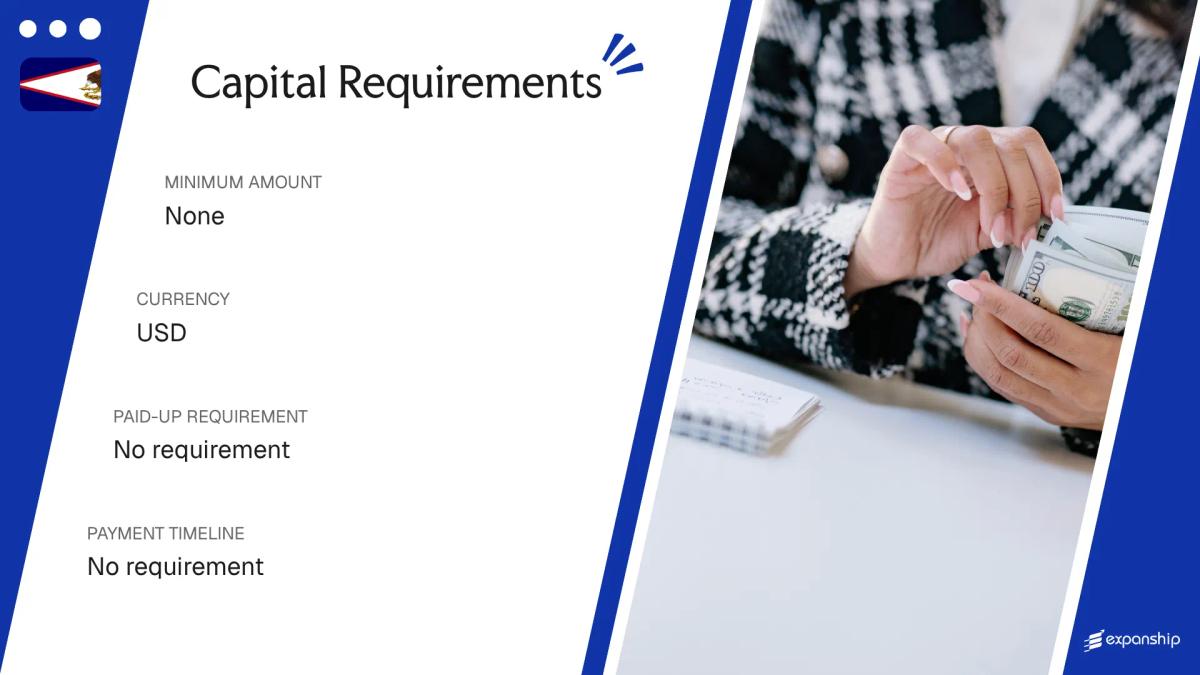
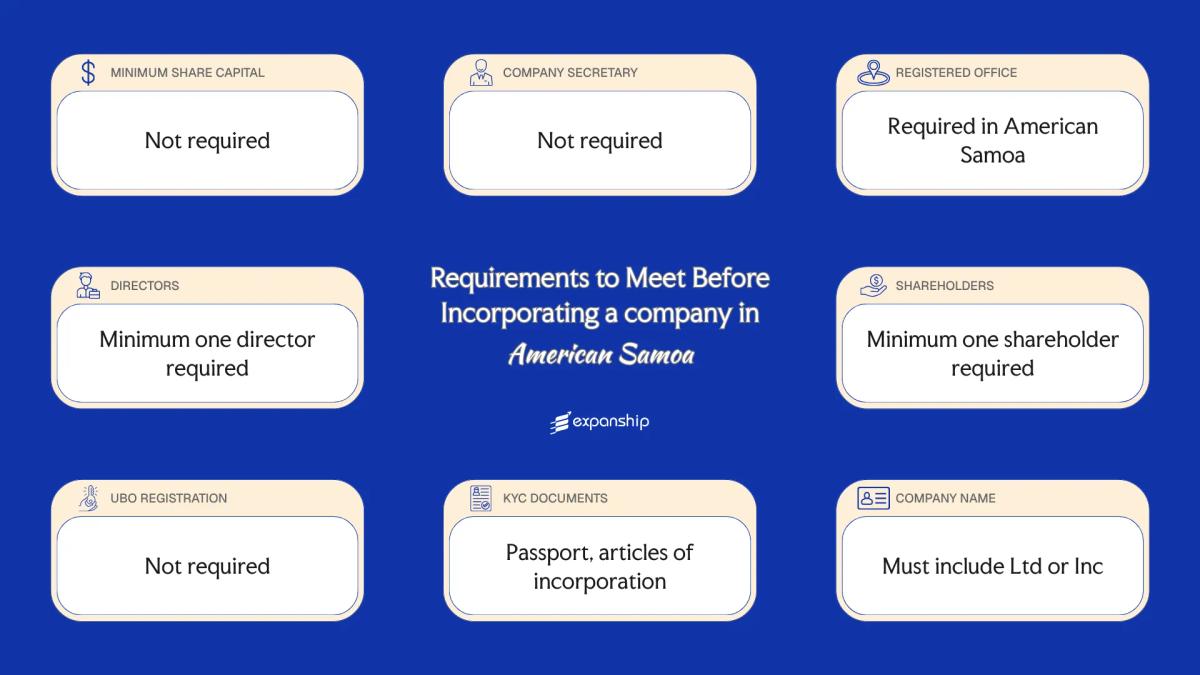
American Samoa share capital requirements are governed under the Revised Uniform Limited Liability Company Act and related corporate statutes administered through the American Samoa Government's Office of the Lieutenant Governor, which oversees business registration. No statutory minimum authorized or paid-up capital is imposed on most business entities at the point of incorporation.
The territory operates on a par value share system, though companies may issue shares with or without par value depending on their articles of incorporation. Capital compliance is not an ongoing statutory obligation tied to a recurring threshold; the structure established at incorporation generally remains in place unless amended through the registry.
| Parameter | Detail |
|---|---|
| Minimum Authorized Share Capital | No statutory requirement |
| Maximum Authorized Share Capital | No statutory requirement |
| Minimum Paid-Up Capital | No statutory requirement |
| Paid-Up Requirement at Incorporation | No statutory requirement |
| Accepted Currency | US Dollar (USD) |
| Accepted Forms of Contribution | Cash and non-cash contributions permissible |
| Timeframe to Deposit Capital | No statutory deadline |
Even without a mandated minimum, your articles of incorporation must still define the authorized share capital and class structure. The Office of the Lieutenant Governor reviews this information at filing, and an incomplete capital structure can delay registration.
Registered Agent Requirements in American Samoa
Maintaining a registered agent is a mandatory requirement under American Samoa corporate regulations. The agent serves as the official point of contact for receiving service of process, legal notices, and government correspondence on behalf of your entity.
Registered agent obligations in American Samoa include maintaining availability during standard business hours and forwarding received documents to the appropriate officers or directors of the company. Failure to maintain a compliant agent can affect the entity's good standing with the territorial authorities.
Qualification criteria for who may serve as a registered agent:
- The agent must maintain a physical presence within American Samoa's territory.
- Individuals serving in this capacity must be of legal age and a resident of the territory.
- A domestic corporation or a foreign corporation authorized to conduct business in the territory may act as agent.
- The registered agent must be capable of accepting legal documents during regular business hours.

Incorporate a Company in American Samoa
Set up your business entity in American Samoa with guidance on statutory requirements, documentation, and territorial compliance.
Registered Office Requirements in American Samoa
American Samoa registered office requirements mandate that every corporation formed under the American Samoa Code maintain a designated principal office address within the territory at all times. Failure to maintain a compliant local address can result in administrative dissolution or loss of good standing with the American Samoa Government's Office of the Lieutenant Governor, which oversees business registrations.
- A physical street address within American Samoa is required; P.O. boxes are not accepted as a registered office address.
- Virtual office addresses are generally not recognized as compliant registered office locations under local business registration rules.
- The address must be locally based within the territory; a foreign or off-island address does not satisfy this obligation.
- No ownership of the premises is required, but a lease or documented authorization to use the address must be in place.
- The registered office address is publicly recorded in the business registry maintained by the Office of the Lieutenant Governor.
- Any change to the registered office address requires formal notification to the Office of the Lieutenant Governor, typically through an amendment filing.
Director Requirements in American Samoa
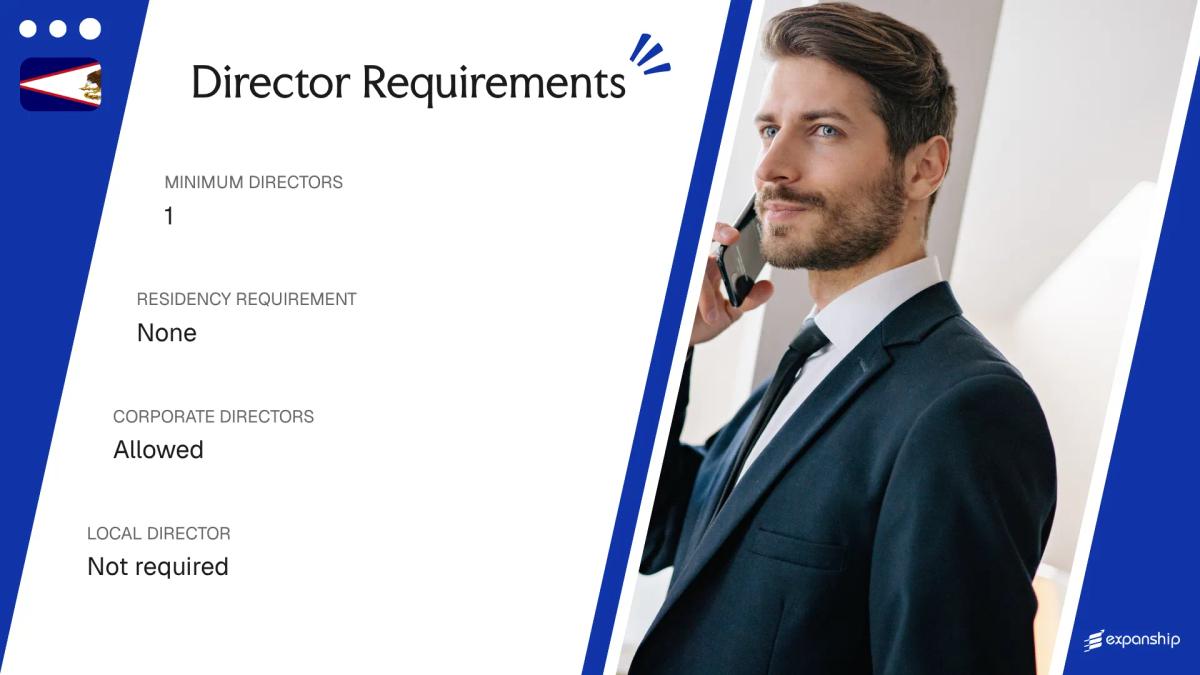
American Samoa director requirements follow the provisions set out under the American Samoa Code Annotated (ASCA), with directors assuming fiduciary duties of care and loyalty to the corporation upon appointment.
| Parameter | Detail |
|---|---|
| Minimum Number of Directors | One director is required. |
| Maximum Number of Directors | No statutory maximum is prescribed. |
| Local/Resident Director Required | There is no statutory requirement for a locally resident director. |
| Nationality Restrictions | No nationality restrictions are imposed under the ASCA. |
| Minimum Age Requirement | Directors must be at least 18 years of age. |
| Corporate Directors Permitted | No statutory prohibition exists, though natural persons are standard in practice. |
| Director Must Be a Shareholder | No statutory requirement for a director to hold shares in the company. |
| Publicly Listed on Registry | Director information is generally recorded in corporate filings but is not prominently published in a public registry. |
| Disqualification Conditions | A director may be disqualified upon conviction of fraud, breach of fiduciary duty, or by court order under applicable ASCA provisions. |
Despite American Samoa being a U.S. territory, its corporations are not governed by any U.S. state corporate statute, meaning Delaware or Model Business Corporation Act standards do not automatically apply to entities formed there.
Shareholder Requirements in American Samoa
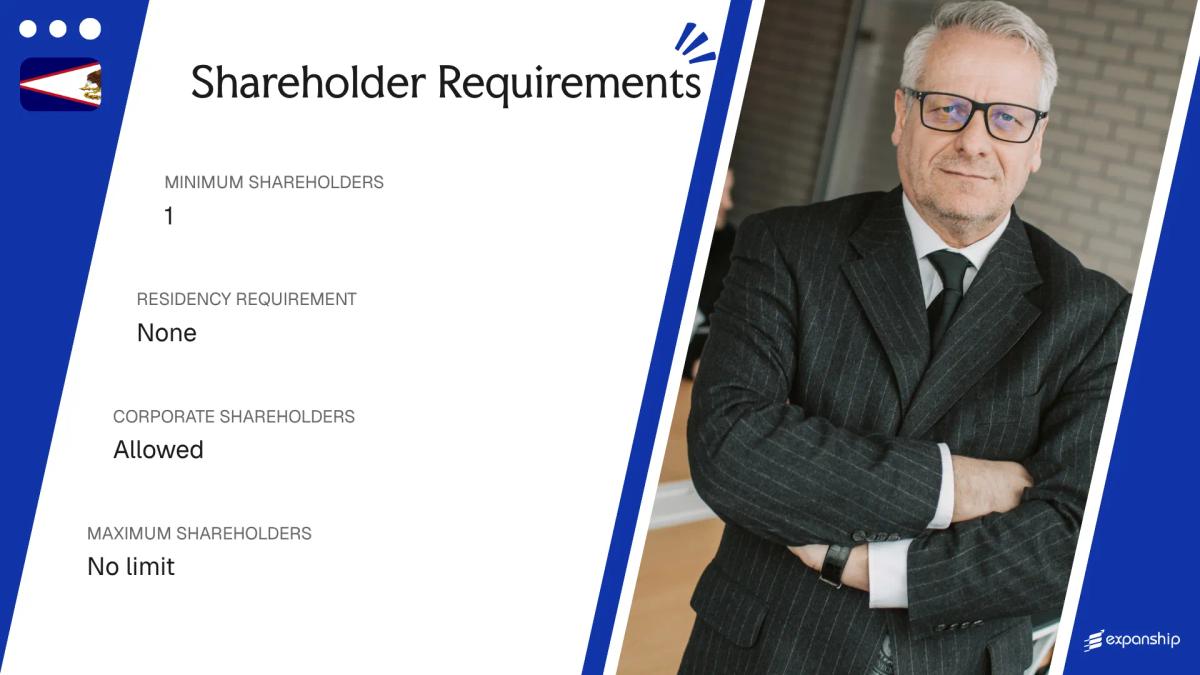
American Samoa shareholder requirements permit a corporation to be formed with a single shareholder, satisfying both the minimum and the full ownership structure simultaneously. No statutory maximum on the number of shareholders is imposed under the American Samoa Code.
Nationality and Residency Restrictions
Shareholders are not required to be residents or nationals of the territory. Foreign nationals and non-resident individuals may hold shares without restriction on ownership percentage.
Corporate Shareholders
Corporate entities are permitted to act as shareholders in an American Samoa corporation. No special conditions are attached solely by virtue of the shareholder being a legal entity rather than a natural person.
Shareholder Liability
Stockholder liability is generally limited to the amount of capital contributed in exchange for shares. Circumstances such as piercing the corporate veil may extend personal liability, though this requires a finding of abuse of the corporate form by a court.
Register of Shareholders
A register of shareholders must be maintained by the corporation as an internal record. This register is not filed with a public registry, though it must be available for inspection by authorized parties upon request.
Get Guidance on Shareholder Compliance for Your American Samoa Corporation
Speak with a specialist to understand how shareholder structuring rules apply to your specific entity type and ownership setup in American Samoa.
UBO / Beneficial Ownership Disclosure Requirements in American Samoa
American Samoa beneficial ownership requirements are not governed by a dedicated UBO disclosure statute at the territorial level. No statutory framework currently mandates the identification or registration of beneficial owners for entities incorporated under American Samoa law.
KYC / Document Requirements in American Samoa
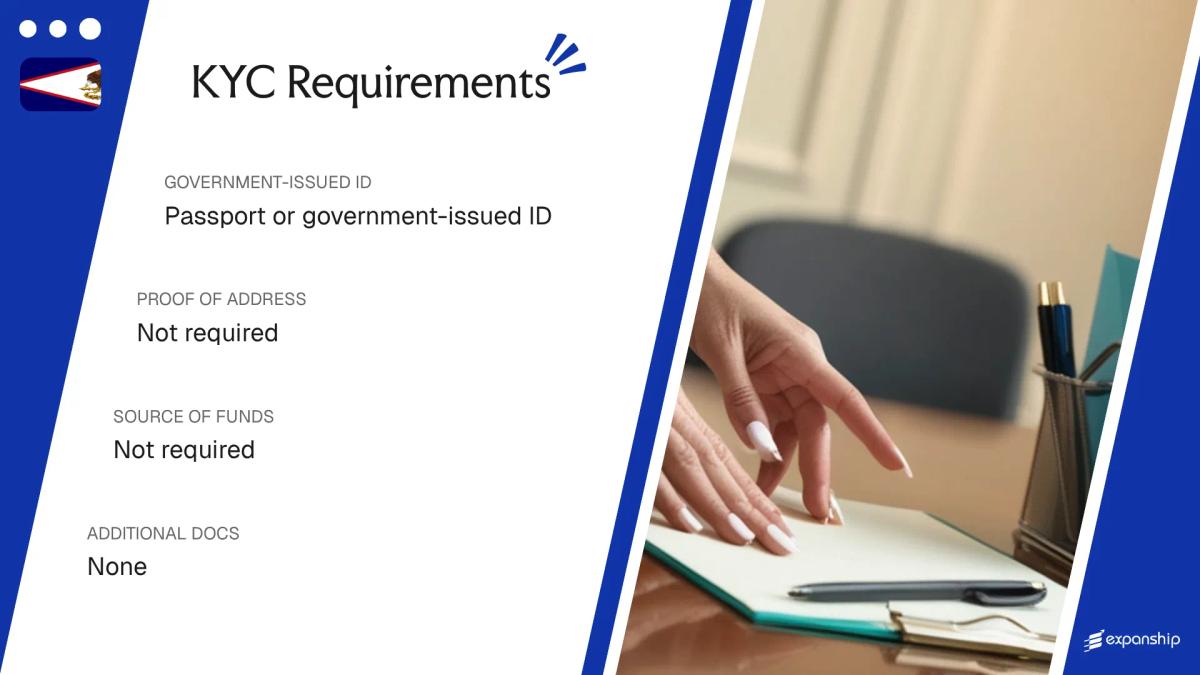
American Samoa KYC requirements incorporation obligations are governed by the American Samoa AML Act and administered through the territory's financial regulatory framework, requiring identity and due diligence documentation at the point of registration.
Individual / Personal Documents
- Government-issued photo identification, such as a passport or national identity card, for each director, shareholder, and beneficial owner
- Proof of residential address dated within three months, such as a utility bill or bank statement
- Completed and signed KYC declaration or customer due diligence form as required by the registered agent
- A recent passport-sized photograph may be requested depending on the registered agent's internal compliance procedures
Corporate Documents
- Certificate of incorporation or equivalent constitutive document for any corporate shareholder or director
- Memorandum and articles of association or equivalent constitutional document
- Current register of directors and register of shareholders for the corporate entity
- Proof of registered office address for the corporate entity
Source of Funds Documentation
- Bank statements from the preceding three to six months evidencing the origin of capital
- Audited financial statements where the introducing entity is an established business
- A written source of funds declaration signed by the relevant individual or authorised officer
Notarisation and Apostille Requirements
- Documents originating outside the United States may require notarisation by a licensed notary public
- Apostille certification under the Hague Convention is generally required for foreign public documents
- Official translation into English is required for any document not originally issued in English
Incomplete or inconsistent beneficial ownership documentation is the most frequent cause of incorporation delays in this territory.
Company Name Requirements in American Samoa
American Samoa company name requirements are assessed at the point of incorporation through a review process that checks for conflicts with existing registered entities and ensures the proposed name meets territorial standards.
Your chosen name must include a legal suffix that reflects the business structure, such as "Corporation," "Incorporated," "Limited," or their accepted abbreviations. Names must be in the English language.
Certain words are restricted or prohibited outright. Terms suggesting government affiliation, banking, insurance, or professional licensing typically require prior approval from the relevant regulatory authority before the name can be accepted.
Name reservation is generally available through the territorial registry, allowing you to secure a proposed name ahead of formal incorporation. The reservation period and application process follow standard territorial procedures, with a fixed validity window after which the reservation lapses if incorporation has not been completed.
Compliance Services for Companies in American Samoa
Stay aligned with American Samoa's territorial requirements, from annual filings to ongoing regulatory obligations.
Conclusion
Meeting the incorporation requirements American Samoa sets out involves engaging with a distinct territorial legal framework, separate from U.S. federal corporate law. The registered agent requirement, which mandates a locally present individual or entity, and the director eligibility rules are among the more structurally significant obligations covered. Beneficial ownership disclosure adds a further compliance layer. Once these formation conditions are clearly understood, the practical work of structuring your entity, preparing documentation, and coordinating with the American Samoa Bar Association or relevant territorial authorities can begin.
Expanship Services for Your American Samoa Expansion
American Samoa company formation services carry specific requirements — a local registered agent physically present in the territory, compliance with the Revised Uniform Limited Liability Company Act or the relevant corporate statutes, and ongoing obligations to the American Samoa Government's filing authorities. Expanship helps your business meet these structural requirements from the outset, reducing the coordination burden that comes with establishing a compliant entity in a U.S. territory operating under its own distinct legal framework.
Beyond initial registration, Expanship supports your firm across the full incorporation and post-incorporation cycle:
- Preparing and filing incorporation documents with the relevant American Samoa authorities
- Providing a qualified local registered agent and maintaining a registered office address in the territory
- Liaising directly with government agencies on your behalf throughout the filing process
- Managing ongoing compliance obligations after your entity is established
- Facilitating introductions to banking institutions familiar with American Samoa-registered entities
- Handling tax registration and coordination with local revenue authorities
To discuss your requirements, contact Expanship American Samoa.
Frequently Asked Questions (FAQ)
A corporation in American Samoa can be formed with a single shareholder, so no minimum plurality is required. This applies to both resident and non-resident shareholders, making the structure accessible to sole foreign investors looking to establish a presence under American Samoa law.
Failure to maintain a registered agent in American Samoa can result in the company losing its good standing, which may lead to administrative dissolution by the territory's regulatory authorities. Reinstatement after dissolution typically involves back fees, compliance filings, and a formal application, making ongoing registered agent maintenance a non-negotiable obligation rather than a procedural formality.
American Samoa is an unincorporated U.S. territory, and its regulatory alignment with federal beneficial ownership rules under the Corporate Transparency Act warrants careful review, as territorial application can differ from mainland U.S. requirements. You should confirm directly with the American Samoa Government whether federal UBO reporting obligations apply to entities incorporated locally, as territorial carve-outs can affect compliance scope.
Yes, American Samoa does not restrict the nationality of directors, meaning a foreign national can serve as the sole director of a locally incorporated corporation. There is no statutory requirement for a resident director, which gives foreign investors direct control over their entity without needing a local nominee.
Company name registration and approval in American Samoa is handled through the territory's business registration authority, which checks proposed names against the existing registry to prevent duplication or misleading similarity. Names that imply government affiliation or use restricted terms such as "bank" or "insurance" without the appropriate licensing will not be approved, so confirming name availability before filing formation documents saves significant processing time.
American Samoa does not impose a mandatory minimum paid-up share capital for standard business corporations, which removes a common financial barrier seen in other jurisdictions. There is no statutory requirement to deposit capital into a local bank account as a precondition for completing the incorporation process.
Legal Disclaimer
The information provided in this article is for general informational purposes only and does not constitute legal, tax, or professional advice. While we strive to ensure the accuracy and timeliness of the content, laws and regulations are subject to change, and the application of laws can vary widely based on specific facts and circumstances.
Readers should not act upon this information without seeking professional counsel tailored to their individual situation. Expanship and its authors disclaim any liability for actions taken or not taken based on the content of this article.
For specific advice regarding your business setup, compliance requirements, or any legal matters, please consult with qualified legal and tax professionals in the relevant jurisdiction.