
Key Takeaways
- Businesses incorporated in American Samoa cannot access U.S. federal financial markets on the same terms as domestic U.S. entities, since the territory's residents are U.S. nationals rather than citizens and federal law applies only selectively to the jurisdiction.
- Corporate obligations under the AS Code require compliance with a local regulatory framework that remains less developed than U.S. state-level equivalents, creating legal uncertainty around enforcement, dispute resolution, and entity governance.
- Geographic isolation in the South Pacific drives up logistics, energy, and import costs to levels that structurally disadvantage most business models reliant on goods movement or consistent supply chains.
- The dual compliance burden of satisfying both American Samoa Government requirements and applicable federal statutes increases administrative overhead in ways that would not arise in a standard U.S. state incorporation.
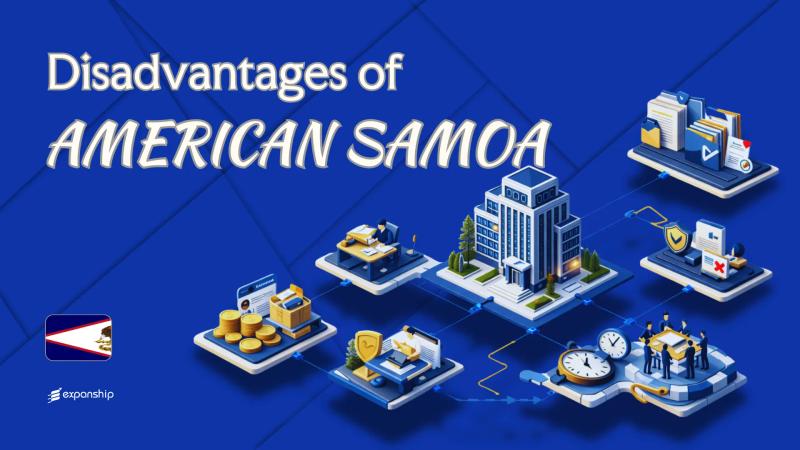
American Samoa operates under a hybrid regulatory framework, where local governance under the American Samoa Government (ASG) intersects with selective application of U.S. federal law — a structure that creates distinct compliance obligations not found in most other jurisdictions. The disadvantages of incorporating in American Samoa span operational, financial, legal, and structural categories, each shaped by the territory's geographic isolation and its semi-autonomous status.
How severely these drawbacks affect your business depends largely on your industry, the entity type you register, and whether your operations are locally focused or internationally oriented.
This article is most relevant to foreign investors and U.S.-based entrepreneurs considering the territory as a base for manufacturing, export, or tax planning purposes. Primary corporate conduct in the territory is governed by the AS Code, which outlines registration requirements and entity obligations under local law.
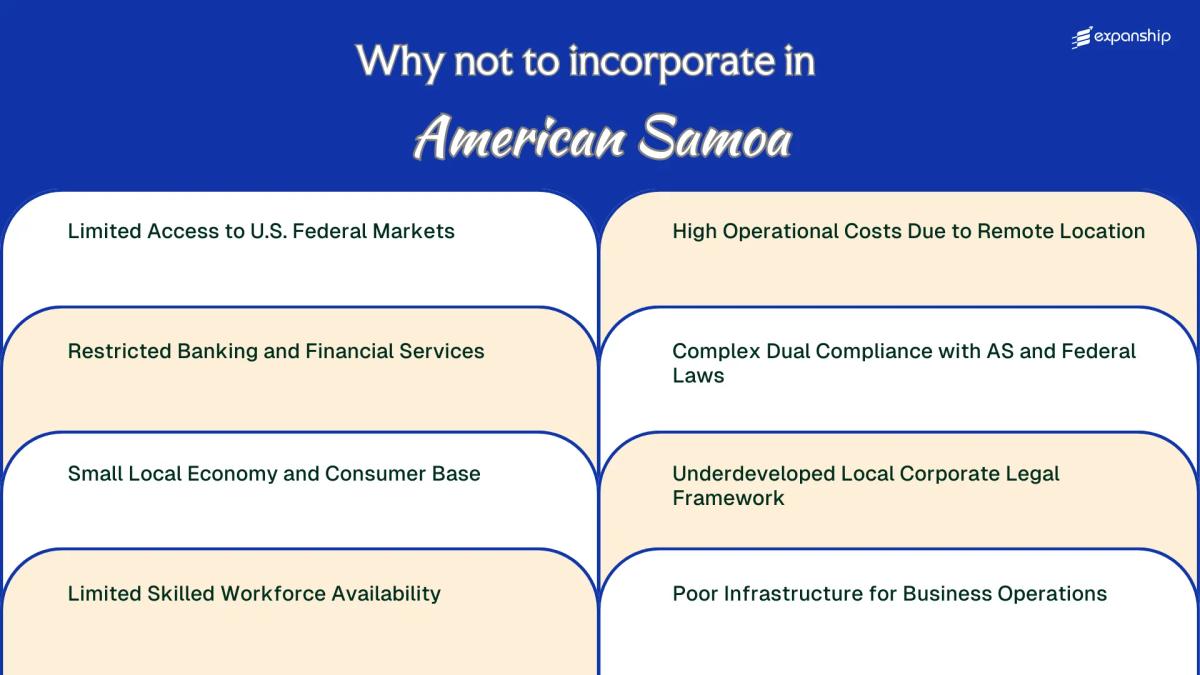
Limited Access to U.S. Federal Markets
American Samoa federal market access restrictions create a structural barrier that most foreign business owners underestimate before incorporating here. The territory's unincorporated status under U.S. law separates it from the protections and privileges that apply to domestic U.S. entities.
Federal Procurement and Interstate Commerce Barriers
Businesses incorporated in American Samoa do not automatically qualify as domestic U.S. companies for federal contracting purposes. Your firm may face eligibility restrictions under federal procurement frameworks administered by the U.S. Small Business Administration, which define size standards and business domicile requirements that an American Samoa-based entity may not satisfy.
Limitations of U.S. market entry from American Samoa also extend to interstate commerce. Certain federal regulatory licenses and business authorizations are structured for entities operating within U.S. states, not unincorporated territories, which can disqualify your business from programs it would otherwise meet.
Federal Financial and Grant Program Exclusions
American Samoa business federal commerce challenges are compounded by exclusions from several federal economic programs. Many U.S. federal grant programs, including those administered through the Small Business Innovation Research scheme, restrict eligibility to entities based in the fifty states.
This means a foreign-owned firm incorporated here cannot access the same federal capital channels available to a Delaware or Wyoming entity.
A business incorporated in American Samoa may be structurally ineligible for federal procurement contracts and SBA-administered programs, directly limiting its ability to generate U.S.-sourced institutional revenue.
Restricted Banking and Financial Services
American Samoa banking restrictions for businesses are among the most practical deterrents for foreign incorporators. The territory has no locally chartered commercial banks with full international correspondent banking relationships, leaving companies dependent on a small number of institutions, primarily branches of U.S.-based banks such as Bank of Hawaii and Amerika Samoa Bank.
Because these institutions apply U.S. Bank Secrecy Act and FinCEN compliance standards, foreign-owned entities face heightened due diligence requirements that can delay or block account opening entirely.
Limited financial services in American Samoa companies also extend to payment infrastructure. Credit card processing, foreign currency accounts, and trade finance facilities are largely unavailable locally, forcing firms to seek mainland U.S. banking relationships that may refuse non-resident-owned territorial entities.
Corporate banking challenges this creates for foreign owners include:
- Inability to open multi-currency accounts locally forces reliance on offshore arrangements, adding compliance layers under FBAR and FATCA reporting obligations
- Correspondent banking refusals mean wire transfers for routine vendor payments can be delayed or rejected without explanation
- Absence of local trade finance products requires businesses to secure letters of credit through mainland institutions that may not recognize the territorial corporate structure
Businesses incorporated in sectors requiring payment processing or escrow face the most acute friction, as no local fintech or e-money infrastructure exists to fill these gaps.

Company Incorporation in American Samoa
Understand the structural and regulatory requirements for incorporating a business entity in American Samoa before committing to this jurisdiction.
Small Local Economy and Consumer Base
American Samoa small economy business limitations are most visible in the territory's population figures. With roughly 56,000 residents concentrated primarily on Tutuila, the addressable local market is too narrow to sustain most commercially scaled operations.
Domestic consumer spending is further constrained by below-average household income levels relative to U.S. mainland standards. A business incorporated locally and dependent on resident purchasing power will quickly encounter a ceiling that limits revenue growth without external market access.
| Market Factor | Figure / Condition | Business Impact |
|---|---|---|
| Total resident population | ~56,000 | Insufficient base for most B2C models |
| Median household income | Below U.S. mainland average | Compressed consumer spending capacity |
| Geographic isolation from U.S. mainland | ~2,600 miles from Hawaii | High barriers to regional market expansion |
| Primary economic sectors | Government, tuna canning | Limited private-sector demand diversification |
The economy is heavily concentrated in government employment and tuna canning operations, principally through the StarKist facility. Outside these two sectors, private demand for goods and services remains structurally thin.
For a foreign firm targeting growth through local sales volume, the limited consumer base in American Samoa incorporation planning represents a genuine structural barrier. The territory's geographic isolation compounds this, as expanding into neighboring Pacific markets requires separate regulatory engagement and significant logistics investment.
Limited Skilled Workforce Availability
American Samoa workforce availability challenges stem directly from the territory's population size. With roughly 45,000 residents, the total labor pool is structurally small, and a significant share of working-age adults emigrate to Hawaii or the U.S. mainland in search of higher wages and broader career opportunities.
Sectors requiring technical or professional credentials — finance, engineering, IT, and specialized legal services — face acute shortages locally. Your business cannot simply recruit from the domestic market if the role demands certifications or advanced training that local institutions do not widely produce.
The American Samoa Community College remains the primary post-secondary institution, but its program offerings are limited compared to mainland universities. This means that talent acquisition risks are built into the territory's educational supply chain, not just its geography.
Bringing in foreign skilled workers requires navigating U.S. immigration rules, since the territory falls under federal immigration jurisdiction administered by USCIS, adding processing timelines and visa costs that a mainland-based competitor would not face in the same way.
- Roles requiring licensed professionals may go unfilled for extended periods due to the shallow local talent pool.
- Foreign worker sponsorship falls under federal USCIS processes, not a local territorial authority.
- Relocation incentives and higher compensation packages are typically required to attract mainland candidates.
- Staff turnover risk is elevated because retaining skilled hires in a remote territory is structurally harder than in metropolitan markets.
Despite its U.S. territorial status, American Samoa nationals are classified as U.S. nationals — not U.S. citizens by birth — which creates an unusual legal distinction that affects their work authorization status on the U.S. mainland and complicates reciprocal talent movement between the territory and stateside operations.
High Operational Costs Due to Remote Location
High operational costs in American Samoa stem directly from its geographic position in the South Pacific, roughly 2,600 miles southwest of Hawaii. Every structural cost tied to that distance compounds over time for a foreign-incorporated entity.
Freight Dependency and Import Cost Pressures
American Samoa has no domestic manufacturing base capable of supplying commercial-grade inputs, so virtually all business materials, equipment, and goods must be imported by sea or air. This freight dependency means your operational expenses are subject to shipping schedules, fuel surcharges, and carrier availability in a market with limited competitive pressure on pricing.
Effect on Day-to-Day Business Viability
Perishable inventory, replacement parts, and time-sensitive supplies face delays that mainland U.S. firms do not encounter, creating reliability gaps that raise indirect costs alongside direct import expenses. Businesses operating under American Samoa's local licensing and tax framework administered by the American Samoa Government (ASG) still bear these logistics costs regardless of any tax concessions granted under the territory's incentive structures.
Managing Incorporation Challenges in American Samoa
Speak with a specialist about the cost implications and compliance requirements of running a business entity in American Samoa.
Complex Dual Compliance with AS and Federal Laws
Businesses incorporated in the territory face American Samoa dual compliance law challenges that arise from operating under two distinct and sometimes conflicting legal regimes simultaneously. Your entity must satisfy both territorial statutes under the American Samoa Code Annotated and applicable federal laws, a dual obligation that few other U.S. jurisdictions impose with the same degree of ambiguity.
- The territorial government enforces its own business licensing, tax, and corporate regulations independently of federal frameworks, requiring your firm to maintain separate compliance tracks with both the American Samoa Government (ASG) and relevant federal agencies.
- Federal laws apply selectively to the territory under the Territorial Clause of the U.S. Constitution, meaning your legal team must assess each federal statute individually to determine applicability, generating ongoing legal costs.
- Gaps between territorial and federal consumer protection or employment standards can expose your business to simultaneous liability under two separate enforcement systems.
- Local regulatory bodies in the territory lack the interpretive guidance infrastructure that mainland agencies provide, leaving compliance questions frequently unresolved without formal legal opinion.
Underdeveloped Local Corporate Legal Framework
The American Samoa corporate legal framework limitations create a structural gap that affects how disputes are resolved, how contracts are enforced, and how corporate governance operates in practice. The territory's company law is largely derived from U.S. model statutes but has not been systematically updated to reflect modern commercial realities, leaving significant areas without clear legislative guidance.
Local corporate matters fall under the American Samoa Code Annotated (ASCA), which governs business entities through provisions that are comparatively sparse. For foreign-owned entities, this translates to legal uncertainty in areas where established jurisdictions offer codified protections.
The weak corporate legal infrastructure means commercial litigation is processed through the High Court of American Samoa, a court with limited capacity and a narrow body of corporate case law to draw from. Precedents are thin, and judicial reasoning on complex commercial matters may require reference to external legal systems, adding cost and unpredictability to dispute resolution.
Qualified local corporate counsel is scarce, which compounds the legal gap considerably. Retaining attorneys familiar with both the ASCA and cross-border corporate structures often requires engaging mainland U.S. firms at substantially higher rates.
A foreign business owner disputing a contract worth $150,000 USD may need to retain off-island legal counsel at $400-600 USD per hour, given the limited pool of locally qualified corporate attorneys, potentially making litigation costs disproportionate to the value of the claim itself.
Poor Infrastructure for Business Operations
American Samoa infrastructure problems for businesses are not incidental — they are structural. The territory relies on a single commercial port at Pago Pago and limited air cargo capacity, meaning supply chain disruptions have no practical alternative routing.
Electricity is supplied primarily by the American Samoa Power Authority (ASPA), which operates an aging diesel-dependent grid. Power outages occur with some regularity, and backup generation adds direct operating cost to any business requiring consistent uptime.
Internet connectivity depends heavily on undersea cable systems with limited redundancy. For firms in financial services, technology, or any data-sensitive sector, this creates genuine operational exposure that mainland U.S. or Pacific hub locations do not share.
- Road infrastructure outside Tutuila's main corridor is underdeveloped, complicating distribution logistics
- Cold chain and warehousing capacity is limited relative to commercial demand
- No commercial airport handles significant cargo volume independently of sea freight timelines
These conditions collectively raise the baseline cost and complexity of running physical or hybrid operations from this territory.
Any foreign business owner assuming remote or digital operations will sidestep these limitations should verify that their specific service model is not dependent on reliable, high-bandwidth connectivity before committing to incorporation here.
Mitigating Incorporation Challenges in American Samoa
Mitigating incorporation challenges in American Samoa requires a structural approach rather than reactive fixes, given that the territory's limitations span regulatory, financial, and infrastructural dimensions simultaneously.
- Register your entity under the American Samoa Revised Code and confirm which business classification applies to your ownership structure, particularly given the land ownership restrictions affecting foreign nationals.
- Open correspondent banking arrangements before incorporation, since local financial institutions operate under restricted federal access and may not support international transaction volumes.
- Assess federal nexus exposure early by determining whether your business activities trigger U.S. federal tax obligations under the Internal Revenue Code's territorial provisions.
- Source professional and technical staffing from outside the territory through formal employment arrangements, given documented workforce skill gaps in the local labour market.
- Conduct a logistics cost audit covering import duties, freight timelines, and utility dependencies before committing to an operational model.
These steps do not eliminate the underlying structural constraints tied to the territory's semi-autonomous status under U.S. federal law. Reducing compliance risk depends on how precisely your business model accounts for the dual regulatory framework governing corporate activity here.
American Samoa's Overall Business Viability
American Samoa presents genuine American Samoa business viability risks for most foreign-owned entities, particularly those relying on banking access, skilled labor, or scalable infrastructure. That said, for businesses with a specific territorial nexus — such as those tied to the tuna processing industry or entities with existing Pacific regional operations — incorporation here carries a defensible rationale.
| Pros | Cons |
|---|---|
| U.S. territory status provides a degree of legal familiarity and federal oversight | Foreign-owned entities face restricted access to U.S. federal procurement and interstate commerce protections |
| Goods produced locally may qualify for certain U.S. customs benefits under territorial trade rules | The local banking sector is limited, with few institutions offering services suited to international business activity |
| The territory operates under a defined corporate legal framework through the American Samoa Code Annotated | The corporate legal framework lacks the depth and case law precedent found in mainland U.S. jurisdictions |
| Geographic positioning in the Pacific offers proximity to regional markets | Remote location significantly increases logistics, shipping, and operational costs |
| Territorial tax arrangements may differ from standard U.S. federal tax treatment | Businesses must manage compliance obligations across both territorial and applicable federal regulatory requirements |
Corporate Compliance Services in American Samoa
Maintain your company's good standing under the American Samoa Code Annotated with territory-specific compliance support covering annual filings, registered agent requirements, and regulatory obligations.
Conclusion
The cons of American Samoa business registration are real and structurally embedded in the territory's legal and economic position. Restricted access to U.S. federal procurement and interstate commerce protections, combined with a thin local consumer base, limits the commercial ceiling for most entities incorporated here. Banking access remains constrained, with few institutions willing to service foreign-owned firms under the territory's framework. Dual compliance obligations under both local and federal law add ongoing administrative weight. For businesses where these constraints are material, specialist guidance on entity structure, compliance obligations, and cross-border banking arrangements will determine whether the incorporation achieves its intended purpose.
Expanship's American Samoa Business Solutions
Incorporating in American Samoa carries real administrative weight, from satisfying the American Samoa Government's Office of the Governor licensing requirements to managing the territory's dual compliance obligations under both local statutes and applicable federal law. Expanship's American Samoa incorporation solutions are structured to reduce that operational burden by handling the procedural and regulatory work that consumes time your business could spend elsewhere. Overcoming American Samoa incorporation restrictions requires local knowledge; Expanship's American Samoa business formation services provide exactly that.
Beyond formation, the firm's service scope covers the full post-registration period:
- Your company registration is prepared and documented to meet American Samoa's local requirements.
- A registered agent and office address are provided within the territory.
- Government filings and liaison with relevant AS regulatory authorities are managed on your behalf.
- Post-incorporation compliance obligations are tracked and maintained on an ongoing basis.
- Banking introduction assistance is available to support your initial financial setup.
- Tax registration and liaison with local authorities are handled as part of the process.
Reach out through Expanship American Samoa to discuss your specific requirements.
Frequently Asked Questions (FAQ)
The underdeveloped local corporate framework affects all registered entities, but the consequences are most acute for foreign-owned firms that require predictable legal recourse. American Samoa's local statutes have not kept pace with modern corporate governance standards, which means disputes may rely on patchwork interpretations drawing from both territorial law and applicable federal statutes. Investors accustomed to jurisdictions with codified shareholder protections or well-established case law will find the legal environment materially weaker.
Your company faces potential penalties from two separate regulatory tracks. At the federal level, violations of applicable U.S. federal law carry the same consequences they would for any U.S.-affiliated entity, including fines, restrictions on interstate commerce, or federal enforcement action. Local non-compliance with the American Samoa government's business registration and licensing requirements can result in loss of good standing, which may also trigger downstream federal reporting complications.
In most U.S. states, state and federal compliance frameworks are well-integrated and supported by extensive legal infrastructure. American Samoa imposes a separate territorial compliance layer that does not benefit from that same integration, meaning your business must actively monitor two distinct regulatory environments without the guidance of a mature local legal profession or established administrative precedent. The administrative overhead is structurally higher than in a comparable U.S. state incorporation.
Shipping costs, logistics delays, and limited air freight connectivity to the contiguous United States translate into materially higher input costs for any business that moves goods. American Samoa has no direct land connection to any major distribution hub, and its port infrastructure handles a limited volume compared to U.S. Pacific competitors. These factors compound for businesses that require regular physical supply chains, making the cost disadvantage substantial rather than marginal.
Access is restricted in practice. While American Samoa is a U.S. territory, companies incorporated there do not automatically receive the same treatment as entities incorporated in the fifty states under all federal contracting frameworks. Certain federal market access rules and procurement programs are structured around state-incorporated entities, and the territorial status of American Samoa creates eligibility ambiguities that require legal clarification on a program-by-program basis.
American Samoa has a small resident population of approximately 55,000 people, and the local labor pool for technical, financial, or specialized professional roles is limited. Many skilled workers emigrate to Hawaii or the U.S. mainland, which means businesses dependent on local talent face persistent recruitment gaps. Importing skilled labor involves its own costs and immigration considerations that further increase the operational burden.
The domestic consumer market is too small to support most commercially viable business models on its own. With a GDP that reflects the territory's limited industrial base and population size, any firm targeting the local market directly will encounter a ceiling on revenue growth that cannot be resolved through operational efficiency alone. Most businesses incorporated in American Samoa that achieve meaningful revenue do so by targeting external markets, which raises the question of why the American Samoa incorporation structure is the most appropriate vehicle for that activity.
Legal Disclaimer
The information provided in this article is for general informational purposes only and does not constitute legal, tax, or professional advice. While we strive to ensure the accuracy and timeliness of the content, laws and regulations are subject to change, and the application of laws can vary widely based on specific facts and circumstances.
Readers should not act upon this information without seeking professional counsel tailored to their individual situation. Expanship and its authors disclaim any liability for actions taken or not taken based on the content of this article.
For specific advice regarding your business setup, compliance requirements, or any legal matters, please consult with qualified legal and tax professionals in the relevant jurisdiction.