
Key Takeaways
- Businesses that qualify under the American Samoa Economic Development Credit program can access federal tax reductions unavailable in any U.S. state, making the territory structurally distinct from every domestic incorporation option.
- Operating under the Revised Code of American Samoa while retaining access to U.S. correspondent banking and dollar-denominated wire infrastructure eliminates the credibility gap that typically accompanies offshore registration.
- Foreign-owned entities incorporated in American Samoa face no material ownership restrictions in most sectors, giving international investors a compliant entry point into a U.S.-aligned legal and financial environment.
- American Samoa's position as an unincorporated U.S. territory, administered through the American Samoa Government's Department of Commerce, means companies benefit from recognizable institutional oversight without bearing the full federal tax burden of a domestic U.S. entity.
American Samoa sits in the South Pacific Ocean, approximately 2,600 miles southwest of Hawaii, and operates as an unincorporated territory of the United States. That political status gives businesses registered there access to certain U.S. frameworks while operating under a distinct local regulatory environment. The benefits of incorporating in American Samoa draw interest from foreign investors who want exposure to U.S.-aligned systems without the full tax burden of a domestic U.S. entity.
Company registration falls under the oversight of the ASG (American Samoa Government), with the relevant administrative functions handled through its Department of Commerce. Foreign businesses most commonly form a Limited Liability Company when establishing a presence in the territory. The jurisdiction's tax posture is best characterized as partially territorial, with local incentive programs that can significantly reduce the effective tax rate for qualifying entities.
Foreign ownership is generally permitted, and the territory does not impose restrictions that would materially limit foreign direct investment in most sectors. This article covers the key advantages your business can expect when structuring through a local entity here.
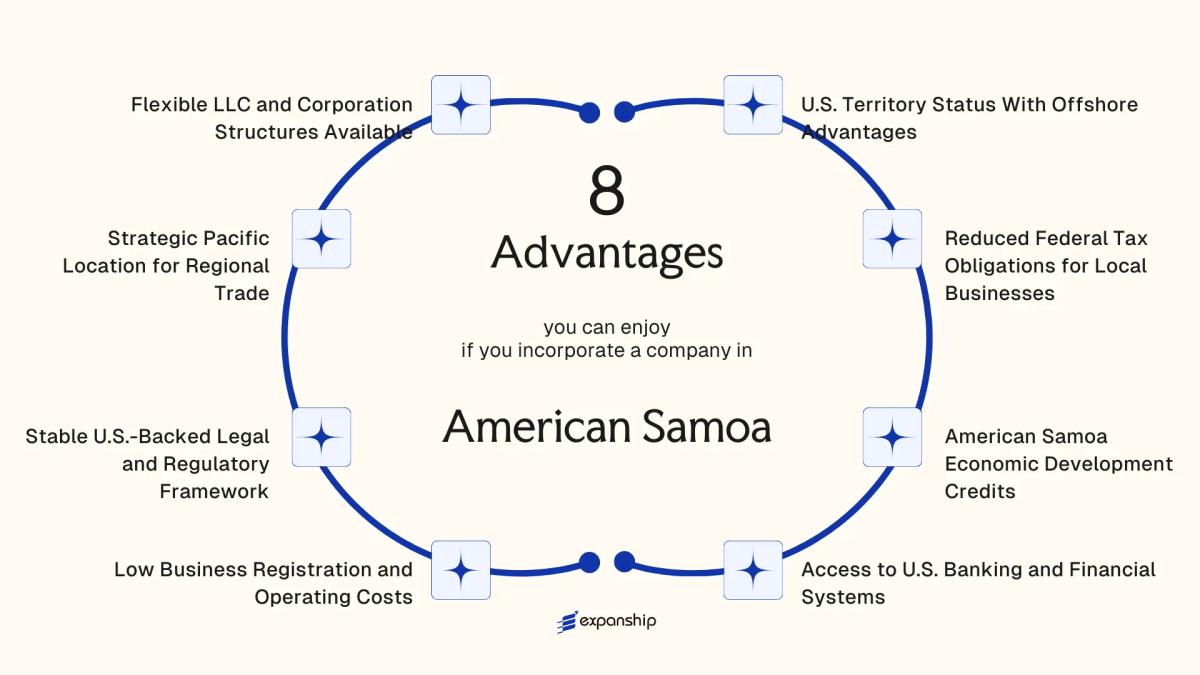
U.S. Territory Status With Offshore Advantages
American Samoa occupies a structurally unusual position: it is an unincorporated U.S. territory, yet it operates outside the full reach of the U.S. Internal Revenue Code. That combination creates a set of American Samoa US territory offshore advantages that few jurisdictions can replicate.
A U.S. Address Without Full U.S. Tax Reach
Federal tax law does not apply uniformly across all U.S. territories. American Samoa administers its own separate territorial tax system under the American Samoa Tax Code, meaning a locally incorporated entity with genuine operations there is generally not subject to standard U.S. federal income tax. For foreign business owners, this translates to operating within a U.S.-affiliated framework while avoiding the tax exposure that incorporation in any of the fifty states would trigger.
The Structural Benefit of Unincorporated Status
Under U.S. constitutional law, American Samoa's unincorporated status means Congress has not extended all federal statutes to the territory automatically. Your business benefits from the credibility and banking access associated with a U.S.-linked address, without being drawn into the full compliance architecture of a domestic U.S. entity. That separation is codified in practice, not merely theoretical.
Your entity holds a U.S.-affiliated registration while remaining outside the standard federal tax net that applies to mainland U.S. corporations.
Reduced Federal Tax Obligations for Local Businesses
American Samoa reduced federal tax obligations represent one of the more concrete fiscal advantages available to businesses incorporated under local law. Under Section 931 of the U.S. Internal Revenue Code, bona fide residents of American Samoa may exclude income derived from sources within the territory from U.S. federal gross income. For a qualifying corporation conducting genuine business operations locally, this exclusion can significantly reduce the effective federal tax burden compared to operating through a standard U.S. domestic entity.
The practical implication is direct: profits earned from within-territory activities are not subject to standard federal corporate income tax rates, which currently sit at 21% under U.S. federal law. Your business instead falls under the jurisdiction of the American Samoa Government's local tax authority, where rates and structures differ from federal schedules.
Qualification matters here. To access these federal income tax exemption benefits, a business must demonstrate substantive economic presence, not merely a registered address.
Several structural features make the qualification threshold workable for foreign business owners:
- Local payroll requirements focus on actual employment, not headcount minimums that are prohibitive for small firms
- The income sourcing rules are tied to where business activities genuinely occur, which rewards real operational presence
- Local tax filings are administered through the American Samoa Tax Office, keeping compliance within a single territory-level body

Company Incorporation in American Samoa
Establish a locally compliant entity in American Samoa and position your business to qualify for territory-level tax treatment under applicable U.S. tax law.
American Samoa Economic Development Credits
American Samoa Economic Development Credits benefits are among the most structurally distinctive incentives available in any U.S.-affiliated jurisdiction. Under the Economic Development Credit Act (EDCA), qualifying businesses can access income tax credits that substantially reduce their territorial tax liability, in some cases offsetting it almost entirely.
The credits are administered through the American Samoa Government and are tied to investment activity, job creation, and the development of qualifying industries within the territory. A business that meets the eligibility thresholds can receive credits against its American Samoa income tax obligations, which already operate at rates independent from the U.S. federal tax code.
| Parameter | Detail |
|---|---|
| Administering Authority | American Samoa Government (ASG) |
| Governing Legislation | Economic Development Credit Act (EDCA) |
| Tax System | Separate from U.S. federal income tax |
| Credit Basis | Investment, employment, and qualifying industry activity |
| Eligible Entities | Corporations and qualifying business entities operating in-territory |
For a foreign investor, the practical implication is significant. Your entity is not subject to U.S. federal corporate income tax on income sourced within the territory, and EDCA credits can further reduce the local tax burden on that same income. This two-layer reduction is not available in most other U.S. territories under equivalent terms. Eligibility requires genuine economic presence, including physical operations and local employment, which conditions the benefit to businesses with substantive in-territory activity.
Access to U.S. Banking and Financial Systems
American Samoa access to US banking system infrastructure is one of the more structurally significant advantages available to foreign business owners incorporating there. As a U.S. territory, businesses registered in American Samoa can open accounts with U.S.-chartered financial institutions, transact in U.S. dollars, and operate within the federal banking framework without holding a U.S. state registration.
All transactions settle in USD, eliminating currency conversion costs and exchange rate exposure that firms operating through non-dollar jurisdictions routinely face. For businesses billing clients in the U.S. market, this alignment removes a friction point that affects both payment processing times and receivables predictability.
The territory falls under the oversight of the FDIC, meaning deposits held at qualifying institutions carry federal deposit insurance protections. This is a structural guarantee not available in most offshore jurisdictions, where deposit protection frameworks are either absent or limited to local schemes with less backing.
Wire transfers, ACH payments, and correspondent banking relationships function through the same U.S. federal clearing systems. Your firm can receive payments from U.S. counterparties without the delays or compliance scrutiny that foreign-domiciled accounts typically trigger.
Keep the following in mind when relying on this benefit:
- Confirm that your chosen bank extends services to American Samoa-registered entities, as individual bank policies vary
- Anti-money laundering obligations under the Bank Secrecy Act apply to accounts held in U.S. banking institutions
- Beneficial ownership disclosure requirements under FinCEN rules remain applicable
Despite being a U.S. territory, American Samoa is not part of the U.S. customs zone, which means goods can move through the territory under a distinct trade status that differs from what most people assume applies uniformly across U.S. territories.
Low Business Registration and Operating Costs
American Samoa low business operating costs begin at the registration stage itself. Filing fees with the American Samoa Government's Office of the Lieutenant Governor, which oversees business registration, are modest compared to incorporation costs in U.S. states like Delaware or Wyoming. For a foreign owner, this means less capital consumed at setup, with more retained for actual operations.
Registration Fees and Annual Compliance Costs
A business entity registered in the territory pays annual report fees that remain well below those in most U.S. states. Registered agent requirements exist, but the local market for these services reflects the territory's generally lower cost base.
Compliance obligations administered through the Department of Commerce are straightforward, and the reporting cadence does not require frequent filings. Fewer mandatory filings translate directly into lower professional fees for legal and accounting support over the life of your company.
Operational Overhead in a Low-Cost Environment
Wage levels on the island are lower than on the U.S. mainland, partly due to the territory's exemption from the standard federal minimum wage framework under a separate statutory schedule. For firms hiring locally, this reduces recurring payroll costs meaningfully.
Office and commercial space rental rates also reflect a local economy that operates at a fraction of the cost of major U.S. business hubs. Your firm's fixed overhead can remain controlled in ways that simply are not possible in continental U.S. jurisdictions.
Maximize Your Cost Advantages in American Samoa
Speak with an Expanship specialist to understand the full scope of registration fees, compliance costs, and operational savings available to your business in American Samoa.
Stable U.S.-Backed Legal and Regulatory Framework
Corporate governance in American Samoa operates under a legal structure grounded in U.S. federal law, which gives businesses registered there access to American Samoa US-backed legal framework advantages that are unavailable in fully sovereign offshore jurisdictions. The territory's local code is administered through the American Samoa Government, with the judiciary applying a legal framework derived from U.S. common law principles. That foundation means contract enforcement, property rights, and dispute resolution follow well-established precedents rather than untested local statutes.
- Court decisions and legal proceedings in the territory draw on U.S. common law, giving your business access to a predictable body of precedent when enforcing contracts or resolving commercial disputes.
- The American Samoa Code Annotated governs local corporate matters, providing a codified, publicly accessible set of rules that reduces legal uncertainty for foreign directors and shareholders.
- Because the territory is subject to select U.S. federal laws, certain baseline protections that apply to American institutions extend to businesses operating here, offering a degree of legal stability that purely offshore jurisdictions cannot replicate.
- Regulatory oversight is conducted through established government departments rather than opaque or ad hoc bodies, which supports a stable regulatory environment for businesses that require documented compliance records for banking or investor due diligence purposes.
Strategic Pacific Location for Regional Trade
Situated in the South Pacific Ocean, roughly equidistant between Hawaii and New Zealand, American Samoa's geographic position creates direct access to shipping lanes that connect North America, Asia, and Oceania. For a business that moves goods or services across the Pacific Rim, this placement reduces transit times compared to routing through continental U.S. ports.
Pago Pago Harbor is one of the deepest natural harbors in the Pacific, capable of accommodating large commercial vessels. This physical infrastructure supports firms in fishing, logistics, and manufacturing that depend on reliable port access for import and export operations.
Your entity also benefits from operating under a U.S. territorial jurisdiction while maintaining proximity to Pacific Island nations, Australia, and New Zealand. Regional trade relationships in Oceania often favor counterparts with U.S.-backed legal standing, which reduces friction in commercial negotiations and contract enforcement across borders.
A vessel operating from Pago Pago to Sydney covers approximately 2,600 nautical miles, compared to roughly 5,400 nautical miles from Los Angeles to Sydney. For a firm shipping 500 metric tons of goods at standard freight rates, routing through Pago Pago can reduce per-shipment freight costs by a material margin on trans-Pacific routes.
Flexible LLC and Corporation Structures Available
American Samoa LLC corporation structure benefits stem from a formation framework that gives foreign investors meaningful choices without imposing unnecessary complexity. Under the American Samoa Revised Code, businesses can register as a limited liability company, a standard corporation, or a limited partnership, each carrying distinct governance and liability characteristics.
LLCs in the territory permit single-member ownership, flexible profit-distribution arrangements, and pass-through taxation treatment, which means income is reported at the member level rather than taxed twice at the entity level. For foreign investors managing multi-jurisdictional holdings, this structural flexibility reduces administrative overhead considerably.
Corporations formed under local statutes can issue multiple share classes, which supports tiered ownership arrangements useful for joint ventures or phased investor entry. The territory's Registrar of Corporations administers these formations, and the statutory requirements around minimum capital and director residency are comparatively light.
- LLCs allow customized operating agreements, giving members control over management structure
- Corporations can designate a local registered agent without requiring a resident director
- Both entity types can be 100% foreign-owned
Certain local business activities require a license from the American Samoa Government's Department of Commerce, regardless of the entity type chosen, so confirm your specific activity classification before assuming unrestricted foreign ownership applies.
How American Samoa Stacks Up Against Competing Jurisdictions
Evaluating American Samoa against competing jurisdictions requires choosing comparators that a realistic investor would also be researching. The U.S. Virgin Islands, Guam, and the Commonwealth of the Northern Mariana Islands (CNMI) represent the most relevant benchmarks: all are U.S. insular territories with similar federal relationships, targeting comparable investor profiles. What the comparison reveals is that American Samoa's combination of territorial tax separation and U.S. institutional backing is not uniformly replicated across those peers.
Among U.S. territories, the degree of fiscal autonomy varies considerably. Unlike Guam, which applies a mirror tax system that closely tracks federal income tax rates, American Samoa operates its own tax code under the American Samoa Government (ASG), allowing local rate-setting that diverges from federal schedules. The CNMI offers a similar mirror-code arrangement to Guam, reducing its flexibility relative to American Samoa vs competing jurisdictions advantages. For businesses that need U.S.-affiliated banking access alongside genuine tax differentiation, that structural distinction carries weight.
| Parameter | American Samoa | U.S. Virgin Islands | Guam | CNMI |
|---|---|---|---|---|
| Tax System | Independent ASG tax code | Separate mirror-code system | Federal mirror tax code | Federal mirror tax code |
| Corporate Tax Rate | Set locally by ASG | Up to 23.1% (USVI Economic Development Program rates available) | Up to 21% federal-mirrored | Up to 21% federal-mirrored |
| U.S. Banking Access | Yes | Yes | Yes | Yes |
| Economic Development Incentives | Yes, via ASG credits | Yes, via USVI EDC | Limited | Limited |
| USD Currency | Yes | Yes | Yes | Yes |
| Common Law Legal Framework | Yes | Yes | Yes | Yes |
Compliance Services for Companies in American Samoa
Meet your ongoing ASG regulatory obligations with structured compliance support, covering annual filings, local reporting requirements, and entity maintenance.
Conclusion
The benefits of incorporating in American Samoa rest on a structural combination that few jurisdictions can replicate: U.S. territorial standing paired with a tax regime that diverges sharply from federal norms. Under the American Samoa Economic Development Credit program, qualifying businesses can reduce their federal tax burden to rates not available in any U.S. state, while still operating within a legal framework governed by the Revised Code of American Samoa and administered through recognizable U.S.-aligned institutions.
That combination has concrete implications for how a business operates day to day. Access to U.S. correspondent banking, dollar-denominated accounts, and domestic wire infrastructure removes friction that affects companies incorporated in conventional offshore centers. For businesses that need both credibility and cost efficiency, this territorial status carries material weight.
American Samoa company formation advantages are specific enough to suit particular business profiles rather than every structure across every industry. A holding company, a Pacific-facing trading entity, or a U.S.-linked operation seeking to reduce its effective tax rate stands to gain more than a business with no U.S. nexus or regional trade interest. The right fit depends on how your corporate structure intersects with the territory's eligibility rules, local presence requirements, and the nature of your underlying commercial activity. Understanding those parameters precisely is the starting point for determining whether this jurisdiction belongs in your structure.
Start Your American Samoa Company With Expanship Today
Expanship handles the structural and compliance requirements that accompany formation in this territory, from preparing and legalizing foundational documents to filing with the American Samoa Economic Development Authority and maintaining your entity in good standing under the American Samoa Revised Code. The tax credit structures, LLC flexibility, and banking access covered throughout this blog each carry distinct compliance obligations, and each falls within Expanship's service scope.
American Samoa company formation with Expanship covers the full process from pre-incorporation to ongoing regulatory maintenance:
- Document preparation, notarization, and legalization for government submission
- Registered agent and registered office provision within the territory
- Government filing and direct liaison with the relevant registrar and licensing bodies
- Post-incorporation compliance management, including annual filings and record maintenance
- Banking introduction assistance to support account opening with U.S.-affiliated institutions
To discuss how your business structure aligns with the territory's regulatory requirements, contact Expanship American Samoa.
Frequently Asked Questions (FAQ)
Foreign nationals can own 100% of a corporation or LLC formed under American Samoa law, with no mandatory local equity requirement for most business structures. However, certain industries — particularly those involving land ownership or natural resource extraction — are subject to restrictions under local statutes that limit non-Samoan participation. You should confirm the specific activity your firm intends to conduct before assuming unrestricted foreign ownership applies.
Yes, the Economic Development Credit under the American Samoa Economic Development Credit Act requires that qualifying businesses maintain a substantive presence in the territory, including local employees and operations. A shell entity or nominally registered company without genuine economic activity in the territory would not meet the criteria for the credit. The credit is specifically structured to incentivize real investment and employment within the local economy.
Registration timelines vary depending on entity type and document completeness, but standard formation through the relevant government office generally takes several business days to a few weeks. Delays typically arise from incomplete submissions or requirements for notarized foreign documents. Engaging a registered agent familiar with local procedures can reduce processing time.
Businesses operating in American Samoa that do not qualify for the Economic Development Credit are subject to territorial income tax rates administered by the American Samoa Tax Office, which generally mirror the U.S. federal tax structure but are applied separately under territorial authority. The territory operates its own tax system, distinct from IRS jurisdiction, meaning federal corporate income tax does not directly apply to income sourced within the territory. The specific rate applicable to your entity depends on income level and the nature of business activities conducted locally.
As a U.S. unincorporated territory, American Samoa benefits from association with U.S. regulatory standing, which provides a degree of credibility not available to independent offshore jurisdictions. That said, OECD Base Erosion and Profit Shifting (BEPS) frameworks and substance requirements still apply in the context of international structuring, and tax authorities in your home country may scrutinize structures that lack genuine economic substance in the territory. Proper documentation of local operations and employment is essential to support the legitimacy of any territorial tax position.
A registered agent with a physical address in the territory is required for both corporations and LLCs formed under local law. Director residency requirements depend on the entity type and the specific provisions of the American Samoa Revised Code governing that structure; corporations generally do not require local directors, but you should verify current requirements for your chosen entity form. Failure to maintain a registered agent can result in administrative dissolution of the entity.
Unlike a standard U.S. state incorporation, a business operating genuinely within American Samoa can access territorial tax incentives that are unavailable in any of the 50 states, including the Economic Development Credit, which can substantially reduce or eliminate territorial income tax liability. A Delaware or Wyoming LLC, by contrast, remains subject to full U.S. federal corporate tax on worldwide income without equivalent offset mechanisms. For a business with substantive Pacific operations, the territorial structure offers a materially different tax outcome, provided the substance requirements are met.
Legal Disclaimer
The information provided in this article is for general informational purposes only and does not constitute legal, tax, or professional advice. While we strive to ensure the accuracy and timeliness of the content, laws and regulations are subject to change, and the application of laws can vary widely based on specific facts and circumstances.
Readers should not act upon this information without seeking professional counsel tailored to their individual situation. Expanship and its authors disclaim any liability for actions taken or not taken based on the content of this article.
For specific advice regarding your business setup, compliance requirements, or any legal matters, please consult with qualified legal and tax professionals in the relevant jurisdiction.