

Key Takeaways
- Foreign investors incorporating in Argentina must comply with General Companies Law (Ley 19.550), with the Inspección General de Justicia serving as the registration authority for entities domiciled in Buenos Aires and provincial registries applying for all other jurisdictions.
- Directors of Argentine companies are subject to mandatory residency requirements, meaning foreign-owned entities must secure compliant local representation before registration can proceed.
- Beneficial ownership disclosure is a binding obligation under the UIF regime, requiring entities to identify and report ultimate beneficial owners as a condition of lawful operation.
- The structural requirements that apply to your entity — including capital thresholds, shareholder composition, and registered office obligations — vary depending on whether you incorporate as a Sociedad Anónima (SA), Sociedad de Responsabilidad Limitada (SRL), or another recognized form under Argentine commercial law.
Corporate entity formation in Argentina is governed by the General Companies Law, Ley 19.550, with the Inspección General de Justicia (IGJ) serving as the primary regulatory body overseeing registration for entities domiciled in Buenos Aires. Provinces maintain their own registries, so jurisdiction of incorporation determines which authority processes your application.
This article covers the structural, documentary, and compliance requirements you must satisfy before your entity can be legally registered and operational.
Failure to meet Argentina company registration requirements results in rejection of the registration application by the IGJ or provincial registry, and operating without formal registration exposes the business to legal liability under Argentine commercial law.
Specific requirements vary depending on the entity type you select, whether a Sociedad Anónima (SA), Sociedad de Responsabilidad Limitada (SRL), or another form, as well as the industry sector and whether foreign capital is involved.
This article is most relevant to foreign investors and multinational firms establishing a local presence for the first time under Argentina business incorporation rules.
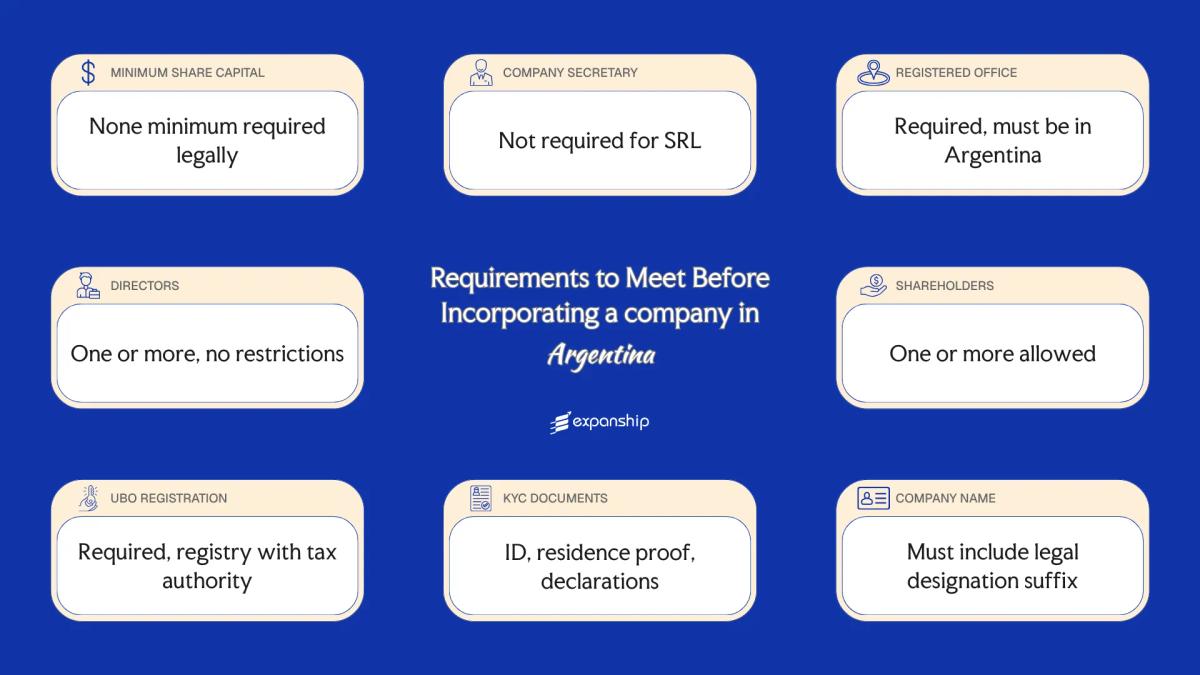
Minimum Share Capital Requirements in Argentina

Argentina minimum share capital requirements differ by entity type and are governed by the General Companies Law (Ley General de Sociedades, Law No. 19,550). Both the Sociedad Anónima (SA) and the Sociedad de Responsabilidad Limitada (SRL) operate on a par value share system, meaning each share or quota carries a nominal value stated in the company's constitutive documents.
Capital verification at incorporation falls under the jurisdiction of the Inspección General de Justicia (IGJ) in Buenos Aires, or the equivalent provincial registry in other jurisdictions. Share capital is a statutory condition of registration, not a one-time formality that lapses after incorporation.
| Parameter | Detail |
|---|---|
| Minimum Authorized Share Capital | ARS 100,000 for SA; no statutory minimum for SRL |
| Maximum Authorized Share Capital | No statutory requirement |
| Minimum Paid-Up Capital | 25% of subscribed capital at incorporation for SA; SRL requires full integration of in-kind contributions |
| Paid-Up Requirement at Incorporation | 25% of cash contributions must be deposited at the time of registration for SA |
| Accepted Currency | Argentine Peso (ARS) |
| Accepted Forms of Contribution | Cash and in-kind contributions; in-kind assets require independent valuation |
| Timeframe to Deposit Capital | Remaining 75% of cash contributions must be integrated within two years of incorporation |
The 25% cash deposit for an SA must be made into a bank account opened in the company's name before the IGJ completes the registration. Proof of deposit is a required filing document.
Company Secretary Requirements in Argentina
Under Argentine corporate law, there is no standalone "company secretary" role equivalent to what exists in common law jurisdictions. Instead, Argentina company secretary requirements are effectively absorbed by the statutory functions assigned to directors and the Fiscalizadores (supervisory body), with oversight exercised by the Inspección General de Justicia (IGJ) for entities domiciled in Buenos Aires.
The IGJ imposes ongoing Argentina corporate secretary obligations on the board, including maintaining statutory books, filing annual financial statements, and recording changes in corporate structure. Your firm must ensure these records are kept current and accessible at the registered domicile.
Qualification criteria for those fulfilling secretarial and supervisory functions under Argentine corporate law:
- Individuals must have full legal capacity under Argentine civil law; minors and persons under judicial disability are excluded.
- Fiscalizadores serving in a supervisory capacity must hold a certified public accountant (contador público) license issued in Argentina.
- Corporate officers handling compliance filings with the IGJ must be domiciled within Argentina.
- Foreign nationals may serve if they hold valid Argentine residency and meet applicable professional registration requirements.
- Legal entities cannot directly serve in secretarial or supervisory officer roles; only natural persons qualify.

Incorporate a Company in Argentina
Set up your Argentine legal entity with full IGJ compliance support, from document preparation through registration.
Registered Office Requirements in Argentina
Argentina registered office requirements mandate that every company maintain a registered legal domicile (domicilio social) within the country, with the address recorded in the Public Registry of Commerce (Registro Público de Comercio) under the oversight of the Inspección General de Justicia (IGJ) in Buenos Aires or the equivalent provincial authority elsewhere. Failure to maintain a valid, locally registered address can result in administrative sanctions, suspension of corporate standing, or nullification of legal acts performed in the entity's name.
- A physical street address is required; a P.O. box does not satisfy the domicilio social obligation.
- Virtual office addresses are generally not accepted unless they correspond to a genuine, verifiable physical premises.
- The address must be located within Argentina, in the specific jurisdiction where the company is registered.
- Proof of occupancy, such as a lease agreement or title deed, is typically required to substantiate the registered address at incorporation.
- The domicilio social is publicly listed in the Registro Público de Comercio and accessible to third parties.
- Any change to the registered address must be formally approved by the shareholders or board and filed with the IGJ or the relevant provincial registry to take legal effect.
Director Requirements in Argentina

Under Argentina director requirements incorporation rules, directors of a Sociedad Anónima (SA) assume personal liability for breaches of the General Companies Law (Law 19,550), including failure to act in the company's best interest or violations of fiduciary duties. The Inspección General de Justicia (IGJ) oversees compliance, and directors can be held jointly and severally liable for damages caused to the entity, shareholders, or third parties.
| Parameter | Detail |
|---|---|
| Minimum Number of Directors | An SA requires at least one director; a publicly offered SA requires a minimum of three. |
| Maximum Number of Directors | No statutory maximum is set under Law 19,550. |
| Local/Resident Director Required | At least the majority of directors must have a real and established domicile in Argentina. |
| Nationality Restrictions | No nationality restrictions apply; foreign nationals may serve as directors. |
| Minimum Age Requirement | Directors must be of legal age, which is 18 years under Argentine civil law. |
| Corporate Directors Permitted | Corporate directors are not permitted; only natural persons may serve. |
| Director Must Be a Shareholder | No statutory requirement exists for directors to hold shares in the company. |
| Publicly Listed on Registry | Directors are recorded in the IGJ public registry and the listing is accessible. |
| Disqualification Conditions | Persons who are bankrupt, convicted of certain criminal offences, or subject to civil incapacity orders are disqualified under Law 19,550. |
Even a single foreign national can serve as the sole director of an Argentine SA, provided a local domicile is established in Argentina — no Argentine citizenship or permanent residency is required.
Shareholder Requirements in Argentina

Argentina's Sociedad de Responsabilidad Limitada (SRL) requires a minimum of two socios (shareholders) and permits up to fifty. A single-shareholder SRL is not permitted under the Ley General de Sociedades No. 19,550.
Nationality and Residency Restrictions
No nationality or residency requirement applies to shareholders in an SRL. Foreign individuals and entities may hold shares without restriction on ownership percentage.
Corporate Shareholders
Corporate entities may act as shareholders in an SRL. A foreign company acting as a socio must register with the Inspección General de Justicia (IGJ) or the relevant provincial registry before participating.
Shareholder Liability
Shareholder liability is limited to each socio's capital contribution. Under exceptional circumstances, Argentine courts may apply the doctrine of disregard of legal personality (inoponibilidad de la persona jurídica) to extend liability beyond that contribution.
Register of Shareholders
An SRL must maintain an internal register recording each socio's quota holdings. This register is not publicly accessible, though quota transfers must be filed with the IGJ to be enforceable against third parties.
Guidance on Shareholder Compliance for Your Argentine Entity
Get tailored advice on meeting socio requirements and quota registration obligations when forming an SRL in Argentina.
UBO / Beneficial Ownership Disclosure Requirements in Argentina
Under Argentina's beneficial ownership disclosure requirements, a "titular real" (beneficial owner) is defined as any natural person who owns or controls, directly or indirectly, 20% or more of a legal entity's capital or voting rights. The framework is governed by Resolution UIF 76/2019 issued by the Unidad de Información Financiera (UIF), the country's financial intelligence unit.
- Identify all natural persons meeting the 20% ownership or control threshold within the entity's structure.
- Collect and verify the required identifying information for each beneficial owner, including full name, nationality, tax identification number (CUIT/CUIL), and domicile.
- Report the beneficial ownership data to the UIF through obligated subjects (such as notaries or accountants) at the time of incorporation or upon any subsequent structural change.
- Update the UIF disclosure whenever a change in ownership or control structure occurs.
| Parameter | Detail |
|---|---|
| Ownership Threshold for UBO Status | 20% of capital or voting rights |
| Filing Authority | Unidad de Información Financiera (UIF) via obligated subjects |
| Disclosure Deadline at Incorporation | At the time of incorporation |
| Publicly Accessible Register | No public register; data held by UIF |
| Penalties for Non-Disclosure | Administrative sanctions under Law 25,246, including fines |
| Ongoing Update Obligation | Yes; disclosure required upon any change in ownership or control |
KYC / Document Requirements in Argentina

Argentina KYC document requirements for incorporation are governed by Law No. 25,246 on Anti-Money Laundering and its subsequent amendments, with oversight exercised by the Unidad de Información Financiera (UIF). The IGJ, as the commercial registry authority for entities formed in Buenos Aires, applies UIF-mandated due diligence standards at the point of registration.
Individual / Personal Documents
- Valid government-issued photo ID (DNI for Argentine nationals; passport for foreign individuals)
- Proof of residential address dated within 90 days, such as a utility bill or bank statement
- Completed UIF affidavit declaring politically exposed person (PEP) status
- Tax identification number (CUIT or CUIL) or proof of application where not yet assigned
Corporate Documents
- Certified copy of the corporate shareholder's certificate of incorporation or equivalent constitutional document
- Current register of directors and register of shareholders from the parent entity's home jurisdiction
- Proof of the corporate entity's registered address in its country of formation
Source of Funds Documentation
- Bank statements covering a minimum recent period evidencing the origin of capital
- Audited financial statements or accountant-certified balance sheet where bank statements are insufficient
- Written declaration of the source and ownership of funds signed by the contributing party
Notarisation and Apostille Requirements
- Foreign-issued documents must be apostilled under the Hague Convention or legalised through the Argentine consulate in the issuing country
- Official Spanish translations must be produced by a sworn public translator (traductor público matriculado) registered in Argentina
- Notarised copies must be certified by an Argentine notary (escribano público) where originals cannot be submitted
Incomplete or uncertified UIF affidavits are among the most common causes of IGJ registration rejection or delay.
Company Name Requirements in Argentina
Proposed company names in Argentina are assessed by the Inspección General de Justicia (IGJ) for federal entities, or by the relevant provincial registry for locally incorporated firms. Each name must be distinguishable from existing registered entities and must not duplicate or closely resemble names already on record.
Sociedad Anónima (S.A.) and Sociedad de Responsabilidad Limitada (S.R.L.) formations must include the corresponding legal suffix in the denominación social. The name must be expressed in Spanish, though foreign words may be permitted in certain contexts.
Words implying government affiliation, regulated activities such as banking or insurance, or national symbols are either prohibited outright or require prior authorisation from the relevant sectoral authority before the IGJ will accept the registration.
Name reservation is available through the IGJ prior to formal incorporation. A reserved name is held for a defined period, during which no other entity may register the same denomination, allowing time to complete the remaining formation steps.
Compliance Services for Companies in Argentina
Ongoing compliance obligations for Argentine entities include annual filings, statutory record maintenance, and regulatory reporting to the IGJ. Learn how Expanship supports your firm's compliance requirements.
Conclusion
Incorporating a company in Argentina requires working within a framework governed by the General Companies Law (Law No. 19,550) and overseen by the Inspección General de Justicia in Buenos Aires. The requirements covered across this guide span capital structure, directorship, registered office, and disclosure obligations. Among the more consequential considerations are the residency rules for directors and the beneficial ownership reporting obligations introduced under the UIF regime. Once these Argentina company formation requirements are understood, a foreign investor's next practical step is securing compliant local representation and preparing the documentation required for IGJ registration.
Expanship's Corporate Formation Services in Argentina
Expanship's Argentina corporate formation services are designed to support businesses working through the specific requirements set by the IGJ, including statutory document preparation, compliance with local director and shareholder rules, and correct UBO disclosure filings. Your firm handles these obligations with the backing of local expertise, reducing the administrative load that Argentine incorporation places on foreign principals.
Beyond initial registration, Expanship covers the full scope of what your entity needs to operate in Argentina:
- We prepare and submit all incorporation documents to the relevant Argentine authorities, including the IGJ.
- A registered agent and local office address are provided to satisfy statutory presence requirements.
- Our team liaises directly with government bodies and regulatory offices on your behalf.
- Ongoing compliance obligations are managed post-incorporation to keep your entity in good standing.
- We facilitate introductions to local banking institutions suited to your business structure.
- Tax registration with AFIP and coordination with local authorities are handled as part of the process.
To discuss your requirements, contact Expanship Argentina.
Frequently Asked Questions (FAQ)
A majority of the S.A.'s board of directors must maintain domicile in Argentina, meaning most directors need to be Argentine residents, not merely citizens. This requirement is set out under the Ley General de Sociedades (Law 19,550) and applies regardless of whether the company is foreign-owned. If your intended board structure is predominantly non-resident, you will need to appoint qualifying local directors to meet this threshold before registration can proceed.
Foreign entities can hold shares in both an S.R.L. and an S.A., but a foreign company acting as a shareholder must first register with the IGJ under Article 123 of Law 19,550 before exercising shareholder rights in a local entity. This registration is separate from the incorporation of the Argentine company itself and requires submitting apostilled constitutional documents from the home jurisdiction. Failure to complete this step prevents the foreign entity from legally participating as a shareholder.
Non-compliance with UBO disclosure obligations under Argentina's anti-money laundering framework, overseen by the Unidad de Información Financiera (UIF), can result in administrative sanctions, fines, and potential suspension of the company's registration. The severity of the penalty scales with the degree of non-disclosure and whether regulators determine the omission was intentional. Companies operating in regulated sectors face heightened scrutiny and may face additional sanctions from sector-specific regulators beyond the UIF.
The registered address must be a genuine physical location within Argentina, and the IGJ requires documentary proof of the right to occupy that address, such as a lease agreement or title deed. A virtual office or mail-forwarding address without a verifiable physical presence does not satisfy this requirement. The address also determines which provincial registry has jurisdiction over the company, so relocating the registered office across provincial lines triggers a formal re-registration process.
Foreign nationals must provide apostilled or legalized identity documents, including a valid passport, along with proof of address from their country of residence, translated into Spanish by a certified public translator registered in Argentina. Local founders submit Argentine national ID (DNI) documents and tax registration details directly, which the IGJ can verify through domestic databases. The additional authentication and translation requirements for foreign founders typically extend the document preparation timeline compared to a domestic incorporation.
Yes, the IGJ requires applicants to submit the proposed company name for prior approval to confirm it is not identical or confusingly similar to an already-registered entity. This step must be completed before the company's constitutive documents are drafted and submitted for formal registration. The name must also comply with IGJ guidelines regarding prohibited terms, and for S.A. entities, the name must include the designator "Sociedad Anónima" or its abbreviation "S.A."
Legal Disclaimer
The information provided in this article is for general informational purposes only and does not constitute legal, tax, or professional advice. While we strive to ensure the accuracy and timeliness of the content, laws and regulations are subject to change, and the application of laws can vary widely based on specific facts and circumstances.
Readers should not act upon this information without seeking professional counsel tailored to their individual situation. Expanship and its authors disclaim any liability for actions taken or not taken based on the content of this article.
For specific advice regarding your business setup, compliance requirements, or any legal matters, please consult with qualified legal and tax professionals in the relevant jurisdiction.