

Key Takeaways
- Foreign investors operating under Argentina's Knowledge Economy Law No. 27,506 benefit from a reduced corporate tax burden that distinguishes the jurisdiction from most comparable markets in the Latin American region.
- Incorporating as a Sociedad Anónima under Ley General de Sociedades No. 19,550 provides foreign-owned entities with limited liability protections and ownership flexibility while remaining subject to oversight by the Inspección General de Justicia (IGJ).
- Law No. 21,382 establishes national treatment for foreign capital, meaning overseas investors access the same commercial participation rights as domestic operators across most sectors of the Argentine economy.
- Membership in the Mercosur trade bloc extends the commercial reach of a locally registered entity beyond Argentina's domestic consumer base to the broader Southern Cone market, making it a structurally relevant advantage for export-oriented businesses.
Situated in South America's southern cone, Argentina is a sovereign federal republic and the second-largest economy on the continent by GDP. Company registration falls under the oversight of the Inspección General de Justicia (IGJ), the national body responsible for the incorporation and ongoing compliance of commercial entities in the Buenos Aires jurisdiction, with provincial registries handling formations elsewhere. Foreign businesses entering the market most commonly do so through a Sociedad Anónima.
Argentina operates a residence-based tax system, meaning locally registered entities are taxed on worldwide income while foreign-source rules vary by structure and treaty application. On foreign investment, the country maintains a generally open posture — national treatment for foreign capital is established under Law No. 21,382, which broadly permits overseas investors to participate in local commercial activity on equal terms with domestic operators. The benefits of incorporating in Argentina are shaped by a combination of market size, legal infrastructure, and sector-specific policy — each of which this article examines in detail.
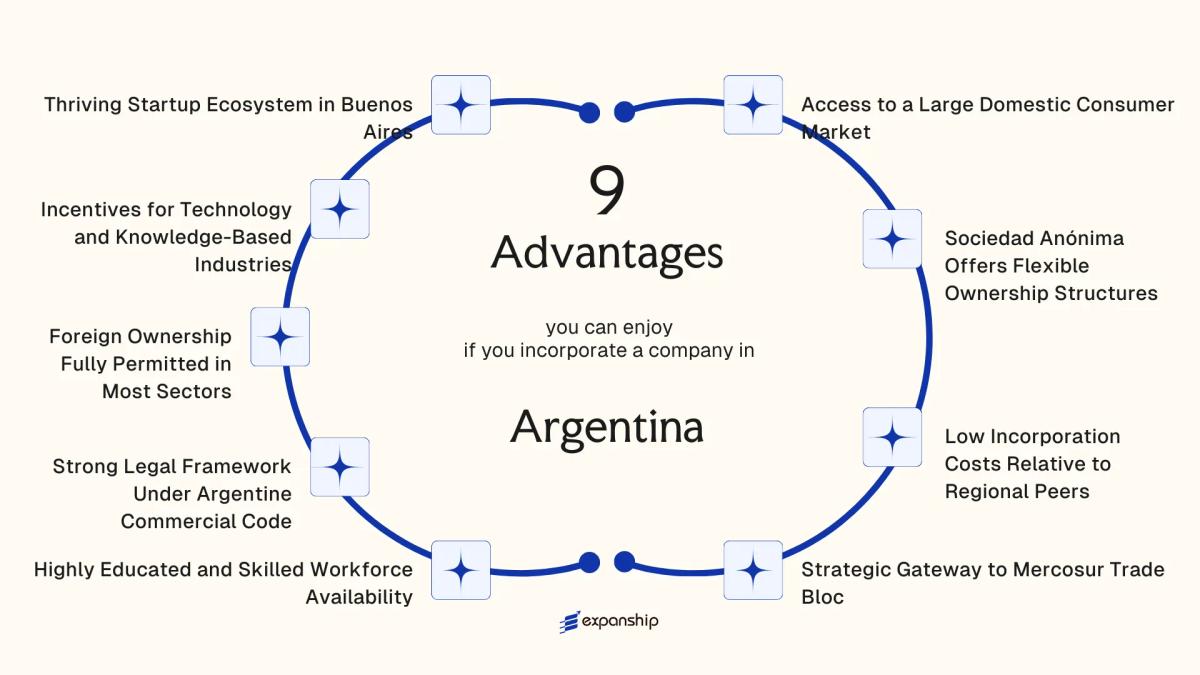
Access to a Large Domestic Consumer Market
Argentina's large domestic consumer market advantage is grounded in scale: the country's population exceeds 46 million, making it the third-largest consumer market in Latin America by population.
Urban Concentration and Purchasing Reach
Greater Buenos Aires alone accounts for roughly 15 million residents, creating a dense commercial corridor where a single distribution point can reach a significant share of national demand. For a foreign firm entering the market, this concentration reduces the logistical complexity of initial market penetration without requiring a multi-city infrastructure from day one.
Formal Consumer Economy and Spending Patterns
Argentina maintains a relatively formalized retail and services economy, which means your business transacts within traceable, regulated channels rather than predominantly informal ones. Consumer spending in services, technology, and food categories has historically remained active even during economic contractions, reflecting structural demand that persists across business cycles.
A company incorporated under Argentine law can access a 46-million-person consumer base through a single legal entity, without requiring separate registrations across multiple jurisdictions.
Sociedad Anónima Offers Flexible Ownership Structures
The Sociedad Anónima (SA) is the dominant corporate vehicle for foreign investment in Argentina, and its ownership structure is one of its most practical attributes. Under the General Companies Law No. 19,550, an SA can be formed with as few as two shareholders, and there is no upper limit on the number of shareholders the entity can accommodate. Shareholders can be individuals or legal entities, resident or non-resident, which means your business can be owned entirely by foreign nationals without a local partner requirement.
Shares in an SA are freely transferable by default, unless the company's bylaws impose restrictions. This transferability gives investors meaningful flexibility when restructuring ownership, bringing in new capital, or planning an exit.
Several structural features make the SA a practical choice for foreign-owned businesses:
- Shareholders are only liable up to the value of their subscribed shares, protecting personal assets from corporate obligations
- Shares can be issued as ordinary or preferred, allowing different economic and voting rights within the same entity
- Foreign legal entities can hold shares directly, avoiding the need for an intermediate holding structure in many cases
- The shareholder register is maintained privately at the company level, not filed in a public registry
Capital contributions must be partially integrated at incorporation, with the remainder payable within two years, which keeps initial financial commitments manageable.

Incorporate a Company in Argentina
Set up your Sociedad Anónima in Argentina with full compliance support from entity registration through to post-incorporation requirements.
Low Incorporation Costs Relative to Regional Peers
Forming a company in Argentina carries lower upfront costs than most comparable Latin American markets, which directly affects how much capital you preserve for actual operations. Registration fees paid to the Inspección General de Justicia (IGJ), the regulatory body overseeing corporate registrations in Buenos Aires, are calculated on a sliding scale tied to share capital rather than set at flat rates that penalize smaller initial investments. For entities formed under the Ley General de Sociedades No. 19,550, the statutory capital requirements for a Sociedad de Responsabilidad Limitada are modest, reducing the cash you must commit before the business generates revenue.
| Cost Component | Governing Body / Reference | Practical Note |
|---|---|---|
| Registration fee | Inspección General de Justicia | Scaled to declared share capital |
| Notarial fees | Provincial notary regulations | Vary by province; Buenos Aires rates are codified |
| Legal publication | Official Gazette (Boletín Oficial) | Mandatory one-time requirement under Ley 19,550 |
| Minimum share capital (SRL) | Ley General de Sociedades | Set at a low nominal threshold |
Compared to markets like Brazil, where the Junta Comercial process and municipal registration layers can extend timelines and add cost at each stage, Argentine corporate formation concentrates most requirements through a single national body. That consolidation reduces the professional fees you pay to local counsel during setup. For foreign investors, lower formation costs mean a shorter payback period on entry expenses before the entity reaches operational breakeven.
Strategic Gateway to Mercosur Trade Bloc
Argentina's membership in Mercosur — the Southern Common Market established by the Treaty of Asunción in 1991 — is a concrete structural advantage for the Argentina Mercosur trade bloc gateway advantage that foreign investors seek. The bloc gives member-state entities preferential tariff access to Brazil, Uruguay, and Paraguay, a combined market exceeding 300 million consumers. A company incorporated in Argentina operates inside that preferential zone rather than trading into it from outside.
For goods classified under Mercosur's Common Nomenclature (NCM), intra-bloc tariffs are generally zero or near-zero. That means a firm producing or sourcing within the country can export to Brazil — the region's largest economy — without the tariff burden that a non-member entity would face. The practical effect is lower landed costs and faster customs processing within the bloc.
Beyond tariffs, Mercosur has negotiated association agreements with Chile, Bolivia, and other Andean states. Access to those preferential frameworks extends through your Argentine entity without requiring separate registrations in each market.
Keep in mind:
- NCM classification of your product determines the applicable intra-bloc tariff rate
- Some sensitive sectors retain temporary protection periods under Mercosur rules
- Associate-member agreements carry different terms than full-member access
Official Mercosur treaty documentation governs tariff schedules and dispute resolution.
Argentina's associate agreements with Andean Community states mean your local entity may access preferential trade terms across nine South American countries simultaneously.
Highly Educated and Skilled Workforce Availability
Argentina's skilled workforce advantage for businesses is grounded in a public university system that produces graduates at no tuition cost, creating a continuous pipeline of credentialed professionals. The country's tertiary enrollment rates consistently rank among the highest in Latin America, with institutions such as the Universidad de Buenos Aires (UBA) generating thousands of graduates annually across engineering, law, medicine, and the sciences.
Depth of Technical and Professional Talent
UBA alone regularly appears in global university rankings for its faculties of exact sciences and economics. For a foreign firm establishing local operations, this translates into access to degree-holding professionals at compensation levels that remain materially lower than equivalent roles in North America or Western Europe.
The IT sector illustrates this most concretely. Argentina produces a significant volume of software engineers and data science graduates each year, many of whom are bilingual in Spanish and English.
Multilingual Capacity and Specialized Credentials
English proficiency rates among university-educated professionals are comparatively high by regional standards, reducing onboarding friction for foreign-owned entities that operate across multiple markets. This linguistic capacity is not incidental; it is a direct product of curriculum requirements embedded across public and private institutions.
Beyond language, the country's medical, legal, and accounting professions operate under structured licensing frameworks overseen by national professional councils (colegios profesionales), meaning credentialed hires carry verifiable, regulated qualifications rather than unverified certifications.
Connect With Our Argentina Team
Get tailored guidance on accessing Argentina's talent market and ensuring your business structure is set up to hire effectively from day one.
Strong Legal Framework Under Argentine Commercial Code
Argentina's commercial legal system is codified primarily in the Código Civil y Comercial de la Nación (Law 26.994), which came into force in 2015 and unified previously separate civil and commercial codes. For a foreign investor, this unification matters because contractual obligations, corporate governance rules, and liability provisions now operate under a single, internally consistent statutory framework rather than fragmented legislation. The Argentine Commercial Code legal framework benefits businesses by reducing interpretive uncertainty across transactions.
- Disputes involving commercial contracts are adjudicated by specialized commercial courts (fueros comerciales), which operate separately from civil courts in key jurisdictions such as the City of Buenos Aires. Dedicated commercial judiciary means judges have domain-specific expertise, which generally produces more predictable outcomes in corporate and contractual disputes.
- Argentina is a signatory to the New York Convention on the Recognition and Enforcement of Foreign Arbitral Awards, ratified through Law 23.619. This allows foreign arbitral awards to be enforced domestically, giving your business access to international arbitration as a dispute resolution mechanism.
- Under Law 26.994, foreign companies operating locally must register with the Inspección General de Justicia (IGJ), the corporate registry for Buenos Aires. Registration establishes legal standing and grants the entity the same statutory protections available to domestically incorporated firms.
Foreign Ownership Fully Permitted in Most Sectors
Foreign ownership rights in Argentina companies are not restricted by nationality. Under the Ley de Inversiones Extranjeras (Law 21,382), foreign investors hold the same legal standing as domestic shareholders and may own 100 percent of a Sociedad Anónima or Sociedad de Responsabilidad Limitada without requiring a local co-owner. This parity removes a structural barrier that exists in several competing jurisdictions across Latin America.
Your firm can repatriate profits, dividends, and capital without percentage-based ownership caps triggering differential tax treatment on distributions. Ownership is unrestricted in most commercial, industrial, and services sectors.
A limited set of sectors — including media, border-zone real estate, and certain defense-related activities — carry specific foreign ownership thresholds under separate regulatory instruments. Outside these categories, no prior approval from a sectoral authority is required solely on the basis of foreign ownership.
A foreign investor incorporating a Sociedad Anónima in Argentina with 100% share ownership retains full voting control and profit entitlement from day one, without mandating a local partner whose equity stake would dilute returns. On a USD 500,000 net profit, that structural difference preserves the entire distribution for the foreign shareholder rather than splitting it under a forced joint-venture arrangement.
Incentives for Technology and Knowledge-Based Industries
Argentina technology industry incentives for businesses are anchored in Ley 27.506, the Knowledge Economy Law, which came into force in 2020 and was extended through 2029. The law targets software development, IT services, biotechnology, audiovisual production, and several other knowledge-intensive sectors.
Qualifying firms benefit from a reduced income tax rate of 15% against the standard 35% corporate rate. Payroll tax contributions for registered employees are partially offset through fiscal credits, which directly reduces the cost of hiring locally. These credits can also be applied against VAT obligations.
Eligible companies are also exempt from withholding taxes on dividend distributions and profit remittances abroad, a material advantage for foreign-owned entities repatriating earnings.
Registration is administered through the Secretaría de Economía del Conocimiento, and approval grants access to the full incentive package for the duration of the law.
- Covered activities include: software and IT, nanotechnology, biotech, geology and mining services, and certain creative industries
- A minimum percentage of revenue must derive from eligible activities to maintain registration status
- Firms must demonstrate investment in R&D, training, or exports to qualify
Registration under the Knowledge Economy Law requires your business to meet specific activity, revenue composition, and investment thresholds — simply operating in a tech-adjacent field does not automatically qualify your entity.
Thriving Startup Ecosystem in Buenos Aires
Buenos Aires startup ecosystem benefits for investors extend well beyond informal networking. The city hosts one of Latin America's highest concentrations of venture-backed technology firms, with districts like Palermo and San Telmo functioning as established hubs for early-stage companies, accelerators, and co-working infrastructure.
Distrito Tecnológico and Institutional Support
The Buenos Aires government formally designated the Parque Patricios neighborhood as the Distrito Tecnológico under Law 2972. Firms that establish operations within this zone may access exemptions from the Ingresos Brutos (gross revenue) tax, a levy that otherwise applies broadly to commercial activity in the city. For a foreign company entering at the early stage, this tax relief directly reduces operating costs during the period when revenue is not yet consistent.
Access to Accelerators and Capital Networks
Several globally connected accelerators operate out of Buenos Aires, including local branches affiliated with international programs. This gives your business a path to regional investors and cross-border partnerships without requiring a presence in multiple cities. The density of the ecosystem means legal, accounting, and technology talent familiar with startup structures is readily available at competitive rates.
Talent Pipeline from Local Universities
- The University of Buenos Aires (UBA) produces large cohorts of engineering, computer science, and business graduates annually.
- UBA graduates consistently rank among the most technically proficient in Latin America.
- Proximity to this talent pool gives foreign firms a hiring advantage without the relocation costs common in other startup markets.
Why Argentina Stands Out Against Regional Alternatives
Comparing across Latin America reveals a consistent pattern: jurisdictions that offer lower nominal tax rates often impose tighter restrictions on foreign ownership, narrower treaty networks, or thinner talent pools. The three competitors selected here — Brazil, Chile, and Colombia — reflect the realistic shortlist for foreign investors evaluating South American incorporation. Each targets a similar profile of international business, yet differs structurally in ways that affect day-to-day operations.
What the Argentina vs Latin America incorporation advantages comparison ultimately surfaces is a question of trade-offs. Brazil's market size is larger, but its tax compliance burden under the Simples Nacional and federal/state layering is substantially heavier. Chile scores well on macroeconomic stability, yet its domestic market is roughly one-third the size. Colombia has improved its investment climate, but foreign ownership restrictions persist in specific regulated sectors. Argentina's commercial framework, underpinned by the Código Civil y Comercial de la Nación, permits full foreign ownership across most industries without prior authorisation, which reduces entry friction in a way that several regional peers do not match at the formation stage.
| Parameter | Argentina | Brazil | Chile | Colombia |
|---|---|---|---|---|
| Foreign Ownership (General) | 100% permitted | 100% permitted | 100% permitted | 100% permitted (restrictions in select sectors) |
| Standard Corporate Tax Rate | 35% | 34% (base) + surtax | 27% | 35% |
| Primary Business Entity | Sociedad Anónima (SA) | Sociedade Anônima (SA) / Ltda | Sociedad Anónima (SpA) | Sociedad por Acciones (SAS) |
| Mercosur Membership | Full member | Full member | Associate member | Observer status |
| Tech/Knowledge Sector Incentives | Yes (Ley del Conocimiento 27.506) | Yes (Lei do Bem) | Limited | Yes (Ley 1834) |
| Minimum Paid-in Capital | Low (no statutory minimum for SRL) | Varies by entity type | No minimum (SpA) | No minimum (SAS) |
Compliance Services for Companies in Argentina
Maintain good standing with Argentine regulatory requirements, including IGJ filings, annual reporting, and ongoing statutory obligations.
Conclusion
Incorporating in Argentina offers a structurally sound case for foreign business owners whose objectives align with what the market genuinely provides. The combination of Mercosur access and the liability protections available through the Sociedad Anónima under Ley General de Sociedades No. 19,550 gives your business a foundation that extends well beyond the domestic market. For technology-oriented firms, the preferential treatment under the Knowledge Economy Law No. 27,506 reduces the effective corporate tax burden in ways that few comparable markets in the region can match.
That said, the advantages here are not universally applicable. Sectors subject to foreign ownership restrictions, or businesses requiring frequent capital repatriation, face a different calculus than those operating in services or export-oriented industries. Your corporate structure, sector classification, and long-term operating model will determine how much of the available framework your entity can actually use.
The benefits of incorporating in Argentina are most pronounced when your business is positioned to use what the jurisdiction specifically offers: a large domestic consumer base, a university-trained talent pool, and preferential trade terms under the Mercosur framework. For companies structured to take advantage of these conditions, the regulatory environment under Argentine commercial law provides a workable and established path to regional market participation. The next step is translating that opportunity into a properly registered, compliant entity.
Start Your Argentine Company With Expanship Today
Incorporating in Argentina involves obligations that span multiple regulatory bodies, from the Inspección General de Justicia (IGJ) for entity registration to the Administración Federal de Ingresos Públicos (AFIP) for tax enrollment. When you incorporate an Argentina company with Expanship, the process is managed with direct knowledge of these requirements, including the specific documentation thresholds the IGJ applies to foreign-owned Sociedad Anónima and Sociedad de Responsabilidad Limitada formations.
Expanship's Argentina company formation services cover each stage of the incorporation and ongoing compliance cycle:
- Preparation and legalization of constitutional documents, including estatutos and actas de directorio
- Registered agent and legal domicile provision, as required under Argentine commercial law
- Filing coordination and liaison with the IGJ and AFIP on your behalf
- Post-incorporation compliance management, covering annual reporting and renewal obligations
- Banking introduction assistance to support corporate account establishment with local financial institutions
- Ongoing registered office maintenance to satisfy the IGJ's domicile requirements
Each service is scoped to the actual obligations your entity will carry under Argentine law, rather than a generic formation template.
Reach Expanship Argentina to discuss how your specific structure, ownership profile, and sector fit within the Argentine regulatory framework.
Frequently Asked Questions (FAQ)
Registration timelines vary depending on the chosen structure and the workload of the Inspección General de Justicia (IGJ), the body that oversees company registration in Buenos Aires. An SA generally takes longer to incorporate than an SRL due to more formal capital and governance requirements. In practice, the full process, from deed execution before a notary to IGJ approval, can range from several weeks to a few months.
Law 27,506, the Software Promotion Regime, offers qualifying technology and knowledge-based firms a reduction in income tax rates and partial relief from employer social security contributions. To access these benefits, companies must register with the Secretaría de Economía del Conocimiento and meet activity and investment criteria. The regime was extended and expanded under Law 27,570, reinforcing its relevance for foreign firms establishing tech operations locally.
Mercosur membership grants companies incorporated within the bloc preferential tariff treatment on a wide range of goods traded between Argentina, Brazil, Uruguay, and Paraguay. A firm registered in Argentina can export to these markets under the bloc's common trade framework without paying the standard external tariff that applies to non-member countries. Associate member agreements with additional South American nations extend some of these advantages further, though the scope varies by product category and bilateral schedule.
Yes, a registered legal address within Argentina is required to incorporate a company under Law 19,550. The IGJ requires that this address be stated in the company's founding documents and used as the official domicile for legal correspondence and regulatory notices. A virtual or representative office address may satisfy this requirement in some circumstances, but the address must be verifiable and functional for official purposes.
Failure to submit annual financial statements to the IGJ within the required timeframe can result in administrative sanctions, fines, and ultimately a suspension of the company's active status. The IGJ has authority under its regulatory framework to initiate dissolution proceedings against entities that are persistently non-compliant with filing obligations. Reinstating an administratively dissolved company involves a formal reactivation process that can be more costly and time-consuming than maintaining compliance from the outset.
The answer depends on the scale of operations and governance preferences. An SA is better suited to businesses that anticipate multiple shareholders, external investment, or eventual share transfers, since its equity is divided into freely transferable shares. An SRL imposes restrictions on quota transfers and caps the number of partners at 50, making it more appropriate for closely held operations where ownership changes are infrequent.
Legal Disclaimer
The information provided in this article is for general informational purposes only and does not constitute legal, tax, or professional advice. While we strive to ensure the accuracy and timeliness of the content, laws and regulations are subject to change, and the application of laws can vary widely based on specific facts and circumstances.
Readers should not act upon this information without seeking professional counsel tailored to their individual situation. Expanship and its authors disclaim any liability for actions taken or not taken based on the content of this article.
For specific advice regarding your business setup, compliance requirements, or any legal matters, please consult with qualified legal and tax professionals in the relevant jurisdiction.