

Key Takeaways
- Foreign-owned entities incorporated in Argentina face compounding registration burdens under Ley 19.550, with federal, provincial, and commercial registry requirements that materially extend the time and cost required to establish a legal presence.
- Argentina's corporate tax environment imposes a significant fiscal load on locally incorporated entities, reducing the net returns available to foreign investors compared with other Latin American jurisdictions.
- Persistent currency instability and strict foreign exchange controls create structural barriers to repatriating profits and managing cross-border treasury operations for Sociedades Anónimas and Sociedades de Responsabilidad Limitada alike.
- Labor law compliance in Argentina generates ongoing administrative and financial obligations that apply from the moment of first hire, leaving little operational flexibility for foreign-owned entities scaling their local workforce.
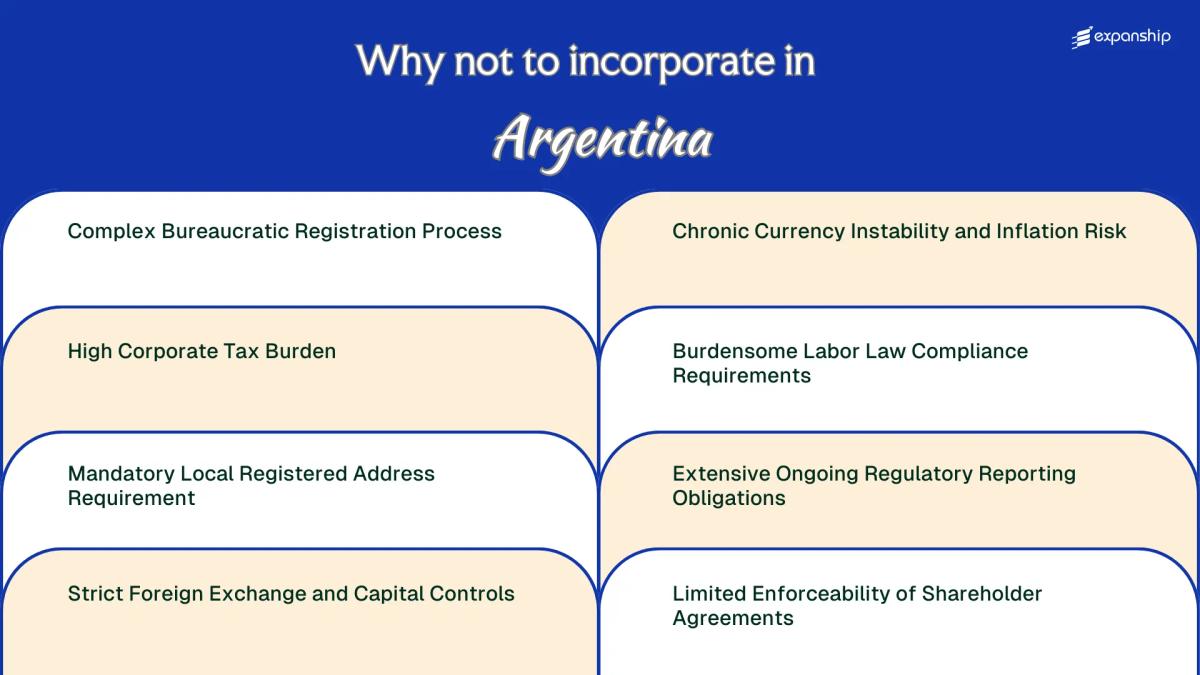
Argentina operates under a heavily regulated corporate and commercial framework, shaped by overlapping federal and provincial requirements that affect how foreign-owned entities are formed and maintained. The disadvantages of incorporating in Argentina span registration complexity, fiscal pressure, currency controls, and labor obligations, among other structural constraints addressed in this article.
The degree of difficulty your business encounters will depend on its structure, industry sector, and whether it involves foreign capital — the cons of setting up a company in Argentina are not uniform across all entity types or operating models. The primary legislation governing commercial entities is the General Companies Law (Ley 19.550), which establishes the foundational rules for incorporation and ongoing corporate governance.
This article is most relevant to foreign investors and multinational firms considering a direct market presence through a locally incorporated Sociedad Anónima or Sociedad de Responsabilidad Limitada.
Complex Bureaucratic Registration Process
Argentina company registration bureaucracy ranks among the most procedurally intensive in Latin America, with timelines that regularly extend well beyond what foreign investors anticipate when planning market entry.
The IGJ Registration Bottleneck
The Inspección General de Justicia (IGJ) governs the formation of companies in Buenos Aires, and its pre-registration review process involves multiple sequential approval stages rather than a parallel filing system. For a Sociedad de Responsabilidad Limitada (SRL), this sequential structure means errors or missing documentation at any stage restart the clock entirely, often pushing Argentina SRL formation delays past 60 to 90 days.
Foreign shareholders face an added layer: personal documentation must be apostilled, translated by a certified public translator, and legalized before submission. Each requirement introduces an independent timeline variable outside your control.
Structural Costs of Complexity
The IGJ also requires statutes to be drafted to specific notarial standards, making professional legal and notarial fees unavoidable rather than optional. Complex business registration in Argentina therefore carries upfront costs that are disproportionate relative to jurisdictions with digital incorporation systems.
A single rejected filing at the IGJ resets the entire review process, meaning documentation errors by your local representative can delay your operational launch by months without any formal appeal mechanism to expedite reconsideration.
High Corporate Tax Burden
The high corporate tax burden in Argentina is one of the most significant financial deterrents for foreign investors. Under the Impuesto a las Ganancias framework, corporations pay a 35% corporate income tax rate on net taxable income, a rate that exceeds most OECD economies and sits well above the global average of roughly 23%.
That headline rate is only part of the problem. Dividends distributed to shareholders are subject to an additional withholding tax, effectively creating a two-tier taxation structure that compounds the cost of repatriating profits.
Beyond income tax, your business faces a layered set of fiscal obligations that inflate the true effective tax rate:
- The minimum presumed income tax historically applied even when a company operated at a loss, creating a tax liability disconnected from actual profitability.
- Provincial gross receipts taxes (Ingresos Brutos) apply at the subnational level, stacking on top of national obligations and varying by province.
- Thin capitalization rules restrict interest deductions on related-party debt, limiting common tax-efficiency structures used by multinational groups.
- Turnover-based taxes at the municipal level can apply regardless of whether the entity is profitable.
Argentina's tax authority, the Administración Federal de Ingresos Públicos (AFIP), enforces extensive filing and withholding obligations, and non-compliance penalties are material. Small foreign firms without dedicated local tax counsel face disproportionate exposure.

Company Incorporation in Argentina
Understand the full tax and compliance structure before incorporating your business in Argentina.
Mandatory Local Registered Address Requirement
The Argentina registered address requirement for foreign companies is not a formality. Under the Ley General de Sociedades (Law 19,550), any company operating or registered in the country must maintain a valid domicilio legal, a legal domicile recorded with the Inspección General de Justicia (IGJ) in the City of Buenos Aires, or the equivalent provincial registry elsewhere.
This address must be a physical, verifiable location. A P.O. box or virtual office without substantive premises is generally insufficient for IGJ purposes, which means your business must secure a lease or service agreement with a compliant local provider before registration can proceed.
| Requirement | Condition | Practical Impact |
|---|---|---|
| Physical domicilio legal | Must be verifiable by the IGJ | Virtual offices often rejected |
| Address change notification | Must be formally filed with the IGJ | Administrative delay and legal fees each time |
| Lease or service agreement | Required as supporting documentation | Ongoing cost even for dormant entities |
| Provincial operations | Separate address registration per province | Multiplied compliance burden across jurisdictions |
Foreign-owned entities cannot simply designate a director's residential address without scrutiny. The IGJ may request supporting documentation to verify occupancy, creating an upfront cost that exists before the business generates any revenue.
Address changes require formal filings with the IGJ, each carrying notarial and registration fees. For a foreign firm managing multiple Argentine subsidiaries or branches, this obligation scales in both cost and administrative complexity.
Strict Foreign Exchange and Capital Controls
Argentina foreign exchange controls restrictions represent one of the most operationally disruptive conditions any foreign-owned entity will face after incorporation. The Banco Central de la República Argentina (BCRA) administers a multi-tiered currency control regime, commonly known as the cepo cambiario, which restricts access to official foreign currency markets and limits the conversion of pesos into dollars or euros.
Foreign firms cannot freely repatriate profits. Dividend remittances abroad require prior BCRA authorization and are subject to specific waiting periods tied to when the profits were generated.
Debt repayments to foreign parent companies also face access restrictions under BCRA regulations, meaning intercompany financing arrangements can become effectively frozen at the point of repayment.
- Dividend repatriation requires BCRA authorization before any transfer abroad
- Access to the official exchange rate (MLC) for imports and debt payments is subject to quotas and approval timelines
- Foreign currency purchases for capital repatriation are capped and subject to regulatory discretion
- BCRA Communication A regulations govern the specific conditions applicable to each transaction type
Even if your entity has fully complied with all tax obligations, BCRA can still block currency access on operational grounds unrelated to tax compliance.
Chronic Currency Instability and Inflation Risk
Argentina currency instability business risk is among the most structurally damaging conditions a foreign company can face when operating through a locally incorporated entity. No other single factor erodes the real value of invested capital and retained earnings as consistently as the peso's long-term depreciation trajectory.
The Structural Nature of Peso Devaluation
Argentina has experienced multiple currency crises over recent decades, with annual inflation repeatedly exceeding 100% — reaching over 211% in 2023 according to INDEC, the national statistics institute. For a foreign firm holding peso-denominated assets or receivables, that rate represents a direct and ongoing destruction of purchasing power with no contractual remedy available under standard Argentine corporate structures.
Revenues earned in pesos cannot be freely converted at market rates due to restrictions enforced by the Banco Central de la República Argentina (BCRA), meaning that peso devaluation corporate risks in Argentina compound the capital controls problem rather than exist independently of it.
Operational and Financial Consequences for Foreign Entities
Financial reporting, payroll obligations, and local supplier contracts are all peso-denominated, so even a well-capitalized foreign firm absorbs inflationary cost pressure continuously. Argentina inflation risk for foreign companies is therefore not a periodic event but an embedded operating condition that distorts budgeting, transfer pricing, and intercompany loan structures on a rolling basis.
Managing Currency and Inflation Risks in Argentina
Speak with our specialists about structuring your Argentine entity to account for peso devaluation, BCRA restrictions, and inflationary cost exposure before they affect your operations.
Burdensome Labor Law Compliance Requirements
Argentina labor law compliance challenges rank among the most operationally demanding obligations any foreign business will encounter after incorporation. The Ley de Contrato de Trabajo (LCT), Law 20,744, governs almost every dimension of the employment relationship, leaving limited room for contractual flexibility.
- Severance pay under the LCT is calculated at one month's salary per year of service, meaning long-tenured employees generate substantial termination liabilities that accumulate silently on your balance sheet.
- Employers must register each worker with AFIP and ANSES before the first shift begins, and retroactive registration triggers fines plus back-payment of social contributions.
- Mandatory contributions to social security, health insurance, and union funds routinely push the employer's total labor cost 40–50% above the agreed gross wage.
- Collective bargaining agreements (convenios colectivos) negotiated by sector-specific unions frequently impose conditions stricter than the LCT baseline, binding your firm regardless of whether your employees are union members.
- Argentine employment law presumes the employment relationship exists whenever a dispute arises, shifting the burden of proof onto the employer.
Extensive Ongoing Regulatory Reporting Obligations
Argentina regulatory reporting obligations for companies extend well beyond annual filings, creating a sustained administrative burden that foreign-owned entities are often unprepared for. The Administración Federal de Ingresos Públicos (AFIP) requires monthly VAT declarations, monthly income tax advance payments, and regular payroll-related filings through the Sistema Integral de Retenciones Electrónicas (SIRE). Each of these carries strict deadlines tied to your firm's CUIT number.
Sociedades Anónimas must also submit annual financial statements to the Inspección General de Justicia (IGJ), with audited accounts prepared under Argentine GAAP. Engaging a locally certified contador público is mandatory, adding a recurring professional cost that cannot be avoided regardless of your entity's activity level.
AFIP's cross-verification systems flag discrepancies between declared income and third-party data automatically, triggering audit risk even for dormant entities. A business generating no revenue still carries full filing obligations.
A foreign-owned S.A. with minimal local activity might reasonably incur between USD 3,000 and USD 6,000 annually in accounting, audit, and compliance fees solely to meet AFIP and IGJ ongoing requirements, before any transactional tax costs are considered.
Limited Enforceability of Shareholder Agreements
Argentina shareholder agreement enforceability problems stem from a structural conflict between private contractual arrangements and mandatory corporate law provisions. Under the Ley General de Sociedades (Law 19,550), certain governance rules cannot be modified by private agreement, regardless of what shareholders have negotiated.
For a Sociedad Anónima (SA), statutory rules governing director appointment, voting rights, and profit distribution take precedence over any conflicting shareholder agreement terms. This means a clause your firm negotiated in good faith may simply be unenforceable against a local counterpart who invokes the statutory default.
Shareholder agreements are binding as contracts between the signing parties but do not bind the company itself or third parties. A dissenting minority shareholder or newly appointed director can effectively ignore agreed-upon governance arrangements without the company incurring direct liability.
For Sociedad de Responsabilidad Limitada (SRL) structures, similar constraints apply to quota transfer restrictions and management appointment rights. Enforcing deviations from the statutory model typically requires litigation, which adds time and cost to any dispute.
The limited shareholder rights Argentina's corporate framework preserves for statutory mechanisms over private contracts creates real exposure for foreign investors who rely on the agreement as the primary governance tool.
Any shareholder agreement clause that conflicts with a mandatory provision of Ley General de Sociedades Law 19,550 is unenforceable against the company and third parties, regardless of its validity as a private contract between the signatories.
Strategies to Overcome These Challenges
Overcoming Argentina business incorporation challenges requires structural preparation rather than reactive adjustments once problems arise. The regulatory environment here is layered, and mitigating risks of incorporating in Argentina depends on understanding the relevant obligations before committing to a legal structure.
- Register your entity with the IGJ (Inspección General de Justicia) and confirm all estatuto social requirements are met before submitting incorporation documents.
- Open a peso-denominated bank account and establish internal foreign exchange protocols that account for BCRA restrictions on capital repatriation.
- Adopt a formal currency exposure policy that accounts for periodic devaluation and indexation adjustments under the current monetary framework.
- Structure your shareholder agreement under Argentine law and have it incorporated directly into the estatuto social to improve enforceability before the IGJ.
- Assign a designated compliance officer or internal function responsible for AFIP filings, provincial tax obligations, and annual reporting deadlines.
- Engage payroll systems that reflect Argentina's Ley de Contrato de Trabajo requirements, including mandatory severance calculations from the date of first hire.
Argentina company formation compliance strategies operate within a framework where federal, provincial, and municipal obligations often overlap. The steps above address structural exposure points; they do not eliminate the underlying regulatory complexity that makes this market operationally demanding.
Argentina's Overall Business Viability
Despite the structural disadvantages covered throughout this blog, Argentina business viability for foreign investors is not a straightforward dismissal. The country holds genuine economic weight in Latin America, with a large consumer base, skilled labor pool, and substantial natural resources that continue to attract foreign capital across several sectors.
| Pros | Cons |
|---|---|
| Large domestic market with significant consumer demand | Chronic inflation and currency depreciation erode profit margins over time |
| Highly educated and technically skilled workforce | Strict foreign exchange controls under the BCRA limit capital repatriation |
| Established legal framework with recognized corporate structures (S.A., S.R.L.) | Corporate income tax at 35% places a heavy burden on profitability |
| Strong agricultural, energy, and technology sectors offering commercial depth | Rigid labor laws under the Ley de Contrato de Trabajo create substantial employment obligations |
| Access to Mercosur trade bloc for regional market expansion | Registration through the IGJ involves lengthy bureaucratic processes with no guaranteed timelines |
Ultimately, your assessment of whether incorporating here is appropriate depends on how your firm's operational model holds up against persistent regulatory friction and macroeconomic volatility.
Compliance Services for Companies in Argentina
Keep your Argentine entity in good standing with local regulatory, tax, and reporting obligations under IGJ and AFIP requirements.
Conclusion
The cons of Argentina company incorporation are well-documented: foreign exchange controls administered under BCRA regulations, chronic peso depreciation, and a corporate tax structure that reaches 35% collectively create a demanding operating environment. Predictability remains elusive, particularly for foreign-owned entities managing cross-border capital flows. Structural compliance obligations under the Inspección General de Justicia do not diminish over time. For your business to function effectively within this framework, local legal and tax counsel is not optional. Specialist support from a firm with established presence and regulatory knowledge in the jurisdiction becomes a practical prerequisite.
Expanship's Support for Your Argentina Expansion
Expanship's Argentina company formation support services are specifically structured around the compliance demands this jurisdiction imposes, from IGJ registration and AFIP enrollment to the ongoing reporting obligations and foreign exchange restrictions covered throughout this blog. The firm's role is to reduce the administrative burden these requirements place on your business, not to alter the regulatory environment itself.
Expanship offers a defined scope of professional services for Argentina entity setup and maintenance:
- Preparing and filing all company registration documents with the IGJ and relevant authorities.
- Providing a registered agent and compliant local office address in Argentina.
- Liaising directly with government bodies, including AFIP and the IGJ, on your behalf.
- Managing post-incorporation compliance obligations as they fall due.
- Facilitating introductions to local banking institutions to support account opening.
- Handling tax registration with AFIP and coordinating with local authorities as required.
To discuss your Argentina incorporation, contact Expanship Argentina.
Frequently Asked Questions (FAQ)
Yes, the 35% corporate income tax rate under the Impuesto a las Ganancias applies to all locally incorporated entities, including Sociedades de Responsabilidad Limitada (SRLs) and Sociedades Anónimas Unipersonales (SAUs). There is no reduced rate for small companies or foreign-controlled entities at the federal level, though certain provincial tax incentives exist in specific sectors or regions. On top of the federal rate, your business also faces turnover tax at the provincial level, which compounds the overall tax burden.
Failures to meet reporting obligations with bodies such as the Inspección General de Justicia (IGJ) or the AFIP, Argentina's federal tax authority, can result in fines, suspension of the entity's legal standing, and in some cases the inability to execute contracts or access the banking system. The IGJ has authority to dissolve companies that persistently fail to comply with annual filing and balance sheet submission requirements. These are not theoretical consequences — enforcement has become more active in recent years, particularly against foreign-controlled entities.
Argentine contract law under the Código Civil y Comercial provides a general framework for shareholder agreements, but courts have historically been reluctant to enforce clauses that conflict with the Ley General de Sociedades (Law 19,550), such as drag-along rights, deadlock resolution mechanisms, or pre-agreed valuation formulas. By comparison, jurisdictions like Chile and Uruguay have made legislative efforts to explicitly recognize and enforce private shareholder arrangements. This gap means that provisions your legal team negotiates carefully may have limited practical weight if a dispute reaches an Argentine court.
Without a valid registered address in Argentina, your entity cannot complete registration with the IGJ, maintain its tax registration with AFIP, or receive official legal notices, any of which can halt operations or expose the company to administrative penalties. The requirement is ongoing, not just a one-time incorporation formality, so if your registered address lapses or becomes invalid, the company's legal status is at risk. Unlike some jurisdictions where a virtual address or a nominee arrangement is straightforwardly accepted, Argentina requires the address to be documentable and verifiable.
Inflation running at triple-digit annual rates erodes the real value of peso-denominated receivables, working capital, and retained earnings faster than most accounting systems are designed to handle. Argentine companies are required under Resolution 539/18 of the Federación Argentina de Consejos Profesionales de Ciencias Económicas to apply inflation-adjusted accounting, which adds complexity to financial reporting and complicates comparisons with foreign parent company accounts. Beyond accounting, pricing contracts in pesos becomes operationally difficult, and dollarizing contracts is legally restricted in many domestic commercial contexts.
Misclassifying workers as independent contractors when they function as employees is a significant legal risk under Argentina's Ley de Contrato de Trabajo (Law 20,744). Argentine labor courts apply a principle of primacy of reality, meaning that if the working relationship exhibits characteristics of employment, such as fixed hours, exclusivity, or direct supervision, it will be treated as such regardless of how the contract is labeled. A reclassification finding can result in back payment of social security contributions, severance obligations, and fines, all calculated retroactively from the start of the relationship.
The annual compliance cost varies depending on company size and activity, but even a minimal-activity foreign-owned entity typically incurs costs for a local accountant certified to prepare inflation-adjusted financials, a registered address provider, annual IGJ filing fees, and AFIP tax obligations including the bimonthly Ingresos Brutos payments at the provincial level. For a dormant or holding structure, you can expect to spend several thousand US dollars per year just to keep the entity in good standing, before factoring in any legal fees for responding to regulatory inquiries. This makes Argentina a materially more expensive jurisdiction to maintain than comparable structures in Uruguay or Chile.
Legal Disclaimer
The information provided in this article is for general informational purposes only and does not constitute legal, tax, or professional advice. While we strive to ensure the accuracy and timeliness of the content, laws and regulations are subject to change, and the application of laws can vary widely based on specific facts and circumstances.
Readers should not act upon this information without seeking professional counsel tailored to their individual situation. Expanship and its authors disclaim any liability for actions taken or not taken based on the content of this article.
For specific advice regarding your business setup, compliance requirements, or any legal matters, please consult with qualified legal and tax professionals in the relevant jurisdiction.