
Key Takeaways
- Foreign investors incorporating in Angola must comply with the Lei do Investimento Privado (Law No. 10/18), which imposes additional regulatory obligations on entities involving foreign capital beyond the standard requirements of the Lei das Sociedades Comerciais (Law No. 1/04).
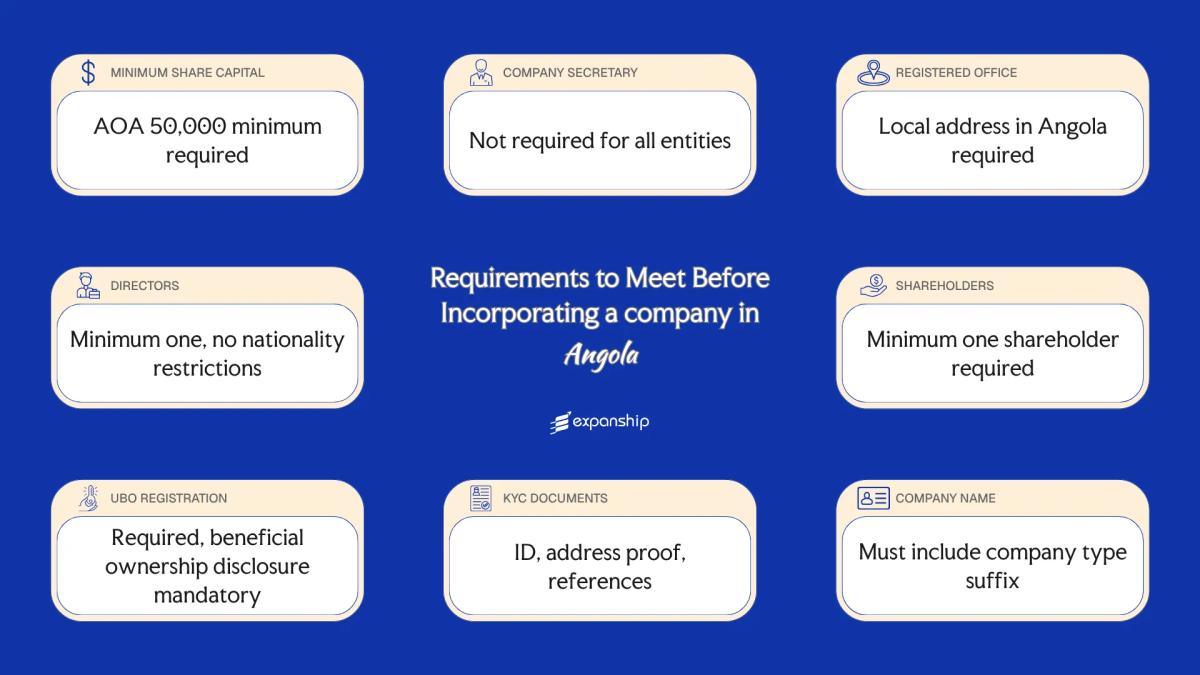
- Every commercial entity registered in Angola is required to maintain a physical registered office in-country, reflecting the legal expectation of a genuine administrative presence rather than a nominal address.
- Minimum share capital thresholds in Angola vary according to the chosen entity type, meaning the correct capital structure must be confirmed before the registration application is submitted to the Guichet Único do Empreendedor.
- Beneficial ownership disclosure is a mandatory compliance obligation under Angola's anti-money laundering legislation, requiring entities to identify and report their ultimate beneficial owners as part of the incorporation and ongoing compliance process.
Company formation in Angola is governed by the Lei das Sociedades Comerciais (Law No. 1/04 of 13 February 2004), which establishes the legal framework for commercial entities. The Guichet Único do Empreendedor (GUE), operated under the Instituto de Fomento Empresarial, serves as the central registry for business registration.
This article addresses the structural and documentary incorporation requirements applicable to entities registering under Angolan commercial law.
Failure to satisfy these requirements results in rejection of the registration application or, where non-compliance is identified post-incorporation, potential exposure to administrative penalties and suspension of operating rights.
Specific requirements differ depending on the entity type selected, the sector in which the business intends to operate, and whether the applicant involves foreign capital subject to the Lei do Investimento Privado (Law No. 10/18).
Foreign investors establishing a new entity, or restructuring an existing one to operate within the country, will find this article most directly applicable to their situation.
Minimum Share Capital Requirements in Angola
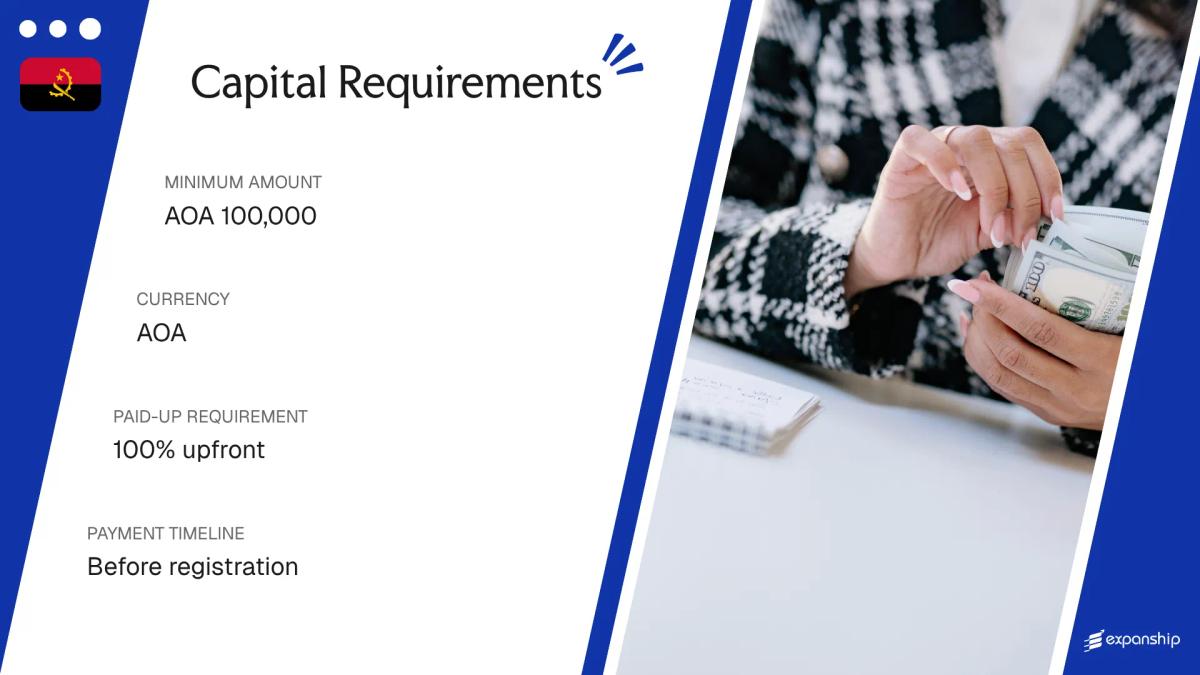
Angola minimum share capital requirements are governed primarily by Law No. 1/04 (the Companies Law) and its subsequent amendments, which establish distinct capital thresholds depending on the legal form of the entity. For a Sociedade por Quotas (Lda), the statutory framework sets a defined minimum, and compliance is verified by the Guichet Único (One-Stop-Shop) under UTINFA at the point of registration.
Share capital obligations in Angola operate on a par value system, meaning each quota or share carries a nominal value. Capital deposit requirements are tied directly to the incorporation process, not treated as an ongoing post-registration obligation.
| Parameter | Detail |
|---|---|
| Minimum Authorized Share Capital | AOA 1,000,000 for a Sociedade por Quotas (Lda) |
| Maximum Authorized Share Capital | No statutory maximum |
| Minimum Paid-Up Capital | AOA 1,000,000 |
| Paid-Up Requirement at Incorporation | Minimum 50% must be paid up at incorporation |
| Accepted Currency | Angolan Kwanza (AOA) |
| Accepted Forms of Contribution | Cash contributions; in-kind contributions permitted subject to valuation |
| Timeframe to Deposit Capital | Prior to or at the point of registration with the Guichet Único |
The remaining unpaid portion of share capital must be deposited within a statutory period following incorporation — failing to meet this deadline can affect the entity's standing with the Conservatória do Registo Comercial.
Company Secretary Requirements in Angola
Under Angolan corporate law, there is no standalone "company secretary" role mandated in the same form as in common law jurisdictions. Angola company secretary requirements are instead absorbed into the responsibilities assigned to the company's management and supervisory bodies under the framework governing commercial entities registered with the Conservatória do Registo das Entidades Legais (CREL).
Certain administrative and compliance functions must nonetheless be fulfilled by designated individuals within the entity's structure. These duties include maintaining statutory books, ensuring filings are submitted to CREL, and keeping records current with the Agência Privada de Investimento e Promoção das Exportações de Angola (AIPEX) where applicable.
Who may carry out these corporate secretary obligations:
- The role is generally performed by a director or designated manager already appointed within the firm's internal structure.
- No separate professional licensing is required for individuals undertaking secretarial functions.
- Both Angolan nationals and foreign nationals may perform these duties, subject to general labour and residency rules.
- Corporate entities may carry out administrative functions on behalf of the business where authorized under the company's constitutive documents.

Incorporate a Company in Angola
Set up your business entity in Angola with full support across registration, documentation, and regulatory compliance.
Registered Office Requirements in Angola
Angola registered office requirements mandate that every company maintain a permanent, physical address within the country, as established under the Lei das Sociedades Comerciais (Law 1/04), where official correspondence and legal notices can be received.
- A physical street address is required; P.O. boxes do not satisfy the sede social obligation.
- The address must be located within Angola; foreign addresses are not accepted.
- Virtual offices are not formally recognised as compliant registered office addresses under Angolan commercial law.
- Proof of occupation is required, meaning the company must hold either a title deed or a valid lease agreement for the premises.
- The registered address is recorded publicly in the Ficheiro Central de Denominações and through the Guichet Único da Empresa (GUE) registry.
- Any change to the registered address must be formally notified to the registry and requires an amendment to the company's articles of association.
- Failure to maintain a compliant address can result in administrative penalties and may affect the entity's good standing with the Agência de Investimento Privado e Promoção das Exportações de Angola (AIPEX) and tax authorities.
Director Requirements in Angola
Under Angola's Lei das Sociedades Comerciais (Law No. 1/04), directors of a private limited company (Sociedade por Quotas) assume personal liability for acts carried out in breach of their statutory duties, including obligations of loyalty, diligence, and lawful management of the entity's affairs. Upon appointment, a gerente becomes directly accountable to shareholders and third parties for losses arising from mismanagement or non-compliance with Angolan commercial law.
| Parameter | Detail |
|---|---|
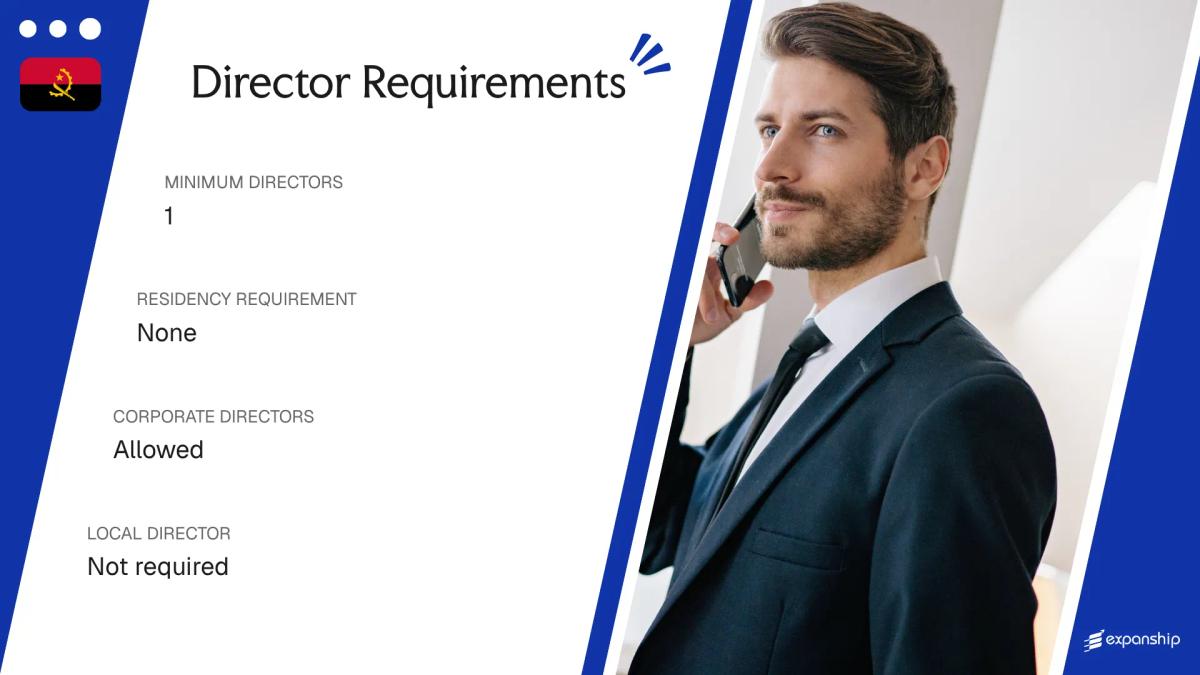
| Minimum Number of Directors | A minimum of one director (gerente) is required for a Sociedade por Quotas. |
| Maximum Number of Directors | No statutory maximum is prescribed under Angolan commercial law. |
| Local/Resident Director Required | No statutory requirement for a locally resident director exists under current law. |
| Nationality Restrictions | No nationality restrictions are imposed on directors. |
| Minimum Age Requirement | Directors must be at least 18 years of age and possess full legal capacity. |
| Corporate Directors Permitted | Corporate directors are generally not permitted; the gerente must be a natural person. |
| Director Must Be a Shareholder | Directors are not required to hold a quota (shareholding) in the company. |
| Publicly Listed on Registry | Director details are recorded with the Conservatória do Registo Comercial and are publicly accessible. |
| Disqualification Conditions | Persons convicted of economic crimes, insolvency-related offences, or disqualified by court order may not serve as directors. |
Despite Angola's strict foreign ownership rules in certain sectors, there is no residency or nationality requirement for a gerente, meaning a non-resident foreign national can legally serve as the sole director of an Angolan company.
Shareholder Requirements in Angola
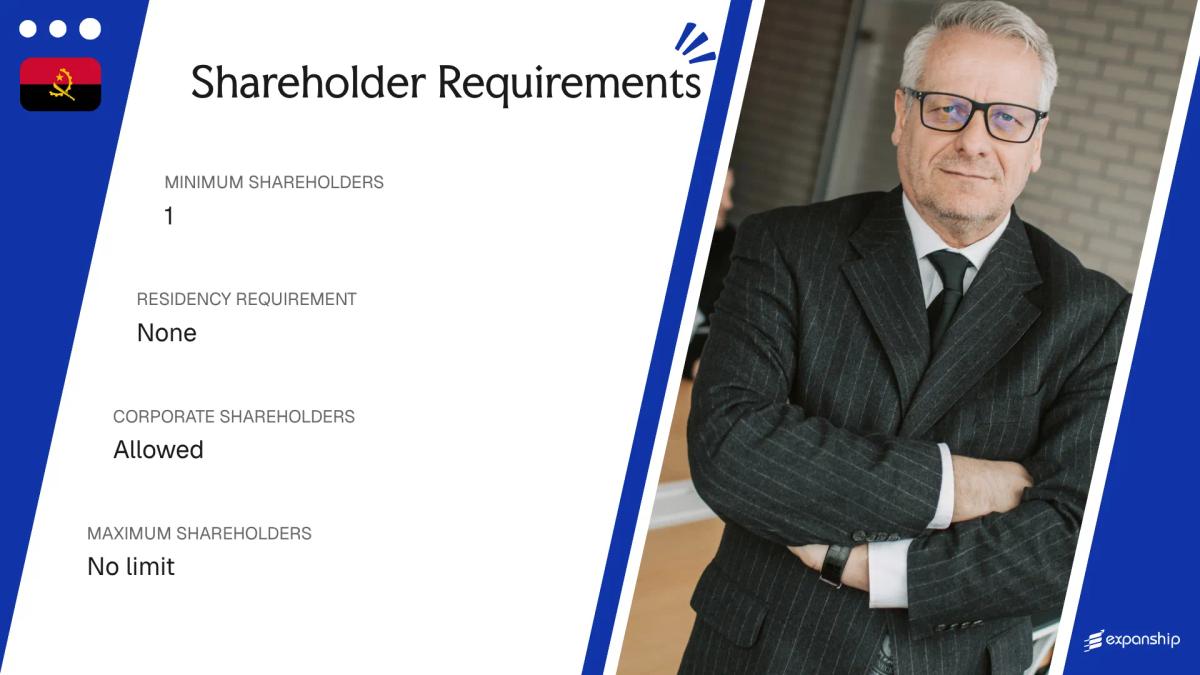
Under Angolan law, a Sociedade por Quotas (Lda.) requires a minimum of two shareholders, though a single-member structure is permitted under specific conditions governed by the Angolan Commercial Code. No statutory maximum applies to the number of shareholders in a private limited company.
Nationality and Residency Restrictions
Angola shareholder requirements company rules do not impose a blanket nationality or residency condition on shareholders. Foreign ownership is generally permitted, though certain regulated sectors may carry sector-specific restrictions on foreign participation percentages.
Corporate Shareholders
Corporate entities are permitted to act as shareholders in an Angolan company. The corporate shareholder must provide relevant constitutional documents, and any foreign corporate shareholder is subject to standard verification under Angolan commercial registration procedures.
Shareholder Liability
Shareholder liability is limited to the value of each socio's subscribed quota. Extended personal liability does not arise under ordinary circumstances, though fraudulent conduct or improper use of the corporate structure may expose shareholders under general Angolan civil law principles.
Register of Shareholders
A register of shareholders must be maintained at the company's registered office. Filing obligations arise upon changes to the shareholding structure, which must be recorded with the Conservatória do Registo Comercial; this register is not generally accessible to the public.
Setting Up Your Shareholding Structure in Angola
Get guidance on structuring your shareholding arrangement in accordance with Angolan commercial registration requirements.
UBO / Beneficial Ownership Disclosure Requirements in Angola
Angola beneficial ownership disclosure requirements are governed by Lei n.º 5/20 (the Anti-Money Laundering and Countering the Financing of Terrorism Law) and supplementary regulations issued by the Unidade de Informação Financeira (UIF), which define a beneficial owner as any natural person who ultimately owns or controls 25% or more of an entity's shares or voting rights.
- Identify all natural persons meeting the 25% ownership or control threshold before or at the time of incorporation.
- Disclose beneficial owner information to the notary during the company formation process, as required under the commercial registration framework.
- Submit UBO declarations to the UIF in accordance with AML compliance obligations applicable to obliged entities and their administrators.
- Record beneficial ownership details in the company's internal registers, maintained at the registered office.
- Report any changes to beneficial ownership to the relevant authorities within the period prescribed by UIF regulations.
| Parameter | Detail |
|---|---|
| Ownership Threshold for UBO Status | 25% of shares or voting rights |
| Filing Authority | Unidade de Informação Financeira (UIF) |
| Disclosure Deadline at Incorporation | At the time of commercial registration |
| Publicly Accessible Register | No publicly accessible register established |
| Penalties for Non-Disclosure | Administrative penalties under Lei n.º 5/20; specific fines subject to UIF determination |
| Ongoing Update Obligation | Yes; changes must be reported to the UIF within the prescribed regulatory timeframe |
KYC / Document Requirements in Angola
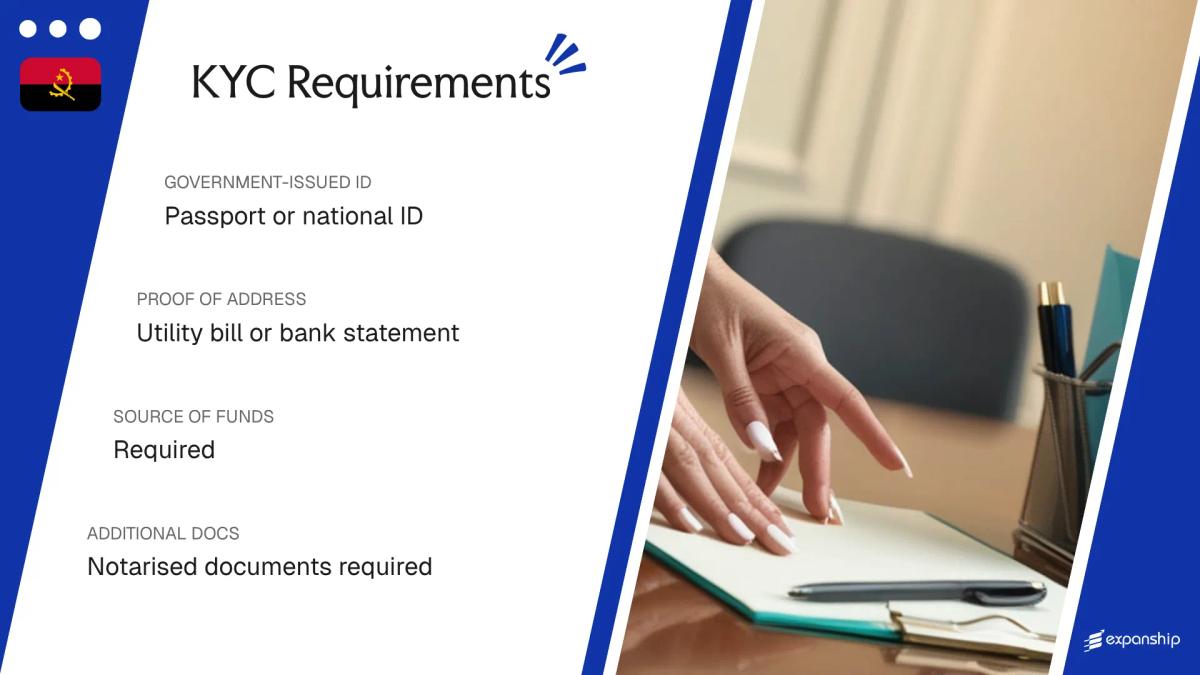
Angola KYC document requirements for incorporation are governed by Law No. 5/20, the Anti-Money Laundering Law, which imposes identity verification and due diligence obligations on all parties before a company can be registered through the Guichê Único do Empreendedor (GUE).
Individual / Personal Documents
- Valid passport or national identity card for each director, shareholder, and beneficial owner
- Proof of residential address dated within the last three months, such as a utility bill or bank statement
- Taxpayer Identification Number (NIF) issued by the Angolan Tax Authority (AGT)
- Signed and dated KYC declaration form as required by the registering authority
Corporate Documents
- Certificate of incorporation or equivalent constitutional document for each corporate shareholder or director
- Register of directors from the country of origin
- Proof of registered address for the corporate entity
- Certificate of good standing where required by the corporate entity's home jurisdiction
Source of Funds Documentation
- Bank statements covering a minimum recent period to evidence the origin of subscribed capital
- Audited financial accounts where the corporate subscriber is an established entity
- Written declaration of the source of funds signed by the contributing party
Notarisation and Apostille Requirements
- Foreign documents must be apostilled under the Hague Convention if the issuing country is a signatory
- Documents from non-signatory countries require legalisation through the relevant Angolan consulate
- All non-Portuguese documents must be accompanied by a certified Portuguese translation
Unsigned or undated source of funds declarations are among the most common causes of registration rejection at the GUE.
Company Name Requirements in Angola
Angola company name requirements are assessed during incorporation through the commercial registry, which checks proposed names against existing registrations to confirm availability and compliance with applicable naming rules.
Company names must be written in Portuguese, reflecting Angola's official language. A legal suffix indicating the entity type is mandatory, such as "Lda." for a private limited company or "S.A." for a public company.
Certain words are restricted or prohibited outright. Terms implying government affiliation, banking functions, or regulated professional activities require prior approval from the relevant supervisory authority before the registry will accept the name.
Name reservation is available prior to formal incorporation. Reservations are submitted to the commercial registry and hold the proposed name for a defined period, during which no other entity may register the same denomination.
Compliance Services for Companies in Angola
Maintain your Angolan company's good standing with ongoing compliance support, from annual filings to regulatory reporting obligations.
Conclusion
Angola company incorporation requirements span several regulatory areas, governed primarily by the Private Investment Law and the rules administered by RECREATE, the national business registry. Minimum share capital thresholds vary by company type, and the mandatory appointment of a local registered office reflects the broader principle that the entity must maintain a genuine administrative presence in-country. Beneficial ownership disclosure obligations, introduced through recent anti-money laundering legislation, add another compliance layer to the registration process. Once these requirements are understood, the practical next step involves assembling the necessary documentation and engaging with the relevant Angolan authorities to initiate the formal registration procedure.
Expanship's Corporate Services for Angola Expansion
Expanship supports businesses working through Angola's corporate services company formation process, where requirements like local shareholder thresholds, notarised documentation in Portuguese, and registration through MAPTSS create real administrative weight. Our role is to reduce that burden on your team so that deadlines are met and filings are handled correctly the first time.
Beyond initial registration, your business may need ongoing support across several areas:
- We prepare and submit all incorporation documents, including Articles of Association, through the Conservatória do Registo Comercial.
- A registered office address and local representative are provided for your entity's Angola presence.
- Government submissions and liaison with regulatory bodies, including MAPTSS and AGT, are managed on your behalf.
- Post-incorporation obligations, from annual returns to corporate record maintenance, are kept on track.
- Introductions to local banking institutions are arranged to support your account opening process.
- Tax registration with AGT and coordination with local authorities are handled as part of your setup.
Reach out to Expanship Angola to discuss how we can support your entry into the Angolan market.
Frequently Asked Questions (FAQ)
Angola does not impose a nationality requirement on directors, meaning foreign nationals can serve on the board without restriction. However, any foreign director who will be physically present and active in Angola must hold a valid work permit and residency authorization issued under Angolan immigration law. Failing to secure the correct visa category before assuming executive duties can expose both the individual and the company to administrative penalties.
Non-disclosure of beneficial ownership information under Angola's anti-money laundering framework can result in fines and suspension of the company's commercial activity. The Angolan Financial Information Unit (UIF) oversees compliance with beneficial ownership obligations, and failure to report triggers regulatory scrutiny that can delay or block banking relationships. Rectifying an omission after the fact does not automatically remove the liability already incurred.
A registered office in Angola must be a physical, verifiable address located within Angolan territory where official correspondence and regulatory notices can be received. Virtual office arrangements that lack a genuine physical presence do not satisfy this requirement under the Companies Law (Lei das Sociedades Comerciais). Providing a non-compliant address during registration can result in the application being rejected by the Conservatória do Registo Comercial.
The company secretary requirement in Angola applies differently depending on the entity type, and not every structure carries the same statutory obligation. For a Sociedade Anónima (SA), the appointment is a formal requirement tied to corporate governance obligations under the Lei das Sociedades Comerciais, whereas an LDA operates under lighter administrative requirements in this regard. You should confirm the specific obligations applicable to your chosen structure before completing the registration process.
Foreign individual shareholders must submit certified copies of a valid passport, proof of residential address, and a bank reference or equivalent source of funds documentation as part of the KYC process. Corporate shareholders incorporated outside Angola are additionally required to provide apostilled constitutional documents, a certificate of good standing, and details of their own beneficial ownership structure. All foreign-language documents must be accompanied by a certified Portuguese translation before they will be accepted by the registrar.
Company names in Angola must be submitted in Portuguese or be compatible with Portuguese language conventions, and names that imply a government connection or use restricted terms require prior ministerial approval. The Conservatória do Registo Comercial conducts a name availability check, and identical or confusingly similar names to existing registered entities will be refused. Reserving a name in advance is possible, but the reservation period is limited, and the full registration must be completed within that window.
A Sociedade por Quotas in Angola requires a minimum of two quota holders, so a single individual cannot hold 100% of the shares in this structure. If sole ownership is the objective, an alternative structure or the use of a nominee quota holder may need to be considered, though any nominee arrangement must still comply with beneficial ownership disclosure obligations. A Sociedade Anónima similarly requires multiple shareholders, meaning neither of Angola's primary private company forms accommodates full single-owner structures without additional planning.
Legal Disclaimer
The information provided in this article is for general informational purposes only and does not constitute legal, tax, or professional advice. While we strive to ensure the accuracy and timeliness of the content, laws and regulations are subject to change, and the application of laws can vary widely based on specific facts and circumstances.
Readers should not act upon this information without seeking professional counsel tailored to their individual situation. Expanship and its authors disclaim any liability for actions taken or not taken based on the content of this article.
For specific advice regarding your business setup, compliance requirements, or any legal matters, please consult with qualified legal and tax professionals in the relevant jurisdiction.