
Key Takeaways
- Angola's Private Investment Law imposes mandatory minimum share capital thresholds and compulsory local partnership requirements that directly constrain how foreign investors can structure their entry into regulated sectors.
- Foreign currency controls and profit repatriation restrictions add a layer of financial risk that is particularly burdensome for capital-intensive operations in oil, gas, mining, and telecommunications.
- Registering a company through both INACOM and ANIP involves sequential, multi-agency approval processes that extend incorporation timelines well beyond what investors typically encounter in comparable African markets.
- Corporate tax and reporting obligations in Angola require ongoing compliance across multiple statutory instruments, creating administrative overhead that compounds the baseline cost of maintaining a local entity.
Angola operates under a heavily regulated business environment, shaped by a combination of statutory corporate law and sector-specific oversight bodies. The Private Investment Law and the broader commercial legal framework impose structured obligations on foreign entities seeking to establish a presence there. Understanding the disadvantages of incorporating in Angola is particularly relevant to foreign investors entering capital-intensive industries such as oil and gas, mining, telecoms, or financial services.
The drawbacks of Angola company formation span regulatory, financial, and operational dimensions, each addressed individually in this article. Not every disadvantage applies equally across all business types — a foreign holding structure faces different friction points than an operational subsidiary or a joint venture with a local partner.
Risks of setting up business in Angola tend to be more acute for investors without prior exposure to Lusophone African markets or to civil law-based commercial systems.
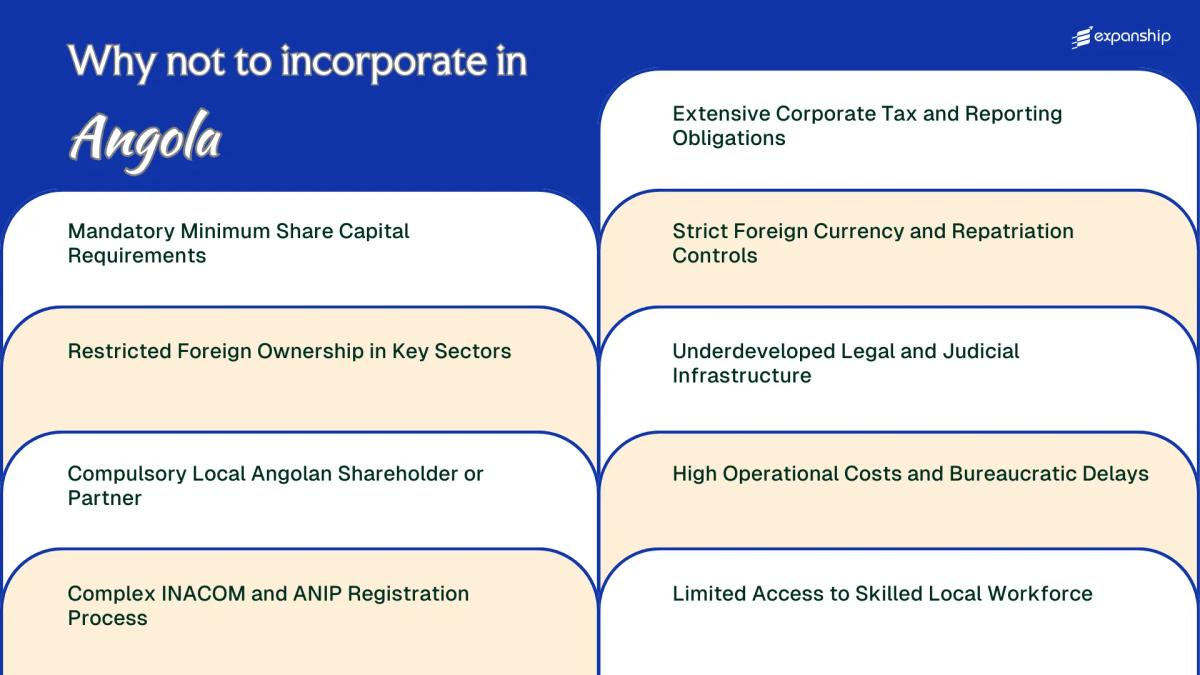
Mandatory Minimum Share Capital Requirements
Angola minimum share capital requirements create a direct financial barrier to entry that many comparable African markets do not impose at the same threshold.
Capital Thresholds Under Angolan Company Law
Under the Lei das Sociedades Comerciais (Law No. 1/04), a Sociedade Anónima requires a minimum share capital of AOA 20,000,000. At least 30% of this amount must be paid up at the time of incorporation, with the remainder due within a defined period post-registration. For a foreign investor accustomed to jurisdictions with nominal or zero minimum capital requirements, this upfront commitment ties up working capital before the business generates a single kwanza in revenue.
Private limited companies (Sociedades por Quotas) carry a lower threshold, but the SA structure is typically required for sectors where foreign participation is permitted, making the higher capital floor difficult to avoid in practice.
Why the Requirement Creates Operational Risk
The capital must be deposited in a local Angolan bank account, which itself requires prior regulatory approvals that can extend your setup timeline by weeks. This dependency on banking access before incorporation is complete creates a structural delay with real cost implications.
If your sector mandates the SA structure, you cannot sidestep the AOA 20,000,000 capital requirement, meaning significant funds are committed and inaccessible during an already lengthy registration process.
Restricted Foreign Ownership in Key Sectors
Angola foreign ownership restrictions sectors represent one of the most direct barriers you will encounter as a foreign investor. Certain industries are either fully closed to foreign participation or subject to mandatory local equity thresholds that significantly limit how your business can be structured.
The petroleum sector operates under specific frameworks, including the Lei das Actividades Petrolíferas, which governs participation rights and concessionary arrangements. Foreign oil companies cannot independently hold concessions and must partner with Sonangol, the state oil company, under terms that limit operational and financial autonomy.
Beyond oil, the Angolanization policy imposes local content requirements across sectors including mining, telecoms, and financial services. These requirements affect staffing ratios, supplier contracts, and equity structures simultaneously.
For a foreign business owner, these restrictions create friction at multiple levels:
- Licensing in restricted sectors may be conditional on Angolan nationals holding minimum equity stakes, reducing your ownership and dividend entitlements
- Compliance with sector-specific local content rules requires ongoing legal review, adding recurring professional costs
- Negotiating compliant partnership structures with local shareholders takes considerable time before any operational activity can begin
- Sector regulators, including IRSE for insurance and BNA for banking, each apply their own foreign participation limits independently
Joint venture requirements in these sectors are not universally standardized, so the threshold varies by industry and regulatory body.

Company Incorporation in Angola
Understand the ownership structures, sector restrictions, and registration requirements before establishing your business presence in Angola.
Compulsory Local Angolan Shareholder or Partner
The Angola compulsory local shareholder requirement is one of the most operationally disruptive obligations a foreign investor will face. Under the country's Private Investment Law (Law No. 10/18), many sectors require foreign-owned entities to include an Angolan national or locally registered entity as a shareholder or partner, a policy widely referred to as Angolanization.
This structure forces your business into a joint venture arrangement, often before you have identified a trustworthy local counterpart. Finding a qualified Angolan partner with sufficient capital contribution capacity and aligned commercial interests is difficult in practice, and failure to satisfy the requirement can block registration entirely.
| Sector | Minimum Local Ownership Required | Implication for Foreign Investor |
|---|---|---|
| Oil & Gas (downstream) | Up to 35% local participation | Significant equity dilution from day one |
| Telecoms | Local partner required | Foreign control structurally capped |
| Media & Publishing | Majority local ownership | Foreign investor holds minority position |
| General commerce | Angolanization targets apply | Profit-sharing obligations to local partner |
Even outside heavily regulated industries, the Angola local partner requirement risks extend to governance. A local shareholder may hold veto rights or board representation disproportionate to their capital stake, depending on how the shareholders' agreement is structured under the Commercial Companies Law (Lei das Sociedades Comerciais).
Dissolving or replacing an unsuitable local partner later involves litigation exposure and significant legal cost.
Complex INACOM and ANIP Registration Process
Angola INACOM ANIP registration challenges stem from two separate regulatory bodies that operate with little coordination, each imposing its own procedural timeline on foreign businesses. INACOM (Instituto das Tecnologias de Informação e Comunicação de Angola) handles licensing for technology-related firms, while ANIP (Agência Nacional para o Investimento Privado) oversees foreign investment approvals under the Private Investment Law (Lei n.º 10/18).
Obtaining ANIP approval before operational registration can take several months, and any incomplete documentation restarts the review cycle entirely. Your business cannot legally operate until both processes conclude.
Angola business registration bureaucracy problems compound when sector-specific licensing from INACOM runs concurrently with ANIP's review, as the two bodies do not share documentation or communicate procedural status with each other.
- ANIP approval is required before finalising company registration for foreign-owned entities
- INACOM licensing applies separately to any ICT or technology-related business activity
- Documentation must meet each body's individual requirements; shared submissions are not accepted
- Incomplete or rejected filings reset review timelines with no automatic appeal period guaranteed
- Investments above USD 1 million require a formal investment project submission to ANIP
Foreign investors approved through ANIP are legally entitled to repatriate profits, yet separate BNA (Banco Nacional de Angola) foreign exchange approval is still required before any transfer can actually proceed.
Extensive Corporate Tax and Reporting Obligations
Angola corporate tax compliance burdens extend well beyond a standard income tax filing. Foreign-owned entities face a layered system of obligations administered by the Agência Geral Tributária (AGT) that collectively demand significant time and specialist resources.
The Structure of Tax Exposure
Corporate income tax in Angola is levied under the Industrial Tax (Imposto Industrial, or IPI), with a standard rate of 25% applied to assessed profits. Angola IPI industrial tax reporting obligations require companies to file estimated tax declarations, interim payments, and annual accounts within strictly defined windows, meaning a missed deadline triggers penalties that compound quickly for firms without dedicated local tax counsel.
The Operational Weight on Foreign Businesses
Angola corporate tax risks for foreign companies are amplified by withholding tax requirements on dividends, interest, and service fees paid to non-residents, which can reach 15% depending on the payment category. Beyond IPI, businesses may simultaneously carry Value Added Tax (VAT) obligations at 14%, payroll-related taxes, and sector-specific levies, each with separate filing cycles under AGT oversight. Angola AGT tax authority compliance challenges are particularly acute for foreign parent companies unfamiliar with Portuguese-language documentation requirements and local accounting standards.
Managing Tax and Compliance Obligations in Angola
Understand the full scope of Angola's corporate tax framework and reporting requirements before committing to incorporation.
Strict Foreign Currency and Repatriation Controls
Angola foreign currency repatriation restrictions present one of the most structurally constraining challenges for foreign investors, with the Banco Nacional de Angola (BNA) maintaining tight oversight over all cross-border capital movements.
- Foreign investors must obtain prior BNA authorization before repatriating profits, dividends, or capital, creating delays that can extend well beyond standard business planning cycles.
- All foreign exchange transactions must be conducted through authorized commercial banks operating under BNA regulation, limiting your operational flexibility and adding intermediary costs.
- The kwanza is not freely convertible, meaning currency transfer risks are compounded by limited access to hard currency at commercially viable exchange rates.
- Angola profit repatriation limitations under the Private Investment Law require documented proof of registered investment and tax compliance before any outbound transfer is approved.
- BNA foreign exchange controls require that export revenues be repatriated and surrendered through the domestic banking system within defined timeframes, restricting how your firm manages international liquidity.
Underdeveloped Legal and Judicial Infrastructure
Angola's legal infrastructure weaknesses create measurable exposure for foreign businesses, particularly in contract enforcement and dispute resolution. The civil court system operates under significant backlogs, and commercial cases can take years to reach a final judgment.
Judicial independence remains a structural concern. The World Bank's Doing Business methodology historically ranked Angola poorly on contract enforcement, reflecting both the length of proceedings and the cost relative to claim value.
Commercial disputes are governed primarily by the Commercial Code and the Civil Procedure Code, neither of which has been substantially modernized to reflect contemporary cross-border business structures. Foreign firms often find that contractual protections negotiated at the drafting stage are difficult to enforce in practice.
Angola joined the New York Convention on the Recognition and Enforcement of Foreign Arbitral Awards in 2017, which technically allows arbitral awards to be enforced domestically. However, enforcement still depends on domestic courts, which reintroduces the same delays and capacity constraints.
- Judicial appointments remain subject to political influence in practice
- Specialist commercial courts have limited reach outside Luanda
- Legal professionals with international commercial law expertise are scarce
According to the World Bank's Doing Business 2020 report, enforcing a contract in Angola required an average of 1,296 days and cost approximately 44.4% of the claim value, compared to a sub-Saharan Africa average of 655 days and 41.1% of claim value.
High Operational Costs and Bureaucratic Delays
Angola's high business operational costs begin before your first transaction. Office rental in Luanda ranks among the most expensive in sub-Saharan Africa, and imported equipment faces customs duties that can significantly inflate capital expenditure from the outset.
Administrative processes compound this financial burden. The Guichet Único do Empreendedor, the single-window registration system, was designed to reduce processing time, but in practice, approvals from multiple line ministries, including the Ministry of Finance and sector-specific regulators, frequently extend timelines well beyond published estimates.
Foreign firms often absorb costs for local legal counsel, certified translations, notarial authentication, and repeated document submissions due to procedural inconsistencies. Each requirement carries a fee, and delays mean your entity sits inactive while fixed costs accumulate.
Licensing obligations under Lei do Investimento Privado (Law No. 10/18) require prior authorization from AIPEX (formerly ANIP) for foreign-invested entities, adding a regulatory layer that domestic firms do not face at the same threshold. Time lost in authorization cycles directly increases your pre-revenue cost exposure.
Foreign investors whose capital falls below the minimum threshold specified under Law No. 10/18 may face restricted access to AIPEX's investment facilitation procedures, leaving them subject to standard administrative channels with no guaranteed processing timeline.
Limited Access to Skilled Local Workforce
Angola skilled workforce limitations present a direct staffing constraint for foreign businesses operating outside the extractive sector. The country's tertiary enrolment rates remain low relative to regional peers, and technical training infrastructure is concentrated in Luanda, leaving significant gaps in specialised disciplines such as finance, engineering, and ICT.
Under the Lei Geral do Trabalho (General Labour Law, Law No. 7/15), employers must meet Angolanisation quotas, which require a defined percentage of the workforce to be Angolan nationals. Meeting these quotas when qualified local candidates are scarce forces firms to invest heavily in internal training programmes, which raises operating costs and extends the timeline to full operational capacity.
Foreign companies facing Angola labour market restrictions often resort to expatriate hires, but work permit approvals through the Serviço de Migração e Estrangeiros (SME) are slow and subject to numerical caps tied to staff ratios. This compounds the workforce gap rather than resolving it.
Overcoming Angola's Incorporation Challenges
Overcoming Angola's incorporation challenges requires structural preparation rather than reactive problem-solving. Foreign investors who understand the regulatory architecture before entry are better positioned to manage procedural delays and compliance obligations.
- Confirm that your intended sector does not fall under the reserved or restricted categories defined by the Private Investment Law (Law No. 10/18), as this determines ownership thresholds before any registration begins.
- Structure your entity with the minimum share capital thresholds met at the point of filing with the ANIP, not after, to avoid registration rejection or delays.
- Appoint a legally compliant local shareholder or partner prior to incorporation where sector rules mandate Angolan participation, ensuring the shareholding arrangement is documented under Angolan commercial law.
- Register with INACOM if your business operates in the information and communications technology sector, as this is a separate mandatory process from general commercial registration.
- Establish a Banco Nacional de Angola-compliant foreign currency account structure from the outset to address repatriation and capital transfer restrictions.
These steps address procedural and structural requirements set by Angolan law, not discretionary best practices. The measures operate within a regulatory framework that remains subject to administrative interpretation, and outcomes can vary depending on the competent authority handling your application.
Angola's Investment Potential Despite the Barriers
Angola investment potential despite barriers is not a contradiction in terms. The country holds substantial hydrocarbon reserves, a large consumer base, and active government efforts to attract foreign capital through the Agência Nacional para o Investimento Privado e a Promoção das Exportações (AIPEX). The barriers documented throughout this article are real and material, yet they do not uniformly disqualify foreign business presence.
| Consideration For | Consideration Against |
|---|---|
| Angola holds proven oil and gas reserves alongside growing non-oil sectors such as agriculture and mining. | Foreign ownership is restricted in several strategic sectors, limiting equity control for international investors. |
| AIPEX provides a formal channel for private investment applications and export facilitation. | The INACOM and ANIP registration processes carry administrative delays that extend the time-to-operate. |
| A population of over 35 million represents a domestic consumer market with long-term demand potential. | Minimum share capital thresholds and local partnership requirements tie up capital before operations begin. |
| The Angolan government has introduced legal reforms aimed at improving the business environment. | Currency repatriation controls under Banco Nacional de Angola rules constrain profit outflows for foreign firms. |
| Geographic position along the Atlantic coast supports logistics connections to other Sub-Saharan markets. | Underdeveloped judicial infrastructure creates uncertainty in contract enforcement and dispute resolution. |
Corporate Compliance Services in Angola
Maintain your company's standing under Angolan law, including tax filings, annual reporting obligations, and regulatory submissions to the relevant authorities.
Conclusion
The cons of Angola company incorporation are real and substantive. Across the preceding sections, the barriers covered reflect systemic constraints rather than isolated procedural inconveniences. Mandatory minimum capital thresholds, sector-specific foreign ownership restrictions enforced under the Private Investment Law, and the repatriation controls administered through Banco Nacional de Angola collectively create a demanding entry environment. Bureaucratic delays tied to ANIP and INACOM registration compound the financial exposure for foreign entities. Qualified professional guidance, grounded in current Angolan regulatory requirements, remains a practical prerequisite for any firm pursuing formal establishment in this jurisdiction.
Expanship's Angola Expansion Support Services
Structuring an Angola expansion support corporate services section with the right balance of specificity and service scope.
Angola's incorporation environment, shaped by ANIP oversight, Angolan Law no. 10/21 (Private Investment Law), mandatory local partnership thresholds, and BNA's foreign currency controls, creates a compliance burden that requires consistent, on-the-ground management rather than a single setup effort. Expanship works alongside your business to reduce that operational weight across the registration process and beyond.
Our Angola company formation compliance assistance covers the full entity lifecycle from initial setup to ongoing obligations:
- We prepare and submit all company registration documentation in accordance with INACOM and ANIP requirements.
- A registered agent and corporate address in Angola are provided to meet statutory presence requirements.
- We liaise directly with government bodies, including BNA and tax authorities, on your behalf.
- Post-incorporation compliance management covers AGM filings, annual returns, and ongoing reporting obligations.
- Banking introduction assistance helps connect your entity with local financial institutions.
- Tax registration with the Agência Geral Tributária and local authority liaison are handled as part of the setup process.
Reach out to Expanship Angola to discuss how we can support your entry into this market.
Frequently Asked Questions (FAQ)
The requirement is not universal across every legal structure, but it applies broadly enough to affect most foreign-led ventures in regulated industries. Under Angola's Private Investment Law, foreign investors in specific sectors must partner with Angolan nationals or state-linked entities to meet minimum local equity thresholds. Even in less regulated sectors, ANIP scrutinises ownership structures carefully during the registration review process.
Violations of Angola's foreign exchange regulations, overseen by the Banco Nacional de Angola (BNA), can result in substantial administrative fines and the freezing of accounts held within the Angolan banking system. Repeated or wilful breaches may trigger criminal liability under Angola's foreign exchange law. The BNA has broad authority to audit transactions and impose sanctions without prior notice.
The minimum share capital varies by company type, but for a Sociedade por Quotas (private limited company), the requirement has historically been set in Angolan kwanza, and the equivalent in hard currency fluctuates considerably given the kwanza's instability. This currency risk means the real cost of meeting capital requirements can shift substantially between the date of planning and the date of actual registration. Foreign investors should calculate capital requirements in USD or EUR to account for exchange rate exposure.
Angola's dual registration process, requiring engagement with both ANIP for investment approval and INACOM for certain commercial registrations, is widely regarded as more procedurally intensive than equivalent processes in Mauritius, Rwanda, or South Africa. The document authentication requirements, mandatory notarisation, and inter-agency coordination add weeks or months to timelines that comparable jurisdictions complete in days. Angola consistently ranks poorly on ease of doing business indicators, which reflects this structural friction.
Angola's Imposto Industrial (industrial tax) regime imposes filing obligations with strict deadlines enforced by the Agência Geral Tributária (AGT). Missing these deadlines triggers automatic penalties calculated as a percentage of the outstanding tax liability, and repeated non-compliance can result in the suspension of your business licence. The AGT has the authority to conduct audits retroactively, so gaps in historical reporting carry ongoing financial exposure.
Interposing a holding company does not eliminate the underlying local participation requirement where Angolan law mandates it at the operational entity level. ANIP reviews the beneficial ownership structure, not merely the nominal shareholder on record, so a foreign holding company with no Angolan equity participation will still be assessed against sector-specific local ownership rules. Structuring through intermediaries without genuine local equity participation is treated as non-compliant and can result in registration denial.
Contract enforcement in Angola is slow and unpredictable, with commercial disputes often taking several years to resolve through the courts. The limited capacity of the judiciary, combined with inconsistent application of the Commercial Companies Law, means that minority shareholder protections and contractual remedies are difficult to enforce in practice. Foreign investors with disputes against local partners or state entities have limited recourse and often find that arbitration clauses, while legally recognised, are difficult to execute domestically.
Legal Disclaimer
The information provided in this article is for general informational purposes only and does not constitute legal, tax, or professional advice. While we strive to ensure the accuracy and timeliness of the content, laws and regulations are subject to change, and the application of laws can vary widely based on specific facts and circumstances.
Readers should not act upon this information without seeking professional counsel tailored to their individual situation. Expanship and its authors disclaim any liability for actions taken or not taken based on the content of this article.
For specific advice regarding your business setup, compliance requirements, or any legal matters, please consult with qualified legal and tax professionals in the relevant jurisdiction.