

Key Takeaways
- Law No. 10/18, Angola's Private Investment Law, grants foreign investors statutory protections against arbitrary expropriation and a codified right to repatriate profits — legal guarantees that many comparable Sub-Saharan jurisdictions do not offer by legislation.
- Priority sector businesses registered in Angola can access reduced corporate income tax rates under the Investment Tax Benefits Code, creating a measurable fiscal advantage over standard Industrial Tax treatment.
- Companies established within the Luanda-Bengo Special Economic Zone qualify for additional fiscal concessions tied to specific employment and capital thresholds, making the zone particularly relevant for investors planning significant operational scale.
- Choosing the right entity structure from the outset — whether a Sociedade por Quotas, a branch, or a holding company — directly determines which protections and incentives administered by the Agência Nacional do Investimento Privado are available to a foreign firm.
Situated on the southwestern coast of Africa, Angola is an independent sovereign nation and a member of both the African Union and the Southern African Development Community. Company registration is overseen by the INAPEM — the Instituto Nacional de Apoio às Micro, Pequenas e Médias Empresas — alongside the One-Stop Shop service, known locally as the Guichê Único da Empresa. Foreign businesses establishing a presence here most commonly do so through a Sociedade por Quotas.
Angola operates a territorial-based tax system, meaning resident companies are taxed on Angola-sourced income under the Industrial Tax regime. On the question of foreign ownership, the Private Investment Law (Law No. 10/18) sets out a formal framework that permits foreign participation across most sectors, with certain strategic industries subject to specific conditions. Your company's eligibility for incentives and protections will depend largely on the sector and investment volume declared at registration. This article examines the principal advantages that Angola company formation offers to internationally operating businesses.
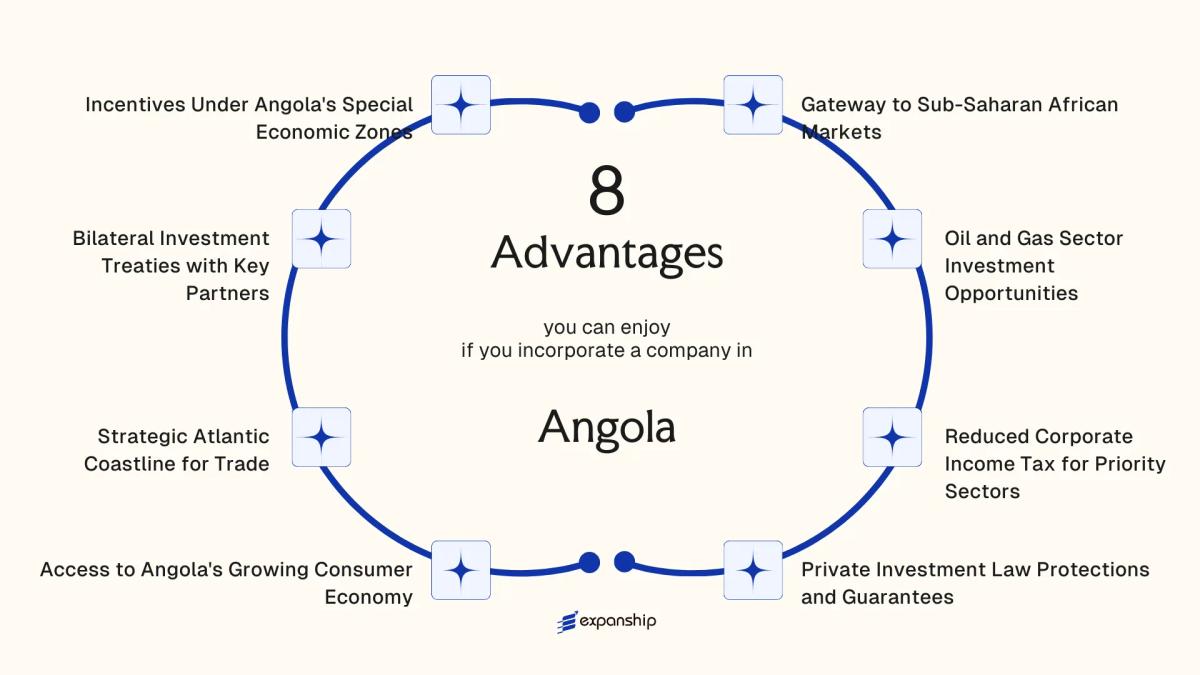
Gateway to Sub-Saharan African Markets
Angola's geographic position along the Atlantic seaboard places it at a crossroads between Central and Southern Africa, making it a functional entry point for companies pursuing Angola gateway to Sub-Saharan Africa markets access across multiple regional blocs simultaneously.
Regional Bloc Connectivity
Angola holds membership in both the Southern African Development Community (SADC) and the Economic Community of Central African States (ECCAS). That dual membership means a company registered in Luanda can engage with trade frameworks spanning over a dozen national markets without requiring separate regional establishment.
Proximity to Key Trade Corridors
The Lobito Corridor, a rail and logistics route connecting Angola's Benguela Railway to the Democratic Republic of Congo and Zambia, gives firms with an Angolan presence direct access to landlocked resource economies. For businesses in distribution, commodities, or industrial supply chains, this physical infrastructure translates into reduced transit times compared to routing freight through East African ports.
A firm incorporated in Angola can operate within both SADC and ECCAS frameworks from a single registered entity, reducing the structural overhead of multi-market entry in Sub-Saharan Africa.
Oil and Gas Sector Investment Opportunities
Angola holds Africa's second-largest proven oil reserves, and the upstream sector remains the primary driver of foreign direct investment into the country. For businesses seeking entry into sub-Saharan Africa's most significant petroleum economy, the Angola oil and gas sector investment benefits begin with direct access to one of the continent's most active licensing environments, overseen by the Agência Nacional de Petróleo, Gás e Biocombustíveis (ANPG).
Upstream investment opportunities are structured through concession contracts and production sharing agreements, which define cost recovery mechanisms and profit oil splits. These instruments give your entity a clearly defined legal framework from the point of contract award, reducing ambiguity over entitlements and fiscal obligations.
The petroleum industry advantages for foreign investors also extend to how capital is structured. Entities operating under applicable petroleum legislation may benefit from ring-fencing provisions that treat each block as a separate fiscal unit, which limits tax exposure across your broader operations.
Several structural features make entry conditions more defined than in comparable frontier markets:
- Block-specific contracts mean your fiscal terms are fixed at award rather than subject to general tax code changes
- ANPG provides a dedicated interface for upstream licensing, reducing the number of regulatory counterparties you manage
- Production sharing agreements set cost recovery ceilings in advance, giving your financial projections a firmer foundation

Company Incorporation in Angola
Establish your corporate presence in Angola's petroleum economy with a properly structured local entity.
Reduced Corporate Income Tax for Priority Sectors
Angola's reduced corporate income tax for priority sectors is established under the Private Investment Law (Law No. 10/18) and its accompanying fiscal incentive framework. The standard Corporate Income Tax (CIT) rate sits at 25%, but qualifying businesses operating in designated priority sectors can access a reduced rate, which represents a direct reduction in tax liability from the first years of operation.
| Sector Classification | Standard CIT Rate | Reduced CIT Rate | Minimum Investment Threshold |
|---|---|---|---|
| Agriculture & Fisheries | 25% | 10% | Varies by development zone |
| Manufacturing | 25% | 15% | Varies by development zone |
| Infrastructure & Construction | 25% | 15% | Varies by development zone |
| Technology & Telecommunications | 25% | 15% | Varies by development zone |
The reduced rates are not automatic. Eligibility is determined through the National Private Investment Agency (AIPEX), which assesses applications against sector classification, geographic investment zone, and minimum capital thresholds. Your entity must receive formal approval before the incentive applies.
For a foreign-owned company, this structure means the tax burden during capital-intensive early years is materially lower than what the standard regime would impose. Agriculture, manufacturing, infrastructure, and technology firms stand to benefit most directly. Given that these sectors align with the government's diversification agenda, regulatory appetite for approving qualifying investments in these areas has been consistent with the intent of the law.
Private Investment Law Protections and Guarantees
Angola Private Investment Law protections for investors are codified primarily in Law No. 10/18, the Lei do Investimento Privado, which establishes the legal framework governing foreign capital entry, ownership rights, and profit repatriation. This statute gives your business a defined legal standing from the moment investment is registered, rather than leaving protections subject to administrative discretion.
Under Law No. 10/18, foreign investors are guaranteed the right to repatriate profits, dividends, and capital after meeting tax obligations. That guarantee removes a significant cash-flow risk that affects investors in many African markets where currency transfer approvals are unpredictable.
AIPEX (Agência de Investimento Privado e Promoção das Exportações) is the designated body that registers private investment and acts as the interface between foreign firms and government ministries. Registration through AIPEX formalises the protections under Law No. 10/18, meaning your firm's rights are documentable and legally enforceable.
Keep these points in mind:
- Investment registration with AIPEX is required before protections under Law No. 10/18 apply
- Profit repatriation rights are conditional on settled tax liabilities
- Equal treatment provisions in the law prohibit discriminatory application of regulations against foreign firms relative to domestic ones
- Minimum investment thresholds apply and vary depending on sector classification
Law No. 10/18 explicitly grants foreign investors the same legal protections as Angolan nationals, a parity standard that is not universally guaranteed by statute in comparable frontier markets.
Access to Angola's Growing Consumer Economy
Angola's growing consumer market benefits for businesses stem from a population exceeding 36 million, with urban centers like Luanda generating concentrated purchasing demand for goods, services, and retail. The country's demographic profile skews young, with a median age below 17, meaning the consumer base will expand structurally over the coming decades rather than plateau.
A Domestic Market Shaped by Rising Urban Income
Real wages in formal employment sectors have grown alongside post-conflict reconstruction, creating a traceable Angola expanding middle class with demand for financial services, telecoms, consumer goods, and healthcare. For a foreign company selling directly to end consumers, establishing a local entity under the Sociedade por Quotas structure gives you legal standing to contract, invoice, and repatriate revenue within the framework of Lei n.º 10/18, the Private Investment Law.
Urbanization rates above 65% mean distribution infrastructure, though still developing, concentrates your market coverage in a manageable number of cities. A registered local presence also satisfies procurement requirements set by the Instituto de Fomento Empresarial, which conditions access to certain domestic supply contracts on locally incorporated entities.
Consumer Sector Access Tied to Local Registration
Angola's domestic market advantages for foreign companies extend to regulated sectors like retail banking, insurance, and pharmaceuticals, where operating licenses are issued exclusively to entities incorporated under Angolan law and registered with the Conservatória do Registo Comercial. Without a local entity, your firm is structurally locked out of those sectors regardless of foreign investment approval.
Maximize Your Market Entry in Angola
Speak with our corporate services team about incorporating the right entity structure to access Angola's consumer economy from day one.
Strategic Atlantic Coastline for Trade
Angola's Atlantic coastline trade advantages are most visible in its port infrastructure and geographic position along one of the world's busiest shipping corridors. The country's western seaboard faces directly onto South Atlantic shipping lanes connecting South America, Europe, and sub-Saharan Africa, which gives companies registered there direct access to transoceanic freight routes without reliance on landlocked transit corridors.
- The Port of Luanda is the primary commercial gateway, handling general cargo, containers, and bulk goods. Its proximity to the capital reduces inland logistics costs for businesses that need to move goods quickly from port to distribution points.
- The Port of Lobito, connected to the Lobito Atlantic Railway corridor extending into the Democratic Republic of Congo and Zambia, allows your firm to reach interior Central African markets via a single intermodal route. This reduces dependency on road freight across difficult terrain.
- Under the General Investment Law (Law No. 10/18), logistics and transport companies operating through designated port zones may qualify for sector-specific incentives, giving port-adjacent businesses a structural cost advantage.
- Shorter sea transit distances to Brazilian ports compared to East African alternatives make the Atlantic position relevant for firms engaged in South-South trade or sourcing from Latin American suppliers.
Bilateral Investment Treaties with Key Partners
Angola bilateral investment treaties advantages are most visible in the protections they extend against non-commercial risks that frequently concern foreign investors in emerging markets. The country has signed BITs with several key partners, including Portugal, Germany, Italy, Russia, and Cape Verde, among others. Each treaty establishes binding obligations on the host state regarding fair and equitable treatment, protection against expropriation without compensation, and free transfer of funds.
For your business, the transfer of funds provision is particularly consequential. It means repatriation of profits, dividends, and capital is contractually protected under international law, not subject to administrative discretion alone.
Where a BIT includes an investor-state dispute settlement clause, you gain access to international arbitration rather than being confined to local courts. This shifts the risk profile of the investment meaningfully.
Angola's double taxation agreements, including those with Portugal, reduce withholding tax exposure on dividends and royalties flowing between entities in signatory states.
A foreign investor operating under the Angola-Germany BIT who faces expropriation without adequate compensation can initiate arbitration before an international tribunal, bypassing the domestic court system entirely. This is a structural protection unavailable to investors from non-treaty states.
Eligibility for these protections depends on the investor qualifying as a national or legal entity of the other contracting state under each treaty's specific definitions.
Incentives Under Angola's Special Economic Zones
Angola Special Economic Zones incentives for businesses are codified primarily through the legal framework governing the Zona Económica Especial Luanda-Bengo (ZEE), established to attract industrial and manufacturing investment outside the oil sector. Operating within the ZEE grants your company access to a defined set of fiscal and customs privileges that are not available to standard entities registered elsewhere in the country.
Key benefits available to qualifying firms inside the ZEE include:
- Exemption from customs duties on imported capital goods and raw materials used in production
- Reduced industrial tax rates for businesses operating in priority manufacturing activities
- Simplified licensing procedures administered through a dedicated one-stop-shop within the zone
- Potential exemptions or reductions on property transfer taxes related to zone infrastructure
These advantages are material for foreign manufacturers because they reduce both startup capital requirements and recurring input costs. A firm importing machinery and materials into the ZEE avoids the customs burden that would otherwise apply at standard Angolan ports of entry, directly improving project economics from the first year of operation.
Eligibility is tied to the nature of the activity; service-only businesses or trading companies without a production component may not qualify for the full range of incentives.
ZEE incentive packages are subject to investment approval by the zone's management authority, and the specific benefits granted can vary depending on the sector and investment volume committed in your application.
How Angola Stacks Up Against Neighboring African Jurisdictions
Comparing Angola against neighboring African jurisdictions reveals a specific regional positioning: it sits at a crossroads between SADC members such as Zambia and Namibia and West Africa's dominant economy in Nigeria. These are the jurisdictions a foreign investor evaluating Angola's advantages would most realistically weigh. The comparison is not about declaring a preference but about identifying where Angola holds structurally distinct positions, particularly around its investment law framework under Law No. 10/18, Atlantic port access, and sector-specific tax treatment that neighboring markets do not uniformly replicate.
Nigeria offers scale, but its regulatory environment for foreign entities involves more layered compliance obligations under the Companies and Allied Matters Act. DRC presents significant natural resource opportunities yet lacks Angola's degree of formalized investor protection under a codified private investment statute. Zambia, as a SADC peer, shares some regional trade benefits but does not offer the same Atlantic logistics position for trade routed toward South America or Europe.
| Parameter | Angola | Nigeria | DRC | Zambia |
|---|---|---|---|---|
| Codified Private Investment Protection Law | Yes – Law No. 10/18 | Partial – NIPC Act | Limited | Limited |
| Atlantic Coast Trade Access | Direct | Direct (Gulf of Guinea) | No | No |
| Special Economic Zones with Tax Incentives | Yes – ZEFIS, ZEE | Yes – NEPZA zones | Limited | Limited |
| Standard Corporate Income Tax Rate | 25% | 30% | 30% | 30% |
| Sector-Specific Reduced CIT Available | Yes | Selective | Selective | Selective |
Compliance Services for Companies in Angola
Maintain good standing with Angola's regulatory requirements, including IRSEA filings, annual returns, and ongoing statutory obligations under Angolan commercial law.
Conclusion
Angola positions itself as one of the few Sub-Saharan African markets where the benefits of incorporating in Angola are grounded in enforceable legal protections rather than informal assurances. Law No. 10/18, the Private Investment Law, gives foreign investors statutory guarantees against arbitrary expropriation and ensures the right to repatriate profits, which provides a legal foundation that many comparable regional markets do not offer by statute.
The tax structure reinforces this case. Priority sector entities can access reduced corporate income tax rates under the Investment Tax Benefits Code, and businesses operating within the Luanda-Bengo Special Economic Zone benefit from additional fiscal concessions tied to employment and capital thresholds. For a foreign firm deciding where to establish a permanent commercial presence on the Atlantic side of southern Africa, these incentives carry material cost implications.
Your specific industry and corporate structure will determine how much of this framework applies directly to your entity. A holding company, a branch of a foreign firm, and a Sociedade por Quotas each sit differently within the tax and licensing regime administered by the Agência Nacional do Investimento Privado. Getting that structure right from the outset shapes both compliance exposure and the practical scope of available protections. Formal legal and corporate advisory support, grounded in current Angolan regulatory requirements, is the standard starting point for foreign entities entering this market.
Start Your Angola Company Formation With Expanship Today
Angola company formation with Expanship covers the full registration cycle, from choosing between a Sociedade por Quotas and a Sociedade Anónima to filing with the Guichê Único de Empresa (GUE) under the Ministry of Industry and Commerce. The private investment protections under Law No. 10/18, the reduced CIT rates in priority sectors, and the Special Economic Zone incentive frameworks discussed throughout this blog each carry distinct documentation and compliance requirements. Expanship manages these requirements directly, ensuring your entity structure aligns with the regulatory conditions that activate those benefits.
Specific services available for your Angola entity include:
- Company documentation preparation, notarization, and legalization for submission to the GUE
- Registered agent and registered office provision as required under Angolan commercial law
- Government filing and liaison with the Conservatória do Registo Comercial
- Post-incorporation compliance management, including annual reporting obligations and tax registration with the Agência Geral Tributária
- Corporate bank account introduction assistance with locally operating institutions
To discuss your business objectives and receive guidance on the appropriate entity structure and filing process, contact Expanship Angola.
Frequently Asked Questions (FAQ)
Foreign nationals can own 100% of a company in certain sectors, but restrictions apply in others. Under the Private Investment Law (Law No. 10/18), some industries reserve a minimum equity stake for Angolan nationals or require joint venture arrangements with local partners. The specific ownership threshold depends on the sector and the scale of investment, so reviewing the relevant sectoral legislation before structuring your entity is necessary.
Companies operating within designated Special Economic Zones (SEZs) in Angola may qualify for reduced or temporarily waived corporate income tax, depending on the zone and activity type. The standard Corporate Income Tax (Imposto Industrial) rate sits at 25%, but SEZ-based firms can access negotiated rates as part of approved investment incentive packages. The specific benefit depends on the zone classification and whether the investment meets minimum capital or employment thresholds set by the managing authority.
Company registration in Angola is processed through the Balcão Único do Empreendedor (BUE), the single-window registration body. Timelines vary, but registration generally takes several weeks when documentation is complete and in order. Delays can occur if notarized or apostilled foreign documents require additional verification.
Law No. 10/18 includes explicit guarantees against nationalization or expropriation without prompt and fair compensation. The law also provides for profit repatriation rights, allowing foreign investors to transfer dividends and returns abroad subject to compliance with Angola's foreign exchange regulations administered by the Banco Nacional de Angola. These protections apply to qualifying investments registered under the formal private investment framework.
Angola has signed bilateral investment treaties (BITs) with a number of countries, which provide additional protections including fair and equitable treatment standards and access to international arbitration in the event of a dispute. The availability of treaty protection depends on the nationality of the investor and whether the relevant BIT is in force. Investors should confirm the treaty status with their home country before relying on BIT-based protections.
Angola's standard Imposto Industrial rate of 25% is broadly comparable to South Africa's 27% corporate tax rate and lower than the Democratic Republic of Congo's general rate, though direct comparisons require accounting for surcharges, withholding taxes, and sector-specific levies in each jurisdiction. Angola's SEZ incentives and priority sector reductions can bring the effective rate below the headline figure for qualifying investments. Tax competitiveness also depends on double taxation agreement coverage, which differs across these markets.
Angolan company law generally requires at least one director, and while there is no universal statutory mandate that the director be a resident national, certain regulated sectors impose stricter local management requirements. Practical considerations such as signing authority, banking requirements, and regulatory filings often make appointing a local representative advisable regardless of the formal legal threshold. Confirming the requirements for your specific entity type and sector with qualified local counsel is recommended.
Legal Disclaimer
The information provided in this article is for general informational purposes only and does not constitute legal, tax, or professional advice. While we strive to ensure the accuracy and timeliness of the content, laws and regulations are subject to change, and the application of laws can vary widely based on specific facts and circumstances.
Readers should not act upon this information without seeking professional counsel tailored to their individual situation. Expanship and its authors disclaim any liability for actions taken or not taken based on the content of this article.
For specific advice regarding your business setup, compliance requirements, or any legal matters, please consult with qualified legal and tax professionals in the relevant jurisdiction.