

Key Takeaways
- Anguilla's complete absence of bilateral tax treaties means foreign-owned entities cannot access reduced withholding rates or double taxation relief, creating a structural tax inefficiency that treaty-networked jurisdictions do not impose.
- Under the Companies Act and evolving international compliance pressure, beneficial ownership disclosure requirements have tightened, reducing the privacy protections that historically made Anguilla attractive for offshore structuring.
- Foreign businesses incorporating in Anguilla face material difficulties establishing and maintaining international banking relationships, as correspondent banks apply heightened due diligence to accounts connected with known offshore jurisdictions.
- The shallow pool of local legal, accounting, and corporate advisory professionals means that operational and compliance tasks frequently require engaging overseas service providers, adding cost and coordination complexity to routine corporate maintenance.
Anguilla operates under a relatively light-touch regulatory framework for international business entities, governed primarily by the Companies Act. That framework has evolved in recent years under pressure from international compliance bodies, shifting the conditions under which foreign-registered firms must operate.
The disadvantages of incorporating in Anguilla span several distinct categories — regulatory, financial, reputational, and operational — each with different implications depending on your business structure.
Not every drawback applies equally across all entity types or industries. A holding company has different exposure than an actively trading firm, and a fintech startup faces different scrutiny than a real estate vehicle.
This article is most relevant to foreign investors, offshore structuring advisors, and business owners evaluating Anguilla company formation drawbacks before committing to a registration decision.
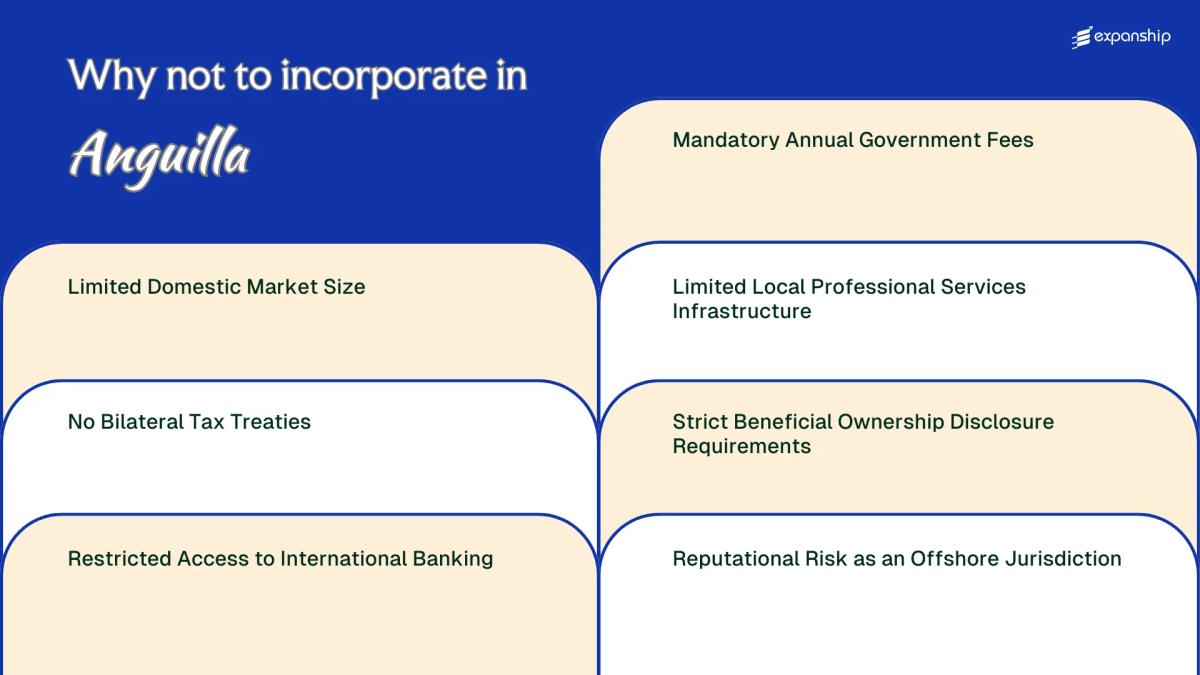
Limited Domestic Market Size
Anguilla's small domestic market limitations make it a structurally unsuitable base for any business that depends on local consumer demand. With a resident population of approximately 18,000 people, the addressable market for goods or services sold within the territory is negligible.
Scale Constraints on Revenue Generation
Your business cannot realistically sustain domestic sales revenue at a commercially viable scale. Most entities registered under the Anguilla Companies Act operate as holding structures or offshore service vehicles precisely because the local consumer base offers no meaningful revenue opportunity.
Operational Dependency on External Markets
Any firm incorporated here must generate its income entirely from foreign markets, which introduces cross-border complexity without the offset of a functioning home market. Unlike jurisdictions with mid-sized populations that allow at least partial domestic revenue, Anguilla provides no such buffer.
This dependency on external markets means your entity's commercial viability rests entirely on conditions outside the jurisdiction's control.
If your business model requires any level of domestic market access or local customer acquisition, an Anguilla-incorporated entity will provide no viable path to achieving that objective.
No Bilateral Tax Treaties
Anguilla no bilateral tax treaties is not merely an administrative gap — it directly affects how your business income gets taxed across borders. The territory has not entered into any double taxation agreements with other countries, meaning income earned by an Anguillan entity that also triggers tax liability in a foreign jurisdiction receives no treaty-based relief.
For a foreign business owner, this creates a structurally inefficient tax position. Two separate tax authorities can claim jurisdiction over the same income stream, with no legal framework to resolve the overlap.
This absence generates specific operational burdens:
- Dividends, royalties, and service fees paid from a treaty-network country to your Anguillan entity may attract full withholding tax at domestic rates, with no reduction available
- You cannot use treaty tie-breaker rules to establish residency status, complicating cross-border income classification
- Counterparties in jurisdictions like Germany or Japan may impose higher withholding rates on payments to entities registered in non-treaty territories
- Tax credit claims in your home country become harder to substantiate without a treaty framework to reference
Countries with even modest treaty networks — such as Mauritius with 46 agreements — give resident entities structured access to reduced withholding rates. Your Anguillan company has no equivalent mechanism.
 Anguilla
 Company Incorporation in Anguilla
Set up your Anguillan entity with full visibility into its tax position and cross-border compliance obligations.
Restricted Access to International Banking
Anguilla offshore banking access restrictions represent one of the most immediate operational challenges for foreign business owners. Banks in major financial centres, particularly in the United States, United Kingdom, and European Union, apply heightened due diligence to companies incorporated in Caribbean offshore jurisdictions under anti-money laundering frameworks such as FATF guidance and internal correspondent banking policies.
The practical consequence is that many tier-one banks will decline account applications outright, regardless of the legitimacy of your business activities.
| Friction Point | Specific Burden |
|---|---|
| Correspondent banking refusals | Major US and EU banks routinely reject account applications from Anguilla IBCs without review of underlying business |
| Enhanced due diligence requirements | Applicants typically must provide multi-year audited financials, ownership structures, and source-of-funds documentation exceeding standard requirements |
| Account opening timelines | Where acceptance is possible, processing periods at offshore-friendly banks frequently extend to 90-180 days |
| Geographic restrictions | Many accepting banks limit transaction currencies or restrict payments to specific high-risk counterparty regions |
Alternative banking solutions, typically in jurisdictions such as Mauritius, Georgia, or certain Eastern European markets, tend to impose higher monthly maintenance fees and transaction costs than comparable accounts in mainstream financial centres. Your firm's payment processing and treasury operations absorb those costs directly.
Anguilla companies incorporated under the International Business Companies Act do not benefit from any bilateral financial services agreement that would ease correspondent banking relationships. This structural gap distinguishes the jurisdiction from onshore incorporation options where established banking relationships are standard.
Mandatory Annual Government Fees
Anguilla mandatory annual government fees apply to all registered business entities, including International Business Companies (IBCs) and Limited Liability Companies (LLCs), regardless of whether the company conducted any activity during the year. These fees are non-negotiable and recurring, meaning dormant entities carry the same financial obligation as active ones.
Under the Anguilla Companies Act and the associated fee schedule administered by the Financial Services Commission, annual renewal costs are structured as flat-rate government fees. For IBCs and LLCs, these renewal fees fall in the range of several hundred US dollars annually, though exact amounts depend on the entity type and authorized share capital.
Missing the renewal deadline results in late penalties and, if left unresolved, eventual striking off of the entity from the register. Reinstatement carries additional costs, compounding the original obligation.
- Annual government fees are payable regardless of company activity or revenue
- Deadlines are set annually; failure to pay triggers penalty fees under the Companies Act
- Struck-off companies face reinstatement fees on top of unpaid annual dues
- Fees are assessed per entity, so holding multiple structures multiplies the recurring cost
Did You Know? An Anguilla IBC that has been struck off the register can be reinstated, but only within a limited statutory window, after which the company name may become available for registration by a third party.
Limited Local Professional Services Infrastructure
Anguilla's limited professional services infrastructure creates tangible operational gaps for foreign business owners who require on-island legal, accounting, or compliance support.
Shallow Local Expertise Pool
The territory's small population, under 20,000 residents, means the number of qualified solicitors, corporate attorneys, and licensed accountants actively serving international business clients is limited. If your entity requires specialised legal opinions, complex structuring advice, or formal audit work, you will likely need to engage professionals based in larger Caribbean jurisdictions or internationally, adding cost and coordination delays.
Registered agents operating under the Anguilla Financial Services Commission are generally equipped to handle routine filing obligations. However, their scope typically stops short of substantive legal counsel or cross-border tax advisory, meaning the gap between administrative compliance and strategic professional support falls entirely on the business owner to fill externally.
Consequences for Ongoing Operations
Sourcing qualified external professionals unfamiliar with Anguilla-specific corporate law, including the Companies Act and LLC Act, introduces the risk of misapplied advice. Reliance on offshore professional support also increases costs compared to jurisdictions where a deeper local services market creates competitive pricing for corporate legal work.
Anguilla Professional Support for Your Anguilla Entity
Get guidance on sourcing qualified legal, compliance, and advisory services for your Anguilla-incorporated business.
Strict Beneficial Ownership Disclosure Requirements
Anguilla beneficial ownership disclosure requirements have become significantly more stringent following the territory's adoption of frameworks aligned with FATF standards and UK overseas territory directives. Foreign business owners face concrete, ongoing disclosure obligations that go beyond simple registration.
- Under the Anguilla Beneficial Ownership Secure Search System (BOSS), any individual holding 25% or more of shares or voting rights in a company must be recorded, creating an administrative tracking burden for structures with multiple or layered ownership tiers.
- Failure to maintain accurate and current UBO data can result in regulatory penalties imposed by the Anguilla Financial Services Commission, directly exposing your business to enforcement action.
- Beneficial ownership risks in Anguilla IBCs are heightened for clients from high-scrutiny jurisdictions, as their disclosed information may be accessible to foreign competent authorities through information exchange agreements.
- Updating ownership records following any structural change requires timely filings, meaning even routine corporate reorganizations generate compliance costs for foreign-held entities.
Reputational Risk as an Offshore Jurisdiction
Anguilla offshore jurisdiction reputational risks are a practical concern that can affect how banks, institutional partners, and counterparties assess your business. The territory is widely categorized as a tax haven, and that classification carries operational consequences independent of your firm's actual conduct.
Correspondent banks and payment processors frequently apply enhanced due diligence to entities registered in low-tax Caribbean jurisdictions. This means longer onboarding timelines, higher documentation requirements, and a statistically greater chance of account rejection compared to companies incorporated in OECD member states.
- Some EU and UK financial institutions apply blanket restrictions to offshore-registered entities during counterparty screening.
- Suppliers and enterprise clients in regulated industries may require additional verification before entering contracts with your company.
- Audit firms in certain jurisdictions charge premium rates to sign off on financials tied to offshore structures.
The OECD's Global Forum on Transparency and Exchange of Information has historically scrutinized Caribbean jurisdictions, and any future listing or adverse review could compound existing perception problems for your entity.
Hypothetical scenario: A technology firm incorporated in the territory applies to open a business account with a mid-tier European bank. The bank's compliance team flags the jurisdiction and requests 14 additional documents, including a detailed substance report, delaying account activation by 11 weeks and incurring approximately $3,200 in legal preparation costs.
Overcoming These Incorporation Drawbacks
Overcoming Anguilla incorporation drawbacks requires deliberate structural planning before the entity is formed, not after problems arise. The jurisdiction's regulatory framework, administered under statutes such as the Limited Liability Company Act and overseen by the Anguilla Financial Services Commission, sets defined parameters within which most challenges can be addressed.
- Appoint a licensed registered agent in Anguilla, as required under local company law, to ensure ongoing statutory compliance and timely fee payments.
- Establish banking relationships across multiple jurisdictions before incorporation, given that domestic banking options are limited.
- Maintain auditable beneficial ownership records consistent with the Beneficial Ownership Secure Search System Act to meet disclosure obligations.
- Select a company structure, such as an LLC or IBC, that aligns with the specific operational and tax reporting requirements of your home jurisdiction.
- Engage correspondent banking arrangements through jurisdictions with treaty networks to partially offset the absence of bilateral tax agreements.
Mitigating risks of Anguilla company formation is possible, but each step carries its own compliance obligations. The solutions available operate within a tightly regulated offshore framework, and none eliminate the structural constraints already discussed.
Anguilla's Overall Value for Businesses
Weighing the Anguilla company formation pros and cons produces a picture that is neither uniformly favorable nor damning. The jurisdiction operates under a functioning legal framework, the Companies Act and the Limited Liability Company Act, and continues to attract international registrations. That standing, however, depends on whether your business can absorb the structural limitations documented throughout this blog.
| Pros | Cons |
|---|---|
| No corporate income tax on offshore profits under the current tax regime | No bilateral tax treaties, leaving you exposed to withholding taxes in counterparty jurisdictions |
| Low and predictable annual government fees for IBCs and LLCs | Mandatory fees apply regardless of trading activity or revenue |
| Privacy protections exist within a regulated legal framework | Beneficial ownership disclosure requirements apply under the Proceeds of Crime Act framework |
| Established common law legal system derived from English law | Local professional services infrastructure is thin, often requiring reliance on overseas advisors |
| Minimal paid-up capital requirements for company formation | Restricted access to correspondent banking limits transactional functionality |
| Straightforward incorporation process through the Anguilla Financial Services Commission | Offshore jurisdiction status carries reputational risk with counterparties and financial institutions |
Evaluating the Anguilla jurisdiction for business ultimately comes down to operational fit. Your entity needs reliable banking access and treaty protection to function commercially — two areas where this jurisdiction presents documented constraints.
Anguilla Compliance Services for Companies in Anguilla
Maintain good standing under the Anguilla Financial Services Commission's requirements, including annual filings, beneficial ownership obligations, and renewal of registration.
Conclusion
Anguilla incorporation risks and limitations are real and measurable. The absence of double tax treaties exposes your entity to unrelieved withholding taxes in counterparty jurisdictions, while correspondent banking restrictions continue to affect account access for Anguillan firms. Reputational scrutiny tied to the territory's offshore status adds a compliance burden that affects relationships with banks, investors, and counterparties alike. Structural decisions made at registration carry long-term consequences. Professional guidance specific to the territory's regulatory framework, including obligations under the Financial Services Commission, remains a practical necessity.
Expanship's Support for Your Anguilla Expansion
Expanship Anguilla company formation support extends specifically to the compliance obligations that make this jurisdiction more demanding than it first appears. From coordinating with the Anguilla Financial Services Commission on beneficial ownership registration to managing annual government fee submissions, the operational workload compounds quickly. Expanship's role is to reduce that burden, not remove the obligations themselves.
Our services cover the full incorporation and maintenance cycle for your Anguilla entity:
- We prepare and file all company registration documents with the relevant Anguillian authorities.
- A registered agent and local office address are provided to satisfy statutory requirements.
- We handle government filings and liaise directly with regulatory bodies on your behalf.
- Ongoing post-incorporation compliance is managed to keep your firm in good standing.
- Banking introduction support is available to help your business establish an appropriate account relationship.
- Tax registration and liaison with local authorities is handled as part of the setup process.
Reach out through Expanship Anguilla to discuss your specific requirements.
Frequently Asked Questions (FAQ)
The lack of tax treaties affects any business that generates income from jurisdictions that apply withholding taxes on dividends, royalties, or interest payments. Because Anguilla has no double taxation agreements in force, income flowing from treaty-reliant countries to an Anguilla entity is taxed at source without any reduction or credit mechanism, increasing the effective tax cost for businesses with cross-border revenue streams. Companies operating entirely within zero-withholding-tax environments are less exposed, but that scenario is increasingly uncommon.
Anguilla IBCs are subject to annual renewal fees payable to the Anguilla Financial Services Commission, and failure to pay on time results in the company falling into arrears, which can lead to administrative strike-off under the International Business Companies Act. Reinstatement is possible but involves penalty fees on top of the outstanding amounts. A struck-off entity loses its legal standing, which can invalidate contracts and banking arrangements tied to the company.
Under the Anguilla Beneficial Ownership Secure Search System Act, beneficial ownership information must be filed with a registered agent and is accessible to competent authorities upon request, including for tax and law enforcement purposes. This is not a fully public register, so the general public cannot search ownership records, but foreign governments and regulators can obtain the data through information exchange agreements. If your business involves investors or principals who require strict confidentiality from public disclosure, the current framework provides some protection, but the data is not sealed from regulatory access.
Anguilla carries comparable offshore jurisdiction risk to the BVI and Cayman Islands in terms of international perception, but it has considerably less institutional infrastructure than either. The BVI and Cayman Islands have larger legal service ecosystems, more established banking relationships, and greater familiarity among institutional counterparties, which means Anguilla entities may face more friction in practice even when the legal structure is sound. For businesses that need a well-recognised offshore brand name, Anguilla's lower profile works against it.
Yes, directly. Institutional investors, private equity firms, and development finance institutions often apply negative screening to entities registered in jurisdictions on EU or OECD watchlists, and Anguilla has faced scrutiny in this context. If your business is seeking external funding, some investors will require restructuring through a more recognised holding jurisdiction before committing capital. This is a structural issue tied to the jurisdiction itself, not something resolved by improving the company's internal governance.
Non-compliance with beneficial ownership filing requirements under the Beneficial Ownership Secure Search System Act can result in civil penalties imposed on the registered agent and, depending on the nature of the breach, criminal liability for the officers involved. The Anguilla Financial Services Commission oversees enforcement and has the authority to direct registered agents to remediate filing deficiencies within specified timeframes. Persistent non-compliance risks the revocation of the registered agent's licence, which would force all companies on that agent's register to find a replacement or face strike-off.
It does, particularly for companies that require ongoing legal, accounting, or corporate secretarial support beyond basic registered agent services. The pool of qualified local practitioners is small, meaning demand for specialist services often has to be met by offshore advisors, which adds cost and coordination complexity. If your structure requires local substance, such as resident directors or locally managed operations, finding qualified and available professionals in Anguilla is genuinely harder than in larger offshore centres.
Legal Disclaimer
The information provided in this article is for general informational purposes only and does not constitute legal, tax, or professional advice. While we strive to ensure the accuracy and timeliness of the content, laws and regulations are subject to change, and the application of laws can vary widely based on specific facts and circumstances.
Readers should not act upon this information without seeking professional counsel tailored to their individual situation. Expanship and its authors disclaim any liability for actions taken or not taken based on the content of this article.
For specific advice regarding your business setup, compliance requirements, or any legal matters, please consult with qualified legal and tax professionals in the relevant jurisdiction.