

Key Takeaways
- Anguilla's International Business Companies Act codifies a zero-tax position on offshore income, profits, and capital gains, meaning qualifying IBC structures carry none of the fiscal drag imposed by higher-tax jurisdictions.
- Beneficial ownership details are shielded from public disclosure under the International Business Companies Act, giving foreign owners a defined privacy framework without exposure through public registries.
- Foreign nationals can hold 100% ownership of an Anguilla IBC without appointing a local director or maintaining a physical presence, reducing structural overhead while remaining compliant.
- Oversight by the Financial Services Commission within a British Overseas Territory constitutional framework provides the legal predictability of a UK-linked system without the associated tax obligations for offshore entities.
Anguilla is a British Overseas Territory in the eastern Caribbean, operating under a stable constitutional framework with the United Kingdom retaining responsibility for defense and foreign affairs. Domestic company registration falls under the oversight of the Financial Services Commission, which administers corporate filings and licensing for entities formed on the island. Foreign businesses incorporating here most commonly do so through an International Business Company.
The territory maintains a zero-tax posture for offshore entities, imposing no tax on income, profits, or gains derived outside its borders. Foreign ownership is broadly permitted, with no statutory restrictions on non-residents holding full ownership of a locally registered business. This openness extends to corporate structures, where you are not required to appoint a local director or maintain a physical presence to operate a compliant entity.
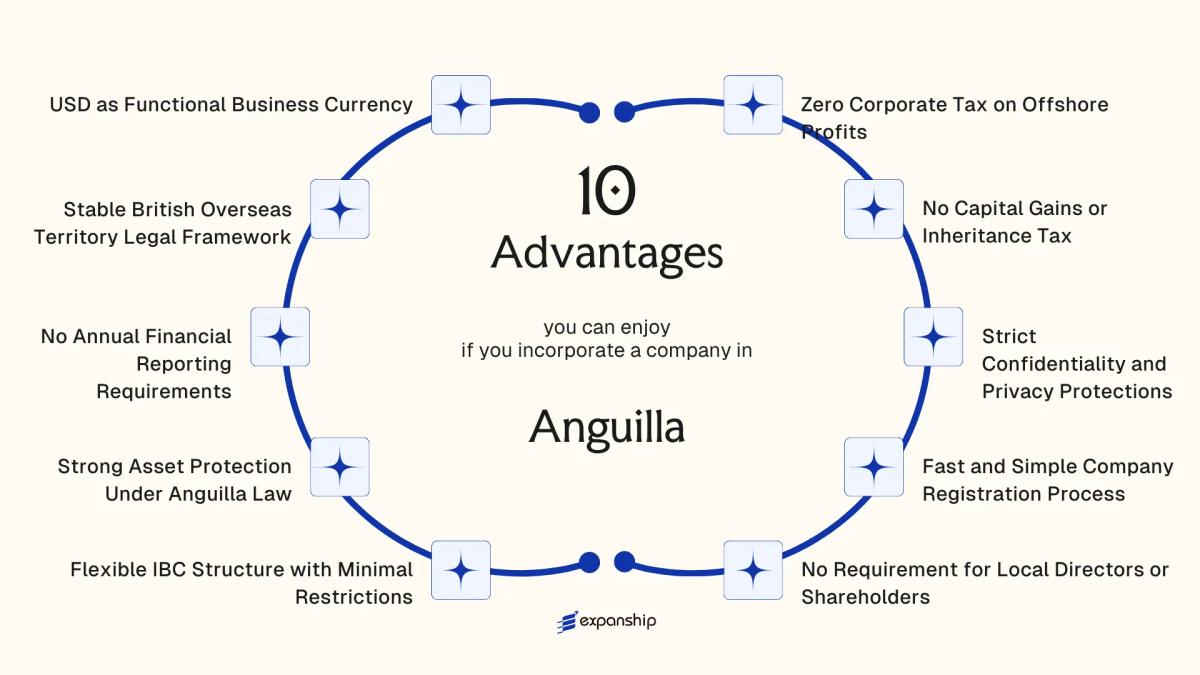
The benefits of incorporating in Anguilla span tax treatment, privacy protections, structural flexibility, and legal stability. This article examines each of those advantages in detail.
Zero Corporate Tax on Offshore Profits
Under the International Business Companies Act (IBC Act), companies incorporated in Anguilla and conducting business exclusively outside the territory pay zero corporate tax on offshore profits. This single structural feature has direct consequences for how foreign-owned firms retain and deploy earnings.
How the Zero-Rate Applies to Your Business
An IBC registered under the Anguilla IBC Act qualifies for full exemption from corporate income tax on profits generated outside Anguilla. No partial rates apply, no minimum tax thresholds exist, and the exemption is not time-limited — it holds for the life of the entity, provided offshore activity remains the operational basis.
This means every dollar of qualifying offshore profit stays within the business rather than being remitted to a tax authority. For firms routing international consulting fees, trading income, or licensing revenue through the entity, the cumulative retention advantage over a standard jurisdiction taxing at 20–25% is substantial over a multi-year period.
What Qualifies as Offshore Income
The exemption applies specifically to income sourced from outside the territory. Transactions with Anguilla residents or locally derived revenue fall outside this protection, which is a standard carve-out under the IBC framework.
Foreign business owners structuring cross-border operations — where clients, contracts, and services are entirely outside the jurisdiction — can treat the full Anguilla IBC tax exemption benefits as unconditional within those parameters.
Profits earned outside Anguilla are not subject to corporate tax at the entity level, allowing full reinvestment or distribution without a local tax charge.
No Capital Gains or Inheritance Tax
Anguilla's International Business Companies Act imposes no capital gains tax on IBCs. Profits derived from asset sales, property disposals, or investment portfolios held through a registered IBC are not subject to any capital gains charge. For an investor structuring cross-border transactions or holding appreciating assets offshore, this means returns accumulate without a deduction at the point of realization.
Inheritance tax is equally absent. Assets held within an Anguilla IBC do not trigger estate or succession duties upon transfer, which has direct implications for wealth structuring across generations. Ownership can pass through share transfers without the tax friction that onshore estate regimes typically impose.
The practical advantages of this tax posture extend across several asset classes:
- Equity holdings in foreign companies can be sold without creating a local tax event inside the IBC
- Real estate held through the structure benefits from the same treatment on disposal gains
- Dividend income and interest receipts are not reclassified as capital in ways that create unexpected exposure
- Share reorganizations within a group structure do not attract gains-based levies under Anguilla's IBC framework
These exemptions apply to qualifying offshore business activity. Transactions conducted within Anguilla itself fall under separate domestic rules, so the distinction between onshore and offshore operations remains relevant to how the IBC is used.
 Anguilla
 Incorporate a Company in Anguilla
Register an IBC in Anguilla and access a tax-neutral structure with no capital gains, no inheritance tax, and no levy on offshore profits.
Strict Confidentiality and Privacy Protections
Anguilla company confidentiality protections are grounded in statute, not convention. Under the International Business Companies Act (as revised), the names of shareholders and directors of an IBC are not filed on any public register. No government database in the territory exposes beneficial ownership to general public access, which means third parties cannot identify who controls your company through routine registry searches.
| Privacy Element | Public Disclosure Required | Governing Instrument |
|---|---|---|
| Shareholder names | No | IBC Act (Revised) |
| Director names | No | IBC Act (Revised) |
| Beneficial owner identity | No (held by registered agent only) | AML/CFT Regulations |
| Share register | No | IBC Act (Revised) |
| Financial statements | No | IBC Act (Revised) |
Beneficial ownership information is held confidentially by the licensed registered agent, who is bound by the Anguilla Financial Services Commission's regulatory requirements. This structure keeps sensitive ownership data within a controlled, professionally supervised channel rather than exposing it through public filings.
For investors managing assets across multiple jurisdictions, this matters practically. Litigation adversaries, competitors, and unsolicited claimants cannot confirm corporate ownership through public sources. Your name does not appear on any document accessible without legal process. That separation between public record and actual control is a structural privacy feature, not a procedural gap that could be closed by a registry update.
Fast and Simple Company Registration Process
Anguilla's fast company registration benefits are most visible in the time between application and incorporation. Under the International Business Companies Act (the governing statute for IBC formation), a company can typically be registered within one to two business days once documentation is submitted through a licensed registered agent. For foreign business owners, that speed directly reduces the window during which capital sits idle and contracts cannot be signed.
The registered agent handles filing with the Anguilla Financial Services Commission on your behalf. Your physical presence is not required at any stage, which removes the logistical burden of travel or in-person notarization that several other offshore jurisdictions still impose.
Documentation requirements are minimal. A standard IBC formation requires a memorandum and articles of association, basic identification for beneficial owners, and payment of the government registration fee. No local witness, no consular authentication in most cases.
- Confirm your registered agent is licensed by the Anguilla Financial Services Commission
- Prepare certified copies of identification documents before submission
- Verify your chosen company name against the official registry before filing
- The IBC Act does not permit business activity within Anguilla itself; the entity must operate internationally
That short formation window means your entity can be operational, open bank accounts, and execute agreements within days rather than weeks. For time-sensitive transactions, that difference carries real commercial weight.
An Anguilla IBC can be incorporated without a company seal, which is a requirement still mandated by several competing offshore jurisdictions.
No Requirement for Local Directors or Shareholders
Under the Anguilla International Business Companies Act (the IBC Act), there is no statutory requirement for any director or shareholder of an IBC to be a resident of the territory. A single individual or corporate entity can hold all shares and fill all director positions simultaneously, regardless of nationality or country of residence. This is the core of the Anguilla no local director requirement benefit: your ownership and management structure can remain entirely offshore.
Full Foreign Ownership Without Structural Compromise
An IBC may be incorporated with a minimum of one director and one shareholder, both of whom can be the same non-resident person. No local nominee is legally mandated to satisfy formation requirements, which means you retain direct control over the entity without routing authority through a third party.
That absence of a residency condition removes a layer of cost and governance complexity that exists in many competing jurisdictions where at least one director must hold local residency or citizenship.
Consolidating Control Across Borders
For groups operating across multiple jurisdictions, the ability to appoint existing group directors or holding company officers as directors of the Anguilla entity keeps your corporate chain clean and auditable. There is no need to fragment decision-making authority to satisfy a local presence rule.
Corporate shareholders are equally permitted, so a parent company incorporated elsewhere can directly own 100% of the IBC's shares without an intermediate local holding structure.
Anguilla Structure Your Anguilla IBC With Full Foreign Control
Speak with our corporate specialists about appointing directors and shareholders for your Anguilla IBC without any local residency requirements.
Flexible IBC Structure with Minimal Restrictions
The Anguilla IBC flexible structure advantages stem directly from the International Business Companies Act, which imposes minimal operational constraints on foreign-owned entities. Under this legislation, an IBC faces almost no restrictions on the type of business activities it may conduct outside the territory, giving you broad latitude to structure operations around your commercial needs rather than around regulatory compliance.
- There is no minimum capital requirement under the IBC Act, meaning you can incorporate with whatever share capital suits your business model without satisfying a statutory threshold.
- An IBC may issue shares in any currency, in multiple classes, and with or without par value, allowing you to structure equity arrangements that reflect investor agreements precisely.
- The company may hold its meetings anywhere in the world, or conduct them entirely in writing, removing any obligation to convene directors or shareholders within the territory.
- An IBC can be incorporated with a single shareholder and a single director, both of whom may be the same person, reducing structural overhead for sole operators or small firms.
- The entity may amend its Memorandum and Articles of Association after incorporation with relative procedural ease, so the firm's governing documents can evolve as your business does.
Strong Asset Protection Under Anguilla Law
Anguilla asset protection for businesses rests on a legal framework that separates your personal assets from corporate liabilities with statutory precision. Under the International Business Companies Act (Revised Statutes of Anguilla, Chapter I20), an IBC is treated as a distinct legal person, meaning creditors pursuing claims against the company generally cannot reach the personal wealth of shareholders.
Beyond standard corporate separation, Anguilla permits the use of charging orders as the primary remedy for judgment creditors seeking to reach IBC interests. This limits a creditor's ability to seize or liquidate company assets directly, restricting them instead to receiving economic distributions if and when the company makes them.
Foreign judgments are not automatically enforceable against an Anguilla-registered entity. A creditor must re-litigate their claim before a local court, which applies Anguillan law rather than the originating jurisdiction's standards.
Hypothetical scenario: A foreign investor holds $2 million in business assets through an Anguilla IBC. A judgment creditor from their home country obtains a civil court ruling. To pursue those assets, the creditor must initiate separate proceedings in Anguilla, incurring additional legal costs and time, during which the investor's assets remain shielded behind a distinct corporate structure governed by Anguillan statute.
No Annual Financial Reporting Requirements
Under the Anguilla International Business Companies Act, IBCs are not required to file annual financial statements, audited accounts, or annual returns with any government authority. This Anguilla no annual financial reporting requirement means your company's financial records remain entirely internal, with no statutory obligation to disclose them to a regulator or the public.
The practical implication is significant. Preparing and filing audited accounts in jurisdictions like the UK or EU member states typically costs thousands of dollars annually and demands considerable management time. An Anguilla IBC avoids that cost structure entirely.
Your firm is still required to maintain accounting records sufficient to reflect its financial position, but:
- Records do not need to be filed with the Registrar of Companies
- No audit is mandated under the IBC Act
- No minimum accounting standard is prescribed for internal records
This Anguilla offshore company no audit requirement is particularly advantageous for holding companies, special-purpose vehicles, and entities with straightforward financial activity, where the administrative overhead of formal reporting would otherwise consume a disproportionate share of operating resources.
This reporting exemption applies specifically to IBCs incorporated under the IBC Act; entities engaged in regulated activities such as banking or insurance are subject to separate reporting obligations under their respective licensing frameworks.
Stable British Overseas Territory Legal Framework
Anguilla's status as a British Overseas Territory is a structural legal advantage that shapes how foreign-owned entities operate within the jurisdiction. Anguilla British Overseas Territory legal stability derives from a constitutional relationship with the United Kingdom that has remained intact for decades, providing a governance foundation that most purely independent offshore jurisdictions cannot replicate.
Constitutional and Legislative Grounding
The territory operates under its own Constitution, the Anguilla Constitution Order 1982, with a locally elected House of Assembly responsible for domestic legislation. At the same time, UK constitutional principles and oversight mechanisms apply at the governmental level. This dual-layer structure means your business is incorporated in a jurisdiction that maintains formal accountability to one of the world's most established legal systems.
Common Law Jurisdiction
Anguilla applies English common law as the foundation of its legal system, including principles of contract, property, and corporate law. For foreign business owners, this means disputes, agreements, and corporate governance questions are interpreted through a legal tradition that is widely recognized and understood internationally. Common law precedent from English courts carries persuasive authority in Anguillian proceedings, which reduces legal uncertainty when structuring cross-border arrangements.
Judicial Oversight Structure
The Eastern Caribbean Supreme Court has jurisdiction over civil and commercial matters, with further appeals available to the UK Privy Council. Access to the Privy Council as a final appellate body provides a meaningful check on judicial outcomes.
- Final appeal to the UK Privy Council is available
- Eastern Caribbean Supreme Court governs commercial disputes
- English common law principles apply directly to contract and corporate matters
USD as Functional Business Currency
Anguilla uses the Eastern Caribbean Dollar (XCD) as its official currency, but the USD functional currency business advantage here is structural: the XCD is pegged to the US dollar at a fixed rate of 2.7 XCD to 1 USD, a peg maintained by the Eastern Caribbean Central Bank (ECCB) since 1976. For a foreign business owner, this means your USD-denominated contracts, invoices, and treasury positions carry no meaningful conversion risk relative to the local operating environment.
International Business Companies (IBCs) incorporated under the Anguilla Companies Act can conduct business, hold accounts, and maintain financial records in US dollars. Because the vast majority of offshore transactions your entity processes will be in USD, there is no friction between your functional reporting currency and the currency in which you actually operate.
The practical consequences for cross-border commerce are direct:
- USD invoicing to clients in North America, the Caribbean, or internationally requires no conversion layer before funds reach your company account
- Banking relationships established through Anguilla-based or correspondent institutions can be structured entirely in USD without currency mismatch
- Asset valuations, intercompany loans, and equity contributions denominated in USD remain stable against the local peg, avoiding the mark-to-market exposure common in jurisdictions with floating currencies
For investors structuring holding vehicles or operating entities that transact predominantly in US dollars, the fixed peg eliminates the currency translation adjustments that complicate consolidated reporting under IFRS or US GAAP. That reduction in accounting complexity has a measurable effect on the cost and time required to maintain your books.
Why Anguilla Outshines Other Offshore Jurisdictions
Compared to similarly positioned offshore jurisdictions, the Anguilla advantages over other offshore jurisdictions become clearest when examined against the specific structural features each territory offers. BVI and Cayman Islands are the most direct points of comparison, given that all three target the same profile of foreign investor: non-resident business owners seeking a low-tax, common-law incorporation environment in the Caribbean. The choice between them is rarely about eligibility and almost always about cost, privacy, and administrative burden.
Where the distinction matters most is in ongoing compliance. BVI IBCs are subject to more prescriptive economic substance requirements under the BVI Economic Substance Act, and Cayman Islands entities face higher government fees and more intensive regulatory oversight from the Cayman Islands Monetary Authority. For a foreign business operating outside either territory, those requirements create friction that Anguilla's framework, governed by the International Business Companies Act, does not impose at the same threshold.
| Parameter | Anguilla | BVI | Cayman Islands |
|---|---|---|---|
| Annual government fee | Low (fixed, flat-rate) | Moderate to high (share capital-based) | High |
| Corporate tax on offshore profits | 0% | 0% | 0% |
| Beneficial ownership public register | No | Partially advancing | No |
| Economic substance requirements | Limited applicability for IBCs | Broader application | Broader application |
| Director/shareholder residency requirement | None | None | None |
| Annual financial reporting to regulator | Not required for IBCs | Not required for IBCs | Not required for exempted companies |
Anguilla Compliance Services for Anguilla Companies
Stay current with Anguilla's regulatory requirements for international business companies, including annual renewals, registered agent obligations, and substance considerations.
Conclusion
Anguilla's value as an offshore jurisdiction rests on a combination of structural features that directly reduce administrative and tax burdens for foreign-owned businesses. The absence of corporate tax on offshore profits under the International Business Companies Act, combined with the elimination of capital gains and inheritance tax, means that the fiscal drag common in higher-tax jurisdictions does not apply to qualifying entities incorporated here. These are not incidental features; they are codified positions that affect the net economics of operating through this structure.
Privacy protections under the International Business Companies Act further reinforce the case. Beneficial ownership information is not exposed through public registries, and the requirement to maintain a registered agent within the territory provides a defined, manageable compliance anchor without the overhead of a local operational presence.
The benefits of incorporating in Anguilla are most pronounced for business owners whose activities are genuinely international and whose income is sourced outside the jurisdiction. The IBC structure suits holding arrangements, IP ownership, and international trading operations, though suitability depends on your residency, the nature of your income, and the tax rules of your home country. Understanding how these structural features align with your specific circumstances determines whether the model delivers its full advantage.
Start Your Anguilla Company with Expanship Today
To start an Anguilla company with Expanship, you work with a team that handles the full formation and ongoing compliance lifecycle for International Business Companies registered under the Anguilla International Business Companies Act. Every engagement is coordinated directly with the Financial Services Commission, the statutory body that oversees IBC registration, licensing, and regulatory standing in the territory.
Expanship's services across the Anguilla formation process include:
- Preparation and legalization of all incorporation documents, including the Memorandum and Articles of Association
- Registered agent and registered office provision, as required under Anguillian law
- Government filing and direct liaison with the Financial Services Commission
- Post-incorporation compliance management, including annual license fee renewals
- Document certification and apostille processing for cross-border use
- Banking introduction assistance for corporate account establishment
Your firm's ongoing good standing depends on meeting annual obligations on time. Expanship tracks those deadlines and manages the administrative relationship with the relevant authorities on your behalf, reducing the exposure that comes from managing an offshore entity remotely without local support.
Reach out to Expanship Anguilla to discuss your formation requirements.
Frequently Asked Questions (FAQ)
Anguilla IBCs are subject to zero corporate tax on profits derived from activities conducted outside the territory. This exemption is built into the International Business Companies Act, which governs the taxation treatment of qualifying offshore entities. Income sourced domestically, however, falls outside this exemption and may be treated differently under local fiscal rules.
No annual financial statements or audited accounts are required to be filed with the Anguilla Financial Services Commission for a standard IBC. The entity must maintain records sufficient to reflect its financial position, but these do not need to be submitted to any public registry or regulatory body. This distinguishes Anguilla from jurisdictions that impose mandatory public disclosure of company accounts.
Incorporation can generally be completed within one to two business days once all required documents are submitted to the registered agent. The Anguilla Financial Services Commission oversees the regulatory framework, while the day-to-day filing process is handled through licensed registered agents operating on the island. Delays typically arise from incomplete documentation rather than processing backlogs.
Anguilla's confidentiality protections are governed by local statute, but they do not make the jurisdiction immune to international legal obligations or mutual legal assistance requests. If a recognized foreign court or an international treaty mechanism compels disclosure, local authorities may be required to cooperate depending on the nature of the request and applicable agreements. Confidentiality provisions operate as a default protection against casual or commercially motivated disclosure, not as an absolute shield against legitimate judicial processes.
Anguilla operates under English common law principles as a British Overseas Territory, meaning its courts apply legal precedents that are broadly consistent with those of other common law systems. The judicial structure includes a right of appeal to the Eastern Caribbean Supreme Court and, in certain cases, further appeal to the Privy Council in London. This appellate framework gives asset protection structures formed under Anguilla law a degree of judicial predictability that purely civil law or hybrid jurisdictions may not offer.
Yes, the US dollar is the functional currency in Anguilla, so an IBC can hold accounts, issue invoices, and record its financials in USD without any mandatory conversion to a local currency. There is no central bank in Anguilla imposing currency controls on offshore entities, which simplifies cross-border treasury operations. This is particularly relevant for companies transacting with counterparties in North America or other USD-denominated markets.
No, British Overseas Territory status does not bring an Anguilla-incorporated company within the scope of UK corporate tax law or UK financial regulation. The territory has its own legislative assembly and administers its own tax and corporate statutes independently, including the International Business Companies Act. UK regulatory bodies such as the Financial Conduct Authority have no jurisdiction over Anguilla IBCs unless those entities separately conduct regulated activities within the United Kingdom.
Legal Disclaimer
The information provided in this article is for general informational purposes only and does not constitute legal, tax, or professional advice. While we strive to ensure the accuracy and timeliness of the content, laws and regulations are subject to change, and the application of laws can vary widely based on specific facts and circumstances.
Readers should not act upon this information without seeking professional counsel tailored to their individual situation. Expanship and its authors disclaim any liability for actions taken or not taken based on the content of this article.
For specific advice regarding your business setup, compliance requirements, or any legal matters, please consult with qualified legal and tax professionals in the relevant jurisdiction.