
Key Takeaways
- Foreign-owned companies must navigate registration requirements across multiple statutory bodies simultaneously, including the CIPC, SARS, and SARB, with no single consolidated process available.
- The Companies Act 71 of 2008 exposes directors to personal liability under reckless trading provisions, meaning limited liability protection is not unconditional for those managing South African entities.
- Non-resident shareholders face a compounding compliance burden through SARB exchange control regulations, which restrict how capital is moved in and out of the country and require prior approval for many cross-border transactions.
- Businesses operating in transformation-sensitive industries carry an additional structural obligation through B-BBEE compliance, where ownership levels, management representation, and procurement sourcing are all subject to formal measurement and reporting.
South Africa operates under a heavily regulated corporate framework, where multiple statutory bodies govern different aspects of business registration, taxation, and ongoing compliance. The disadvantages of incorporating in South Africa span regulatory, financial, and structural categories — each with distinct implications depending on how your business is set up.
Not every foreign investor will encounter these challenges equally. The cons of registering a company in South Africa tend to be most pronounced for non-resident shareholders, foreign-owned private companies, and businesses operating in regulated or transformation-sensitive industries.
Applicable obligations also shift based on entity type, annual turnover, and the percentage of foreign ownership involved. The Companies Act 71 of 2008 is the primary legislation governing company formation and corporate conduct, but it operates alongside a layered set of tax, exchange control, and empowerment frameworks.
This article is most relevant to foreign investors and multinational firms evaluating a South African subsidiary or branch registration for the first time.
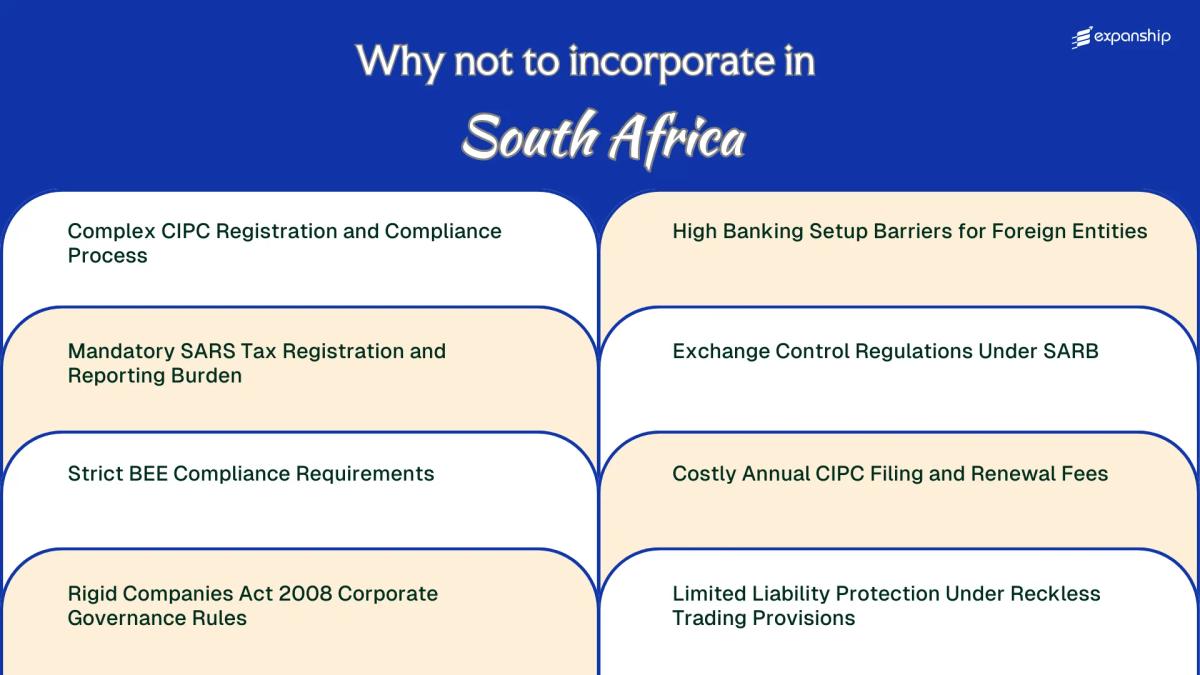
Complex CIPC Registration and Compliance Process
CIPC registration challenges South Africa are more procedural than many foreign founders anticipate, and the administrative load begins before your business generates a single rand.
A Multi-Step Process With Institutional Dependencies
Incorporating a private company (Pty Ltd) requires filing through the Companies and Intellectual Property Commission, but the process involves identity verification, name reservation, and Memorandum of Incorporation submission across systems that have historically experienced outages and processing backlogs. Each delay in CIPC processing stalls downstream requirements, including tax registration with SARS, since you cannot obtain an income tax reference number until the company exists on record.
Ongoing Compliance That Compounds the Entry Cost
Beyond incorporation, your entity must file an Annual Return with the CIPC each year, and failure to do so triggers deregistration under the Companies Act 71 of 2008. Foreign directors without South African identity numbers face additional verification friction, as the CIPC system is structured primarily around local identification documents.
A foreign-owned company that misses its CIPC Annual Return filing window risks automatic deregistration, which legally dissolves the entity and can render existing contracts and bank accounts unenforceable.
Mandatory SARS Tax Registration and Reporting Burden
The SARS tax registration burden in South Africa begins before your company earns a single rand. Every incorporated entity must register with the South African Revenue Service for income tax, and if turnover exceeds R1 million annually, for Value Added Tax as well.
Corporate income tax is levied at 27% on taxable income, following a reduction from 28% in 2022. For a foreign-owned company, that rate applies to income sourced within the country, which requires ongoing accounting to distinguish domestic from foreign revenue streams.
SARS also requires separate registrations for Pay-As-You-Earn if you employ staff, and for Skills Development Levy obligations. Each registration carries its own filing schedule, creating a parallel compliance track for each tax type.
In practice, this multiplies the administrative burden for foreign operators:
- Missing a VAT registration threshold triggers penalties and retrospective liability, forcing back-calculations across prior trading periods
- PAYE submissions are due monthly, meaning a single late payroll filing generates automatic interest charges under the Tax Administration Act 28 of 2011
- Annual corporate income tax returns require SARS-compliant financial statements, adding local accounting costs even when global financials already exist
- Provisional tax payments are due twice yearly, requiring forward income estimates that foreign directors are often poorly positioned to make accurately
Non-compliance with SARS reporting can result in administrative penalties under the Tax Administration Act, including fixed monthly penalties tied to assessed tax liability.

Company Incorporation in South Africa
Understand the full tax registration requirements before incorporating a company in South Africa.
Strict BEE Compliance Requirements
BEE compliance risks South Africa presents to foreign investors go well beyond paperwork. Under the Broad-Based Black Economic Empowerment Act 53 of 2003, as amended by the B-BBEE Amendment Act 46 of 2013, your business is scored against a generic scorecard administered by the B-BBEE Commission. That score directly determines whether you can win government contracts, access certain licences, or form partnerships with state-owned enterprises.
Foreign-owned entities typically start at a structural disadvantage. Ownership points, which carry the highest weighting on the scorecard, require that at least 25% of equity be held by black South Africans as defined under the Act. Securing that ownership stake on commercially acceptable terms is rarely straightforward for an incoming foreign firm with no existing local network.
| Scorecard Element | Points Available | Why It Burdens Foreign Firms |
|---|---|---|
| Ownership | 25 | Requires minimum 25%+ black equity; hardest element for foreign shareholders to satisfy |
| Management Control | 19 | Senior roles must reflect demographic targets foreign firms have no history meeting |
| Skills Development | 20 | Requires spend of 6% of leviable payroll on black employees specifically |
| Enterprise & Supplier Development | 40 | Demands preferential procurement from black-owned suppliers across a new supply chain |
Sector codes complicate matters further. Certain industries, including financial services and construction, operate under sector-specific codes that override the generic scorecard and impose distinct thresholds. A foreign entity entering one of these sectors cannot simply apply a standard compliance model.
Non-compliance carries concrete consequences. A low B-BBEE rating does not result in a fine, but it functionally excludes your firm from public sector procurement and from partnerships with entities that must themselves maintain supplier development scores.
Rigid Companies Act 2008 Corporate Governance Rules
The Companies Act 2008 imposes a prescriptive governance framework that applies to all registered companies, including those owned by foreign principals. For private companies, the Act mandates specific requirements around director appointments, board conduct, record-keeping, and shareholder rights that generate real administrative overhead regardless of company size.
Section 76 of the Act holds directors to both a fiduciary duty and a duty of care and skill. This dual obligation means that foreign directors operating remotely face personal liability exposure under South African law, even when they have limited involvement in day-to-day operations.
The Act also requires that certain resolutions be passed, documented, and retained in prescribed formats. A failure to maintain compliant minute books or statutory registers is an auditable offense under the Act, not merely an administrative oversight.
- Section 30 requires annual financial statements prepared under IFRS or IFRS for SMEs depending on the entity's public interest score.
- Companies above a prescribed public interest score threshold must have their financials independently reviewed or audited.
- Director changes must be filed with the CIPC within 10 business days of the change.
- Social and Ethics Committee appointment is compulsory for certain entities once they cross defined scoring thresholds.
Did You Know? A private company in South Africa can be required to appoint a mandatory Social and Ethics Committee even if it has no public shareholders, solely based on its public interest score calculation.
High Banking Setup Barriers for Foreign Entities
Opening foreign bank accounts in South Africa presents one of the most consistent banking setup barriers South Africa foreign companies report during market entry, often delaying operations by several months.
Structural Requirements That Create Delay
South African banks require extensive due diligence documentation from foreign entities, including certified constitutional documents, proof of beneficial ownership, and SARS tax reference numbers before an account can be opened. Without a local registered address or resident director, many major banks — including Absa, Standard Bank, and Nedbank — will decline the application outright, treating non-resident structures as higher-risk clients under the Financial Intelligence Centre Act (FICA).
Practical Cost of Foreign Entity Banking Challenges
South Africa business banking restrictions mean your firm may wait three to six months before receiving a functional account, effectively freezing payroll, supplier payments, and contractual obligations. The FICA compliance burden applies equally to domestic and foreign firms, but foreign entities carry a disproportionate documentation load because they cannot rely on local credit histories or existing banking relationships to satisfy Know Your Customer requirements.
Support for Banking and Compliance Challenges in South Africa
Get structured guidance on meeting FICA requirements, documentation preparation, and banking entry barriers when establishing your business in South Africa.
Exchange Control Regulations Under SARB
SARB exchange control restrictions in South Africa impose binding obligations on how foreign-owned entities move capital in and out of the country, enforced under the Currency and Exchanges Act 9 of 1933 and administered by the South African Reserve Bank.
- Any transfer of funds offshore by a locally incorporated entity requires approval through an Authorised Dealer bank, adding procedural layers that delay access to your own capital.
- Foreign investors repatriating profits or loan repayments must comply with FinSurv reporting requirements, creating recurring administrative obligations that vary by transaction type.
- Non-resident shareholders face restrictions on receiving dividends abroad, as these payments must pass through SARB's approval framework before being remitted.
- Foreign exchange regulations drawbacks compound for holding structures, where intercompany loans between a South African subsidiary and an offshore parent require documented approval and carry-through conditions.
- Breaching exchange control provisions can result in civil penalties or criminal prosecution under the Act, meaning compliance failures carry consequences beyond administrative fines.
Costly Annual CIPC Filing and Renewal Fees
CIPC annual filing costs South Africa imposes on registered companies are calculated as a percentage of the entity's authorised share capital, which means the fee scales upward as your capital structure grows. For foreign-owned businesses that register with higher share capital to reflect group funding arrangements, this formula can produce disproportionately high annual return fees compared to jurisdictions that charge flat statutory fees.
Annual returns must be filed within 30 business days of each anniversary of incorporation under the Companies Act 71 of 2008. Missing that window triggers penalty fees, and extended non-compliance can result in deregistration, which forces a costly reinstatement process.
- Annual return fees under CIPC are tiered by authorised share capital
- Late filing attracts additional CIPC penalty fees on top of the standard annual return amount
- Deregistered companies must apply for reinstatement, incurring separate administrative and legal costs
A foreign-owned private company incorporated with ZAR 10 million in authorised share capital could face an annual CIPC return fee significantly higher than the minimum rate applicable to low-capital domestic firms, with the exact amount determined by CIPC's published fee schedule tied to capital bands.
Limited Liability Protection Under Reckless Trading Provisions
The limited liability risks reckless trading South Africa framework creates under the Companies Act 71 of 2008 can strip directors of the protection that incorporation is meant to provide. Sections 22 and 77 of that Act expose directors to personal liability if the business trades recklessly, with gross negligence, or with fraudulent intent.
Unlike purely common law veil-piercing, these statutory provisions do not require a court to find deliberate abuse of the corporate form. A pattern of trading while technically insolvent, or continuing operations where losses were foreseeable, can be sufficient to trigger personal liability claims.
For foreign directors who are not resident in South Africa and may lack direct visibility into day-to-day financial conditions, this risk is compounded. Distance from operations does not insulate a director from liability under these provisions.
The Companies and Intellectual Property Commission and aggrieved creditors can both initiate proceedings, meaning exposure is not limited to formal insolvency processes.
- Personal liability under Section 77 can extend to the full extent of losses suffered by the company or third parties.
- Foreign directors are treated no differently from resident ones under these provisions.
If your company continues operating while unable to pay its debts as they fall due, you as a director may be held personally liable under Section 22 of the Companies Act 71 of 2008, regardless of your country of residence or degree of operational involvement.
Overcoming South Africa's Incorporation Challenges
Overcoming South Africa's Incorporation Challenges
Overcoming South Africa incorporation challenges requires structural preparation before the first registration step, not after problems emerge. The regulatory obligations imposed by CIPC, SARS, the SARB, and the Companies Act 2008 are interdependent, meaning a gap in one area typically creates downstream compliance failures.
- Register your company through the CIPC portal and simultaneously initiate SARS tax registration to avoid delays across both processes.
- Appoint a resident public officer to satisfy SARS requirements and ensure a compliant signatory structure under the Companies Act 2008.
- Obtain a B-BBEE certificate from an accredited verification agency before entering procurement or contracting processes.
- Open a dedicated South African bank account early, as SARB exchange control reporting depends on a verified local account linked to your entity.
- File annual returns with CIPC within the prescribed period to avoid deregistration and loss of legal standing.
Each of these steps addresses a discrete regulatory obligation, yet they function together within a single compliance framework that the South African government enforces consistently across all entity types.
South Africa's Value as a Business Destination
South Africa presents a credible case for foreign incorporation despite the disadvantages outlined across this blog. The regulatory friction is real, but the underlying fundamentals — an established legal system, deep capital markets, and a gateway position into sub-Saharan Africa — give the jurisdiction weight that cannot be dismissed.
| Pros | Cons |
|---|---|
| Companies Act 2008 provides a structured, court-tested corporate governance framework | CIPC registration involves multi-step processes that extend timelines for foreign applicants |
| South Africa's tax treaty network reduces withholding tax exposure in cross-border transactions | SARS imposes layered registration and reporting obligations that increase ongoing compliance costs |
| The JSE and established banking sector offer access to institutional finance | Commercial banks apply rigorous due diligence to foreign-owned entities, delaying account opening |
| Courts recognise and enforce foreign judgments with relative consistency | SARB exchange control regulations restrict how foreign entities move capital across borders |
| Incorporation in a G20 economy carries reputational weight in African market entry | B-BBEE compliance requirements add cost and structural complexity for foreign-owned firms |
Compliance obligations in South Africa do not diminish after incorporation. CIPC annual returns, SARS filings, and B-BBEE verification cycles create a recurring administrative load that requires consistent attention.
Compliance Services for Companies in South Africa
Manage your South African company's ongoing compliance obligations, including CIPC annual returns, SARS filings, and B-BBEE verification requirements.
Conclusion
The cons of South Africa company registration are real and structurally embedded in the regulatory environment. Exchange control restrictions under the Currency and Exchanges Act, BEE compliance obligations tied to the B-BBEE Act, and the administrative load imposed by CIPC and SARS collectively create friction that affects operational planning and cost forecasting. None of these are incidental hurdles. Knowing precisely where your entity sits within these frameworks before incorporation determines how well your business absorbs the compliance burden over time.
Expanship's South Africa Expansion Support
Expanship works with foreign businesses entering South Africa to reduce the operational weight of requirements covered throughout this blog, from initial CIPC registration through to ongoing SARS reporting obligations and BBBEE compliance positioning. South Africa expansion support for foreign companies involves coordinating across multiple regulatory bodies simultaneously, and Expanship helps manage that coordination so your team can focus elsewhere.
Beyond registration, the firm supports clients across the full incorporation and post-incorporation cycle.
- Your company registration documents are prepared and filed with CIPC accurately and on time.
- A registered office and resident agent are provided to satisfy local statutory requirements.
- All government filings and regulatory body liaison are handled on your behalf.
- Post-incorporation compliance obligations are tracked and managed continuously.
- Banking introduction assistance is provided to help you approach South African financial institutions.
- SARS tax registration and liaison with relevant local authorities are coordinated for your entity.
To discuss your South Africa incorporation plans, contact Expanship South Africa.
Frequently Asked Questions (FAQ)
Broad-Based Black Economic Empowerment requirements apply to all businesses operating in South Africa, including foreign-owned private companies, and cannot be opted out of. Your BEE scorecard affects your ability to win government contracts, operate in certain regulated sectors, and maintain relationships with larger South African corporates that are themselves required to measure their supply chain compliance. The extent of the requirement scales with your annual turnover, but even exempted micro-enterprises are not fully outside the BEE framework.
Violations of exchange control rules administered by the South African Reserve Bank can result in fines, forfeiture of the funds involved, and in serious cases, criminal prosecution under the Currency and Exchanges Act. The SARB has discretionary authority to impose penalties without court proceedings for certain contraventions, which gives it significant enforcement reach. Foreign entities moving capital in or out of South Africa without proper approvals or reporting face the highest exposure.
The direct CIPC annual return filing fees are relatively modest and calculated based on your company's turnover, but the total cost compounds quickly when you account for mandatory appointed local auditors, company secretarial fees, and the cost of maintaining a registered South African address. Foreign-owned firms that cannot self-administer these filings will routinely pay several thousand rand annually in professional service fees on top of statutory fees. Missing the annual return deadline triggers additional penalties and can ultimately result in deregistration of the entity.
South Africa's banking due diligence requirements for foreign-owned entities are among the most stringent on the continent, largely because local banks apply FICA compliance checks that go well beyond basic Know Your Customer requirements. Opening a business account can take several months, requires extensive documentation of beneficial ownership, and is frequently declined for entities from jurisdictions South African banks classify as higher risk. By comparison, several other African jurisdictions with less developed financial systems impose far lighter onboarding requirements, though they carry different trade-offs in banking infrastructure quality.
SARS requires companies to register for income tax within 60 days of incorporation, and failure to do so exposes the entity to administrative penalties under the Tax Administration Act 28 of 2011. Late registration does not exempt the company from its tax obligations during the period it was unregistered, meaning SARS can assess tax liability retroactively from the date of incorporation. For foreign-owned companies that incorporate remotely and delay local administrative steps, this gap can create a significant back-tax exposure before the business has even generated revenue.
Using a shelf company does not bypass CIPC compliance obligations; the entity still carries all outstanding filing requirements and any legacy liabilities accumulated prior to transfer. Nominee director and shareholder arrangements are not prohibited under South African law, but they do not shield the beneficial owner from SARS disclosure obligations or from the Exchange Control Regulations, which require transparent reporting of foreign ownership. Attempting to obscure beneficial ownership can trigger scrutiny under both FICA and the Companies Act 2008, compounding rather than reducing your compliance risk.
Legal Disclaimer
The information provided in this article is for general informational purposes only and does not constitute legal, tax, or professional advice. While we strive to ensure the accuracy and timeliness of the content, laws and regulations are subject to change, and the application of laws can vary widely based on specific facts and circumstances.
Readers should not act upon this information without seeking professional counsel tailored to their individual situation. Expanship and its authors disclaim any liability for actions taken or not taken based on the content of this article.
For specific advice regarding your business setup, compliance requirements, or any legal matters, please consult with qualified legal and tax professionals in the relevant jurisdiction.