

Key Takeaways
- Every company incorporated in Vanuatu must appoint a licensed local registered agent, an ongoing obligation under the Companies Act [CAP 191] that extends beyond initial registration and carries continuous compliance responsibilities.
- Foreign investors are required to disclose beneficial ownership information to the Vanuatu Financial Services Commission (VFSC), with this obligation applying both at the point of formation and throughout the entity's operational life.
- KYC documentation must be submitted at the time of registration and kept current for the duration of the company's existence, as the VFSC maintains these standards as a standing compliance requirement rather than a one-time formality.
- Structural requirements — including those governing directors, shareholders, share capital, and the registered office — are assessed by the VFSC during the application process, and failure to satisfy any single requirement results in rejection of the incorporation filing.
Entity formation in Vanuatu is governed by the Companies Act [CAP 191], administered by the Vanuatu Financial Services Commission (VFSC), which serves as the central registry for company registration requirements and related corporate filings.
This article addresses the structural, documentary, and compliance requirements applicable to foreign entities setting up a company in Vanuatu under the VFSC's registration framework.
Requirements span several categories, and failing to satisfy any of them results in rejection of the application or, post-registration, potential deregistration and loss of legal standing to operate.
Applicable requirements can differ based on entity type, the nature of the business activity, and whether the applicant holds foreign investor status under local regulations.
Foreign entrepreneurs and internationally mobile business owners seeking a Pacific-based corporate structure will find this article most directly applicable to their situation.
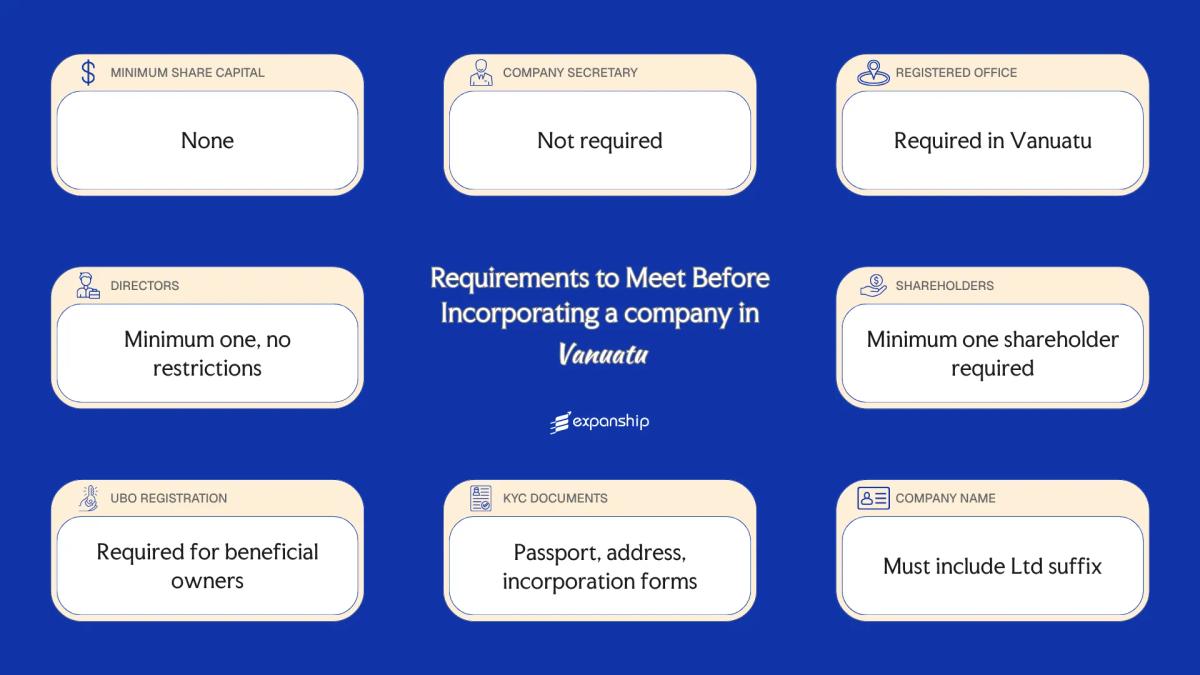
Minimum Share Capital Requirements in Vanuatu
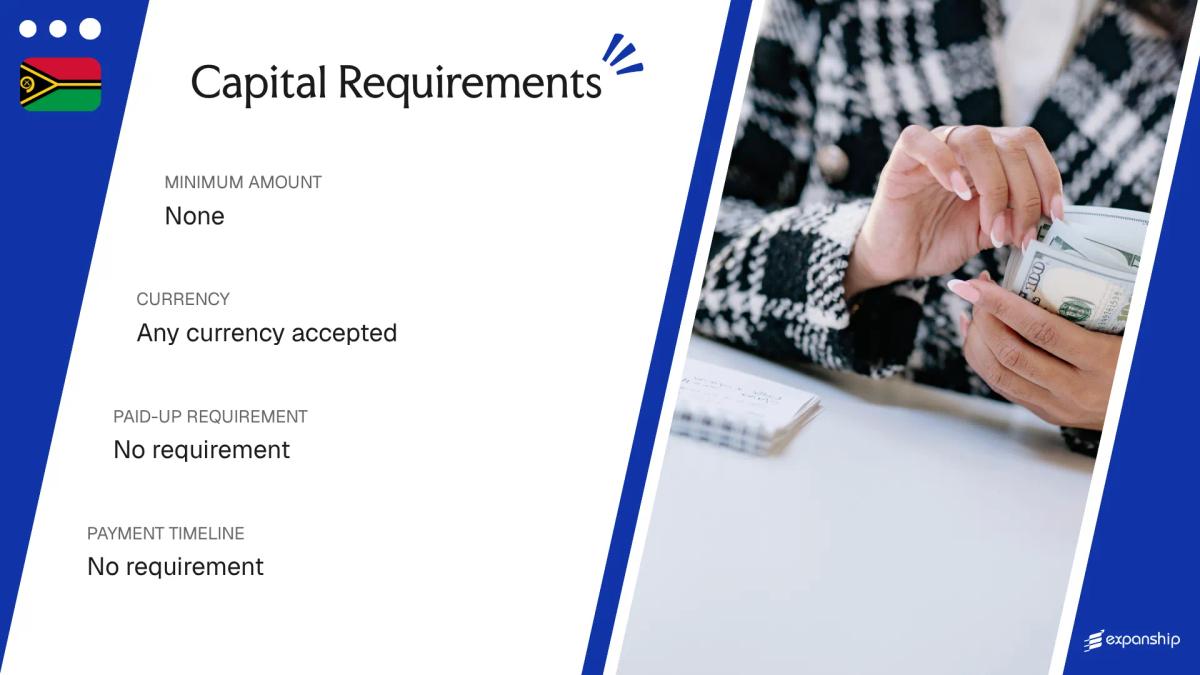
Under the Vanuatu International Companies Act [CAP 222], there is no statutory minimum authorized share capital for international business companies. The Vanuatu Financial Services Commission (VFSC), which oversees company registration, does not require proof of capital deposit at the point of incorporation.
Shares may be issued with or without par value, and your chosen authorized capital amount is recorded in the company's memorandum and articles of association rather than verified through a bank or government authority. Capital structure is an incorporation-time decision, not an ongoing statutory obligation under the IBC framework.
| Parameter | Detail |
|---|---|
| Minimum Authorized Share Capital | No statutory requirement |
| Maximum Authorized Share Capital | No statutory cap |
| Minimum Paid-Up Capital | No statutory requirement |
| Paid-Up Requirement at Incorporation | No statutory requirement |
| Accepted Currency | Any currency |
| Accepted Forms of Contribution | Cash or non-cash assets, as permitted by the company's constitution |
| Timeframe to Deposit Capital | No statutory timeframe |
No minimum capital requirement does not mean capital structure can be left undefined. Your company must still state its authorized share capital and share structure in its constitutional documents filed with the VFSC.
Registered Agent Requirements in Vanuatu
Every company incorporated under the International Companies Act in Vanuatu must appoint a registered agent. This is a statutory requirement, not an optional administrative convenience.
The registered agent holds responsibility for maintaining the company's statutory records, acting as the official point of contact with the Vanuatu Financial Services Commission (VFSC), and ensuring the entity remains in good standing under the Act.
Qualification criteria for who may serve as a registered agent:
- Must be licensed by the Vanuatu Financial Services Commission to provide registered agent services
- Only entities physically present and operating within Vanuatu are eligible to hold this licence
- Individual natural persons do not qualify; the agent must be a corporate body
- The agent must hold a current licence in good standing; a lapsed or suspended licence disqualifies the firm

Incorporate a Company in Vanuatu
Set up your international business company in Vanuatu with full compliance support, from statutory filings to ongoing agent obligations.
Registered Office Requirements in Vanuatu
Vanuatu registered office requirements apply to all companies incorporated under the International Companies Act [Cap 222], which mandates that every registered entity maintain a physical office address within the country at all times. Failure to maintain a compliant registered address can result in regulatory action by the Vanuatu Financial Services Commission (VFSC), including administrative penalties or striking the company from the register.
- A physical address is required; P.O. Box addresses alone do not satisfy the registered office requirement.
- The address must be located within Vanuatu; foreign addresses are not permitted under Cap 222.
- Virtual office arrangements may be used provided they supply a genuine, physical street address in Vanuatu.
- No ownership of the premises is required; a lease or service agreement with an address provider is acceptable.
- The registered office address is recorded with the VFSC and forms part of the publicly accessible company register.
- Any change to the registered office address must be formally notified to the VFSC by filing the prescribed notice of change of registered office.
Director Requirements in Vanuatu

Under the International Companies Act [Cap 222], directors of a Vanuatu IBC assume statutory duties upon appointment, including fiduciary obligations to act in the company's best interests and exercise reasonable care and diligence in their role. Liability can attach personally where a director acts outside their authority or in breach of these duties.
| Parameter | Detail |
|---|---|
| Minimum Number of Directors | One director is required. |
| Maximum Number of Directors | No statutory maximum is prescribed. |
| Local/Resident Director Required | No local or resident director is required. |
| Nationality Restrictions | No nationality restrictions apply under the International Companies Act [Cap 222]. |
| Minimum Age Requirement | Directors must be at least 18 years of age. |
| Corporate Directors Permitted | Yes, corporate directors are permitted. |
| Director Must Be a Shareholder | No, a director is not required to hold shares in the company. |
| Publicly Listed on Registry | Director details are not publicly disclosed on the Vanuatu Financial Services Commission registry. |
| Disqualification Conditions | A person who is bankrupt or has been convicted of a relevant criminal offence may be disqualified from acting as a director. |
Despite being a well-known offshore jurisdiction, Vanuatu permits a single non-resident corporate entity to serve as the sole director of an IBC, with no individual natural person required at the board level.
Shareholder Requirements in Vanuatu
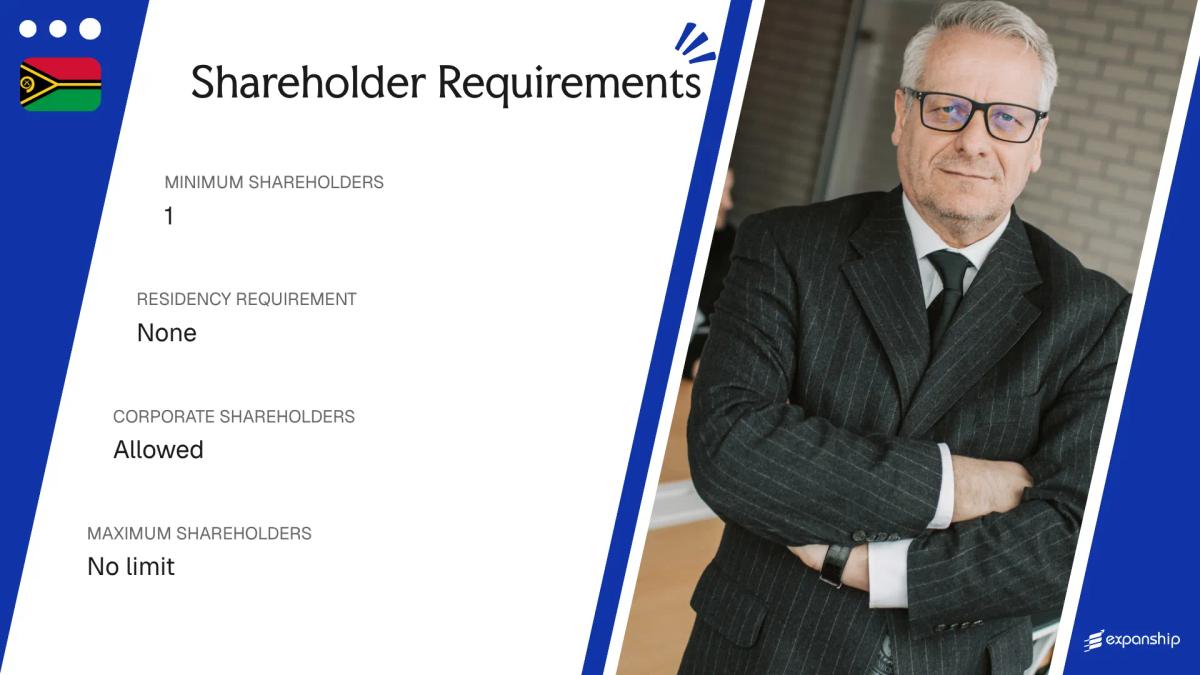
Vanuatu IBC shareholder rules permit a minimum of one shareholder, making sole-shareholder structures fully permissible under the International Companies Act. No statutory maximum applies, allowing the entity to scale its ownership structure without legislative restriction.
Nationality and Residency Restrictions
Foreign nationals face no ownership restrictions when holding shares in a Vanuatu IBC. There are no local residency requirements, and 100% foreign ownership is permitted.
Corporate Shareholders
Corporate entities may act as shareholders without restriction. A company incorporated in another jurisdiction can hold shares directly, subject to standard KYC verification at the time of incorporation.
Shareholder Liability
Shareholder liability is limited to the amount unpaid on their shares. No general circumstances under the International Companies Act extend personal liability beyond that contribution.
Register of Shareholders
A register of shareholders must be maintained by the registered agent. This register is not publicly accessible, though it must be kept current and made available to authorized parties upon lawful request.
Structure Your Vanuatu Company's Ownership Correctly
Get guidance on meeting shareholder requirements when setting up your company in Vanuatu, from ownership structure to documentation.
UBO / Beneficial Ownership Disclosure Requirements in Vanuatu
Vanuatu beneficial ownership disclosure requirements are established under the Anti-Money Laundering and Counter-Terrorism Financing Act No. 13 of 2014, administered by the Vanuatu Financial Intelligence Unit (FIU), with the Vanuatu Financial Services Commission (VFSC) overseeing company-level compliance.
- Identify any individual who directly or indirectly holds 25% or more of the shares or voting rights in the entity, or who otherwise exercises ultimate effective control.
- Record beneficial ownership information in the company's internal statutory register at the time of incorporation.
- Submit the required UBO information to the VFSC as part of the company's registration and ongoing annual compliance obligations.
- Report any changes to beneficial ownership to the VFSC within the prescribed timeframe following the change.
| Parameter | Detail |
|---|---|
| Ownership Threshold for UBO Status | 25% of shares, voting rights, or effective control |
| Filing Authority | VFSC and Vanuatu FIU |
| Disclosure Deadline at Incorporation | At time of company registration |
| Publicly Accessible Register | No |
| Penalties for Non-Disclosure | Fines and potential criminal liability under the AML/CTF Act No. 13 of 2014 |
| Ongoing Update Obligation | Yes; changes must be reported to the VFSC upon occurrence |
KYC / Document Requirements in Vanuatu
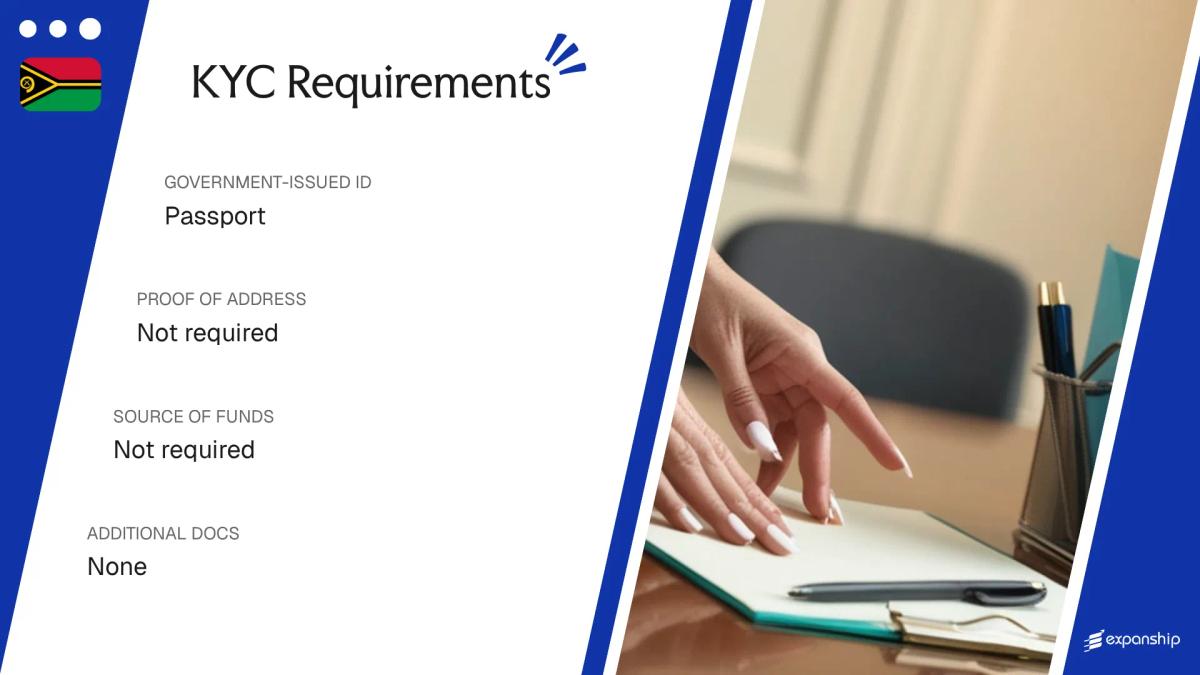
Vanuatu KYC document requirements are governed by the Anti-Money Laundering and Counter-Terrorism Financing Act No. 13 of 2014, administered by the Financial Intelligence Unit. All documents must be submitted to the registered agent at the point of incorporation.
Individual / Personal Documents
- Certified copy of a valid passport or government-issued photo ID
- Proof of residential address dated within three months, such as a utility bill or bank statement
- Completed and signed personal declaration or KYC questionnaire as required by the registered agent
- Recent passport-sized photograph may be required by some licensed agents
Corporate Documents
- Certified copy of the certificate of incorporation of the corporate shareholder or director
- Constitutional documents, such as articles of association or equivalent memorandum
- Current register of directors from the home jurisdiction
- Proof of registered address of the corporate entity
Source of Funds Documentation
- Bank statements from the preceding three to six months
- Audited financial statements where the introducer of capital is a corporate entity
- A signed written declaration explaining the origin of funds if bank statements are unavailable
Notarisation and Apostille Requirements
- Documents issued outside Vanuatu generally require notarisation by a qualified notary public
- Apostille certification is accepted for documents originating in Hague Convention member states
- Non-English documents must be accompanied by a certified English translation
Incomplete or uncertified source of funds documentation is the most frequently cited reason for incorporation delays under Vanuatu's AML compliance review process.
Company Name Requirements in Vanuatu
Proposed names for a Vanuatu International Business Company are assessed by the Vanuatu Financial Services Commission (VFSC) at the point of registration. The name must not be identical or confusingly similar to an existing registered entity.
Your chosen name must end with a legal suffix denoting limited liability, such as "Limited," "Ltd," "Incorporated," or "Inc." English is the standard language used, though names in French are generally accepted.
Certain words are prohibited outright or require regulatory consent before use. Terms implying banking, insurance, government affiliation, or royal patronage fall into the restricted category.
Name reservation is available through the VFSC prior to formal incorporation. Reservations are typically held for a defined period, allowing you to proceed with documentation before the name is formally assigned.
Compliance Services for Companies in Vanuatu
Stay compliant with Vanuatu's regulatory requirements, including annual filings, registered agent obligations, and VFSC reporting standards.
Conclusion
Vanuatu company incorporation requirements are defined primarily under the International Companies Act, with oversight from the Vanuatu Financial Services Commission. Meeting these requirements involves a defined set of structural, documentary, and compliance obligations.
Among the most consequential are the mandatory appointment of a licensed local registered agent and the beneficial ownership disclosure obligations, both of which carry ongoing compliance responsibilities beyond the initial registration. KYC documentation standards also apply at the point of formation and must be maintained throughout the entity's life.
Once these requirements are understood, a foreign investor's next practical step is engaging the appropriate licensed service providers to execute the formation process correctly.
Expanship's Corporate Services for Vanuatu Expansion
Expanship's Vanuatu company formation services are structured around the specific compliance framework governing IBCs under the Vanuatu Companies Act and the oversight of the Vanuatu Financial Services Commission. From satisfying registered agent requirements to maintaining UBO disclosure records, the operational requirements carry real administrative weight. Expanship reduces that burden by managing the procedural and filing obligations on your behalf throughout the incorporation process.
Beyond formation, Expanship supports the full lifecycle of your entity in Vanuatu:
- Your company is registered with all required documentation prepared and submitted to the VFSC.
- A licensed registered agent and compliant registered office address are provided in-country.
- All government filings and regulatory correspondence with the VFSC are handled directly.
- Post-incorporation compliance obligations, including annual filings, are actively managed for your entity.
- Banking introductions are facilitated to support your firm's operational setup.
- Tax registration and liaison with relevant local authorities are coordinated as required.
To discuss your requirements, contact Expanship Vanuatu.
Frequently Asked Questions (FAQ)
Yes, a single foreign national can act as the sole director of a Vanuatu International Company. There is no residency or nationality requirement for directors under CAP 222, and corporate directors are also permitted. The register of directors does not need to be made publicly available, which is a feature specific to the IBC structure in Vanuatu.
The Vanuatu Financial Services Commission requires certified copies of a valid passport, proof of residential address dated within three months, and a source-of-funds declaration from each foreign shareholder. These documents must meet the anti-money laundering standards set out under the Anti-Money Laundering and Counter-Terrorism Financing Act [No. 13 of 2014]. Certified copies must generally be authenticated by a licensed professional such as a lawyer, notary, or accountant.
Failure to maintain a licensed registered agent in Vanuatu can result in the company being struck off the register by the Vanuatu Financial Services Commission. CAP 222 treats the registered agent as a mandatory ongoing requirement, not merely an incorporation formality, so lapses in this appointment carry direct compliance consequences. Restoration to the register after a strike-off involves additional fees and procedural steps.
Beneficial ownership information in Vanuatu is held on a private register maintained by the registered agent and accessible to the Vanuatu Financial Services Commission, not the general public. This structure was introduced to align with FATF recommendations while preserving the confidentiality that the jurisdiction is known for. Public disclosure of UBO details is not currently a requirement under Vanuatu's regulatory framework.
Certain words are restricted or require prior approval from the VFSC before they can be included in a company name, including terms that imply government affiliation, banking, or insurance. The name must also not be identical or confusingly similar to an existing registered entity on the VFSC register. Approval is generally processed as part of the incorporation application rather than as a separate pre-registration step.
Yes, the compliance obligations differ meaningfully between the two structures. A Vanuatu International Company incorporated under CAP 222 is exempt from local income tax and is not required to file annual financial statements with the VFSC, whereas a domestic company incorporated under the Companies Act [CAP 191] is subject to local tax obligations and standard filing requirements. The IBC structure is specifically designed for international business conducted outside Vanuatu.
Legal Disclaimer
The information provided in this article is for general informational purposes only and does not constitute legal, tax, or professional advice. While we strive to ensure the accuracy and timeliness of the content, laws and regulations are subject to change, and the application of laws can vary widely based on specific facts and circumstances.
Readers should not act upon this information without seeking professional counsel tailored to their individual situation. Expanship and its authors disclaim any liability for actions taken or not taken based on the content of this article.
For specific advice regarding your business setup, compliance requirements, or any legal matters, please consult with qualified legal and tax professionals in the relevant jurisdiction.