

Key Takeaways
- Uganda's flat 30% corporate tax rate, administered by the Uganda Revenue Authority, places the country's tax burden above many competing Sub-Saharan African jurisdictions that offer tiered or incentive-based structures for foreign investors.
- Under the Companies Act of 2012, the Uganda Registration Services Bureau registration process involves multiple sequential steps that can extend timelines considerably beyond what investors encounter in more streamlined regional markets.
- Foreign-owned entities operating in Uganda must contend with currency volatility in the Ugandan shilling alongside foreign exchange controls that complicate cross-border profit repatriation and financial planning.
- Intellectual property protections exist in Uganda's legal framework but are weakly enforced in practice, creating measurable commercial risk for businesses whose revenue depends on proprietary technology, branding, or creative assets.
Uganda operates under an evolving regulatory framework, where company law and compliance obligations are governed primarily by the Companies Act of 2012. For foreign investors assessing the drawbacks of Uganda company registration, that framework introduces a range of practical and structural friction points spanning registration, taxation, enforcement, and currency management.
The disadvantages covered in this article apply unevenly across business types. A manufacturing firm faces different exposures than a financial services entity or an export-focused operation, and the legal structure you choose — private limited company, branch office, or subsidiary — will affect which constraints carry the most weight.
This article is most directly relevant to foreign investors and multinational firms considering a direct market presence rather than a representative or liaison arrangement.
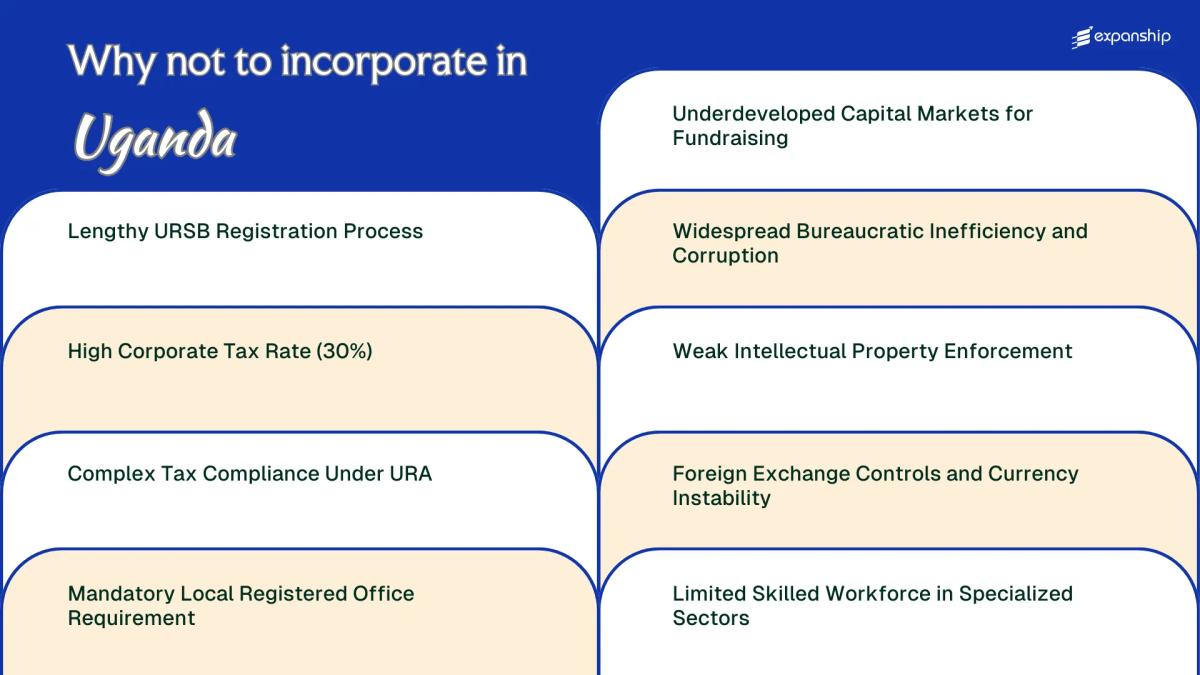
Lengthy URSB Registration Process
URSB registration process delays Uganda present a concrete operational obstacle from the outset. Processing times at the Uganda Registration Services Bureau frequently extend beyond the officially quoted windows, leaving your business in a holding pattern before it can legally operate.
Unpredictable Processing Timelines
Company incorporation under the Companies Act 2012 is administered by the URSB, and while online filing is available through the e-registry portal, approvals do not follow a consistent schedule. Delays of several weeks beyond stated timelines are common, particularly for name reservation and certificate issuance.
For a foreign business owner, this uncertainty makes it difficult to commit to lease agreements, open a corporate bank account, or deploy staff on a defined schedule.
Dependency on Manual Verification
Certain registration steps still require physical document submission or in-person follow-up, which compounds the slow business registration Uganda operators frequently encounter. If your documents require correction or clarification, the back-and-forth cycle restarts the queue.
That dependency on manual intervention means a single administrative error can set your market entry back by weeks, not days.
If your business has time-sensitive contractual or licensing obligations, URSB processing unpredictability can cause you to breach third-party deadlines before your entity is even formally registered.
High Corporate Tax Rate (30%)
Uganda's corporate tax rate sits at 30%, applied to net taxable profits under the Income Tax Act, Cap. 340. For capital-intensive or early-stage businesses, this flat rate consumes a significant portion of earnings before any reinvestment is possible.
Compared to regional peers, the figure carries weight. Rwanda applies a standard rate of 30% but offers tiered incentives that reduce effective rates for qualifying sectors. Kenya levies a 30% rate for resident companies yet extends reduced rates in export processing zones. Your business in Uganda faces the full statutory rate with limited structural relief built into the baseline regime.
The Uganda Revenue Authority administers corporate income tax collection, and the absence of a general reduced rate for small or medium enterprises means most foreign-owned entities absorb the full burden.
In practical terms, the 30 percent corporate tax Uganda imposes creates friction in several ways:
- Profit repatriation becomes costlier once withholding tax on dividends is layered on top of the initial 30% liability
- Thin-margin sectors like distribution or retail face disproportionate pressure, leaving little room after tax to fund local operational growth
- Transfer pricing adjustments by the URA can increase your effective taxable base beyond what you reported, compounding the base rate exposure
Certain sectors, including entities operating under specific investment certificates issued by the Uganda Investment Authority, may access reduced rates, but these concessions are conditional and not guaranteed at incorporation.

Company Incorporation in Uganda
Set up your company in Uganda with structured guidance on registration, tax registration, and compliance requirements under Ugandan law.
Complex Tax Compliance Under URA
Uganda tax compliance challenges under the Uganda Revenue Authority create a persistent administrative burden that is difficult to manage without dedicated local support. Companies are subject to multiple overlapping obligations under the Income Tax Act (Cap 340), the Value Added Tax Act (Cap 349), and the Tax Procedures Code Act 2014, each carrying its own filing cycles, thresholds, and penalty structures.
VAT-registered entities must file monthly returns, while Pay As You Earn (PAYE) deductions require separate monthly submissions. Missing a filing deadline triggers automatic penalties under the Tax Procedures Code Act, regardless of whether tax is actually owed.
| Tax Obligation | Frequency | Penalty for Late Filing |
|---|---|---|
| Corporate Income Tax Return | Annual | UGX 200,000 per month of default |
| VAT Return | Monthly | UGX 200,000 per month of default |
| PAYE Submission | Monthly | 10% of tax due + interest |
| Withholding Tax Remittance | Monthly | Interest at 2% per month |
Foreign-owned firms face an added layer of complexity through transfer pricing documentation requirements, which apply when transacting with related parties abroad. Without a dedicated tax function or local advisor, maintaining the required contemporaneous documentation is a recurring cost that smaller entities often underestimate.
The URA's electronic filing system, while operational, has historically experienced reliability issues that can affect timely submissions. Your business bears the compliance risk regardless of system-side failures.
Mandatory Local Registered Office Requirement
Every company incorporated under the Companies Act 2012 must maintain a registered office address within Uganda. This address must be a physical, operational location — not a P.O. box — and must be disclosed to the Uganda Registration Services Bureau (URSB) at the time of incorporation.
For a foreign business owner, satisfying the Uganda registered office requirement restrictions means you cannot use an overseas address or a virtual mailing service. You are obligated to secure a verifiable local premises before your company can legally exist.
This creates an immediate cost burden. Before generating any revenue, your entity must either lease office space or engage a local registered agent, adding recurring expenditure with no operational benefit in the early stages.
Changes to the registered address must also be formally notified to the URSB, which introduces an ongoing administrative obligation that compounds the compliance workload.
- A physical Uganda address must be registered with URSB at incorporation — P.O. boxes are not accepted
- The address must remain current; any change requires formal notification to URSB
- Foreign owners must secure local premises or appoint a registered agent before the company can be formed
- The registered office is a matter of public record, creating a disclosure obligation you cannot opt out of
Even a dormant company with zero operations in Uganda must maintain an active registered office address or risk being struck off the URSB register.
Underdeveloped Capital Markets for Fundraising
Uganda capital markets limitations fundraising represent a structural barrier that most incorporated companies encounter when attempting to raise growth capital domestically.
Shallow Market Depth on the Uganda Securities Exchange
The Uganda Securities Exchange (USE), established under the Capital Markets Authority Act, lists fewer than 20 securities, with trading volumes that remain thin relative to peer exchanges in Nairobi or Johannesburg. For a foreign-owned company seeking an equity raise or secondary listing, the investor base is simply too narrow to absorb meaningful capital requirements.
Debt capital markets face similar constraints. Corporate bond issuance is rare, and institutional investors with appetite for private placements are limited in number, which forces businesses to rely on bank lending at rates that frequently exceed 20% per annum.
Practical Fundraising Consequences for Incorporated Entities
Your firm cannot realistically treat the USE as a viable exit or fundraising channel if your capital requirements exceed modest thresholds. The Capital Markets Authority (CMA) regulates public offerings, but the compliance cost of a prospectus process is difficult to justify against the thin liquidity available post-listing.
Private equity activity exists but concentrates heavily in agriculture and telecoms, leaving businesses in other sectors with few alternatives to offshore fundraising structures.
Addressing Uganda's Capital Market Constraints for Your Business
Speak with our team about structuring your Uganda entity to access offshore funding channels and navigate domestic capital market limitations effectively.
Widespread Bureaucratic Inefficiency and Corruption
Uganda bureaucratic corruption business risks are well-documented, and Transparency International's Corruption Perceptions Index consistently ranks the country among the lower-performing nations globally, reflecting systemic inefficiencies that impose direct costs on foreign-registered entities.
- Bribes and facilitation payments remain a documented friction point across government agencies, meaning your firm may face pressure to pay informally to expedite approvals that are legally free or fixed-fee under the Uganda Registration Services Bureau's schedule.
- The Uganda Revenue Authority's tax administration suffers from inconsistent officer discretion, creating unpredictable compliance outcomes for businesses that follow the same procedures differently depending on the official assigned.
- Public procurement processes are frequently cited in government corruption challenges, exposing foreign-owned companies that depend on state contracts to opaque award criteria and bid manipulation.
- Government inefficiency in Uganda compounds delays beyond any single agency, so multi-department approvals — such as those required for sector-specific licenses — can extend project timelines by months without legal recourse.
- The Anti-Corruption Act 2009 establishes criminal liability, but enforcement against officials remains inconsistent, offering your business limited practical protection.
Weak Intellectual Property Enforcement
Weak IP enforcement risks Uganda presents to foreign businesses stem from institutional gaps that make protecting trademarks, patents, and copyrights practically difficult. The Uganda Registration Services Bureau (URSB) administers IP registration under the Trade Marks Act (Cap. 217) and the Patents Act (Cap. 216), but registration alone does not translate into meaningful protection.
Enforcement relies on courts and the police, both of which face resource constraints and limited technical capacity in IP matters. Civil litigation to stop infringement can take years, and criminal prosecution of IP violations is rare in practice.
For a foreign firm holding proprietary technology or brand assets, this creates direct exposure. A competitor can replicate your product or mark, and the cost of pursuing legal remedy often exceeds the value of the damages recovered.
- Counterfeit goods circulate openly in urban markets with limited regulatory intervention
- There is no dedicated IP enforcement tribunal or specialized IP court division
A foreign software company registering a trademark in Uganda spends approximately USD 200-400 in filing fees. If infringement occurs, pursuing a High Court civil suit can cost USD 5,000-15,000 in legal fees over 2-4 years, with no guarantee of an injunction being granted or damages awarded.
Foreign Exchange Controls and Currency Instability
Uganda foreign exchange controls risks are less about formal capital restrictions and more about structural currency volatility. The Uganda shilling has experienced sustained depreciation pressure against the US dollar over the past decade, which directly erodes the value of locally retained profits when converted for repatriation.
Under the Foreign Exchange Act (Cap. 154), forex repatriation is legally permitted for foreign investors. In practice, however, thin interbank liquidity and wide bid-ask spreads on the shilling mean your business absorbs real conversion costs that are not visible in the statutory framework.
The Bank of Uganda intervenes periodically to manage volatility, but these interventions do not eliminate the underlying depreciation trend. For a foreign firm invoicing clients in shillings while servicing obligations in hard currency, the functional exposure is significant.
- Dividend repatriation requires supporting documentation, including tax clearance certificates from the Uganda Revenue Authority, adding time and administrative cost to each transfer.
- Contracted payments in foreign currency between local entities require regulatory approval under the Foreign Exchange Act, restricting how your firm structures intercompany arrangements.
Even where repatriation is legally unrestricted, the requirement to obtain a tax clearance certificate from the Uganda Revenue Authority before remitting dividends abroad means any unresolved tax position will block your ability to extract profits from the jurisdiction entirely.
Limited Skilled Workforce in Specialized Sectors
Uganda skilled workforce limitations present a concrete hiring problem for foreign-owned entities operating in technical fields. The country's tertiary enrollment rate and the output of specialized graduates in areas such as engineering, fintech, and advanced manufacturing remain low relative to regional peers like Kenya or South Africa.
Sectors requiring licensed professionals face the sharpest constraints. The Engineers Registration Board (ERB) and the Institute of Chartered Public Accountants of Uganda (ICPAU) regulate entry into their respective fields, and the domestic pool of registered practitioners is limited. Filling mid-to-senior technical roles often means recruiting expatriates, which triggers work permit obligations under the Immigration Act and adds direct cost to your payroll.
Talent shortage challenges in Uganda also affect retention. Qualified professionals frequently migrate to better-compensated markets, creating turnover cycles that increase training expenditure and slow operational continuity for incorporated entities.
Overcoming Uganda's Incorporation Challenges
Overcoming Uganda's Incorporation Challenges
Overcoming Uganda incorporation challenges requires structural decisions made before registration, not reactive fixes after problems emerge. The disadvantages covered in this blog are systemic, and addressing them starts with understanding which regulatory obligations and institutional bodies govern your specific business activities.
- Register your company through the URSB online portal to reduce processing delays tied to manual submission queues.
- Apply for the relevant tax identification number and VAT registration with the Uganda Revenue Authority at the point of incorporation, not after commencing operations.
- Designate a physical registered office address in Uganda that meets the Companies Act 2012 requirements before submitting your incorporation documents.
- File annual returns and financial statements on schedule with URSB to avoid compounding penalties under the Companies Act 2012.
- Register any trademarks or patents with URSB's Intellectual Property Registry immediately upon incorporation to establish enforceable ownership on record.
Mitigating Uganda business registration drawbacks does not neutralize the underlying structural constraints in areas such as capital markets access and foreign exchange controls. These steps reduce procedural exposure but operate within a regulatory environment that retains meaningful friction for foreign-owned entities.
Uganda's Investment Case Despite Drawbacks
Uganda investment risks despite drawbacks are real and documented, yet the country retains a credible case for foreign incorporation. East Africa's third-largest economy by GDP, anchored by the East African Community single market and a young consumer base, still draws serious investors willing to work within its structural limitations.
| Pros | Cons |
|---|---|
| EAC membership opens cross-border trade across Kenya, Tanzania, Rwanda, Burundi, and the DRC | URSB registration timelines frequently extend beyond statutory deadlines due to administrative backlogs |
| Natural resource base, including oil reserves, supports long-term sectoral opportunity | The 30% corporate tax rate sits above the regional average and increases the effective cost of doing business |
| A large, young population creates sustained domestic consumer demand | URA compliance obligations, including multiple tax heads and filing cycles, impose a significant administrative burden |
| The Uganda Securities Exchange and financial sector are expanding, albeit from a low base | The Uganda Shilling's historical volatility introduces currency risk for foreign-currency-denominated businesses |
| Agricultural and infrastructure sectors offer entry points with low saturation | Weak IP enforcement under the Uganda Registration Services Bureau limits protection for technology and branded products |
Structural inefficiencies, from URSB processing delays to gaps in skilled labor availability, raise the operational cost of maintaining a compliant entity. Your business absorbs those costs regardless of sector.
Corporate Compliance Services in Uganda
Maintain your Uganda-registered company in good standing with URA filings, annual returns, and statutory obligations managed accurately and on schedule.
Conclusion
A Uganda company incorporation drawbacks summary reflects a jurisdiction with real structural constraints. The Uganda Registration Services Bureau process, URA's multi-layered compliance obligations, and persistent currency instability under the Bank of Uganda's exchange control framework each impose measurable costs on foreign and domestic investors alike. These are not minor administrative inconveniences — they affect timelines, capital efficiency, and long-term operational planning. Informed entry requires a clear-eyed assessment of these factors before committing to a corporate structure under the Companies Act 2012. Professional guidance with local regulatory knowledge remains a practical necessity.
Expanship's Uganda Company Formation Support
Expanship Uganda company formation support is structured around the specific compliance demands that make this market operationally intensive — from managing URSB registration timelines to fulfilling URA tax obligations and meeting the mandatory registered office requirement under the Companies Act 2012.
Beyond formation, Expanship supports the full lifecycle of your entity's compliance requirements in Uganda. Services cover:
- Preparing and submitting all company registration documents with the URSB on your behalf.
- Providing a local registered agent and office address to satisfy statutory requirements.
- Liaising directly with government bodies and regulatory authorities for filings and approvals.
- Managing post-incorporation compliance obligations, including annual returns and statutory updates.
- Facilitating introductions to local banking institutions to support account opening.
- Handling tax registration with the URA and coordinating with relevant local authorities.
To discuss how Expanship can support your business setup in Uganda, contact Expanship Uganda.
Frequently Asked Questions (FAQ)
The Uganda Registration Services Bureau's processing delays affect both locally owned and foreign-owned entities, though foreign businesses tend to experience compounded timelines because additional documentation requirements apply to non-resident directors and shareholders. There is no fast-track lane that reliably bypasses standard queue times for most applicants. The delays are systemic rather than targeted at any specific ownership structure.
The Uganda Revenue Authority imposes financial penalties for late filing and underpayment of taxes under the Tax Procedures Code Act. Late payment interest accrues at a statutory rate on outstanding tax balances, and persistent non-compliance can trigger audits or additional assessments. Foreign-owned firms with cross-border transactions face heightened scrutiny under transfer pricing rules, which increases the exposure if documentation is incomplete.
A company incorporated under the Companies Act 2012 must maintain a physical registered office address in Uganda where official correspondence and statutory notices can be served. A virtual office arrangement that lacks a verifiable physical presence does not satisfy this requirement. Non-compliance can affect the validity of service of legal documents and create administrative complications with both URSB and URA.
The Ugandan shilling has experienced periods of significant depreciation against major currencies, which directly erodes the value of profits when converted for repatriation. Foreign exchange transactions are governed by the Foreign Exchange Act, and while Uganda does not impose absolute restrictions on repatriation, the practical cost of conversion during volatile periods can be substantial. Exchange rate risk is an ongoing financial exposure that is difficult to hedge affordably within Uganda's shallow financial market.
Uganda's legal framework, including the Trademarks Act and Copyright and Neighbouring Rights Act, provides for both civil remedies and criminal sanctions against IP infringement. The practical problem is enforcement capacity: the police and courts lack the specialised resources to prioritise IP cases consistently, so even valid criminal complaints often stall at the investigative stage. Foreign brand owners have found that civil litigation is slow and that damages awarded rarely reflect actual commercial losses.
Foreign companies in Uganda can apply for work permits to bring in expatriate staff under the Immigration Act, but the process involves bureaucratic delays and quota considerations that vary by sector. The work permit system does not guarantee approval, and the Uganda Revenue Authority will scrutinise whether expatriate remuneration has been correctly subjected to PAYE. Dependence on expatriate talent increases operating costs and adds an administrative layer that does not exist in jurisdictions with deeper labour markets.
Uganda consistently ranks in the lower half of Transparency International's Corruption Perceptions Index, performing below regional peers such as Rwanda and Tanzania. Informal payments are reported at multiple administrative touchpoints, including within URSB processing queues and during interactions with sector-specific regulators. Foreign businesses operating without a local intermediary who understands the system are disproportionately exposed, as they are less equipped to identify when a process is being deliberately obstructed.
Legal Disclaimer
The information provided in this article is for general informational purposes only and does not constitute legal, tax, or professional advice. While we strive to ensure the accuracy and timeliness of the content, laws and regulations are subject to change, and the application of laws can vary widely based on specific facts and circumstances.
Readers should not act upon this information without seeking professional counsel tailored to their individual situation. Expanship and its authors disclaim any liability for actions taken or not taken based on the content of this article.
For specific advice regarding your business setup, compliance requirements, or any legal matters, please consult with qualified legal and tax professionals in the relevant jurisdiction.