
Key Takeaways
- Ukraine's employer payroll obligations impose a substantial cost burden, with the Unified Social Contribution (USC) levied on top of gross salaries, directly increasing the cost of maintaining a local workforce beyond nominal wage levels.
- Foreign-owned entities operating under the Law of Ukraine on Limited Liability Companies must navigate multi-step registration procedures involving notarization, state registrars, and tax enrollment, adding time and administrative complexity to market entry.
- Currency controls administered by the National Bank of Ukraine restrict the free movement of foreign currency, limiting an incorporated entity's ability to repatriate profits or service cross-border obligations without regulatory approval.
- Wartime conditions since 2022 have introduced operational risks — including infrastructure disruption, martial law provisions, and workforce mobilization — that directly affect the continuity of locally registered business entities.
Ukraine operates under an evolving regulatory framework, shaped by ongoing legislative reforms and external pressures that have accelerated since 2022. The Commercial Code governs much of the country's business activity, alongside the Law of Ukraine on Limited Liability Companies, creating a layered legal environment that foreign investors must account for before registering.
The disadvantages of incorporating in Ukraine span several distinct categories, from administrative and financial barriers to structural and security-related concerns.
How severely these disadvantages affect your business depends on the industry, the ownership structure chosen, and the scale of intended operations. A small foreign-owned LLC faces a different risk profile than a larger entity with complex cross-border transactions.
This article is most relevant to foreign entrepreneurs, investors, and multinational firms considering direct market entry through a locally registered entity rather than through representative or branch structures.
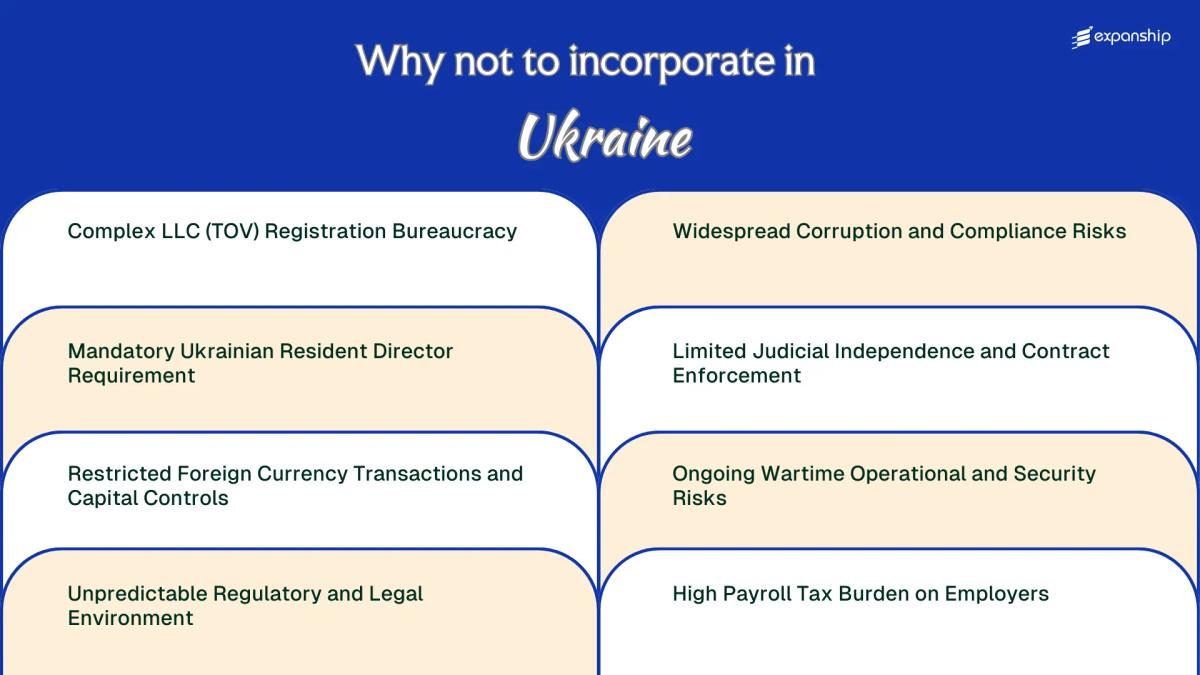
Complex LLC (TOV) Registration Bureaucracy
Ukraine LLC registration bureaucracy presents a significant operational hurdle for foreign investors, with procedural requirements that exceed those found in many Central European jurisdictions.
Document-Heavy Formation Process
Registering a TOV (Tovarystvo z Obmezhenoiu Vidpovidalnistiu) requires submitting formation documents to the State Registrar, including a charter drafted in Ukrainian, notarized identification documents, and proof of a legal address. Foreign founders must have all documents apostilled and officially translated, which adds weeks to timelines and material costs before the entity is even formed.
Every foreign document submitted to Ukrainian authorities must meet authentication standards under the Hague Apostille Convention, and any translation errors or formatting inconsistencies typically result in rejection, forcing the entire submission cycle to restart.
Post-Registration Compliance Burdens
After registration, the firm must register separately with the State Tax Service of Ukraine (STS) and, depending on planned activities, obtain industry-specific licenses or permits. This fragmented multi-agency process creates delays that can extend your operational start date by one to three months.
Unlike single-window registration systems available in EU member states, Ukraine TOV formation problems compound because each agency operates on independent timelines with no coordinated processing obligation.
Foreign founders who underestimate document authentication requirements frequently face full submission rejections from the State Registrar, resetting all timelines and incurring duplicate notarization and translation costs.
Mandatory Ukrainian Resident Director Requirement
Under Ukrainian law, a TOV (товариство з обмеженою відповідальністю) must appoint a director who holds legal authority to act on behalf of the company within the country. The Ukraine resident director requirement restrictions effectively mean that a foreign national without a Ukrainian tax identification number and appropriate residency status faces significant barriers to assuming this role directly.
This is not a formality. The director is personally liable for the company's tax filings, regulatory submissions to the State Tax Service of Ukraine, and statutory reporting obligations.
For a foreign business owner, this creates tangible operational friction:
- You must identify, vet, and contractually bind a local individual whose actions legally commit your company
- The local director can sign contracts and open bank accounts, creating principal-agent risks that are difficult to manage remotely
- Replacing a director requires notarized documentation and re-registration procedures with the State Registrar, incurring delays and fees
- Ongoing salary or service fee obligations to the local director become a fixed cost regardless of company revenue
There is no registered agent model equivalent here that separates administrative presence from executive authority. The director role carries substantive legal weight, not just a compliance checkbox function.

Company Incorporation in Ukraine
Understand the full legal and structural requirements before registering a TOV in Ukraine.
Restricted Foreign Currency Transactions and Capital Controls
Ukraine foreign currency transaction restrictions present a direct obstacle for foreign business owners seeking to move funds across borders. Under martial law, the National Bank of Ukraine (NBU) has imposed extensive controls that limit how a Ukrainian entity can receive, hold, and transfer foreign currency. These measures, introduced and repeatedly extended since February 2022, are not temporary formalities — they materially restrict your firm's ability to operate as part of an international structure.
| Restriction | Threshold / Condition | Business Impact |
|---|---|---|
| Dividend repatriation abroad | Suspended entirely under martial law | Foreign investors cannot extract profits from Ukrainian entities |
| Cross-border transfers by legal entities | Subject to NBU individual licensing or general license limits | Routine intercompany payments require prior authorization |
| Foreign currency purchase for import payments | Capped and subject to NBU approval for amounts above set thresholds | Delays procurement and increases working capital requirements |
| Debt repayment to non-residents | Restricted; principal repayments abroad largely blocked | Foreign-funded entities cannot service offshore loans normally |
Profit extraction is effectively frozen. Dividend repatriation abroad by foreign shareholders of Ukrainian companies remains blocked under NBU Resolution No. 18 (2022) and its subsequent extensions, with no confirmed timeline for lifting this restriction.
Foreign exchange limitations in Ukraine extend to intercompany lending and service fee payments. Your business cannot freely settle invoices with a non-resident parent or affiliate without passing through NBU authorization requirements, creating cash flow gaps that compound over time.
Ukraine capital controls business risks are heightened by the open-ended nature of martial law itself. The NBU's authority to maintain these controls persists as long as martial law remains in force, and parliamentary extensions have continued without a defined end date, leaving currency repatriation restrictions with no predictable resolution.
Unpredictable Regulatory and Legal Environment
Ukraine unpredictable regulatory environment risks are a persistent structural problem, not a temporary condition. Tax codes, licensing requirements, and sector-specific regulations have historically changed with little advance notice, leaving foreign-owned entities exposed to retroactive compliance gaps.
The Tax Code of Ukraine has been amended dozens of times since its adoption in 2010. Each amendment can alter rates, reporting obligations, or eligibility thresholds, requiring your legal and accounting teams to revalidate compliance positions continuously.
Regulatory authority often overlaps between bodies such as the State Tax Service, the National Bank, and sector ministries. That ambiguity creates inconsistent enforcement, where two companies in the same industry may receive contradictory rulings on identical transactions.
- New tax or regulatory amendments may take effect with limited transition periods.
- Secondary legislation and ministerial orders can modify operational requirements without parliamentary review.
- Regulatory interpretations issued by one authority may contradict guidance from another body.
- Foreign investors have no guaranteed mechanism to challenge retrospective regulatory changes.
Wartime martial law has further expanded executive discretion to issue emergency decrees affecting business operations, taxation, and foreign currency rules without standard legislative procedure.
Ukraine's parliament, the Verkhovna Rada, can pass amendments to the Tax Code on the same day they are tabled, with no mandatory public consultation period required by law.
Widespread Corruption and Compliance Risks
Corruption risks for businesses in Ukraine remain among the most cited concerns for foreign investors, consistently placing the country in the lower tiers of Transparency International's Corruption Perceptions Index.
Systemic Exposure Across State Institutions
Ukraine's anti-corruption architecture includes the National Anti-Corruption Bureau (NABU), the Specialized Anti-Corruption Prosecutor's Office (SAP), and the National Agency on Corruption Prevention (NACP). Despite this institutional framework, bribery exposure in licensing, customs clearance, and public procurement continues to generate material compliance risk for foreign-owned entities.
Compliance Costs and Legal Liability for Foreign Firms
Your company remains subject to home-country extraterritorial legislation, such as the U.S. Foreign Corrupt Practices Act or the UK Bribery Act, even when operating under Ukrainian law. Paying unofficial fees to expedite regulatory approvals, a practice that persists across multiple state bodies, can trigger criminal liability in your home jurisdiction regardless of what local custom may tolerate. Ukraine's Law No. 1700-VII on Corruption Prevention imposes disclosure and integrity obligations, but enforcement inconsistency means the compliance burden falls disproportionately on foreign firms that cannot rely on local connections.
Compliance Advisory for Foreign Businesses Entering Ukraine
Get guidance on managing regulatory and anti-corruption compliance obligations when incorporating and operating a company in Ukraine.
Limited Judicial Independence and Contract Enforcement
Ukraine judicial independence limitations present measurable structural risks that directly affect contract enforcement and dispute resolution for foreign-owned entities.
- Ukrainian courts operate under the oversight of the High Council of Justice, a body that international monitoring organizations, including the Venice Commission, have repeatedly identified as susceptible to political influence, meaning adverse rulings against well-connected local parties are a documented risk rather than a theoretical one.
- Commercial disputes filed with the Commercial Court of Ukraine can take years to resolve, creating prolonged legal exposure that ties up capital and management resources for your business.
- Enforcement of foreign arbitral awards, while nominally governed by the New York Convention to which Ukraine is a signatory, faces procedural resistance in domestic courts that can effectively nullify an award obtained abroad.
- Contract enforcement problems in Ukraine are compounded by selective application of procedural rules, which undermines the predictability that cross-border commercial agreements require.
- Judicial reform legislation passed since 2016 has produced limited measurable improvement in court independence according to EU progress reports on Ukraine's accession process.
Ongoing Wartime Operational and Security Risks
Ukraine wartime business operational risks extend well beyond the battlefield. Since Russia's full-scale invasion began in February 2022, businesses registered in the country have faced recurring disruptions to energy infrastructure, logistics networks, and communications systems that directly impair daily operations.
Martial law, introduced under Presidential Decree No. 64/2022 and continuously extended by the Verkhovna Rada, grants authorities broad powers to restrict movement, commandeer assets, and impose curfews. For a foreign-owned entity, these powers create unpredictable constraints on staffing, physical access to premises, and supply chain continuity.
Air raid alerts routinely suspend work across major cities, including Kyiv, Kharkiv, and Odesa. Employees are legally entitled to cease work during alerts, which can last several hours, compressing productive working time significantly.
- Damage or destruction of physical assets carries insurance exclusions for acts of war in most international policies
- Blackouts caused by attacks on energy infrastructure have forced businesses to invest in generators and alternative power sources at substantial cost
- Key personnel may be subject to military mobilisation under the General Staff's conscription orders, creating workforce gaps with little advance notice
A foreign-owned firm operating a 20-person office in Kharkiv, paying approximately USD 1,200 per month in generator fuel and backup power maintenance, while absorbing the cost of two conscripted employees replaced by temporary contractors at 30% above standard rates, would face an estimated USD 25,000 to USD 35,000 in unbudgeted annual operational costs attributable solely to wartime disruptions.
High Payroll Tax Burden on Employers
The Ukraine employer payroll tax burden is concentrated primarily in the Unified Social Contribution (Yedynyi Sotsialnyi Vnesok, or USV), which is set at 22% of gross salary. This rate applies to the employer on top of wages paid, meaning your actual cost per employee is substantially higher than the agreed salary figure.
For most employment categories, the 22% USV rate applies to the full salary amount with no employer-side cap, unlike social contribution systems in several EU member states that impose upper earnings thresholds. A business paying ten mid-level employees can face payroll costs exceeding the gross wage bill by nearly a quarter before accounting for any additional HR or compliance overhead.
The USV is administered by the State Tax Service of Ukraine (Derzhavna Podatkova Sluzhba), and contributions must be reported and remitted monthly. Late or incorrect filings carry penalties, adding an administrative cost layer that compounds the base contribution rate.
- Employers hiring part-time staff are still subject to the minimum USV base, currently calculated against the statutory minimum wage, even if the employee's actual earnings fall below it.
- Foreign-owned entities are not exempt from these obligations and must comply from the first hired employee.
The 22% USV applies regardless of company size or ownership structure, and foreign businesses with even a single locally employed staff member are fully subject to this contribution from day one of employment.
Overcoming Ukraine's Incorporation Challenges
Overcoming Ukraine's incorporation challenges requires structural preparation rather than reactive problem-solving. The disadvantages covered in this blog are not incidental — they reflect systemic conditions that a foreign investor must account for before registration, not after.
- Register your TOV through the state registrar via the Unified State Register maintained by the Ministry of Justice to ensure procedural compliance from the outset.
- Appoint a Ukrainian resident as director at the point of incorporation to satisfy the resident directorship requirement under Ukrainian corporate law.
- Open a UAH investment account through an authorised bank to structure foreign currency contributions in accordance with National Bank of Ukraine capital control regulations.
- Adopt written commercial contracts governed by Ukrainian law with explicit dispute resolution clauses to address the contract enforcement risks documented in this blog.
- Maintain payroll records compliant with the Unified Social Contribution (ESV) rate to manage the employer tax obligations under Ukraine's payroll framework.
These steps reduce procedural exposure but do not neutralise the broader regulatory instability and wartime operational risks that remain active. Ukraine's current legal environment, shaped by martial law provisions, continues to affect how even structurally sound entities function in practice.
Ukraine's Business Potential Despite the Drawbacks
Ukraine's business potential despite drawbacks is real, but it comes with a clearly defined set of structural and situational constraints. The market offers scale, a technically skilled workforce, and competitive operating costs that remain relevant for foreign investors who can absorb the associated risks. That calculus depends heavily on your firm's tolerance for regulatory instability, currency restrictions, and wartime operating conditions.
| Pro | Con |
|---|---|
| Large domestic market with a population historically exceeding 40 million | Active armed conflict creates direct operational and security risks |
| Comparatively low labor costs relative to EU member states | Employer payroll tax obligations, including the 22% Unified Social Contribution, raise total employment costs significantly |
| IT and engineering talent pool recognized for technical depth | Widespread corruption increases compliance exposure and unpredictable costs |
| TOV (LLC) structure allows 100% foreign ownership | Foreign currency transactions are subject to NBU capital controls that restrict profit repatriation |
| EU association and trade access via the DCFTA framework | Judicial independence remains limited, weakening contract enforcement reliability |
For many businesses, the combination of wartime risk and regulatory unpredictability will outweigh the market opportunity. For others, particularly those in technology or export-oriented sectors, the cost and talent advantages may justify a carefully structured entry.
Compliance Services for Companies in Ukraine
Maintain your Ukrainian entity in good standing with local regulatory requirements, including tax filings, reporting obligations, and corporate governance under Ukrainian law.
Conclusion
The cons of Ukraine company incorporation span legal, operational, and geopolitical dimensions that collectively present a demanding environment for foreign investors. Currency controls enforced through National Bank of Ukraine regulations continue to restrict how your business moves capital across borders. Judicial unpredictability, reinforced by limited enforcement mechanisms for foreign contract claims, compounds the structural risks. Active armed conflict adds a layer of operational exposure that no compliance framework can fully offset. Firms prepared to enter this market with specialist legal and administrative support are better positioned to manage what remains a high-complexity incorporation environment.
Expanship's Ukraine Expansion Support
Incorporating in Ukraine means contending with the specific compliance obligations this blog has outlined -- from the State Register of Legal Entities requirements and TOV structuring rules to currency control restrictions under National Bank of Ukraine regulations. Expanship's Ukraine company formation support services are designed to reduce the administrative weight of these obligations on your business, so that local procedural complexity consumes less of your operational bandwidth.
Our team works across the full formation and compliance lifecycle. Here is what that includes:
- We prepare and file all company registration documents with the relevant Ukrainian authorities on your behalf.
- Our team provides a registered agent and local office address to satisfy residency requirements.
- We liaise directly with government bodies and regulatory offices throughout the filing process.
- Post-incorporation compliance management keeps your entity in good standing after registration.
- We facilitate introductions to banking partners familiar with Ukraine business incorporation compliance.
- Tax registration and liaison with local fiscal authorities is handled as part of your setup.
Reach out to Expanship Ukraine to discuss your incorporation requirements.
Frequently Asked Questions (FAQ)
Currency restrictions under the National Bank of Ukraine's regulations apply broadly to all legal entities conducting cross-border transactions, regardless of sector or ownership structure. Foreign investors repatriating profits or repaying cross-border loans face documented delays and mandatory conversion requirements that have tightened further since the onset of full-scale war in February 2022. There are no sector-specific exemptions that meaningfully reduce this burden for most foreign-owned firms.
Failure to correctly calculate and remit the Unified Social Contribution (USV), which sits at 22% of gross salary paid by the employer, triggers penalties from the State Tax Service of Ukraine, including fines and accrued interest on underpaid amounts. The tax authority has the power to freeze company accounts pending resolution. Given the complexity of Ukraine's payroll reporting requirements, even procedural errors can result in formal enforcement actions.
Ukrainian courts rank poorly on enforcement predictability compared to EU-accession states such as Poland or Romania, where judicial independence scores are significantly higher. The High Court of Cassation in Ukraine handles commercial disputes, but proceedings are frequently prolonged, and outcomes in cases involving state-connected parties remain difficult to predict. Foreign companies often attempt to mitigate this through international arbitration clauses, though enforcing resulting awards against Ukrainian counterparties still requires domestic court involvement.
A foreign national can legally serve as director of a Ukrainian TOV, but doing so requires a Ukrainian work permit and tax identification number, which adds cost and administrative lead time to the setup process. In practice, many foreign founders appoint a Ukrainian resident director to avoid the permit process, which creates its own governance risk if that individual's interests diverge from the company's. There is no statutory requirement for the director to be a Ukrainian citizen, but the residency-linked permit obligation functionally discourages fully remote foreign directorship.
Violations of currency control requirements under the Law of Ukraine on Currency and Currency Transactions can result in fines ranging from 1% to 10% of the transaction amount, depending on the nature and severity of the breach. The National Bank of Ukraine holds supervisory authority and can impose these penalties directly on the entity. Repeated or willful violations carry higher penalty bands and can attract additional scrutiny from the State Financial Monitoring Service.
Martial law, declared following Russia's full-scale invasion in February 2022 and extended repeatedly since, grants Ukrainian authorities broad powers to suspend or modify certain contractual obligations through force majeure provisions. The Ukrainian Chamber of Commerce and Industry has been issuing force majeure certificates to local businesses, which counterparties have used to justify non-performance without penalty. Foreign firms entering contracts with Ukrainian entities should account for the elevated risk that standard breach-of-contract remedies may be delayed or contested under wartime legal provisions.
Smaller foreign-owned entities with limited local legal support are disproportionately affected, since Ukraine's regulatory framework has historically been subject to frequent amendments with short or no transitional periods. Large multinationals can absorb compliance shifts through dedicated legal teams, but a small or mid-sized foreign firm relying on periodic external advice may find itself inadvertently non-compliant after a regulatory change. The tax code alone has undergone dozens of amendments in recent years, and wartime legislative activity has further accelerated the pace of change.
Legal Disclaimer
The information provided in this article is for general informational purposes only and does not constitute legal, tax, or professional advice. While we strive to ensure the accuracy and timeliness of the content, laws and regulations are subject to change, and the application of laws can vary widely based on specific facts and circumstances.
Readers should not act upon this information without seeking professional counsel tailored to their individual situation. Expanship and its authors disclaim any liability for actions taken or not taken based on the content of this article.
For specific advice regarding your business setup, compliance requirements, or any legal matters, please consult with qualified legal and tax professionals in the relevant jurisdiction.