
Key Takeaways
- Ukraine's flat 18% corporate income tax rate, administered by the State Tax Service of Ukraine, provides a predictable and comparatively low baseline tax burden for foreign-owned entities across most sectors.
- Technology companies that qualify under the Diia City special legal regime operate under a structurally distinct regulatory framework that can materially reduce both tax exposure and legal risk compared to standard LLC registration.
- With over 70 bilateral investment treaties in force, foreign investors in Ukrainian entities benefit from treaty-based protections that reduce legal exposure in cross-border disputes and capital repatriation scenarios.
- Registering a TOV (Товариство з обмеженою відповідальністю) through the Ministry of Justice's Unified State Register of Legal Entities imposes minimal share capital requirements, lowering the financial threshold for foreign market entry.
Ukraine is an independent sovereign state in Eastern Europe, and among the benefits of incorporating in Ukraine is access to a tax environment that combines a standard corporate rate with targeted sectoral incentives, making it a subject of growing interest for foreign investors. Company registration is administered by the Ministry of Justice of Ukraine, which maintains the Unified State Register of Legal Entities and Individual Entrepreneurs. The LLC — known locally as a Товариство з обмеженою відповідальністю (TOV) — is the most widely used vehicle for foreign business entry.
Foreign nationals face no general prohibition on owning a Ukrainian business, and the legal framework permits 100% foreign ownership across most sectors. The country operates a low-tax regime with treaty-based protections for cross-border investment.
This article examines the principal advantages that Ukraine company formation offers to international investors and entrepreneurs considering business registration here.
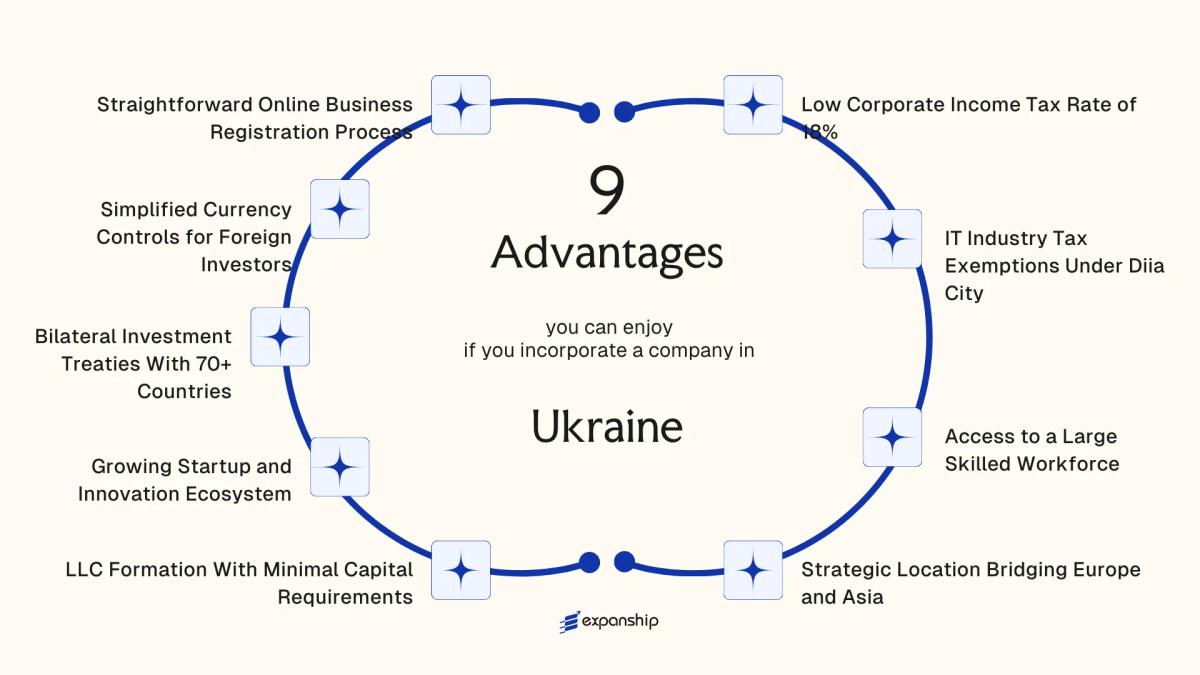
Low Corporate Income Tax Rate of 18%
Ukraine's 18% corporate income tax advantage is straightforward: the rate is flat, applies uniformly to resident legal entities, and is governed by the Tax Code of Ukraine adopted in 2010. For context, the EU average corporate tax rate sits above 21%, making this rate structurally competitive for a European-adjacent jurisdiction.
What the Rate Covers and How It Is Applied
Ukrainian resident companies are taxed on worldwide profit, calculated as accounting profit adjusted for tax differences under the Tax Code. This means your firm's taxable base follows a transparent, formula-driven method rather than discretionary assessments, which reduces uncertainty in financial planning.
The 18% rate applies to both locally owned and foreign-owned entities equally. A foreign investor establishing a limited liability company does not face a higher or separate rate, which removes a common structural disadvantage seen in some emerging markets.
Implications for Profit Repatriation
Dividends paid to a non-resident shareholder are subject to a 15% withholding tax under the Tax Code's general rule, though this rate may be reduced under an applicable double taxation treaty. The interaction between the 18% CIT and a reduced withholding rate can materially lower the total tax cost on repatriated earnings.
Your after-tax profits in Ukraine are calculated against a fixed 18% rate with no progressive tiers, giving you predictable tax exposure from the first year of operation.
IT Industry Tax Exemptions Under Diia City
Established by Law No. 1667-IX and operational since 2022, Diia City is a special legal and tax regime designed specifically for tech companies. Resident firms operating under this framework are exempt from standard corporate income tax on qualifying activities, replacing it with a 9% tax on distributed profits. For a software development firm generating retained earnings, this deferral means capital can be reinvested without triggering an immediate tax liability.
The Diia City IT tax exemptions Ukraine introduced are particularly significant for payroll costs, which typically represent the largest expense in tech operations. Instead of standard personal income tax rates, qualified specialists employed by Diia City residents pay a flat 5% personal income tax rate, and social security contributions are capped at a fixed monthly amount rather than calculated as a percentage of salary. This structure directly reduces the cost of employing senior engineers and technical staff.
Eligible company types include those engaged in software development, cybersecurity, and related IT services, provided they meet residency criteria set by the Ministry of Digital Transformation.
The practical advantages for your business include:
- Distributed profit taxation at 9% applies only when profits are actually paid out, giving you control over when the tax obligation arises
- The capped social contribution removes the salary-scaling cost that penalizes growth in headcount
- Specialist employees benefit directly from reduced personal tax, making compensation packages more competitive without increasing gross payroll spend
- The regime is governed by a dedicated legal framework, not a discretionary policy, providing a degree of predictability for multi-year financial planning

Company Incorporation in Ukraine
Set up a Diia City-eligible entity or standard Ukrainian company with full compliance support across legal, tax, and registration requirements.
Access to a Large Skilled Workforce
Ukraine skilled workforce advantages for businesses are grounded in measurable output. The country produces over 130,000 STEM graduates annually, with technical universities such as Kyiv Polytechnic Institute and Lviv Polytechnic National University consistently generating engineers, developers, and applied scientists. For a foreign firm building a technical team, this means a large candidate pipeline without depending on expensive expatriate hires.
The IT sector alone employs over 300,000 professionals, many of whom hold certifications across major international standards and work regularly with European and North American clients. English proficiency among technical specialists is high by regional standards, reducing friction in cross-border project delivery and client communication.
| Category | Figures |
|---|---|
| Annual STEM graduates | 130,000+ |
| Active IT professionals | 300,000+ |
| Higher education institutions | 600+ |
| IT outsourcing global rank | Top 5 in Europe |
Labor costs remain significantly below Western European rates, even for senior engineering roles. A mid-level software developer commands a fraction of an equivalent hire in Germany or the Netherlands, which directly affects your operating margin when structuring a development or back-office team locally.
Ukraine's educated labor market benefits from a university system accredited under the Bologna Process, meaning academic qualifications are recognized across EU member states. This makes it straightforward to transfer staff or validate credentials when expanding operations internationally.
Strategic Location Bridging Europe and Asia
Ukraine's geographic position as a Ukraine strategic location Europe Asia bridge is a structural asset, not a marketing description. Situated at the crossroads of Central and Eastern Europe, the country shares borders with seven nations, including EU members Poland, Slovakia, Hungary, and Romania, while maintaining land access toward the Black Sea and beyond.
For foreign investors, this translates into proximity to over 700 million consumers across European and Eurasian markets from a single legal base. Ukraine's transport infrastructure connects road, rail, and port networks that historically served as primary transit corridors between continental Europe and Central Asia.
Ukraine holds Association Agreement status with the EU, which governs trade arrangements and regulatory alignment. This means your firm benefits from preferential access to EU markets without the cost base of incorporating inside the bloc.
Keep these points in mind:
- The EU-Ukraine Association Agreement includes a Deep and Comprehensive Free Trade Area (DCFTA) that reduces tariffs on qualifying goods
- Confirm your product category's tariff classification under the DCFTA before assuming preferential rates apply
- Black Sea port access via Odesa historically supports export-oriented businesses in agriculture and manufacturing
- Geographic advantages are distinct from operational conditions; logistics infrastructure varies significantly by region
Ukraine is one of the few non-EU countries that has both a DCFTA with the European Union and a free trade agreement with the CIS bloc members, giving a single entity potential preferential access to two distinct economic zones simultaneously.
LLC Formation With Minimal Capital Requirements
Ukraine's LLC structure, known locally as a Товариство з обмеженою відповідальністю (TOV), carries no statutory minimum share capital requirement under the Law of Ukraine "On Limited Liability Companies and Additional Liability Companies" (No. 2275-VIII). For a foreign investor, this means your entity can be legally established without tying up capital purely to satisfy a registration threshold — funds go toward actual operations instead.
Capital Flexibility From Day One
A UAH 1 nominal share capital is legally sufficient to register a TOV, which stands in contrast to jurisdictions across the EU where minimum capital requirements can reach EUR 25,000 or more for equivalent structures. The absence of a mandatory reserve gives early-stage businesses and holding structures alike the freedom to calibrate initial investment to actual operational need rather than regulatory formality.
Implications for Ownership and Liability
Each founder's liability remains capped at their contributed share, so low initial capital does not expose participants to disproportionate personal risk. Ukraine LLC minimal share capital benefits extend further when structuring multi-owner entities: the Law permits up to 100 participants, and contributions may be made in cash or in-kind assets, giving founders flexibility in how they structure their equity from the outset.
Structure Your Ukrainian TOV With the Right Capital Framework
Speak with Expanship's corporate services team about setting up your TOV with a capital structure that fits your business goals and investor profile.
Growing Startup and Innovation Ecosystem
Ukraine startup ecosystem advantages for investors stem from a combination of structural factors that have taken shape over the past decade, accelerated by deliberate government policy targeting the technology and innovation sectors.
- The Ukrainian Startup Fund, established by the government, provides seed grants to early-stage companies, reducing the initial capital burden on founding teams and making the market accessible to foreign co-founders and investors entering at early rounds.
- Unit.City in Kyiv operates as a dedicated innovation park, housing hundreds of tech firms, accelerators, and R&D units under one ecosystem. Physical proximity to other firms and institutional investors compresses deal-making timelines in ways that distributed markets cannot replicate.
- Ukraine consistently ranks among the top countries globally for the number of certified IT professionals per capita. For a foreign business establishing a tech-oriented entity, this translates directly into access to a deep hiring pool without the premium labor costs typical of Western European markets.
- The Ukraine innovation hub benefits for businesses extend to accelerator programs tied to EU grant frameworks, giving incorporated entities a pathway to non-dilutive funding outside the domestic market.
- Several international venture funds, including those operating under EBRD mandates, maintain active investment programs targeting Ukrainian startups, giving your incorporated entity structured access to institutional capital.
Bilateral Investment Treaties With 70+ Countries
Ukraine bilateral investment treaties benefits extend to foreign investors through a network of over 70 active BITs, which provide legally binding protections that domestic corporate law alone cannot guarantee. These treaties establish enforceable rights under international law, independent of changes to local legislation.
Most of Ukraine's BITs follow a standard structure that includes:
- Fair and equitable treatment of foreign-owned entities
- Protection against expropriation without adequate compensation
- Guaranteed free transfer of profits, dividends, and capital
- Access to international arbitration, typically under ICSID or UNCITRAL rules
That access to arbitration is the practical core of the advantage. If a dispute arises between your business and the Ukrainian state, you are not limited to local courts. You can bring a claim before a neutral international tribunal, which significantly reduces jurisdictional risk for cross-border investors.
The treaties also lock in treatment standards at the time of investment. Even if domestic regulations shift, the BIT obligations remain binding on the state under international law.
A foreign investor whose home country has a BIT with Ukraine can initiate arbitration under ICSID Convention procedures if the state breaches treaty protections, bypassing local court proceedings entirely. This procedural right has been exercised in documented ICSID cases involving Ukraine, including Bosh International, Inc. v. Ukraine (ICSID Case No. ARB/08/11).
Simplified Currency Controls for Foreign Investors
Ukraine currency control benefits for foreign investors stem from a sustained liberalization process the National Bank of Ukraine (NBU) has carried out since 2019 under the Law of Ukraine "On Currency and Currency Transactions." Prior to this reform, foreign exchange operations were tightly restricted, but the current framework shifts the default principle toward permissibility rather than prohibition.
Under the current rules, most cross-border currency transfers do not require individual NBU licenses. This matters practically because your business can repatriate dividends, royalties, and loan repayments without obtaining prior regulatory approval for each transaction, reducing administrative friction on outbound capital flows.
Key operational freedoms under the current regime include:
- Dividend repatriation to non-resident shareholders is permitted without a separate NBU authorization
- Foreign currency loans from non-residents can be received and serviced under a general permission framework
- Currency exchange transactions are available through licensed banks without case-by-case central bank clearance
The NBU retains the authority to impose temporary restrictions during periods of financial instability, and some legacy controls remain in place. Still, the structural shift from a license-based to a notification-based model gives foreign-owned entities measurably more flexibility in managing cross-border financial flows than was possible under the pre-2019 regime.
Certain restrictions on foreign currency transfers may be reinstated by the NBU during periods of martial law or macroeconomic stress, so verify the current status of any applicable NBU resolutions before structuring repatriation arrangements.
Straightforward Online Business Registration Process
Ukraine online business registration advantages begin with the country's State Tax Service and the Ministry of Justice operating a unified e-registration portal that allows foreign nationals to register a legal entity entirely online. This removes the requirement to be physically present in the country, which is a direct time and cost saving for international founders.
Registration through the Unified State Register (USR) system can be completed within 24 hours of submitting the required documentation. For foreign investors, that speed translates into an earlier start date for operations, contract execution, and opening corporate bank accounts — all of which are contingent on legal entity status.
The e-registration system accepts applications prepared by a licensed notary or a representative with a notarized power of attorney. This means you do not need to relocate or appoint a local director solely to satisfy registration procedures, which is a common requirement in several EU member states.
Required documentation for a standard Limited Liability Company (TOV) includes:
- Notarized copies of founder identification documents
- Articles of association (Statute)
- Decision on company establishment
- Confirmation of the registered legal address
Once registered, the entity receives a unique Unified Registration Number (EDRPOU code), which serves as the identifier across tax, customs, and banking authorities. A single code covering multiple regulatory bodies reduces administrative friction compared to jurisdictions where separate registrations are required for each authority.
Foreign-owned firms qualify for e-registration on the same terms as domestic entities, with no additional licensing or approval stages imposed on non-resident founders.
Why Ukraine Stands Out Against Regional Competitors
Compared to neighbouring incorporation destinations, Ukraine's combination of tax structure, workforce depth, and treaty coverage positions it distinctly for foreign investors weighing Eastern European options. Poland and Romania attract significant foreign direct investment, but both carry higher operational costs and more complex regulatory entry points for non-EU founders. Hungary offers competitive tax rates yet comes with EU membership costs and stricter capital requirements for certain entity types.
What the comparison reveals is less about headline rates and more about structural accessibility. A foreign national can register a limited liability company under the Law of Ukraine on Limited Liability Companies without a local director or minimum share capital, a condition that neither Poland nor Romania replicates without additional procedural steps. The Diia City special legal framework adds a layer of sector-specific tax treatment that has no direct equivalent in the comparator jurisdictions below.
| Parameter | Ukraine | Poland | Romania | Hungary |
|---|---|---|---|---|
| Standard Corporate Tax Rate | 18% | 19% (9% for small firms) | 16% (1% micro-regime) | 9% |
| Minimum Share Capital (LLC) | None | PLN 5,000 (~EUR 1,150) | RON 1 (nominal) | HUF 3,000,000 (~EUR 7,500) |
| Local Director Required | No | No | No | No |
| Sector-Specific Tax Regime | Yes (Diia City – IT sector) | No direct equivalent | No direct equivalent | No direct equivalent |
| Bilateral Investment Treaties | 70+ | 60+ | 70+ | 60+ |
| Non-EU Founder Restrictions | None | None | None | None |
Compliance Services for Companies in Ukraine
Stay current with Ukrainian corporate filing requirements, tax obligations, and regulatory reporting through Expanship's compliance support.
Conclusion
Ukraine's combination of a flat 18% corporate income tax, the Diia City special legal regime for technology businesses, and an extensive bilateral investment treaty network creates a coherent case for foreign incorporation rather than a collection of isolated incentives. For businesses in the right sectors, these structural features work together to reduce both the tax burden and the legal exposure that typically accompany cross-border operations.
Not every business will extract equal value from these conditions. A technology firm seeking residency under Diia City operates under a fundamentally different regulatory environment than a trading company registered as a standard LLC under Ukrainian corporate law. The benefits of incorporating in Ukraine are real, but their weight depends on your industry, the jurisdictions where your clients and capital are based, and how your entity is structured.
The legal and regulatory framework is established and documented. Ukraine company formation advantages, including minimal share capital requirements and online state registration through a single registrar system, lower the administrative threshold for market entry. For the right business profile, the foundations are in place to begin operating under a defined legal structure with access to a workforce of over 40 million people and EU-proximate market positioning. Translating that potential into a functioning corporate structure requires accurate entity selection, correct registration filings, and ongoing compliance with the State Tax Service of Ukraine's reporting obligations.
Start Your Ukrainian Company With Expanship Today
Incorporating in Ukraine with Expanship begins with understanding which entity type suits your objectives and what the Ukrainian registration process actually requires. This blog has covered the core advantages available to foreign investors, from the TOV's minimal capital threshold to Diia City's preferential tax treatment for IT businesses. Expanship's work starts where those advantages need to be acted on, guiding your documentation and filings through the State Registration Service of Ukraine.
Expanship supports the full formation and maintenance cycle for your Ukrainian entity:
- Preparation and notarization of incorporation documents, including charter and founder resolutions
- Registered office and resident agent provision to satisfy Ukrainian address requirements
- Filing coordination with the State Registration Service and the State Tax Service of Ukraine
- Post-incorporation compliance management, including annual reporting obligations
- Nominee director and shareholder services where structurally appropriate
- Banking introduction assistance with Ukrainian and international financial institutions
Each service is handled by professionals familiar with the specific procedural requirements that apply to foreign-owned TOVs under Ukrainian corporate law.
To discuss your formation requirements, contact Expanship Ukraine.
Frequently Asked Questions (FAQ)
There is no statutory minimum share capital for an LLC under Ukrainian law. You can register the entity with a nominal capital amount, which removes a common barrier for early-stage businesses or foreign investors testing the market before committing larger capital.
Under the Diia City special legal regime, qualifying IT companies can apply a 5% personal income tax rate on payments to gig-contract specialists, compared to the standard 18% rate. The regime also allows reduced unified social contribution rates. To qualify, a company must meet criteria including a minimum number of qualified employees and a minimum monthly revenue threshold.
The 18% rate applies to the majority of corporate entities, though Diia City participants operating under the alternative tax model pay a different effective rate on distributed profits rather than total income. Banks and certain financial institutions are subject to different provisions under the Tax Code of Ukraine.
Ukraine has ratified bilateral investment treaties with over 70 countries. These treaties typically provide foreign investors with protections against expropriation without compensation, guarantee fair and equitable treatment, and grant access to international arbitration if a dispute arises with the Ukrainian state.
Registration through the Unified State Register via the online portal can be completed within one to three business days once all documents are submitted correctly. The State Registration Service of Ukraine processes incorporation filings, and the timeline assumes no additional licensing requirements apply to your specific business activity.
A company that fails to maintain the qualifying conditions for Diia City status, such as falling below the required number of gig-contract workers or the monthly revenue floor, can be removed from the register of Diia City residents. Upon removal, the entity reverts to the standard tax treatment under the Tax Code of Ukraine, and preferential rates cease to apply from that point forward.
Legal Disclaimer
The information provided in this article is for general informational purposes only and does not constitute legal, tax, or professional advice. While we strive to ensure the accuracy and timeliness of the content, laws and regulations are subject to change, and the application of laws can vary widely based on specific facts and circumstances.
Readers should not act upon this information without seeking professional counsel tailored to their individual situation. Expanship and its authors disclaim any liability for actions taken or not taken based on the content of this article.
For specific advice regarding your business setup, compliance requirements, or any legal matters, please consult with qualified legal and tax professionals in the relevant jurisdiction.