

Key Takeaways
- Tuvalu's corporate framework, governed by the Companies Act and overseen by the Financial Supervision Commission, offers limited regulatory sophistication compared to established offshore jurisdictions, creating compliance uncertainty for complex international structures.
- Businesses requiring active banking relationships face compounding friction, as Tuvalu's underdeveloped domestic financial infrastructure combines with restricted correspondent banking access to constrain routine treasury and payment operations.
- With a negligible double taxation treaty network, entities incorporated in Tuvalu cannot rely on treaty protections to reduce withholding tax exposure or resolve cross-border tax disputes through formal bilateral mechanisms.
- The jurisdiction's extreme geographic remoteness and climate vulnerability introduce material operational risk, as reliance on costly imports and fragile transport and telecommunications links raises the baseline cost of maintaining any business presence on the islands.
Tuvalu operates under a lightly regulated corporate framework, governed primarily by the Companies Act alongside oversight from the Financial Supervision Commission. For foreign investors assessing Tuvalu company formation drawbacks, the disadvantages of incorporating in Tuvalu span structural, geographic, financial, and operational categories.
Not all drawbacks apply equally across every business type or industry. A firm using a Tuvalu-registered entity purely as a holding structure will encounter a different set of friction points than one attempting active operations on the islands.
This article is most relevant to foreign entrepreneurs, offshore structuring advisors, and international investors who are evaluating cons of registering a business in Tuvalu for the first time or reassessing an existing structure.
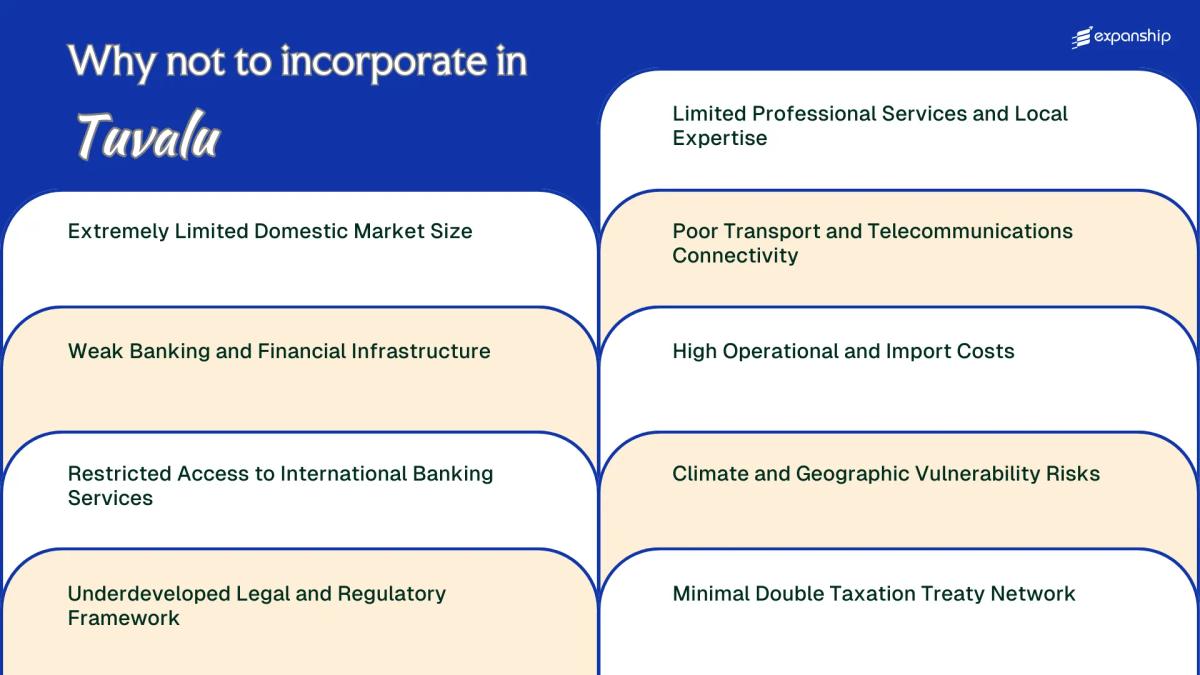
Extremely Limited Domestic Market Size
Tuvalu small domestic market limitations present one of the most structurally binding constraints for any foreign business considering incorporation here. With a population of approximately 11,000 spread across nine low-lying atolls, the consumer base is among the smallest of any sovereign nation.
Scale That Renders Local Revenue Unviable
Domestic consumption across the entire island group cannot sustain most commercial operations at a scale that justifies incorporation costs. Any business model dependent on local sales volume will find that Tuvalu's economic scale restrictions make break-even thresholds nearly impossible to reach through in-country revenue alone.
GDP remains below USD 60 million annually, meaning aggregate purchasing power across the entire economy is smaller than a single mid-sized retailer in most Pacific regional centers.
Structural Dependency on External Revenue Sources
Your business cannot realistically generate operational returns from the local market, which means revenue must be sourced externally from the moment of incorporation. This structural dependency forces firms registered under Tuvaluan law to maintain parallel commercial infrastructure elsewhere, effectively doubling administrative overhead without proportional return.
Any entity incorporated in Tuvalu that targets domestic consumers as a primary revenue source will face a structurally unviable business model from the outset, given the limited consumer base and negligible aggregate market demand.
Weak Banking and Financial Infrastructure
Tuvalu banking infrastructure weaknesses stem from a financial sector built primarily to serve a population of under 12,000 people. The National Bank of Tuvalu, the country's sole commercial bank, operates with limited product offerings and cannot support the transactional complexity most foreign businesses require from day one.
Opening a corporate account through the National Bank of Tuvalu means accepting constrained foreign currency facilities, restricted wire transfer capabilities, and minimal credit product availability.
Practical burdens this creates for your business include:
- Delays in processing international payments reduce your ability to meet supplier or payroll obligations on time
- Limited foreign exchange services force you to route currency conversions through third-party institutions, adding transaction costs
- Absence of trade finance products means you cannot access letters of credit or export financing locally
- No local correspondent banking redundancy means a single operational disruption affects your entire financial position in the jurisdiction
Banking risks incorporating in Tuvalu extend beyond inconvenience. The financial sector limitations translate directly into slower capital movement and higher per-transaction costs compared to jurisdictions with multi-bank competitive environments.

Company Incorporation in Tuvalu
Understand the full scope of incorporating a business entity in Tuvalu, including registration requirements and compliance obligations.
Restricted Access to International Banking Services
Tuvalu international banking access restrictions are among the most concrete operational barriers your company will face after incorporation. The country has no domestic commercial banking sector to speak of, and foreign-registered entities have no local correspondent bank relationships to rely on for routine transactions.
| Barrier | Practical Impact |
|---|---|
| No resident commercial bank branches | Zero domestic banking infrastructure for corporate accounts |
| Correspondent banking relationships | Severely limited; most major banks decline Tuvalu entities due to high-risk classification |
| FATF grey-listing risk exposure | Increases compliance scrutiny from overseas institutions reviewing your company's origin jurisdiction |
| Account opening acceptance rate | Offshore banks routinely reject or delay applications citing jurisdiction reputation |
| Wire transfer rejection risk | Elevated for entities registered in Pacific micro-states without verified economic substance |
Opening a corporate bank account for a Tuvalu-registered entity typically requires approaching offshore institutions in Singapore, Hong Kong, or the EU, where compliance teams apply enhanced due diligence under their internal risk frameworks.
The requirement to demonstrate genuine economic substance, a standard increasingly enforced by correspondent banks screening Pacific jurisdictions, is difficult to satisfy when your firm has no physical presence or local operations. This effectively blocks access to mainstream banking channels. Even where an account is eventually opened, transaction monitoring is stricter and processing delays are longer than you would encounter with an entity incorporated in a well-regarded financial centre.
Underdeveloped Legal and Regulatory Framework
Tuvalu legal framework drawbacks stem largely from the country's reliance on inherited colonial-era legislation that has seen limited substantive reform. The Companies Act, drawn from older Commonwealth templates, lacks the detailed provisions that commercial operators expect in a modern jurisdiction, creating genuine uncertainty around shareholder rights, directorship obligations, and corporate restructuring procedures.
The Financial Supervision Commission (FSC) serves as the primary regulatory authority, but its supervisory capacity is constrained by limited staffing and resources. This means enforcement inconsistencies are structurally embedded, not incidental, and your entity may face unpredictable regulatory responses to routine compliance matters.
There is no dedicated commercial court. Disputes are handled through a general court system with limited exposure to complex corporate or cross-border commercial cases, which directly affects how enforceable your contractual arrangements are in practice.
- No specialist commercial tribunal exists; contract disputes proceed through general civil courts
- Corporate legislation does not provide detailed guidance on cross-border mergers or restructuring
- The FSC's regulatory framework applies to licensed entities, but gaps in secondary legislation leave interpretive ambiguity
- There is no formal insolvency regime comparable to UNCITRAL Model Law standards
- Statutory audit and reporting thresholds are not clearly codified for foreign-owned entities
Tuvalu has no published case law database, meaning legal precedent from its courts is largely inaccessible to foreign counsel conducting due diligence.
Limited Professional Services and Local Expertise
Tuvalu professional services limitations present a structural problem that few other offshore jurisdictions impose to the same degree. The country's small population and geographic isolation mean that qualified legal, accounting, and corporate advisory professionals are exceptionally scarce domestically.
Scarcity of Qualified Professionals On the Ground
Tuvalu has no established law society or formal bar association operating at a scale comparable to regional counterparts, and the number of resident lawyers with international corporate law experience is extremely limited. If your business requires ongoing legal counsel for compliance with the Companies Act or the Financial Institutions Act, you will almost certainly need to engage professionals based in Fiji, Australia, or New Zealand, adding cost and coordination delays.
Consequences for Foreign Business Operations
Lack of local expertise in Tuvalu means routine corporate tasks, such as registered agent services, statutory filings, and notarization, depend heavily on external service providers or government officials whose responsiveness can be unpredictable. This dependency is not merely inconvenient; it directly extends turnaround times for time-sensitive regulatory requirements.
Working Around Professional Services Gaps in Tuvalu
Expanship can help you identify and coordinate qualified external legal, accounting, and compliance professionals for your Tuvalu entity.
Poor Transport and Telecommunications Connectivity
Tuvalu connectivity challenges for businesses are among the most operationally disruptive constraints a foreign entity will face, given the country's remote mid-Pacific location with limited physical and digital infrastructure links to major commercial centres.
- Funafuti International Airport handles only a small number of scheduled flights per week, meaning urgent personnel travel, courier shipments, or time-sensitive documents face delays measured in days rather than hours.
- No deep-water port exists, so all cargo arrives by sea with extended transit times that disrupt supply chains and inventory planning for any business dependent on physical goods.
- Internet connectivity relies on satellite links and a single undersea cable, creating bandwidth constraints that make real-time financial transactions, video conferencing, and cloud-based operations unreliable.
- Telecommunications outages are not uncommon, and because no redundant terrestrial infrastructure exists, downtime has no rapid local remediation path.
- Your business may face situations where remote operational management is effectively suspended during infrastructure disruptions, with no alternative connectivity provider to switch to domestically.
High Operational and Import Costs
Running a business in Tuvalu carries high operational costs that most founders significantly underestimate before committing. The country imports nearly all manufactured goods, fuel, and consumables, since domestic production capacity is negligible.
Freight costs are disproportionate relative to cargo volume. Shipping routes to Funafuti are infrequent, and smaller consignments attract premium per-unit logistics rates that erode margins before goods even reach end users.
- Fuel costs for generators run materially higher than regional averages, directly inflating electricity expenses for any office or warehouse operation.
- Imported office equipment, IT hardware, and consumables carry landing costs that can exceed the original purchase price.
- Expatriate staff, if required, need accommodation and relocation packages priced for a remote Pacific atoll, not a commercial hub.
Local procurement alternatives are scarce. Your firm cannot substitute imports with local supply chains for most operational needs, so cost exposure is structural rather than manageable through sourcing decisions.
A hypothetical scenario: A small foreign-owned trading entity importing a single 20-foot container to Funafuti could realistically pay USD 4,000–6,000 in freight and port handling charges from Auckland, before customs duties under Tuvalu's Customs Act are applied — costs that would represent a fraction of that figure for equivalent shipments into Fiji or Samoa.
Climate and Geographic Vulnerability Risks
Tuvalu climate risk business incorporation decisions must account for a physical reality that has no parallel in most corporate jurisdictions: the country's nine atolls sit at an average elevation of under two metres above sea level. Any registered entity or physical operation faces the credible prospect of land loss, saltwater intrusion, and infrastructure damage without a realistic domestic recovery mechanism.
Cyclones and king tide flooding cause recurring damage to roads, power infrastructure, and communications equipment. Each event can suspend business operations entirely, and insurance coverage for assets located in high-risk low-lying Pacific atolls is either prohibitively expensive or commercially unavailable.
The Tuvalu Government has formally acknowledged existential territorial risk through instruments such as the Falepili Union treaty with Australia, which includes provisions for climate mobility. This acknowledgment at the governmental level signals that continuity of jurisdiction itself cannot be guaranteed over a long-term business horizon.
- Physical records, local contracts, and any assets held onshore are exposed to recurrent flood damage with no domestic disaster recovery infrastructure to support restoration.
- Regulatory continuity depends on government institutions that operate with extremely limited resources under the same geographic constraints.
Even if your business operates remotely with no physical presence, a Tuvalu-registered company's legal and regulatory standing depends on government institutions located on atolls subject to ongoing climate-driven displacement, meaning long-term corporate continuity carries sovereign-level uncertainty.
Minimal Double Taxation Treaty Network
Tuvalu has not concluded any bilateral double taxation agreements with other countries. For a foreign business owner, this means income earned through a Tuvaluan entity and repatriated to your home country may be taxed in both jurisdictions, with no treaty mechanism to offset or eliminate that liability.
The absence of Tuvalu double taxation treaty limitations as a structured framework means your effective tax burden depends entirely on the domestic rules of your home jurisdiction. Countries with extensive treaty networks — such as the Netherlands or Singapore, each holding 90+ active DTAs — offer investors clear withholding tax reductions and dispute resolution procedures that simply do not exist here.
The lack of DTAs also affects dividends, royalties, and interest payments flowing out of the entity. Without treaty protection, withholding taxes imposed by counterparty jurisdictions apply at their standard domestic rates, increasing the cost of cross-border transactions.
Strategies to Overcome These Drawbacks
Overcoming Tuvalu incorporation drawbacks requires structural planning rather than reactive fixes. The disadvantages covered in this blog stem from geographic, institutional, and infrastructural constraints that cannot be resolved through local workarounds alone.
- Register under the International Companies Act and maintain a licensed local registered agent to satisfy statutory residency requirements without physical presence.
- Open correspondent banking relationships through jurisdictions with established financial infrastructure before incorporation, given the restricted access to international banking services from Tuvalu-based institutions.
- Appoint foreign-qualified legal counsel familiar with Pacific regional commercial law to compensate for the absence of deep local legal expertise.
- Structure operations to hold contracts, invoicing, and intellectual property at the entity level rather than relying on local enforcement mechanisms.
- Monitor climate-related operational continuity by establishing records and governance processes in an offshore jurisdiction with stable telecommunications infrastructure.
These steps operate within the framework overseen by the Tuvalu government. Given the minimal tax treaty network and underdeveloped regulatory environment, no single mitigation fully offsets the structural limitations inherent to this jurisdiction.
Tuvalu's Overall Business Viability
Tuvalu business viability risks are real and well-documented, but they do not disqualify the jurisdiction entirely. For a narrow category of foreign businesses, primarily those seeking a registered offshore presence with minimal domestic operational requirements, the Tuvalu Companies Act framework still offers a legally recognised structure.
| Pro | Con |
|---|---|
| Companies Act provides a recognised legal basis for offshore entity registration | The domestic market is too small to support meaningful local revenue generation |
| Low incorporation costs relative to many offshore jurisdictions | Access to international correspondent banking is severely restricted for Tuvalu-registered entities |
| No corporate income tax on foreign-sourced income | The double taxation treaty network is minimal, creating withholding tax exposure across most trading partners |
| Remote registration is possible without physical presence requirements | Professional and legal service providers with specialist expertise are scarce on the ground |
| Stable political environment under a Westminster-style constitutional framework | Climate-related physical and regulatory risk to long-term operational continuity is material and growing |
Assessing whether incorporating in Tuvalu is worth it depends almost entirely on your business model's tolerance for banking friction and infrastructure constraints. Companies requiring active banking relationships, access to EU or US markets, or on-the-ground professional support will find the jurisdiction's limitations structurally prohibitive.
Compliance Services for Companies in Tuvalu
Meeting ongoing compliance obligations under the Tuvalu Companies Act requires attention to filing deadlines, registered agent requirements, and regulatory reporting. Review the compliance services available for Tuvalu-registered entities.
Conclusion
This Tuvalu incorporation cons and risks summary reflects a jurisdiction where structural limitations outweigh the modest regulatory simplicity the framework offers. Banking access, the absence of a meaningful tax treaty network, and the extreme geographic isolation compound each other in practice. For businesses requiring reliable financial infrastructure or international counterparty credibility, those constraints remain material. Structural solutions exist, but they require deliberate planning and external professional support to implement effectively.
Expanship's Services for Your Tuvalu Expansion
Expanship Tuvalu company formation services are built around the specific friction points this jurisdiction creates: working within the Companies Act framework administered through the Tuvalu Financial Intelligence Unit's oversight requirements, managing the absence of a developed professional services sector, and operating without reliable local banking infrastructure.
Expanship handles the procedural and administrative burden across the full incorporation and maintenance cycle.
- Your company registration and all supporting document preparation are handled end to end.
- A registered agent and local office address are provided to satisfy statutory presence requirements.
- Government filings and liaison with Tuvaluan regulatory authorities are managed on your behalf.
- Post-incorporation compliance obligations are tracked and fulfilled as they fall due.
- Banking introduction assistance is provided to support your access to correspondent and offshore accounts.
- Tax registration and coordination with local authorities are included in the incorporation process.
Reach out through Expanship Tuvalu to discuss your incorporation requirements.
Frequently Asked Questions (FAQ)
Every company type incorporated under Tuvalu's laws faces this constraint, since the limitation stems from the country's financial system rather than any entity-specific rule. The National Bank of Tuvalu operates as the sole domestic bank, and its correspondent banking relationships with international institutions are narrow. This restricts your ability to open multi-currency accounts, process international wire transfers, or access trade finance from within Tuvalu.
Tuvalu's location in the central Pacific means almost all goods, equipment, and professional services must be imported, typically through Fiji, which adds freight premiums and extended lead times to routine business costs. For a company requiring physical presence or ongoing supply, these logistics costs can be disproportionate relative to the jurisdiction's size. Service-based businesses operating entirely online face lower exposure, but even they encounter costs tied to the limited local IT infrastructure.
Your company would be effectively unable to receive or send international payments, which undermines the core commercial purpose of incorporating in the first place. Correspondent banking de-risking has affected small Pacific jurisdictions broadly, and Tuvalu, given its size and regulatory profile, sits at the more vulnerable end of that spectrum. Some operators attempt to resolve this by layering in a second entity in a better-connected jurisdiction, which adds cost and structural complexity.
Compared to jurisdictions like Vanuatu or the Marshall Islands, which have developed dedicated international business company legislation and supporting regulatory infrastructure over decades, Tuvalu's framework is less developed and less tested. The legal system draws on a mix of received English law and local statutes, but the volume of commercial case law is minimal, leaving gaps in how disputes or insolvencies would be resolved in practice. This creates genuine legal uncertainty for foreign investors that more established offshore centers do not present to the same degree.
Yes, in concrete ways. Tuvalu sits on low-lying atolls with a maximum elevation of approximately five meters, making it one of the jurisdictions most exposed to sea-level rise and storm surge events. If government offices, registry infrastructure, or the National Bank of Tuvalu are disrupted by a climate event, continuity of your company's legal standing, document access, and banking relationships could all be affected simultaneously, with limited contingency systems available.
The scarcity of qualified local lawyers, accountants, and corporate service providers means you will likely depend on professionals based in Fiji or elsewhere in the Pacific to handle ongoing compliance, which increases both cost and turnaround time. Where local filings or in-country representation are required under Tuvaluan company law, delays in securing compliant local agents can put your entity at risk of administrative breach. This is not a theoretical risk; it is a practical constraint that compounds every regulatory requirement the business faces.
Legal Disclaimer
The information provided in this article is for general informational purposes only and does not constitute legal, tax, or professional advice. While we strive to ensure the accuracy and timeliness of the content, laws and regulations are subject to change, and the application of laws can vary widely based on specific facts and circumstances.
Readers should not act upon this information without seeking professional counsel tailored to their individual situation. Expanship and its authors disclaim any liability for actions taken or not taken based on the content of this article.
For specific advice regarding your business setup, compliance requirements, or any legal matters, please consult with qualified legal and tax professionals in the relevant jurisdiction.