

Key Takeaways
- Tuvalu's International Companies Act establishes a zero-tax environment on foreign-sourced income, meaning an IBC engaged in international trade, holding, or investment activity carries no corporate income tax liability on profits generated outside the jurisdiction.
- The absence of exchange controls means capital can move freely in and out of a Tuvalu structure without regulatory restriction, which reduces friction for businesses managing funds across multiple jurisdictions.
- Statutory privacy protections under Tuvalu's offshore framework limit public disclosure of beneficial ownership and directorship details, giving foreign-held entities a meaningful layer of confidentiality that is built into the legislative design rather than applied case by case.
- Because Tuvalu operates within a British common law tradition under a Westminster-style parliamentary system, contractual and corporate disputes are resolved against a body of established legal precedent, providing greater structural predictability than civil law or hybrid offshore regimes.
Tuvalu is an independent Pacific island nation situated in the central Pacific Ocean, governed under a Westminster-style parliamentary system and recognized as a sovereign member of the Commonwealth. Company registration falls under the oversight of the Tuvalu registrar, which administers the formation of corporate entities — most commonly the International Company — for foreign investors seeking an offshore structure. The jurisdiction operates a zero-tax posture on income generated outside its borders, making it a functionally tax-neutral environment for internationally focused businesses.
Foreign ownership is unrestricted for entities incorporated under Tuvalu's offshore framework, and no local partnership or resident directorship is required as a general rule. Your business can be structured entirely from abroad, with full foreign shareholding permitted from the outset.
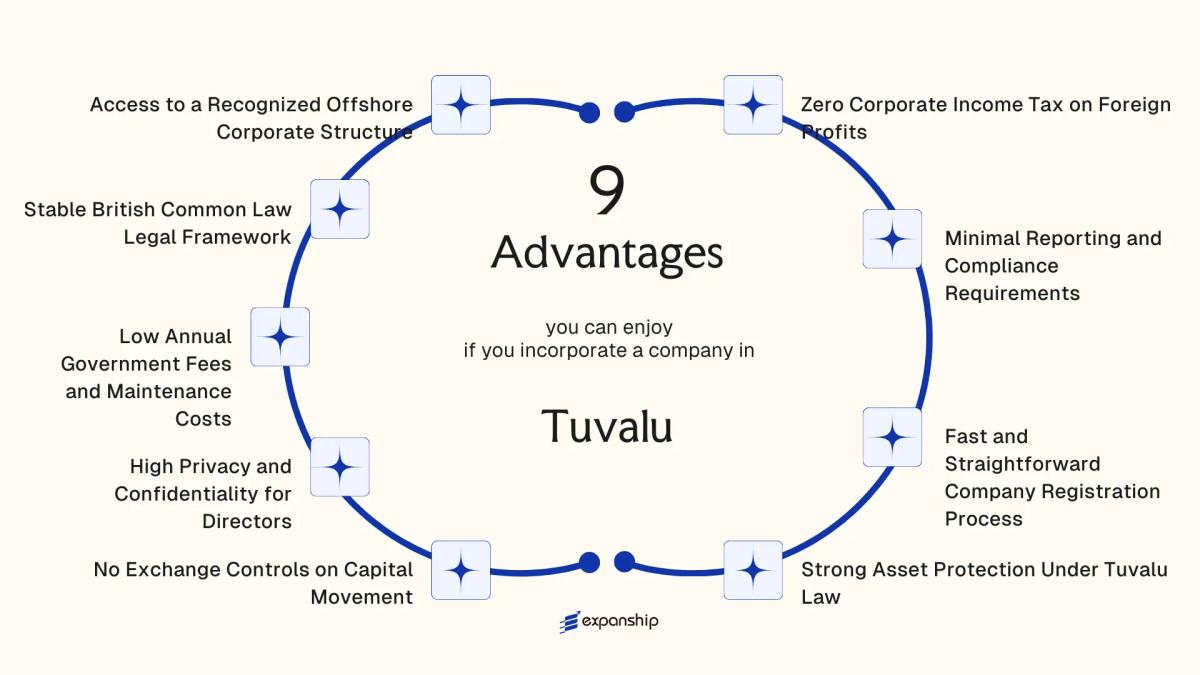
The benefits of incorporating in Tuvalu span tax treatment, privacy protections, regulatory requirements, and legal structure. This article examines the documented advantages available to foreign businesses that choose to form a company here.
Zero Corporate Income Tax on Foreign Profits
Tuvalu zero tax on foreign profits is the defining structural advantage of the jurisdiction's offshore framework. Under the Companies Act (Foreign Companies) and the broader offshore legislation administered through the Tuvalu Financial Services Commission, companies incorporated as International Companies (ICs) are fully exempt from corporate income tax on income sourced outside the country.
What the Exemption Covers
The zero-rate applies exclusively to foreign-sourced income, meaning profits generated from clients, transactions, or operations conducted entirely outside Tuvalu. For a business structured to serve international markets, this means retained earnings are not reduced by a corporate tax charge at the entity level.
Why the Structure Is Commercially Relevant
This territorial-style treatment allows your firm to accumulate offshore profits without triggering a local tax liability. The exemption is not a deferral mechanism or a treaty-dependent concession — it is built directly into the statutory framework governing International Companies, making it a predictable, structurally embedded feature rather than a discretionary relief.
Foreign profits earned by your Tuvalu International Company are not subject to corporate income tax under the country's offshore statutory framework.
Minimal Reporting and Compliance Requirements
Tuvalu minimal compliance requirements offshore are among the most reduced of any registered offshore regime, making the jurisdiction a functional choice for foreign principals who want a compliant structure without extensive administrative overhead.
International Business Companies (IBCs) registered under the Tuvalu Companies Act are not required to file annual financial statements with any local authority. There is no statutory audit requirement for IBCs deriving income exclusively from outside the country. Your entity is not obligated to submit tax returns to the Tuvalu government, since foreign-sourced profits fall outside the local tax base entirely.
The practical effect is that your annual obligations are reduced to maintaining the registered agent relationship and paying the government renewal fee. This removes the recurring costs and professional fees that annual filings, audited accounts, or director reports would otherwise generate.
Several structural features explain why the compliance burden stays low:
- No requirement to file accounts with the Registrar of Companies for qualifying IBCs
- No local accounting standards mandate for foreign-income entities
- No mandatory appointment of a local auditor under the IBC framework
- Annual returns do not require disclosure of beneficial ownership to public registries
Registered agent obligations must still be maintained in good standing throughout the life of the company.

Incorporate a Company in Tuvalu
Register your Tuvalu IBC with full registered agent support and ongoing compliance management.
Fast and Straightforward Company Registration Process
Tuvalu fast company registration advantages stem largely from the structure of its International Business Companies Act, which governs offshore entity formation and sets a compressed administrative timeline. Under this framework, an International Business Company (IBC) can typically be incorporated within one to two business days once documentation is submitted to the Tuvalu registry. For foreign business owners, that speed directly reduces the window between deciding to incorporate and being legally able to operate, sign contracts, or open corporate bank accounts.
| Parameter | Detail |
|---|---|
| Governing Legislation | International Business Companies Act |
| Typical Incorporation Timeframe | 1 to 2 business days |
| Minimum Directors Required | 1 |
| Minimum Shareholders Required | 1 |
| Physical Presence Required | No |
The formation process does not require physical presence in Tuvalu. A registered agent based in the jurisdiction handles filing on your behalf, which means you are not required to travel, appear before a government body, or notarize documents locally. This removes a practical barrier that adds days or weeks to registration in many onshore jurisdictions.
Documentation requirements are minimal by design. A standard IBC application requires identification, a registered agent appointment, and basic constitutional documents. The absence of paid-up capital requirements at the registration stage also means the entity can be formed without first moving funds, allowing your corporate structure to be established before capital is allocated.
Strong Asset Protection Under Tuvalu Law
Tuvalu asset protection advantages for investors stem largely from the structural features of the Companies Act that governs International Business Companies registered there. Under this framework, assets held within a Tuvalu IBC are legally separated from your personal estate, meaning creditor claims arising in your home jurisdiction cannot automatically pierce that corporate veil.
Statutory provisions governing IBCs restrict foreign court judgments from being directly enforced against company assets without initiating fresh proceedings locally. That procedural barrier creates a meaningful delay for creditors and, in many cases, a practical deterrent.
For foreign investors structuring holding companies or asset-holding vehicles, this separation is the functional advantage. It means intellectual property, real estate interests, or investment portfolios held through the entity sit at a distance from personal liability exposure.
Keep these points in mind:
- The IBC structure must maintain genuine separation between personal and corporate finances to preserve protection
- Tuvalu legal asset shielding applies to foreign-sourced assets; local business activity may carry different treatment
- Protection depends on the company remaining in good standing under the Companies Act
- Fraudulent conveyance rules still apply; transferring assets to defeat known creditors may be challenged
Tuvalu's IBC creditor protection benefits operate under common law principles, meaning decades of established case law from British jurisprudence can be applied to interpret asset protection disputes locally.
No Exchange Controls on Capital Movement
Tuvalu imposes no exchange controls on capital movement, meaning foreign-owned companies registered under the Tuvalu Companies Act face no statutory restrictions on transferring funds across borders. For a business that operates internationally, this translates directly into operational freedom: profits generated offshore can be repatriated without regulatory approval, without conversion mandates, and without transaction ceilings imposed by a central monetary authority.
Free Movement of Funds Across Currencies
Your entity can hold accounts in multiple foreign currencies and move capital in and out of the jurisdiction without filing currency declarations or obtaining prior authorization. In many onshore jurisdictions, central bank approval is required for large outward transfers, a process that can delay transactions by days or weeks. The absence of such requirements means treasury operations for your offshore firm remain within your control, not subject to administrative queues.
Structural Advantage for Multinational Structures
For holding companies or international trading entities, unrestricted fund transfers for businesses mean that dividend flows, intercompany loans, and capital injections can be structured on commercial timelines rather than regulatory ones. Tuvalu does not operate a foreign exchange regulatory body that oversees private capital flows for offshore-registered companies. This structural feature is particularly relevant when the entity is a node within a broader multinational group, where timing mismatches in capital movement can carry real financial cost.
Structure Your Tuvalu Company for Full Capital Mobility
Speak with an Expanship specialist about setting up a Tuvalu entity that gives your business unrestricted control over international capital flows.
High Privacy and Confidentiality for Directors
Tuvalu director privacy and confidentiality benefits are established through the Companies Act (Cap 84) and the International Companies Act, which restrict public access to ownership and directorship records held by registered agents. Details of directors and shareholders are not filed with a publicly searchable registry, meaning your identity does not appear in records accessible to third parties without legal cause.
- Director and shareholder information is maintained privately by the registered agent rather than disclosed in any public database, so your personal details remain outside the reach of commercial data aggregators or unsolicited legal inquiries from foreign jurisdictions.
- Nominee director arrangements are legally recognized under the applicable corporate framework. Appointing a nominee director places only that nominee's name in administrative records, keeping the beneficial owner's identity shielded at the structural level.
- Confidentiality is not dependent on a voluntary opt-in; it is the default statutory position for international business companies registered in the jurisdiction.
- Because shareholder registers are also kept privately with the registered agent, IBC shareholder confidentiality advantages extend to equity ownership structures, including multiple-shareholder arrangements where individual stakes would otherwise be visible in a public filing.
This statutory default matters practically: it reduces exposure to unsolicited litigation, competitor intelligence, and reputational risks tied to public ownership disclosure.
Low Annual Government Fees and Maintenance Costs
The Tuvalu low annual government fees advantage is one of the more quantifiable benefits of maintaining an offshore entity here. Under the Tuvalu Companies Act, annual renewal fees for an International Business Company remain low relative to comparable offshore jurisdictions, meaning your recurring overhead stays predictable year over year.
Annual government fees in many Caribbean and Pacific offshore centers can run into several hundred to over a thousand US dollars when combined with registered agent requirements and statutory filing fees. For a Tuvalu IBC, the total annual cost of compliance, including the government renewal fee and registered agent retention, is generally structured to remain accessible for small to mid-sized foreign-owned entities.
Because the jurisdiction imposes no requirement for audited financial statements on IBCs conducting business outside Tuvalu, there are no third-party audit costs added to your annual maintenance budget. That absence of mandatory audit obligations directly reduces the professional fees your firm incurs each year.
A hypothetical example: A foreign investor maintaining an IBC in Tuvalu with standard registered agent services and government renewal fees could expect total annual maintenance costs well under USD 1,000, compared to jurisdictions like Luxembourg or Singapore where equivalent compliance costs routinely exceed USD 3,000 to USD 5,000 annually.
Stable British Common Law Legal Framework
Tuvalu's legal system is grounded in English common law, inherited through its constitutional and legislative history as a former British territory. The Tuvalu Companies Act and related commercial statutes draw directly from this tradition, meaning foreign business owners operate within a predictable body of law with centuries of precedent behind it.
For international investors, this matters in concrete terms. Disputes, contract interpretations, and corporate governance questions are resolved through familiar legal principles rather than an untested or codified civil law system. Courts apply reasoning that aligns with what legal counsel in the UK, Australia, Hong Kong, and other common law jurisdictions would recognize.
Key practical advantages for your business include:
- Contracts governed by Tuvalu law carry enforceability standards consistent with common law doctrine
- Corporate structures are interpreted through established principles of equity and fiduciary duty
- Legal opinions from common law-trained counsel in other jurisdictions translate more directly to your entity's situation
This alignment reduces the cost and complexity of obtaining qualified legal advice, since your existing advisors are likely already familiar with the underlying framework.
While Tuvalu applies English common law principles, local statutory modifications exist, and professional advice from a Tuvalu-qualified practitioner is necessary before assuming identical treatment to UK or Australian law.
Access to a Recognized Offshore Corporate Structure
Tuvalu's offshore corporate framework is governed by the Companies Act, which provides for the formation of International Business Companies (IBCs). These entities are specifically designed for foreign ownership and cross-border commercial activity, meaning your business operates within a structure that is purpose-built for international use rather than adapted from a domestic model.
An IBC registered under Tuvaluan law is legally prohibited from conducting business with residents or trading in local assets within the territory. This restriction is what defines the entity as a pure offshore vehicle, separating your foreign commercial operations from any domestic tax exposure within the jurisdiction.
For a foreign business owner, the practical value of this structure lies in its clear legal identity. Counterparties, financial institutions, and holding arrangements can all recognize the IBC as a distinct international entity with a defined legal standing. That recognition matters when structuring multi-jurisdictional operations or establishing a holding layer above subsidiaries in other countries.
The features available under this structure include:
- Shares may be issued in any currency
- Corporate directors and shareholders are permitted
- The company can maintain its registered office through a licensed local agent without requiring physical presence
- Bearer share provisions and nominee arrangements are subject to the specific terms set out in the Companies Act
Accessing a Tuvalu recognized offshore corporate structure also means the entity is formed under statute, not by private arrangement, which gives it enforceability and standing that informal structures cannot provide.
Why Tuvalu Stands Out Among Offshore Jurisdictions
Positioned in the Pacific alongside jurisdictions like the Marshall Islands, Samoa, and Vanuatu, Tuvalu targets a similar profile of foreign investor: those seeking offshore corporate structures with low tax exposure and minimal administrative burden. These are the jurisdictions a business owner evaluating Tuvalu advantages over other offshore jurisdictions would realistically compare before making a formation decision. What the comparison reveals is not that the jurisdiction offers radically different tools, but that its combination of tax treatment, cost structure, and legal foundation holds its own against better-known Pacific alternatives.
Samoa and Vanuatu both maintain active offshore sectors with comparable zero-tax positions on foreign-sourced income. Where the distinctions emerge is in annual maintenance costs, the depth of the common law framework, and the simplicity of ongoing compliance. Tuvalu's incorporation regime, governed by the Companies Act, applies British common law principles, which provides a recognisable legal reference point for advisers and counterparties operating outside the Pacific region.
| Parameter | Tuvalu | Vanuatu | Samoa |
|---|---|---|---|
| Corporate Tax on Foreign Income | 0% | 0% | 0% |
| Annual Government Maintenance Fee | Low (under USD 300) | Moderate | Moderate |
| Legal System | British Common Law | Mixed (Common Law + French Civil) | British Common Law |
| Beneficial Ownership Public Disclosure | Not publicly required | Not publicly required | Not publicly required |
| Exchange Controls | None | None | Limited controls apply |
| Shelf Companies Available | Yes | Yes | Yes |
Compliance Services for Companies in Tuvalu
Maintain your Tuvalu company's good standing with ongoing compliance support, including annual filings, registered agent services, and regulatory monitoring.
Conclusion
Tuvalu's offshore framework rests on a small number of structural features that carry real weight for foreign business owners: zero tax on foreign-sourced income, the absence of exchange controls, and a privacy regime that limits public disclosure of beneficial ownership. These are not incidental characteristics but deliberate design features of the International Companies Act, and they translate directly into reduced administrative burden and predictable operating costs for a foreign-held entity.
The framework suits a defined set of use cases. An IBC structured for international trade, holding, or investment activity fits the regime well precisely because its income originates outside the jurisdiction. Businesses with significant domestic revenue, regulated financial activities, or operations requiring bilateral tax treaties may find the structure less applicable to their circumstances.
For businesses that do fit the profile, the combination of statutory privacy protections, low annual maintenance costs, and a common law legal foundation provides a stable, low-friction corporate base. Understanding how those features interact with your specific ownership structure and jurisdictional obligations is where the practical work begins.
Start Your Tuvalu Company Formation With Expanship
Tuvalu company formation with Expanship covers the full lifecycle of establishing an International Business Company under the Tuvalu Companies Act, from name reservation through to ongoing compliance obligations filed with the Tuvalu Registrar of Companies. The scope of this blog has covered the structural advantages of the IBC framework, including the zero-tax treatment of foreign-source income, confidentiality protections for directors, and the absence of exchange controls. Expanship's services are built around these specific features, not generic offshore processes.
Across each stage of formation and maintenance, Expanship provides:
- Preparation and legalization of incorporation documents, including the Memorandum and Articles of Association
- Provision of a registered agent and registered office address, as required under the Tuvalu Companies Act
- Government filing and direct liaison with the Tuvalu Registrar of Companies
- Post-incorporation compliance management, including annual renewal filings and statutory record maintenance
- Banking introduction assistance to connect your entity with account providers suited to IBC structures
- Ongoing registered agent support to maintain your company in good standing
Reach out to Expanship Tuvalu to discuss your incorporation requirements.
Frequently Asked Questions (FAQ)
Registration of a Tuvalu IBC is generally completed within a few business days once all required documents are submitted to the Tuvalu Financial Intelligence Unit and the relevant registry. The exact timeframe can vary depending on document verification and the completeness of the application. Delays most commonly result from incomplete submissions rather than processing backlogs.
Foreign-sourced income earned by a Tuvalu IBC is not subject to corporate income tax under the jurisdiction's offshore regime. This exemption applies specifically to profits generated outside Tuvalu; any income derived from domestic business activity is treated differently. Business owners should confirm the source-of-income classification with a qualified advisor before structuring transactions.
Tuvalu's IBC framework does not require a locally resident director or a Tuvaluan national as a shareholder. Both directorship and shareholding can be held entirely by foreign nationals. A licensed local registered agent is required, but this role is distinct from a directorship.
Failure to pay the annual government fee can result in the company being struck off the register, which effectively dissolves the entity's legal standing. Reinstatement may be possible within a prescribed period under Tuvalu company law, though additional fees and procedural requirements typically apply. Continued non-compliance after that window can result in permanent dissolution.
Tuvalu IBCs are recognized legal entities under a common law framework and are generally accepted by international banks, though individual banking institutions apply their own due diligence criteria. Some banks in certain jurisdictions apply additional scrutiny to entities incorporated in smaller Pacific offshore centers. Account approval ultimately depends on the bank's internal compliance policies and the nature of the business activity declared.
Tuvalu's corporate legislation provides for restrictions on the public disclosure of beneficial ownership and directorship details, with such information held by the registered agent rather than appearing on a fully public register. This means third parties cannot freely access the identities of directors or shareholders through a standard registry search. Disclosure obligations to competent authorities, such as the Tuvalu Financial Intelligence Unit, still apply in cases involving lawful regulatory or law enforcement requests.
Legal Disclaimer
The information provided in this article is for general informational purposes only and does not constitute legal, tax, or professional advice. While we strive to ensure the accuracy and timeliness of the content, laws and regulations are subject to change, and the application of laws can vary widely based on specific facts and circumstances.
Readers should not act upon this information without seeking professional counsel tailored to their individual situation. Expanship and its authors disclaim any liability for actions taken or not taken based on the content of this article.
For specific advice regarding your business setup, compliance requirements, or any legal matters, please consult with qualified legal and tax professionals in the relevant jurisdiction.