

Key Takeaways
- Trinidad and Tobago imposes a 30% corporate tax rate, which exceeds the headline rates of many competing Caribbean and Latin American jurisdictions and increases the cost of retained earnings for locally incorporated entities.
- Foreign investors must contend with sector-specific ownership restrictions that can prevent or limit majority stakes, creating structural barriers before operations even begin.
- The Companies Act (Act No. 35 of 1995) imposes ongoing compliance obligations — including registered office maintenance, filing requirements, and directorship rules — that generate recurring administrative and professional costs for foreign-owned companies.
- Currency repatriation is constrained by foreign exchange controls, which can materially affect the ability of incorporated entities to move profits and capital across borders in a predictable timeframe.
Trinidad and Tobago operates under a formally structured regulatory environment, governed by statutes that include the Companies Act and administered through bodies such as the Companies Registry under the Ministry of Legal Affairs. The disadvantages of incorporating in Trinidad and Tobago span taxation, compliance obligations, foreign ownership restrictions, and operational constraints.
Not every disadvantage will affect your business equally. A foreign investor entering a regulated sector faces a materially different compliance burden than one operating in general commerce, and the corporate structure you choose will shape which friction points apply.
This article is most relevant to foreign entrepreneurs, multinational entities, and private investors seeking to establish a locally registered presence rather than operating through a branch or representative office.
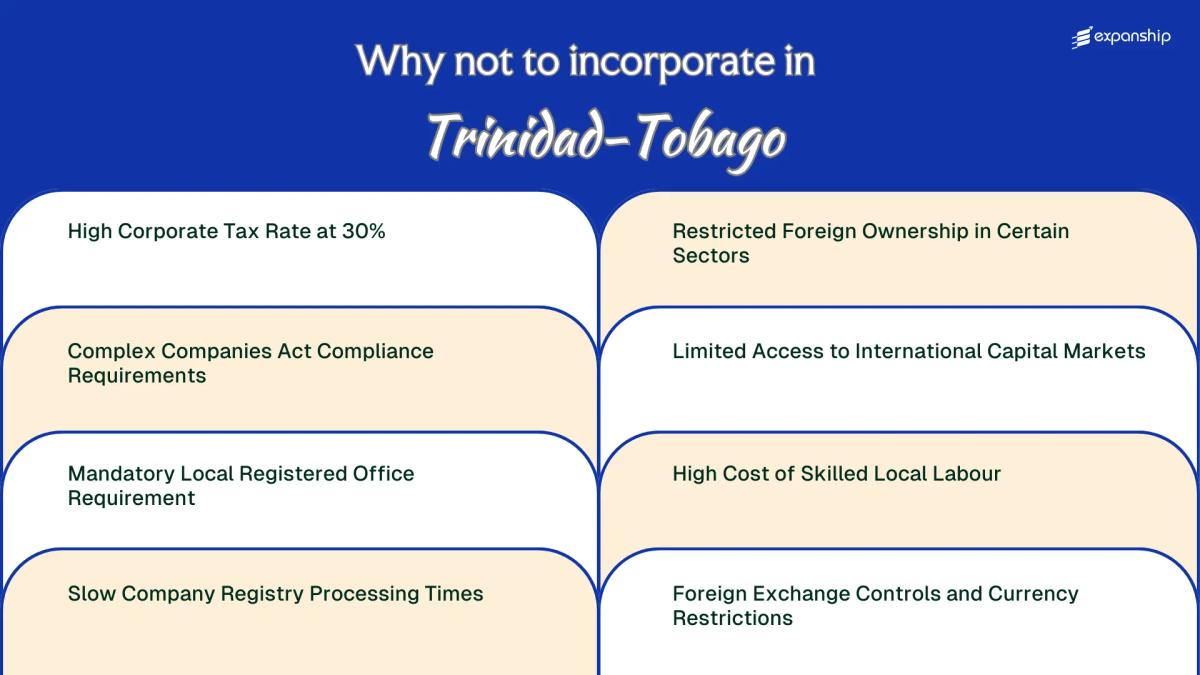
High Corporate Tax Rate at 30%
At 30%, the Trinidad and Tobago corporate tax rate drawbacks are immediate and quantifiable for any foreign business planning to operate here. This rate applies to most companies under the Corporation Tax Act, Chapter 75:02, and positions the country among the higher-taxed jurisdictions in the Caribbean region.
What the 30% Rate Means for Your Bottom Line
The standard 30% corporation tax applies to the chargeable profits of resident and non-resident companies conducting business in the territory. For a foreign firm accustomed to operating in jurisdictions with rates in the 12-20% range, this differential directly compresses net returns on invested capital.
Petroleum companies face a separate regime under the Petroleum Taxes Act, but for general commercial and service businesses, the 30% rate is broadly applied. Your effective tax burden can climb further when business levy obligations and green fund surcharges are factored in alongside the base rate.
How This Compares to Regional Alternatives
Several Caribbean jurisdictions offer rates substantially below 30%, making the high business tax burden in Trinidad and Tobago a genuine competitive disadvantage when evaluating regional structuring options. Barbados, for instance, operates a tiered corporate tax system with rates starting well below that threshold.
Foreign business owners should account for the cumulative effect of corporation tax, business levy, and green fund surcharge when projecting after-tax profitability, as the combined obligations can meaningfully exceed the headline 30% rate.
Complex Companies Act Compliance Requirements
Trinidad and Tobago Companies Act compliance challenges begin with the volume of ongoing obligations imposed under the Companies Act 1995. This legislation governs everything from share capital structure to director duties, and its requirements apply continuously, not just at the point of registration.
Annual returns must be filed with the Companies Registry, and financial statements must meet prescribed formats under the Act. Falling behind on either creates exposure to penalties that accumulate over time, adding a hidden cost burden to your operating budget.
The corporate compliance burden in Trinidad and Tobago is amplified for foreign-owned entities unfamiliar with local procedural norms. Hiring a local attorney or compliance agent to manage these obligations is effectively unavoidable.
Practical friction points for foreign business owners include:
- Annual return filings require locally formatted documents, which means retranslating or reformatting records prepared under your home jurisdiction's standards
- Director and shareholder registers must be maintained and kept at the registered office, creating an ongoing administrative obligation that cannot be managed remotely
- Financial statements must comply with the Act's specific requirements, adding preparation costs beyond standard accounting fees
- Non-compliance triggers statutory penalties under the Companies Act 1995, and rectifying a filing backlog requires engaging local legal counsel at your expense
Smaller firms without a dedicated compliance function face disproportionate costs relative to the size of their Trinidad and Tobago operations.

Company Incorporation in Trinidad and Tobago
Set up your company in Trinidad and Tobago with full compliance support, from registration to ongoing statutory obligations under the Companies Act 1995.
Mandatory Local Registered Office Requirement
Under the Companies Act Chapter 81:01, every company incorporated in Trinidad and Tobago must maintain a registered office at a physical address within the country. This Trinidad and Tobago registered office requirement means a foreign business owner cannot simply list an overseas address or use a virtual mailbox service to satisfy the obligation. The address must be capable of receiving official correspondence from the Registrar of Companies and other statutory bodies.
| Requirement | Detail | Implication for Foreign Business |
|---|---|---|
| Address type | Physical local address required | Virtual or overseas addresses are not accepted |
| Registered agent service (annual estimate) | USD 500 – USD 1,500+ | Recurring cost with no operational return |
| Compliance trigger | Address must be current in registry at all times | Any lapse can result in statutory penalties |
| Notification obligation | Address changes must be filed with the Registrar | Additional filing fees apply per update |
For a foreign firm with no physical operations in the country, satisfying this requirement means engaging a local registered agent solely to meet a statutory threshold. That service carries an annual fee, adding overhead to a structure that may generate no local revenue.
The mandatory local address requirement also creates a dependency on a third-party provider whose reliability directly affects your company's standing with the Registrar of Companies.
Slow Company Registry Processing Times
Trinidad and Tobago company registry processing delays are among the more disruptive operational realities foreign investors face when establishing a local entity. The Companies Registry, operating under the framework of the Companies Act Ch. 81:01, processes incorporation applications manually, which extends the timeline well beyond what most foreign business owners anticipate.
Standard registration for a private company can take several weeks. Delays frequently arise from document deficiencies, name reservation queues, and general administrative backlog, each adding time to a process that some jurisdictions complete in under 48 hours.
For a foreign firm with time-sensitive market entry plans, this creates a concrete structural problem. Your business cannot legally operate, open a corporate bank account, or execute contracts in-country until incorporation is formally complete.
- Incorporation timelines are not guaranteed; delays extend the pre-operational period indefinitely.
- Name reservation must precede full registration and adds a separate processing stage.
- Manual document review means any deficiency restarts the queue position.
- No digital fast-track mechanism currently eliminates in-person or physical submission requirements.
Trinidad and Tobago's Companies Registry does not currently offer a fully online end-to-end incorporation filing system, meaning physical document submission remains part of the process even for straightforward private company registrations.
Restricted Foreign Ownership in Certain Sectors
Foreign ownership restrictions in Trinidad and Tobago apply unevenly across industries, meaning the impact on your business depends heavily on the sector you intend to enter.
Where Restrictions Apply
Certain industries are subject to ownership caps or outright limitations on foreign participation under national policy frameworks and sector-specific legislation. The financial services sector, for instance, is regulated by the Central Bank of Trinidad and Tobago, which imposes fit-and-proper requirements and ownership approval thresholds that can effectively limit foreign control of licensed entities.
Practical Consequences for Foreign Investors
Restricted sectors foreign investment rules in Trinidad and Tobago can require you to secure a local joint venture partner to meet equity thresholds, introducing governance complexity and diluting your control over strategic decisions. Media and utilities have historically faced foreign equity restrictions, which means entering these industries requires structural accommodations that add both legal cost and operational dependency on local partners.
Sectors outside these restricted categories remain more accessible, but identifying which rules apply to your specific business activity requires engagement with the relevant regulatory body before incorporation.
Guidance on Sector Restrictions for Foreign Businesses in Trinidad and Tobago
Understand which industries impose foreign ownership limitations and what that means for your incorporation structure before you commit.
Limited Access to International Capital Markets
Trinidad and Tobago capital markets access limitations present a structural constraint for companies seeking growth capital beyond domestic sources. The Trinidad and Tobago Stock Exchange (TTSE) lists a relatively small number of securities, and its trading volumes remain modest compared to regional exchanges such as the Jamaica Stock Exchange or larger emerging market bourses.
- Listing on the TTSE requires compliance with the Securities Act, Chapter 83:02, which imposes disclosure and governance obligations that smaller foreign-incorporated firms may find disproportionately burdensome relative to the capital available.
- The shallow domestic investor base limits the volume of equity a business can realistically raise through a local public offering.
- Your firm cannot freely access foreign currency financing, as the Central Bank of Trinidad and Tobago's exchange control framework restricts the repatriation and servicing of foreign-denominated debt obligations.
- International institutional investors frequently bypass the TTSE due to its limited liquidity, reducing the practical pool of available limited international financing in Trinidad and Tobago.
High Cost of Skilled Local Labour
High labour costs in Trinidad and Tobago business operations represent a recurring friction point, particularly for foreign firms that benchmark staffing expenditure against other emerging markets in the Caribbean or Latin America.
Skilled professionals in sectors such as energy, finance, and engineering command salaries that reflect the country's petroleum-driven wage expectations. Because oil and gas has historically set the compensation floor for technical roles, firms outside that sector compete for talent at rates disproportionate to their revenue models.
Statutory employment obligations compound the base salary figure. Under the Minimum Wages Act and associated labour regulations, employers must account for severance entitlements, national insurance contributions under the National Insurance Board (NIB), and paid leave requirements, all of which increase the true cost of each hire beyond the negotiated wage.
Workforce availability also creates indirect cost pressure. Skilled workforce challenges in Trinidad and Tobago mean that vacancies in specialist roles often remain open for extended periods, forcing businesses to either pay premium rates to attract candidates or absorb productivity losses.
A foreign firm hiring five mid-level finance professionals at an average annual salary of TTD 180,000 per employee would face an estimated additional TTD 45,000 to TTD 60,000 per year in NIB contributions and statutory leave obligations alone, before accounting for severance exposure under the Retrenchment and Severance Benefits Act, 1985.
Foreign Exchange Controls and Currency Restrictions
Trinidad and Tobago foreign exchange controls restrictions present a direct operational problem for foreign businesses: accessing USD and other hard currencies through the local banking system is inconsistent and often delayed. The Central Bank of Trinidad and Tobago (CBTT) oversees the foreign exchange regime, but the authorized dealer banks it works through have historically been unable to meet demand at the official rate.
The TTD is not freely convertible. For a foreign firm needing to repatriate profits, service foreign debt, or pay overseas suppliers, this creates a practical bottleneck that affects cash flow planning.
Currency restrictions in Trinidad and Tobago companies are not simply a bureaucratic inconvenience. Businesses have reported waiting months to access USD at official rates, forcing some to transact at the parallel market rate, which carries legal and reputational risk.
There is no formal cap on profit repatriation under the Exchange Control Act, but access to foreign currency to execute that repatriation depends entirely on bank availability, which has been structurally constrained for years.
The Exchange Control Act requires all foreign exchange transactions to be conducted through an authorized dealer, meaning your firm cannot independently source or hold foreign currency outside this regulated channel, regardless of your contractual obligations abroad.
Overcoming These Incorporation Challenges
Overcoming Trinidad and Tobago incorporation challenges requires structural preparation before the first filing is made. No single fix addresses all the friction points discussed here, but deliberate pre-entry decisions reduce cumulative exposure.
- Register a locally incorporated company under the Companies Act, Chapter 81:01 to satisfy the registered office requirement and ensure direct access to the Companies Registry.
- Elect a financial year-end that maximises the time available before the first Board of Inland Revenue corporation tax filing falls due.
- Apply for any required Foreign Investment Committee approvals in restricted sectors before committing capital.
- Open a local bank account early to establish a foreign exchange facility under the Central Bank of Trinidad and Tobago's authorised dealer framework.
- Budget for compliant payroll structures from incorporation to address mandatory local labour cost obligations under the Income Tax Act.
Each of these steps operates within a multi-agency regulatory environment overseen by bodies including the Companies Registry, the Board of Inland Revenue, and the Central Bank. Decisions made at incorporation directly affect compliance obligations that persist for the life of the entity.
Trinidad and Tobago Still Worth It
Despite the disadvantages covered across this blog, Trinidad and Tobago remains a credible destination for foreign business formation. Its position as one of the Caribbean's larger energy and services economies, combined with access to CARICOM markets, gives it a functional commercial foundation that smaller offshore jurisdictions cannot replicate.
| Pros | Cons |
|---|---|
| CARICOM membership provides preferential market access across 15 member states | Corporate tax rate of 30% is high relative to competing Caribbean jurisdictions |
| An established legal system based on English common law supports contract enforcement | Company Registry processing times can extend incorporation timelines significantly |
| A skilled professional workforce is available across finance, energy, and services sectors | High labour costs reduce the cost advantages typically associated with emerging market entry |
| The economy is diversified beyond tourism, with a substantive energy and financial services base | Foreign Exchange controls restrict the free movement of capital and complicate profit repatriation |
| Restricted foreign ownership in designated sectors limits the scope of certain investment structures |
Deciding whether incorporating in Trinidad and Tobago is worth it depends on your firm's specific operational objectives and tolerance for regulatory friction. The Trinidad and Tobago business formation pros and cons are not evenly distributed across all business profiles or sectors.
Corporate Compliance Services in Trinidad and Tobago
Maintain your company's good standing under the Companies Act 1995, including annual filings, registered office maintenance, and ongoing regulatory obligations with the Registrar of Companies.
Conclusion
This Trinidad and Tobago company incorporation cons summary reflects a jurisdiction with legitimate structural friction for foreign businesses. The 30% corporate tax rate sits above many competing Caribbean destinations, and foreign exchange restrictions create ongoing operational exposure for firms with cross-border obligations. Slow processing at the Companies Registry adds timeline uncertainty that affects planning. These factors do not exist in isolation — each compounds the others. Professional guidance specific to the Companies Act 1995 framework and the relevant regulatory bodies reduces that exposure materially.
Expanship and Your Trinidad and Tobago Expansion
Incorporating in Trinidad and Tobago carries real compliance weight, from maintaining a local registered office under the Companies Act to managing foreign exchange approvals through the Central Bank. Trinidad and Tobago business expansion challenges support is where Expanship focuses its work, helping your business manage the operational demands of registration and ongoing obligations without absorbing those costs in-house.
Expanship supports the full incorporation and post-formation process across this jurisdiction.
- Your company registration and document preparation are handled end to end, covering the Companies Registry filing requirements.
- A registered agent and local office address are provided to satisfy statutory presence obligations.
- Expanship liaises directly with government bodies and regulatory authorities on your behalf.
- Post-incorporation compliance management keeps your entity in good standing year on year.
- Banking introduction assistance helps connect your business with suitable local financial institutions.
- Tax registration and liaison with the Board of Inland Revenue are managed as part of your setup.
Reach out to Expanship Trinidad and Tobago to discuss your incorporation requirements.
Frequently Asked Questions (FAQ)
The Central Bank of Trinidad and Tobago administers foreign exchange controls that affect a broader set of transactions than profit repatriation alone. Operational payments, including imports, intercompany loans, and service fees to foreign affiliates, can all be subject to approval or face delays when USD liquidity tightens. Businesses in sectors heavily reliant on imported goods or foreign suppliers face recurring disruption, not just a one-time repatriation hurdle.
Under the Companies Act of 1995, failure to file annual returns or maintain a registered office in Trinidad and Tobago can result in the company being struck off the register by the Registrar of Companies. Reinstatement is possible but requires a formal application and payment of outstanding fees and penalties. The process adds cost and delays operations for any firm that lets compliance lapse.
Registry delays at the Companies Registry in Port of Spain affect virtually all standard company formations, not a specific subset. Processing times for incorporation and post-incorporation changes have historically extended to several weeks even for routine filings. There is no publicly available expedited processing track comparable to what some other Caribbean jurisdictions formally offer.
Foreign ownership caps in sectors such as broadcasting and certain financial services are set by sector-specific legislation and cannot be circumvented simply by using a locally incorporated entity with nominal local participation. Regulatory bodies assess the beneficial ownership structure, not just the registered shareholding. Attempting to obscure foreign control through nominee arrangements exposes the business to regulatory sanction and potential licence revocation.
The cost of a registered office service in Trinidad and Tobago varies by provider but adds a recurring overhead that is non-negotiable under the Companies Act of 1995 for companies without a physical presence. For a foreign business operating remotely, this is a fixed compliance cost rather than a business investment. When combined with local statutory filing fees and professional service charges, annual compliance costs for a dormant or holding structure can become disproportionately high relative to the activity conducted.
Limited access to international capital markets is a broader Caribbean challenge, but Trinidad and Tobago's position is compounded by correspondent banking pressures that have reduced the number of international banks willing to maintain relationships with TT-incorporated entities. The country's exposure to de-risking by global financial institutions has made opening foreign currency accounts and processing cross-border transactions more restrictive than in comparable offshore or mid-shore jurisdictions. For businesses that depend on multi-currency treasury management, this creates a concrete operational constraint.
The Companies Act of 1995 requires every company to maintain a registered office in Trinidad and Tobago from the date of incorporation, and non-compliance is treated as a default that can trigger administrative action by the Registrar. Penalties include fines levied against both the company and its officers. Persistent non-compliance is one of the grounds on which the Registrar can initiate strike-off proceedings, which terminates the company's legal existence.
Legal Disclaimer
The information provided in this article is for general informational purposes only and does not constitute legal, tax, or professional advice. While we strive to ensure the accuracy and timeliness of the content, laws and regulations are subject to change, and the application of laws can vary widely based on specific facts and circumstances.
Readers should not act upon this information without seeking professional counsel tailored to their individual situation. Expanship and its authors disclaim any liability for actions taken or not taken based on the content of this article.
For specific advice regarding your business setup, compliance requirements, or any legal matters, please consult with qualified legal and tax professionals in the relevant jurisdiction.