
Key Takeaways
- Foreign investors can own 100% of a Trinidad and Tobago company under the Companies Act 1995, with no mandatory local shareholding requirements and broad freedom to repatriate profits and capital.
- A corporate tax rate of 25%, combined with double taxation treaties covering major trading economies, reduces withholding exposure and eliminates the risk of being taxed twice on the same income across borders.
- Businesses operating in the energy sector benefit from fiscal incentives structured under the Petroleum Taxes Act, advantages that general-purpose or offshore jurisdictions are not positioned to replicate.
- Incorporating in Trinidad and Tobago places a company within CARICOM's integrated trade area of over 15 member states, enabling preferential market access that a standalone Caribbean entity would not otherwise hold.
Situated in the southern Caribbean, approximately 11 kilometres off the northeastern coast of Venezuela, Trinidad and Tobago is an independent republic and the most industrialised economy in the English-speaking Caribbean. Company registration is administered by the Companies Registry, operating under the Companies Act 1995. Foreign businesses incorporating here most commonly do so through a private limited liability company.
The benefits of incorporating in Trinidad and Tobago attract attention across several dimensions: the tax regime is treaty-based and operates at standard corporate rates rather than as a zero-tax or purely offshore structure. Foreign ownership is broadly permitted across most sectors, and the government has maintained a general policy of openness toward foreign direct investment, with few restrictions on the repatriation of profits or capital.
Your business operates within a jurisdiction that holds full sovereignty, maintains a functioning judiciary, and transacts entirely in English. This article examines the principal advantages that Trinidad and Tobago company formation offers to foreign investors and operators considering establishing a legal presence here.
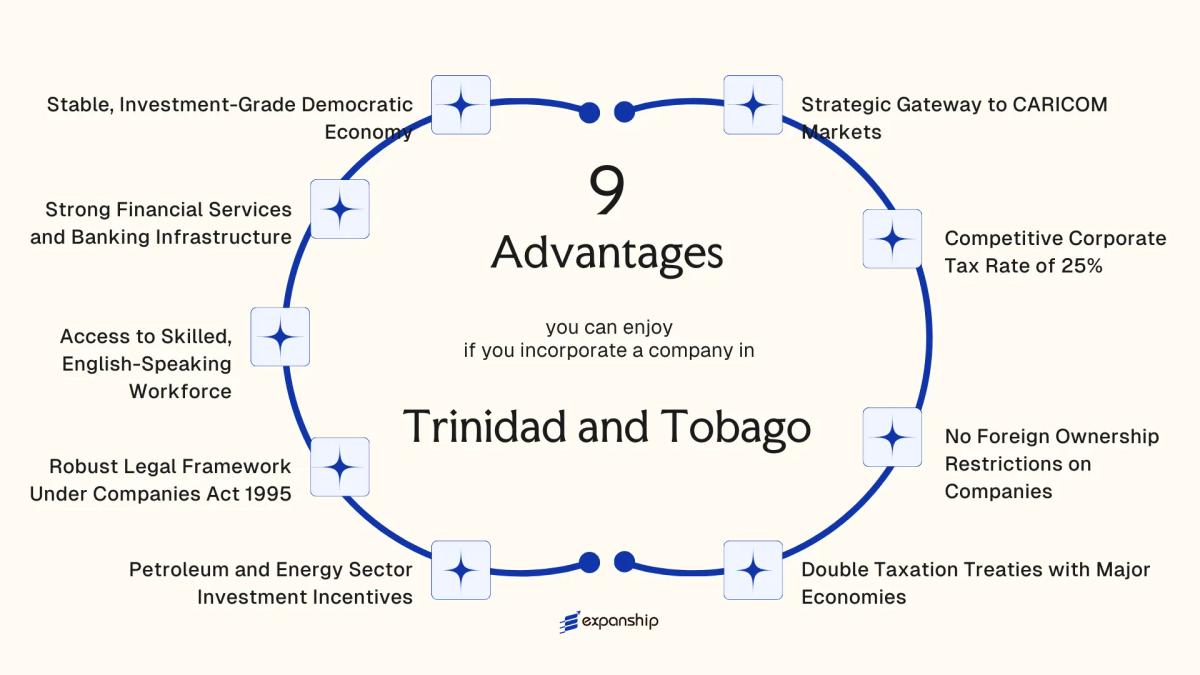
Strategic Gateway to CARICOM Markets
Trinidad and Tobago CARICOM market access benefits are built into the country's founding membership of the Caribbean Community. As a signatory to the Revised Treaty of Chaguaramas, which established the CARICOM Single Market and Economy (CSME), a company incorporated here operates under a framework that removes many of the trade barriers that would otherwise apply across 15 member states.
Preferential Trade Access Across the Region
Under the CSME, goods produced by qualifying firms in Trinidad and Tobago move across participating member states without customs duties. This matters because regional exporters avoid the tariff costs that non-CARICOM entities face when selling into the same markets.
Right of Establishment for Corporate Entities
The Revised Treaty also grants CARICOM-incorporated businesses the right of establishment in other member states, meaning your firm can set up operations across the region without being treated as a foreign entity under domestic laws. Combined with the country's position as one of the largest economies in CARICOM by GDP, this gives businesses incorporated here a structurally stronger regional footprint than those entering from outside the bloc.
A Trinidad and Tobago company gives you preferential trade status and legal standing across 15 CARICOM member states without requiring separate incorporation in each.
Competitive Corporate Tax Rate of 25%
Trinidad and Tobago applies a standard corporate income tax rate of 25% on company profits. That figure sits below the OECD average corporate rate, which has consistently hovered above 23% for developed economies and reaches considerably higher in several G20 nations. For a foreign investor structuring a regional business, this rate directly affects how much post-tax capital remains available for reinvestment or repatriation.
The rate applies to resident companies incorporated under the Companies Act 1995, with liability assessed on chargeable income as defined under the Corporation Tax Act, Chapter 75:02. Knowing the exact legislative basis matters because it confirms the rate is statutory, not discretionary, giving your entity a predictable tax position from the outset.
Practical advantages of this rate structure include:
- The 25% rate applies uniformly, so your firm does not face a higher entry-level rate that phases down only after meeting investment thresholds
- Chargeable income is calculated after allowable deductions, meaning ordinary operating costs reduce the taxable base before the rate is applied
- Tax filings are administered through the Board of Inland Revenue, a single authority, which concentrates your compliance obligations in one place
Petroleum and energy companies operate under a separate fiscal regime entirely, so the 25% rate governs non-energy commercial activity specifically.

Incorporate a Company in Trinidad and Tobago
Register your business under the Companies Act 1995 and establish a compliant legal entity in Trinidad and Tobago.
No Foreign Ownership Restrictions on Companies
There are no foreign ownership restrictions on companies incorporated in Trinidad and Tobago. Under the Companies Act 1995, foreign nationals may hold 100% of the shares in a private or public company without any requirement to take on a local partner or dilute equity to a resident shareholder. This means your business structure remains entirely under your control from the outset.
That unrestricted ownership position has a direct consequence for how you structure capital, governance, and profit repatriation. You retain full authority over shareholder resolutions, dividend policy, and the appointment of directors, without negotiating those decisions alongside a mandated local co-owner.
| Ownership Feature | Position Under TT Law |
|---|---|
| Maximum foreign shareholding | 100% permitted |
| Local partner requirement | None |
| Resident director requirement | None mandated by the Companies Act 1995 |
| Share classes available | Ordinary, preference, and others as defined in articles |
| Governing statute | Companies Act 1995, Chapter 81:01 |
The Registrar of Companies, operating under the Ministry of Legal Affairs, processes incorporations without applying nationality-based filters to ownership applications. Foreign investor ownership rights in Trinidad and Tobago are therefore exercised through the same statutory framework that applies to domestic shareholders, not through a separate or restricted foreign investment track.
Sectors subject to sector-specific licensing, such as banking or broadcasting, may carry separate approval requirements, but those conditions arise from industry regulation, not from general company law.
Double Taxation Treaties with Major Economies
Trinidad and Tobago's network of double taxation treaties provides a concrete structural advantage for foreign businesses operating across borders. The country has signed tax treaties with several significant economies, including the United States, Canada, the United Kingdom, and a number of CARICOM member states. Under these agreements, income such as dividends, interest, and royalties paid between treaty partners is subject to reduced withholding tax rates, directly lowering the tax cost of cross-border transactions for your business.
For a company incorporated here and conducting operations with counterparties in treaty jurisdictions, this means the same income is not taxed in full by both countries. You pay tax once, at agreed rates, with credit mechanisms or exemptions handling the remainder. That reduction in withholding rates can meaningfully affect after-tax returns, particularly for holding structures, licensing arrangements, or service businesses billing into treaty countries.
Treaty eligibility generally depends on your entity meeting the relevant residency conditions under Trinidad and Tobago's domestic tax law, administered by the Board of Inland Revenue.
Keep the following in mind when relying on treaty protection:
- Confirm the specific treaty is in force and covers the income type in question
- Ensure your company meets the tax residency requirements under domestic law
- Obtain a Certificate of Residence from the Board of Inland Revenue where required by the counterpart jurisdiction
- Review the treaty's limitation-on-benefits or anti-avoidance provisions
Trinidad and Tobago's tax treaty with the United States predates many Caribbean nations' bilateral agreements with Washington, giving TT-incorporated entities a longer-established framework for US-facing structures.
Petroleum and Energy Sector Investment Incentives
Trinidad and Tobago petroleum sector investment incentives are among the most structurally defined in the Caribbean, governed primarily by the Petroleum Taxes Act (PTA) and administered through the Ministry of Energy and Energy Industries (MEEI). For foreign investors entering the upstream or midstream energy space, this legislative clarity reduces exposure to regulatory ambiguity from the outset.
Fiscal Terms Under the Petroleum Taxes Act
The PTA establishes a dedicated tax regime for petroleum operations, separate from the standard corporate tax framework. Petroleum companies are subject to Petroleum Profits Tax (PPT) rather than the general 25% corporate rate, with applicable rates and allowances structured around production-sharing contracts and exploration licenses issued by the MEEI. This ring-fenced treatment means your energy operations are assessed under terms designed specifically for capital-intensive extraction activities, not blended with unrelated income streams.
Supplemental Petroleum Tax (SPT) applies to upstream production above defined thresholds and is calculated on gross revenues rather than net profits. While this increases the effective tax burden at higher production levels, the structure is fully codified, allowing investors to model fiscal obligations with precision before committing capital.
Investment Allowances and Incentive Structures
The PTA permits capital allowances on qualifying exploration and development expenditures, which accelerates cost recovery on high-upfront-investment projects. Unutilized losses from petroleum operations can generally be carried forward, reducing taxable income in profitable years. For businesses evaluating oil and gas investment in the region, the combination of defined allowance mechanisms and a single governing statute provides a measurable advantage over jurisdictions where energy taxation is fragmented across multiple regulatory instruments.
Maximize Your Energy Sector Incentives in Trinidad and Tobago
Speak with our corporate services team about structuring your petroleum or energy investment to align with the incentive frameworks under Trinidad and Tobago's Petroleum Taxes Act.
Robust Legal Framework Under Companies Act 1995
The Companies Act 1995 is the primary statute governing corporate formation and operation in Trinidad and Tobago, and its structure carries specific advantages for foreign business owners. Modelled partly on Canadian corporate legislation, the Act establishes clear rules on directorship, share capital, liability, and fiduciary duties, which means your entity operates within a predictable legal environment rather than one shaped by regulatory ambiguity.
- The Act permits single-member companies, so a foreign investor can incorporate and hold full ownership without requiring a local co-founder or nominee shareholder.
- There is no minimum paid-up capital requirement under the Act for private companies, reducing the financial threshold for incorporation.
- Shareholder liability is limited to the amount unpaid on shares, a statutory protection that shields personal assets from corporate obligations.
- The Act mandates clear procedures for corporate governance, including director duties and annual filing obligations with the Companies Registry, which creates an auditable compliance record useful for banks and counterparties.
- Disputes involving incorporated entities fall under a developed body of Commonwealth common law, meaning courts apply established precedent rather than untested doctrine.
That common law foundation, combined with the statutory investor protections encoded in the Act, gives your business a degree of legal certainty that matters when structuring contracts, raising capital, or entering joint ventures in the Caribbean region.
Access to Skilled, English-Speaking Workforce
Trinidad and Tobago's skilled English-speaking workforce advantage is a structural benefit, not incidental. English is the sole official language, meaning contracts, correspondence, audits, and regulatory filings all occur in the same language your foreign business already operates in. That eliminates translation overhead and reduces miscommunication risk in compliance-sensitive functions.
Tertiary education is well-embedded in the local labor market. The University of the West Indies (UWI) St. Augustine Campus, located in Trinidad, produces graduates annually across engineering, law, finance, and information technology. For firms in technical or professional service sectors, this means local hiring does not require significant retraining investment.
The workforce also has demonstrated depth in energy, finance, and trade-related roles, reflecting the economy's industrial composition. Professionals here are familiar with internationally recognized accounting standards and commercial frameworks, which reduces onboarding friction for foreign-owned entities.
According to the World Bank's Human Capital Index, Trinidad and Tobago scores above the Latin America and Caribbean regional average on expected years of quality-adjusted schooling, reflecting consistent investment in educational attainment at the national level.
Strong Financial Services and Banking Infrastructure
Trinidad and Tobago financial services infrastructure benefits foreign businesses through a regulated, deposit-taking environment overseen by the Central Bank of Trinidad and Tobago (CBTT), which operates under the Financial Institutions Act 2008. That legislation governs licensing, capital adequacy requirements, and prudential standards for commercial banks and non-bank financial institutions alike. For a foreign-incorporated entity, this means operating within a system that follows internationally recognised supervisory standards.
Commercial banks in Trinidad and Tobago transact in both TTD and USD, which is a practical advantage for businesses managing cross-border payments or holding foreign currency receipts. The CBTT also administers foreign exchange controls under the Exchange Control Act, so your treasury operations must account for those rules when repatriating funds.
The financial sector includes licensed commercial banks, development finance institutions, and a functioning capital market regulated by the Trinidad and Tobago Securities and Exchange Commission (TTSEC). This depth gives incorporated businesses access to trade finance, credit facilities, and equity capital in a single jurisdiction.
- Multi-currency account access supports international billing
- TTSEC oversight provides a structured environment for raising capital locally
- Correspondent banking relationships connect local institutions to global payment networks
Foreign-owned companies may face enhanced due diligence requirements under the Financial Intelligence Unit of Trinidad and Tobago (FIU) anti-money laundering framework before accounts are opened.
Stable, Investment-Grade Democratic Economy
Trinidad and Tobago stable economy benefits for investors begin with a foundational reality: the country holds investment-grade sovereign credit ratings from major international agencies, reflecting consistent fiscal management and institutional credibility. That rating status matters because it signals lower country risk, which directly affects how counterparties, banks, and insurers assess transactions involving locally registered entities.
Parliamentary democracy has operated without interruption since independence in 1962. Successive peaceful transfers of power under a Westminster-style constitutional framework mean that the regulatory and legal environment does not shift abruptly with changes in government. For a foreign business owner, that continuity reduces the risk of policy reversals affecting licensing conditions, repatriation rights, or corporate tax obligations.
The Central Bank of Trinidad and Tobago, established under the Central Bank Act, maintains monetary policy and financial system oversight independently of the executive branch. That institutional separation is a structural safeguard for businesses holding local accounts or entering long-term contracts denominated in Trinidad and Tobago dollars.
Economic output is anchored by the energy sector but complemented by financial services, manufacturing, and distribution activity. That sectoral spread means your business is not entirely exposed to a single commodity cycle when operating across the domestic economy.
- The Securities and Exchange Commission of Trinidad and Tobago regulates capital markets under the Securities Act 2012
- The country maintains a stable exchange rate policy managed by the Central Bank
- The rule of law index position reflects functioning courts and property rights enforcement
Why Trinidad and Tobago Stands Out Regionally
Compared against its most direct competitors for foreign incorporation, Trinidad and Tobago regional business advantages over competitors become clearest when the comparison is framed correctly. The jurisdictions most likely to appear on the same investor shortlist are Barbados, Jamaica, and Panama, each targeting a similar profile of international business and regional holding structures. What distinguishes TT from these alternatives is not any single factor but a combination of structural features: a hydrocarbon-backed fiscal base, CARICOM treaty access, and a company law framework under the Companies Act 1995 that imposes no residency requirements on directors or shareholders.
Barbados is frequently positioned as a tax-treaty hub, and Jamaica as a nearshore services base, but neither shares TT's direct exposure to energy-sector investment infrastructure or its established network of bilateral investment treaties. Panama offers incorporation speed and a territorial tax system, yet operates outside CARICOM, which limits its utility for businesses whose primary market is the Caribbean single economy. For an entity that requires both regional market access and a credible common-law corporate structure, these distinctions carry practical weight when structuring cross-border operations.
| Parameter | Trinidad and Tobago | Barbados | Jamaica | Panama |
|---|---|---|---|---|
| CARICOM Membership | Yes | Yes | Yes | No |
| Corporate Tax Rate | 25% | 9% (International Business) / 5.5%–1% (various) | 25% | 25% flat |
| Director Residency Requirement | None | None | None | One resident director required |
| Common Law Legal System | Yes | Yes | Yes | Civil Law |
| Double Taxation Treaties | 11+ bilateral treaties | 40+ bilateral treaties | Limited network | Limited network |
| Energy Sector Investment Incentives | Petroleum Taxes Act framework | Minimal | Minimal | Minimal |
| Official Language | English | English | English | Spanish |
Compliance Services for Companies in Trinidad and Tobago
Maintain your company's good standing under the Companies Act 1995 with ongoing compliance support, from annual returns to statutory filings with the Companies Registry.
Conclusion
The benefits of incorporating in Trinidad and Tobago rest on a combination of factors that are difficult to replicate elsewhere in the Caribbean: full foreign ownership under the Companies Act 1995, a 25% corporate tax rate with bilateral treaty protections, and direct access to CARICOM's integrated market of over 15 member states.
For energy-sector investors, the fiscal incentives available under the Petroleum Taxes Act add a layer of structural advantage that general-purpose jurisdictions cannot match. Your specific industry, ownership structure, and target markets will determine how much weight each of these factors carries for your situation.
Establishing a company here positions your business within a common law jurisdiction with a functioning court system, an English-speaking professional services sector, and a currency pegged to the US dollar — conditions that reduce execution risk for cross-border operations. The foundation is in place; the next step is structuring your entity correctly from the outset.
Start Your Trinidad and Tobago Company with Expanship
When you incorporate in Trinidad and Tobago with Expanship, you work with a team that understands the full registration process under the Companies Act 1995, the filing requirements administered by the Companies Registry, and the ongoing compliance obligations that apply to private companies limited by shares. From the initial reservation of a company name through to post-incorporation statutory filings, each stage involves specific procedural requirements that Expanship manages on your behalf.
Expanship's service scope across the formation and maintenance lifecycle includes:
- Company name reservation and document preparation for submission to the Companies Registry
- Registered office and registered agent provision in Trinidad and Tobago
- Government filing, fee payment, and registrar liaison throughout the incorporation process
- Document legalization and notarization where required for foreign-issued instruments
- Post-incorporation compliance management, including annual return filings
- Banking introduction assistance to support corporate account establishment
Each of these services is delivered with direct reference to the procedural requirements set by the Companies Registry and, where applicable, the Financial Intelligence Unit of Trinidad and Tobago for AML-related compliance obligations.
Reach out to Expanship Trinidad and Tobago to discuss your company formation requirements.
Frequently Asked Questions (FAQ)
The standard corporate income tax rate is 25%. Petroleum companies operating under the Petroleum Taxes Act are subject to a different tax regime, which includes petroleum profits tax and supplemental petroleum tax, resulting in a higher effective rate for upstream oil and gas activities. For most non-energy businesses, the 25% rate applies to chargeable profits as assessed under the Income Tax Act.
Trinidad and Tobago has concluded double taxation agreements with several major economies, including the United States, the United Kingdom, Canada, and a number of CARICOM member states. These treaties allocate taxing rights between jurisdictions and typically reduce withholding tax rates on dividends, interest, and royalties paid to residents of the treaty partner country. The specific rates and provisions vary by treaty, so the applicable agreement for your jurisdiction of residence should be reviewed directly.
Incorporation is processed through the Companies Registry, which operates under the Ministry of Legal Affairs. Processing times can vary depending on name availability, document completeness, and current Registry workload, but straightforward applications are generally completed within a few business days to a few weeks. Submitting accurate documentation at the outset, including the Articles of Incorporation and the required statutory forms, avoids delays caused by requisitions.
The Companies Act 1995 does not impose a blanket requirement for a locally resident director for private companies. However, the entity must maintain a registered office address within the jurisdiction, and certain regulatory and tax filings require a local point of contact. Operational factors, such as opening a corporate bank account, may in practice influence decisions around local directorship or representation.
The Petroleum and Energy sector benefits from a dedicated fiscal framework that includes incentives administered through the Ministry of Finance and the Ministry of Energy and Energy Industries. The Petroleum Taxes Act governs the tax treatment of upstream activities, and various production-sharing arrangements with the National Gas Company and other state entities can affect the effective cost of entry. Incentive structures for downstream and petrochemical investments may differ and are subject to negotiation or approval under applicable legislation.
Companies incorporated in Trinidad and Tobago can benefit from the Caribbean Community Single Market and Economy (CSME) framework, which facilitates the movement of goods, services, and capital among participating member states with reduced trade barriers. A locally incorporated entity can access preferential tariff treatment when trading within the CARICOM bloc, which covers 15 member states. This makes the jurisdiction a practical base for businesses targeting regional distribution, service delivery, or manufacturing with export intent across the Caribbean.
The Companies Act 1995 provides the primary statutory framework for corporate governance, including provisions relating to shareholder rights, director duties, and insolvency proceedings. Trinidad and Tobago operates under a common law legal system derived from English law, and its court structure includes a High Court with jurisdiction over commercial matters. Appeals can progress through the Caribbean Court of Justice or, in certain cases, the Privy Council in London, providing access to established jurisprudence for dispute resolution.
Legal Disclaimer
The information provided in this article is for general informational purposes only and does not constitute legal, tax, or professional advice. While we strive to ensure the accuracy and timeliness of the content, laws and regulations are subject to change, and the application of laws can vary widely based on specific facts and circumstances.
Readers should not act upon this information without seeking professional counsel tailored to their individual situation. Expanship and its authors disclaim any liability for actions taken or not taken based on the content of this article.
For specific advice regarding your business setup, compliance requirements, or any legal matters, please consult with qualified legal and tax professionals in the relevant jurisdiction.