
Key Takeaways
- Foreign and domestic entities incorporating in Timor-Leste must comply with the structural and documentary requirements established under the Commercial Companies Law (Decree-Law No. 10/2017), administered through the Ministry of Commerce, Industry and Environment.
- Beneficial ownership disclosure is a mandatory compliance obligation for foreign investors, and failure to satisfy this requirement can result in registration rejection or penalties under applicable commercial law.
- Directors of a Timor-Leste company are not subject to residency requirements, distinguishing the jurisdiction from many of its regional peers, though governance obligations must still be met at the point of registration.
- Registration applications are processed through the Ministry of Justice's One Stop Shop (Balcão Único), and submissions that do not meet the prescribed entity governance, capital, identity, and naming rules will be rejected.
Company registration requirements in Timor-Leste are governed by the Commercial Companies Law (Decree-Law No. 10/2017), administered through the National Directorate of Trade and Industry under the Ministry of Commerce, Industry and Environment. This framework sets out the conditions under which both domestic and foreign entities may establish a legal commercial presence in the country.
This article covers the structural and documentary requirements your business must satisfy to achieve valid registration, spanning entity governance, capital, identity, and naming rules.
Failure to meet these requirements results in rejection of the registration application or, for entities already operating, exposure to penalties under applicable commercial law.
Specific requirements differ depending on the legal form of the entity you intend to register, the sector in which it will operate, and whether foreign ownership is involved.
For the published legislation, refer to Decree-Law No. 10/2017.
This article is most relevant to foreign investors and offshore business owners seeking to establish a limited liability company or branch entity in Timor-Leste for the first time.
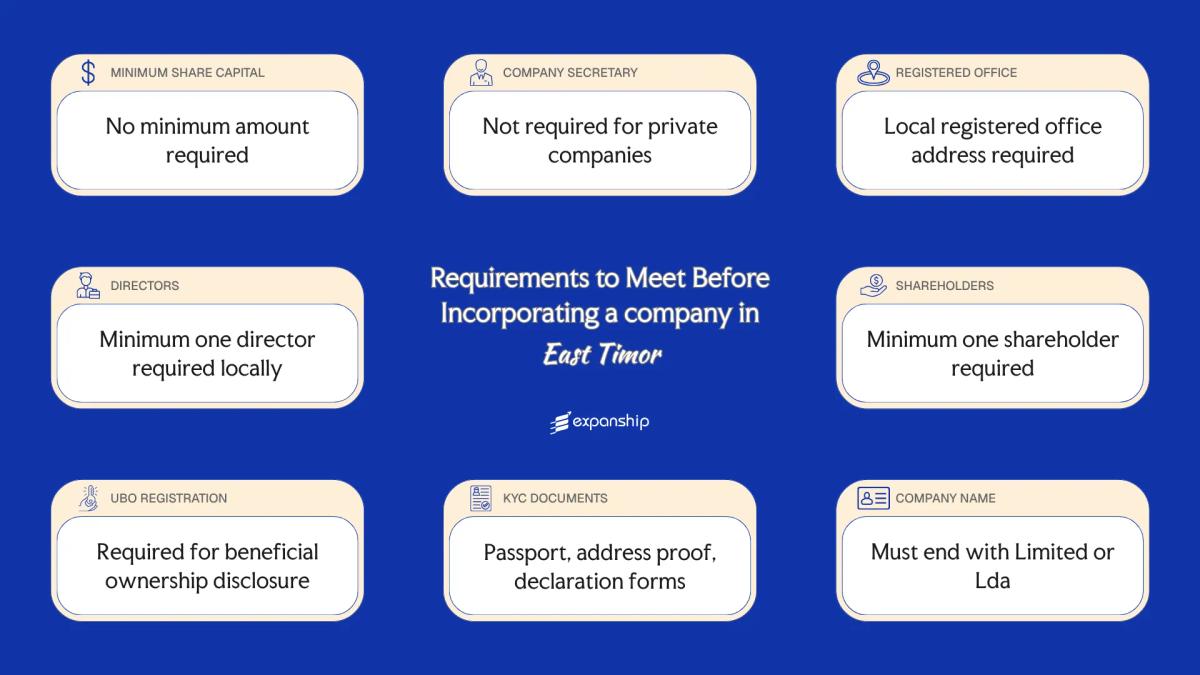
Minimum Share Capital Requirements in Timor-Leste
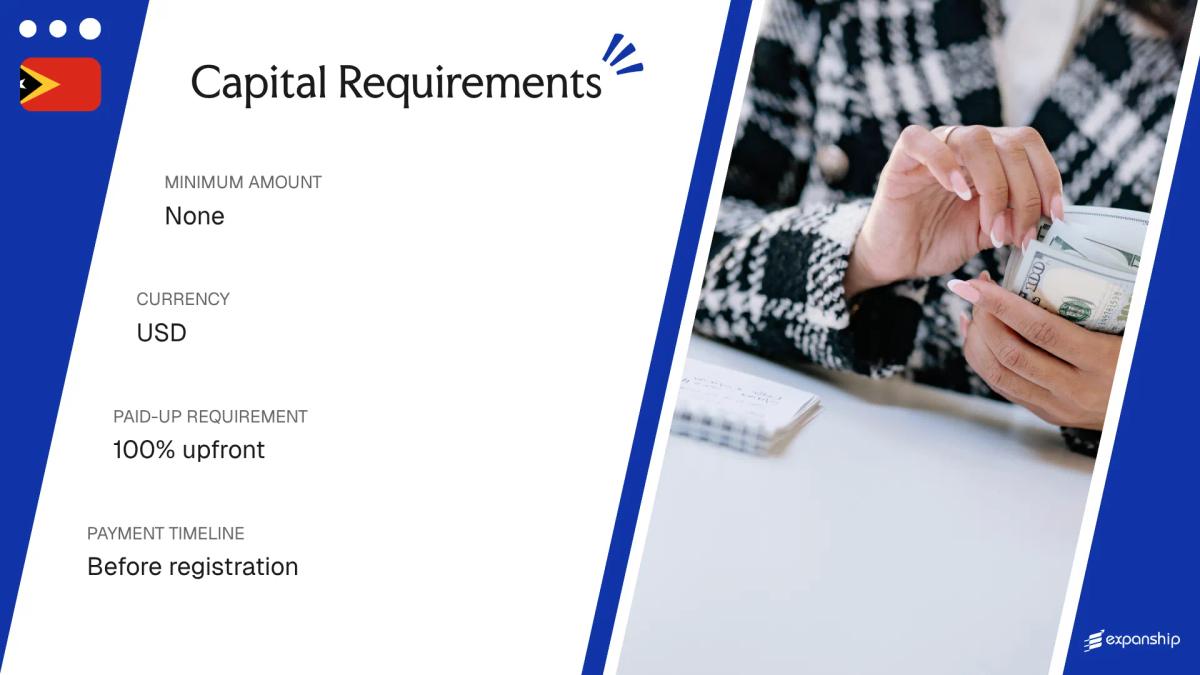
Timor-Leste minimum share capital requirements are governed under the Commercial Companies Law (Decree-Law No. 10/2017), which regulates the formation and capital structure of private limited companies (Sociedade por Quotas) and public companies. The Trade Registry (Registo Comercial), operating under the Ministry of Justice, is the authority responsible for verifying capital declarations at the point of incorporation.
Share capital operates on a par value system. Statutory obligations around capital are assessed at incorporation; there is no ongoing annual requirement to re-confirm or increase capital once the entity is registered.
| Parameter | Detail |
|---|---|
| Minimum Authorized Share Capital | No statutory minimum for private limited companies under Decree-Law No. 10/2017 |
| Maximum Authorized Share Capital | No statutory maximum |
| Minimum Paid-Up Capital | No statutory minimum |
| Paid-Up Requirement at Incorporation | Contributions must be declared at incorporation; full payment terms are defined in the company's constitutive act |
| Accepted Currency | United States Dollar (USD) |
| Accepted Forms of Contribution | Cash and in-kind contributions (subject to valuation) |
| Timeframe to Deposit Capital | No statutory deposit deadline prescribed beyond incorporation declaration |
Even without a statutory minimum, your company's constitutive act must define an authorized capital amount and quota structure. Omitting this detail will result in rejection by the Trade Registry.
Company Secretary Requirements in Timor-Leste
Under Timor-Leste's commercial registration framework, company secretary requirements are not codified in the same form as jurisdictions with dedicated company secretarial legislation. The governing framework for business entities falls under the Companies Law (Decree-Law No. 17/2017), which does not impose a mandatory company secretary role by name, though entities may designate an officer to handle statutory correspondence and filings with the Trade Registry (Registo Comercial).
A designated secretary or equivalent officer typically maintains statutory records, coordinates filings with the Ministry of Justice, and ensures the entity remains in good standing with the Timor-Leste Business Activity Centre (SERVE). East Timor corporate secretary obligations, where assumed, generally include managing resolutions and acting as a point of contact for regulatory correspondence.
Qualification criteria for who may serve in this capacity:
- No mandatory licensing or professional certification is prescribed under current company law
- Both natural persons and corporate entities may be appointed to the role
- Residency within Timor-Leste is not formally required under the Companies Law
- Foreign nationals may serve without restriction under the general framework
- The person or entity must have legal capacity under Timorese civil law

Company Incorporation in Timor-Leste
Set up your business entity in Timor-Leste with support across registration, documentation, and statutory compliance.
Registered Office Requirements in Timor-Leste
Registered office requirements in Timor-Leste mandate that every company registered under the Commercial Companies Law (Law No. 4/2017) maintains a physical address within the country where official correspondence and legal notices can be served. Failure to maintain a compliant address can result in administrative penalties and may affect the entity's standing with the Serviço do Registo Comercial (Commercial Registry Service).
- A physical street address is required; a P.O. box alone does not satisfy the registered office obligation.
- The address must be located within Timor-Leste; a foreign address is not acceptable for domestic registration purposes.
- Virtual office arrangements are not explicitly recognised under current commercial law; a demonstrably occupiable premises is the general standard applied.
- Supporting documentation such as a lease agreement or proof of ownership is typically required to establish the legitimacy of the address at the time of registration.
- The registered office address is recorded in the public commercial register and is accessible to third parties, regulators, and creditors.
- Any change to the registered office address must be formally notified to the Serviço do Registo Comercial, and the update must be reflected in the public register to remain compliant.
Director Requirements in Timor-Leste
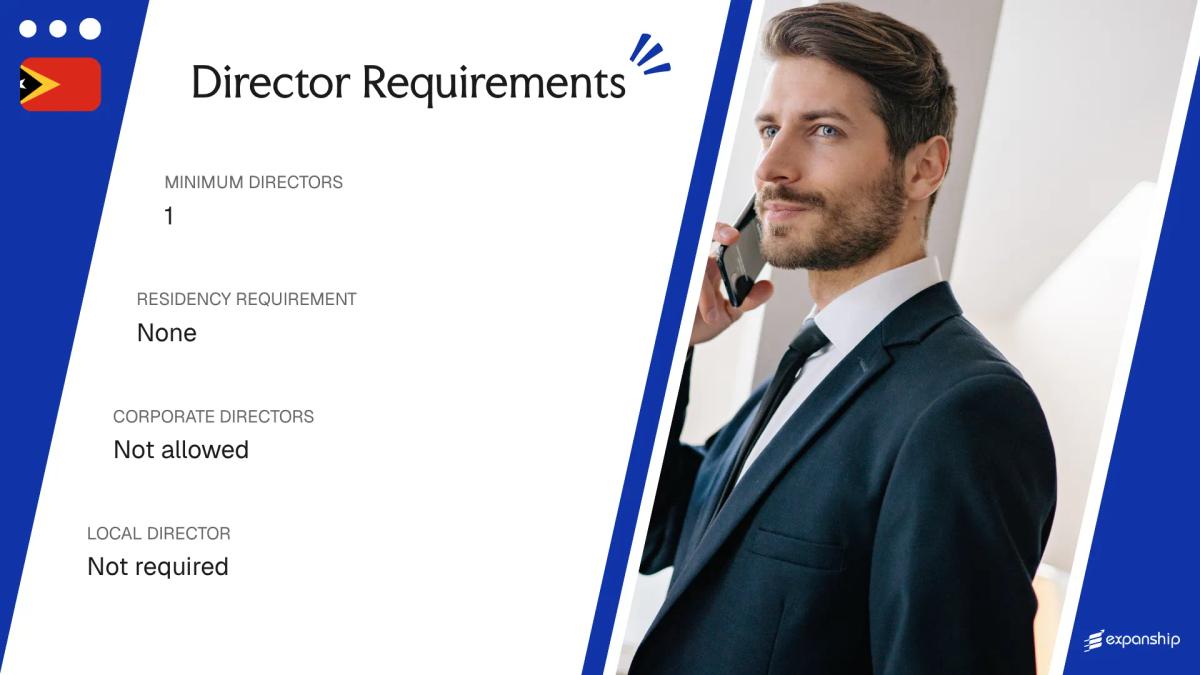
Under Timor-Leste's Commercial Companies Law (Law No. 4/2017), director requirements for a Timor-Leste company center on fiduciary accountability, with appointed directors assuming personal liability for decisions made in breach of their duties of care and loyalty to the entity. Directors are obligated to act in the best interests of the company, maintain accurate financial records, and ensure the firm meets its statutory obligations under the oversight of the Ministry of Trade, Industry and Commerce (MTIC).
| Parameter | Detail |
|---|---|
| Minimum Number of Directors | One director is required. |
| Maximum Number of Directors | No statutory maximum is prescribed. |
| Local/Resident Director Required | No statutory requirement for a local or resident director. |
| Nationality Restrictions | No nationality restrictions are imposed. |
| Minimum Age Requirement | Directors must be at least 18 years of age. |
| Corporate Directors Permitted | No statutory provision explicitly permits corporate directors; natural persons are the standard. |
| Director Must Be a Shareholder | No requirement for a director to hold shares in the company. |
| Publicly Listed on Registry | Director information is filed with the MTIC but full public accessibility is limited. |
| Disqualification Conditions | Persons convicted of fraud, bankruptcy, or serious financial misconduct may be disqualified from directorship. |
Despite no residency requirement, directors bear the same fiduciary duties and personal liability exposure under Law No. 4/2017 regardless of whether they are based in Timor-Leste or abroad.
Shareholder Requirements in Timor-Leste
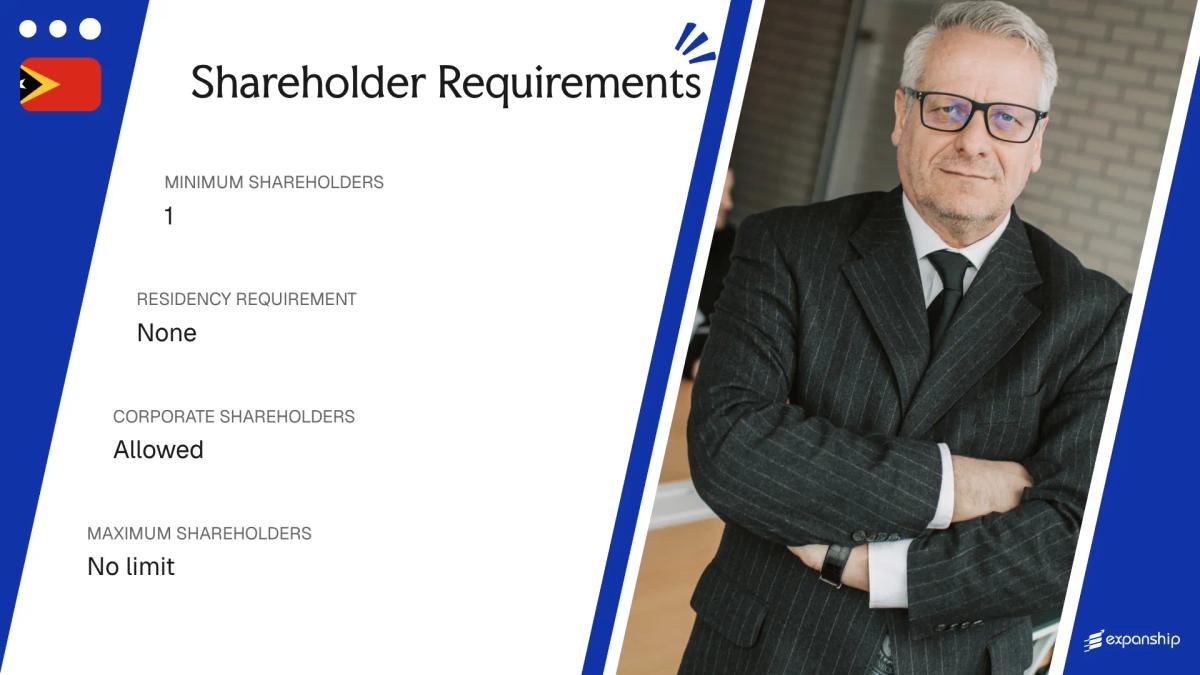
Under Timor-Leste's Commercial Companies Law (Decree-Law No. 10/2017), a private limited company (Sociedade por Quotas) requires a minimum of one shareholder, permitting sole shareholder structures. No statutory maximum applies to private companies.
Nationality and Residency Restrictions
Foreign nationals may hold shares in a Timorese company without a residency requirement. Certain sectors subject to foreign investment restrictions may impose ownership ceilings, which are administered through the national investment framework.
Corporate Shareholders
Corporate entities, including foreign-incorporated companies, are permitted to act as shareholders. Standard due diligence documentation on the corporate shareholder is required during registration.
Shareholder Liability
Shareholder liability is limited to the value of each member's capital contribution. Personal assets remain protected provided the company is properly maintained and the corporate structure is not used for fraudulent purposes.
Register of Shareholders
Your company must maintain an internal register of shareholders recording ownership interests. Filing updates with the Business Registration Service (SERVE) is required when ownership changes occur, though the register is not generally accessible to the public.
Setting Up Shareholder Structures for Your Timor-Leste Company
Get guidance on meeting shareholder eligibility and compliance requirements when incorporating in Timor-Leste.
UBO / Beneficial Ownership Disclosure Requirements in Timor-Leste
Timor-Leste does not currently maintain a fully enforced statutory UBO registration framework with a centralised beneficial ownership register. No specific legislation has established mandatory beneficial ownership disclosure Timor-Leste obligations equivalent to FATF-aligned UBO regimes in comparable jurisdictions.
KYC / Document Requirements in Timor-Leste
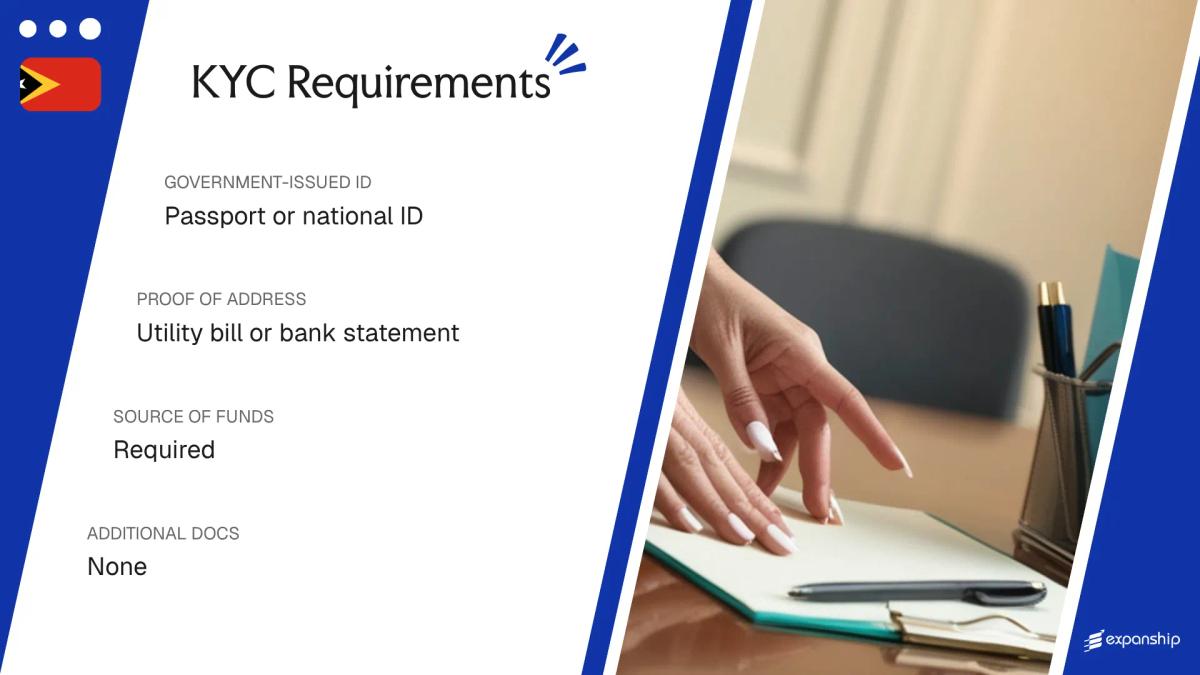
KYC document requirements in Timor-Leste are governed by the Anti-Money Laundering and Combating the Financing of Terrorism (AML/CFT) legal framework administered by the Banking and Payments Authority (BPA), which functions as the financial intelligence unit. All documents submitted at the point of incorporation must satisfy due diligence standards under this framework.
Individual / Personal Documents
- Valid government-issued passport or national identity card for each director, shareholder, and beneficial owner
- Proof of residential address dated within three months, such as a utility bill or bank statement
- Certified copy of any name-change documentation where the applicant's name differs across documents
- Recent passport-sized photograph may be required depending on the registering authority's procedures
Corporate Documents
- Certificate of incorporation of the corporate shareholder or director, issued by the relevant home jurisdiction authority
- Constitutional documents, such as articles of association or equivalent, confirming the entity's structure
- Register of directors and register of shareholders from the corporate entity's home jurisdiction
- Proof of registered office address for the corporate entity
Source of Funds Documentation
- Bank statements from the preceding three to six months evidencing the origin of capital
- Audited financial statements where the introducing entity has an established trading history
- A written declaration of source of funds may be required for newly formed entities without audited accounts
Notarisation and Apostille Requirements
- Foreign-issued documents generally require notarisation by a qualified notary in the country of origin
- Apostille certification is required for documents originating from Hague Convention member states
- Documents not in Tetum or Portuguese must be accompanied by a certified translation into one of those official languages
Unsigned or uncertified translations of foreign-language incorporation documents are the most common cause of registration delays.
Company Name Requirements in Timor-Leste
Company name requirements in Timor-Leste are assessed by the business registration authority at the point of incorporation. Proposed names are reviewed for uniqueness and general compliance before registration is approved.
Your chosen name must be in Portuguese or Tetum, the two official languages. A legal suffix indicating the entity type is mandatory, such as "Lda." for a private limited company.
Certain words are restricted from use without prior approval, including terms that imply government affiliation, banking, or insurance activity. Words that are offensive or misleading to the public are outright prohibited.
Name reservation is available through the registration process, though the duration and formal procedure follow general administrative practice. You submit your preferred name ahead of full registration to secure it while documentation is prepared.
Compliance Services for Companies in Timor-Leste
Keep your registered entity in good standing with ongoing compliance support tailored to Timor-Leste's regulatory requirements.
Conclusion
Timor-Leste company incorporation requirements are governed by the Commercial Companies Law (Law No. 4/2017), which sets out a defined framework administered through the Ministry of Justice's One Stop Shop (Balcão Único). Residency-neutral director rules and the absence of a mandatory company secretary distinguish this jurisdiction from many regional peers. Beneficial ownership disclosure obligations add a further compliance layer that foreign investors must account for before registration. Once these requirements are understood, the practical next step is engaging qualified local support to execute the formation process and maintain ongoing East Timor business registration compliance.
Expanship's Company Formation Services in Timor-Leste
Expanship's Timor-Leste company formation services cover the full registration process under the jurisdiction's legal framework, including document preparation aligned with SERVE's requirements and compliance with the Commercial Companies Law. Coordinating between government agencies, notaries, and local authorities adds layers of administrative work that Expanship helps manage on your behalf.
Beyond registration, Expanship supports your entity across its entire compliance lifecycle in Timor-Leste:
- Preparing and submitting company registration documents with SERVE and relevant authorities
- Providing a registered agent and local office address to meet statutory presence requirements
- Handling government filings and liaising directly with regulatory bodies on your behalf
- Managing ongoing post-incorporation compliance obligations as your business operates
- Facilitating introductions to banking institutions suited to your corporate structure
- Registering your firm for tax purposes and coordinating with local fiscal authorities
To discuss your incorporation requirements, contact Expanship Timor-Leste.
Frequently Asked Questions (FAQ)
The minimum share capital requirement varies depending on the type of entity and whether the company involves foreign investment. Foreign-invested companies are generally required to meet a higher capital threshold than domestic firms under the applicable investment regulations. Confirming the current figure with the Trade and Investment Office (SERVE) is advisable, as thresholds can be updated by ministerial regulation.
A foreigner can serve as a director in a Timor-Leste company. There is no statutory requirement under the Commercial Companies Law for at least one director to be a Timorese national, though directors must meet standard fit-and-proper criteria and comply with any conditions attached to the company's business licence.
Timor-Leste does not impose a statutory requirement for a locally resident company secretary in the same way that some other Asian jurisdictions do. Corporate governance obligations are primarily met through directorial accountability and compliance with the Commercial Companies Law (Decree-Law No. 6/2017).
Failing to maintain a valid registered office address in Timor-Leste means the company cannot receive official correspondence from SERVE or other government bodies, which can result in missed compliance deadlines and potential administrative penalties. A registered office is a legal requirement under the Commercial Companies Law, and operating without one puts the company's good standing at risk.
Timor-Leste's beneficial ownership disclosure framework is still developing relative to more established financial centres. Companies are expected to identify and record ultimate beneficial owners as part of their compliance obligations, particularly where foreign investment is involved, but a centralised public UBO register comparable to those in EU jurisdictions has not yet been fully implemented.
Foreign shareholders are typically required to provide certified copies of their passport, proof of residential address, and, where the shareholder is a corporate entity, certified constitutional documents such as a certificate of incorporation and register of directors. SERVE and any appointed notary may request additional documentation depending on the structure of the proposed company and the nationalities involved.
Legal Disclaimer
The information provided in this article is for general informational purposes only and does not constitute legal, tax, or professional advice. While we strive to ensure the accuracy and timeliness of the content, laws and regulations are subject to change, and the application of laws can vary widely based on specific facts and circumstances.
Readers should not act upon this information without seeking professional counsel tailored to their individual situation. Expanship and its authors disclaim any liability for actions taken or not taken based on the content of this article.
For specific advice regarding your business setup, compliance requirements, or any legal matters, please consult with qualified legal and tax professionals in the relevant jurisdiction.