
Key Takeaways
- Timor-Leste's Commercial Companies Law remains operationally inconsistent, with documented gaps between enacted legislation and actual administrative practice that create unpredictable compliance conditions for foreign investors.
- Foreign businesses establishing operational entities in Timor-Leste face structural constraints across banking access, land ownership rights, and workforce availability that compound the base difficulty of market entry.
- Timor-Leste's limited network of double taxation treaties increases the fiscal exposure of foreign-owned subsidiaries, as cross-border income flows receive minimal treaty-based relief compared to more treaty-connected jurisdictions.
- The country's heavy reliance on petroleum revenue to fund public expenditure leaves the broader business environment vulnerable to oil price volatility, which directly affects regulatory capacity, infrastructure investment, and institutional stability.
Timor-Leste operates under an evolving regulatory framework, where company law and foreign investment rules remain in active development rather than settled practice. The Commercial Companies Law governs business formation, but implementation gaps between legislation and administrative practice are a documented feature of the environment.
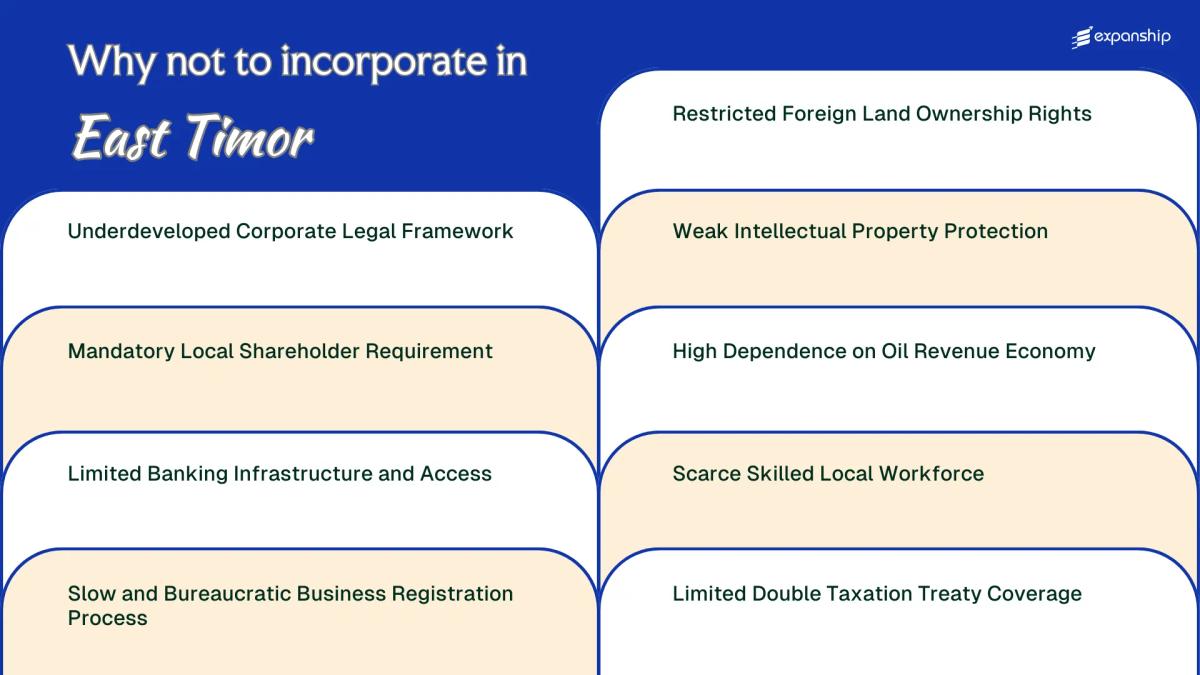
The disadvantages of incorporating in Timor-Leste span several structural and operational categories, from legal and banking limitations to workforce and fiscal constraints.
How severely these disadvantages affect your business depends significantly on industry sector, intended ownership structure, and whether your firm requires local operational capacity or functions as a holding entity. A trading company faces a different risk profile than a services firm.
This article is most relevant to foreign investors and internationally incorporated businesses considering direct operational presence or subsidiary formation in the country.
Underdeveloped Corporate Legal Framework
Timor-Leste's corporate legal framework limitations present a structural challenge that few other Southeast Asian jurisdictions impose to the same degree. The country's commercial law architecture remains largely incomplete, with significant gaps in areas that foreign businesses routinely depend on.
Fragmented and Incomplete Commercial Legislation
The primary legislative instrument governing business entities is the Commercial Companies Law (Decree-Law No. 18/2017), but supporting legislation across areas such as contract enforcement, secured transactions, and insolvency remains underdeveloped. For a foreign investor, this means there is no reliable legal scaffolding to fall back on when disputes arise or when structuring more complex corporate arrangements.
East Timor business law weaknesses extend to the judiciary itself. Courts lack specialised commercial divisions, and judges with expertise in corporate or commercial matters are scarce, which translates directly into unpredictable outcomes and prolonged resolution timelines.
Regulatory Gaps That Affect Operational Certainty
Underdeveloped company regulations in Timor-Leste mean that secondary regulations and administrative guidance, which typically clarify how laws apply in practice, are either absent or inconsistently enforced by SERVE, the national business registry authority. Your business may encounter situations where the law provides no clear answer, leaving interpretation to individual officials.
Timor-Leste commercial law challenges are compounded by the absence of a standalone company insolvency framework, creating genuine exposure if a counterparty or the entity itself faces financial distress.
Without a functional commercial court system or comprehensive insolvency law, a foreign business owner has limited enforceable remedies if contractual or financial disputes arise after incorporation.
Mandatory Local Shareholder Requirement
The Timor-Leste local shareholder requirement is one of the more structurally limiting aspects of foreign investment in the country. Under the Investment Law (Law No. 14/2011) and associated regulations, certain sectors require foreign entities to bring in a local equity partner, restricting your ability to hold full ownership of the business.
This means you cannot simply register a wholly foreign-owned entity and proceed. Your ownership structure, and by extension your control over profits and decisions, is subject to negotiation with a local party whose interests may not align with yours.
In practical terms, this requirement creates several distinct operational burdens:
- Finding a vetted local partner adds cost and delays before the business can even register
- Profit-sharing obligations reduce the effective return on your capital investment
- Disagreements with a mandatory local co-owner can stall operational decisions, with limited legal recourse given the underdeveloped dispute resolution framework
- Transferring shares or exiting the venture requires local partner cooperation, complicating future restructuring
The restriction does not apply uniformly across all sectors, but foreign ownership limitations in Timor-Leste's priority industries mean the carve-outs offer limited relief for most investors.

Company Incorporation in Timor-Leste
Understand ownership structure requirements and registration obligations before setting up your business in Timor-Leste.
Limited Banking Infrastructure and Access
Timor-Leste banking infrastructure challenges are felt almost immediately once a foreign entity begins operating. The country has a very small number of licensed commercial banks, and their branch networks are concentrated in Dili, leaving businesses outside the capital with minimal reliable access to financial services.
Opening a corporate bank account typically requires extensive in-person documentation, and processing times can stretch across several weeks. For a foreign director or shareholder who is not physically present in the country, this requirement alone can stall operational timelines significantly.
| Banking Constraint | Practical Burden |
|---|---|
| Limited number of licensed commercial banks | Few options for account comparison or negotiation on fees and terms |
| Dili-centric branch infrastructure | Businesses outside the capital face restricted access to in-person banking services |
| Mandatory in-person account opening | Foreign directors must travel or appoint a local representative, adding time and cost |
| USD-only official currency (no local currency) | International transfers denominated in other currencies incur additional conversion layers |
| Underdeveloped digital banking services | Routine transactions that would be automated elsewhere require manual processing |
East Timor limited banking access problems extend to trade finance. Credit facilities, letters of credit, and foreign currency accounts are not uniformly available across all institutions, which restricts the financial tools your business can use for cross-border transactions.
Correspondent banking relationships between local banks and international institutions remain limited. This means wire transfers to and from foreign accounts can involve delays and higher intermediary fees than in more financially integrated markets.
Slow and Bureaucratic Business Registration Process
The Timor-Leste business registration process delays are well-documented and stem from systemic inefficiencies that add real cost and uncertainty to market entry. Registration is administered through SERVE, the one-stop-shop portal established to centralise business licensing. Despite its mandate, the system has historically suffered from slow interagency coordination, manual processing bottlenecks, and inconsistent document verification standards.
Even straightforward incorporations can extend weeks beyond the stated processing timelines. Each delay means your business cannot legally operate, open bank accounts, or sign commercial contracts, directly deferring revenue generation.
Foreign firms also face additional approval layers depending on the business activity sector. This extends the East Timor bureaucratic company registration problems beyond a simple paperwork exercise into a multi-agency dependency chain.
- Registration through SERVE requires submission of notarised founding documents, which must comply with the Commercial Companies Law No. 10/2017.
- Foreign ownership structures require additional scrutiny and may trigger review by multiple ministries.
- Business licence categories are activity-specific, meaning multiple licences may be required for diversified operations.
- Processing timelines are not legally binding, so delays carry no regulatory remedy for the applicant.
Despite SERVE being positioned as a single-window system, foreign companies often still need to interact with separate government bodies outside the portal to complete their registration.
Restricted Foreign Land Ownership Rights
Timor-Leste foreign land ownership restrictions present one of the more concrete structural barriers for foreign investors. Under the Land Law (Law No. 13/2017), non-citizens and foreign-incorporated entities are prohibited from owning freehold land.
The Scope of the Restriction
Foreign businesses are limited to leasehold arrangements, which typically extend up to 25 years with a possible renewal. This prevents your firm from building long-term equity in real property, a significant disadvantage when land underpins collateral requirements for local financing or signals operational permanence to partners.
Practical Consequences for Foreign Operators
Leasehold tenure creates contractual uncertainty that complicates capital expenditure planning, particularly for businesses requiring fixed infrastructure such as manufacturing, logistics, or hospitality facilities. East Timor property rights limitations for foreigners also affect exit valuation, since immovable assets cannot be transferred as owned property upon divestment. State-owned land administered through the Ministry of Justice adds a further layer of bureaucratic dependency that extends the timeline for securing usable premises.
Addressing Land Access Challenges for Your Business in Timor-Leste
Speak with our corporate services team about structuring your operations within the legal constraints of Timor-Leste's property framework.
Weak Intellectual Property Protection
Timor-Leste intellectual property protection weaknesses stem from an underdeveloped legal regime that lacks a dedicated, comprehensive IP statute. Businesses holding trademarks, patents, or proprietary content face enforcement gaps that are difficult and costly to close.
- No standalone trademark or patent law has been enacted, meaning your IP rights cannot be formally registered within the domestic legal system.
- Without a functioning IP registry, you cannot obtain a registered title that courts or customs authorities can enforce against infringers.
- East Timor IP rights enforcement challenges are compounded by a judiciary with limited capacity to adjudicate IP disputes or award meaningful remedies.
- Border control mechanisms lack the technical tools to identify and intercept counterfeit or infringing goods entering the market.
- Weak trademark protection in Timor-Leste means a competitor can use your brand identity domestically without facing a clear legal prohibition.
- Membership in WIPO does not substitute for domestic legislation, so international registration frameworks offer only partial practical protection.
High Dependence on Oil Revenue Economy
Timor-Leste oil revenue economy dependency risks are not theoretical. Petroleum receipts have historically accounted for over 90% of government revenue, meaning the entire public expenditure framework, including infrastructure, regulation, and services that businesses depend on, rests on a single depleting resource.
The Petroleum Fund, established under Law No. 9/2005, holds the accumulated oil wealth and finances the state budget through annual transfers. When oil prices fall or production declines, those transfers shrink, and government capacity to fund business-enabling infrastructure contracts accordingly.
Depletion forecasts for the Bayu-Undan field, the primary source of petroleum revenue, have raised structural concerns about the medium-term fiscal position. Your business cannot reasonably plan for a stable regulatory or infrastructure environment when the government's revenue base is this narrow.
Non-oil GDP remains small, and domestic private sector activity is insufficient to substitute for petroleum-linked public spending. That concentration means demand, contract opportunities, and consumer purchasing power are all more exposed to commodity cycles than in more diversified economies.
According to the IMF's 2023 Article IV Consultation on Timor-Leste, petroleum wealth is expected to be largely exhausted within this decade under current withdrawal rates, with no clear fiscal replacement mechanism yet in place.
Scarce Skilled Local Workforce
Timor-Leste skilled workforce scarcity challenges are structural, not incidental. The country has one of the youngest and fastest-growing populations in Southeast Asia, yet tertiary enrollment rates remain low and vocational training infrastructure is underdeveloped. For a foreign business, this translates directly into difficulty sourcing qualified local staff in technical, managerial, or specialist roles.
The National University of Timor-Lorosa'e (UNTL) is the primary public institution producing graduates, but output in fields such as engineering, finance, and law remains limited relative to private sector demand. Filling mid-to-senior roles locally is rarely straightforward, which increases your reliance on expatriate hires.
Hiring expatriates requires work permit authorisation through the Ministry of Interior, adding cost and administrative lead time. Salary expectations for qualified foreign professionals in a frontier market often exceed regional norms, compressing margins.
- Local language considerations (Tetum and Portuguese are official; Bahasa Indonesia is widely used commercially) can restrict your candidate pool further when roles require specific language competencies.
- Retention is difficult given that skilled locals with international exposure often pursue opportunities abroad.
Under Timor-Leste's Labour Law (Law No. 4/2012), employers are subject to localisation expectations, meaning unconstrained reliance on expatriate staff is not a compliant long-term substitute for local hiring obligations.
Limited Double Taxation Treaty Coverage
Timor-Leste has signed very few double taxation agreements, leaving your business exposed to taxation in both its home country and in this jurisdiction simultaneously. Without treaty protection, dividends, royalties, and service fees paid to foreign parent companies are subject to withholding tax under the Taxes and Duties Act 2008, with no bilateral mechanism to offset that liability against taxes paid elsewhere.
Withholding tax on certain cross-border payments can reach rates that materially erode repatriated profits, and no treaty credit exists to recover that cost in most investors' home jurisdictions. This directly increases the effective tax burden on foreign-owned entities operating here.
The practical consequence is that Timor-Leste double taxation treaty limitations affect structuring decisions from the outset. Intercompany transactions, licensing arrangements, and profit repatriation all carry a higher tax cost than equivalent structures placed in jurisdictions with broader treaty networks, such as Singapore or Portugal.
Strategies to Overcome These Challenges
Overcoming Timor-Leste incorporation challenges requires structural preparation before registration, not reactive adjustments after problems arise. The disadvantages outlined in this blog each reflect systemic conditions that cannot be resolved through informal workarounds.
- Register your business through the SERVE portal, the official one-stop service managed by the Ministry of Commerce, Industry and Environment, to reduce processing delays.
- Structure your shareholding to satisfy the local partner requirements under the Private Investment Law from the outset, rather than restructuring post-incorporation.
- Open correspondent banking arrangements through internationally connected financial institutions before committing to in-country operations.
- File for any applicable intellectual property protections through ASEAN regional mechanisms, given the absence of a domestic IP registry.
- Conduct workforce planning against UNTL graduate pipelines and sector-specific training programs to account for local skills gaps.
- Model revenue projections independently of petroleum sector performance, using non-oil GDP data published by the Banco Central de Timor-Leste.
Each of these steps operates within a regulatory environment that remains subject to ongoing legislative reform. Mitigating business risks in East Timor depends on monitoring policy changes through official government channels rather than assuming statutory stability.
Timor-Leste's Overall Business Potential
Timor-Leste's business environment risks and potential are real on both sides of the ledger. The structural disadvantages covered in this blog — from weak intellectual property enforcement to limited double taxation treaty coverage — are not minor friction points; they represent systemic gaps that affect day-to-day operations. That said, for businesses aligned with the country's development trajectory, the case for incorporation is not without merit.
| Pros | Cons |
|---|---|
| Young, growing economy with active petroleum revenues channelled through the Petroleum Fund supports public spending and infrastructure investment. | The economy's dependence on oil revenue creates structural vulnerability, with non-oil GDP remaining fragile. |
| The government has signalled openness to foreign direct investment across priority sectors. | No mandatory local shareholding exemption exists, which limits full foreign ownership in most structures. |
| Geographic position within the ASEAN neighbourhood offers regional market proximity. | Foreign firms cannot own land directly, restricting physical establishment and long-term asset security. |
| SERVE (the one-stop business registration service) consolidates some administrative steps. | Registration processes remain slow and bureaucratic despite SERVE's existence. |
| A developing legal system means early entrants face less incumbent competition. | Corporate legal frameworks and intellectual property protections remain underdeveloped relative to regional peers. |
East Timor investment challenges are structural, not incidental. Your assessment of viability should account for limited local banking access, a thin skilled labour pool, and negligible double taxation treaty coverage before committing capital.
Corporate Compliance Services in Timor-Leste
Maintain your company's standing with local regulatory requirements, annual filings, and ongoing statutory obligations under Timorese law.
Conclusion
The Timor-Leste incorporation drawbacks summary points to a jurisdiction where structural limitations carry real operational weight. The absence of broad double taxation treaty coverage, combined with a still-developing corporate legal framework, creates measurable exposure for foreign investors. Dependence on petroleum revenue further concentrates economic risk in ways that affect the broader business environment. Deciding whether incorporating in Timor-Leste is worth it depends on your sector, risk tolerance, and long-term positioning. Specialist guidance on local regulatory requirements under the applicable commercial law regime can materially affect how those risks are managed.
Expanship's Timor-Leste Expansion Services
Expanship's Timor-Leste company formation services are built around the specific friction points this jurisdiction presents, from working within the Commerce, Industry and Environment Ministry's registration procedures to managing compliance under the Commercial Companies Law (Law No. 4/2017). Expanship helps reduce the operational weight these obligations place on foreign investors, particularly around local shareholder structuring and ongoing regulatory filings.
From initial setup through to post-incorporation maintenance, the firm supports businesses across the full corporate lifecycle:
- Preparing and filing company registration documents with the relevant Timorese authorities
- Providing a registered agent and local office address in Dili
- Handling government filings and liaising directly with regulatory bodies on your behalf
- Managing ongoing compliance obligations after your entity is incorporated
- Facilitating introductions to local and regional banking institutions
- Registering your business for tax purposes with the Autoridade Tributária de Timor-Leste
To discuss your East Timor expansion, contact Expanship Timor-Leste.
Frequently Asked Questions (FAQ)
The local participation requirement applies specifically to certain sectors and investment categories under Timor-Leste's investment framework, not uniformly to every corporate structure. However, foreign investors in restricted sectors must meet local equity thresholds, which limits your control over the entity and complicates profit distribution arrangements. The practical effect is that structuring a wholly foreign-owned company is not always possible depending on your industry.
Enforcement is weak and judicial capacity to handle IP disputes is limited, meaning a foreign registration does not translate into reliable local protection. Timor-Leste's IP framework remains underdeveloped, and the absence of well-established enforcement mechanisms means infringers face minimal deterrent. Your recourse through local courts is slow and the outcome unpredictable.
Yes, registration timelines in Timor-Leste are considerably longer than in most ASEAN economies, where digital systems have reduced incorporation to days. The process in Timor-Leste involves multiple government agencies and manual procedures that can extend the timeline to weeks or longer depending on documentation requirements. For a business with a fixed market-entry deadline, this is a concrete operational risk.
The economy's structural reliance on the Petroleum Fund means that fiscal policy and public investment are tied to oil revenues, creating cyclical instability in non-petroleum sectors. When oil income contracts, government spending and consumer demand follow, directly affecting the commercial viability of businesses outside the extractive industry. This concentration risk makes long-term financial planning difficult for firms in retail, services, or manufacturing.
Sourcing adequately qualified local staff is a genuine operational constraint, particularly for roles requiring technical, legal, or financial expertise. This often forces companies to rely on expatriate hires, which increases payroll costs and triggers additional compliance obligations under Timor-Leste's labor and immigration rules. The workforce gap also extends project timelines and limits the speed at which a new entity can become operationally self-sufficient.
Foreign-owned entities face direct restrictions on land ownership under Timor-Leste's land law framework, which reserves freehold title rights for Timorese nationals and citizens. A foreign company or a locally incorporated firm with foreign shareholders typically cannot hold land outright and must instead operate under long-term lease arrangements. This creates additional legal complexity and limits your ability to use property as collateral for financing.
The limited number of commercial banks, combined with restricted access to trade finance and credit facilities, means that routine transactions such as international wire transfers and working capital loans are slower and more costly than in more developed financial centers. Currency management is a further complication since the US dollar is the official currency but cross-border banking services remain thin. Companies frequently need to maintain offshore banking relationships to manage liquidity effectively.
Legal Disclaimer
The information provided in this article is for general informational purposes only and does not constitute legal, tax, or professional advice. While we strive to ensure the accuracy and timeliness of the content, laws and regulations are subject to change, and the application of laws can vary widely based on specific facts and circumstances.
Readers should not act upon this information without seeking professional counsel tailored to their individual situation. Expanship and its authors disclaim any liability for actions taken or not taken based on the content of this article.
For specific advice regarding your business setup, compliance requirements, or any legal matters, please consult with qualified legal and tax professionals in the relevant jurisdiction.