
Key Takeaways
- Foreign and domestic entities incorporating in Tajikistan must register with the Ministry of Justice under the Law on State Registration of Legal Entities and Individual Entrepreneurs, and operating without completed registration exposes the business to administrative penalties under national law.
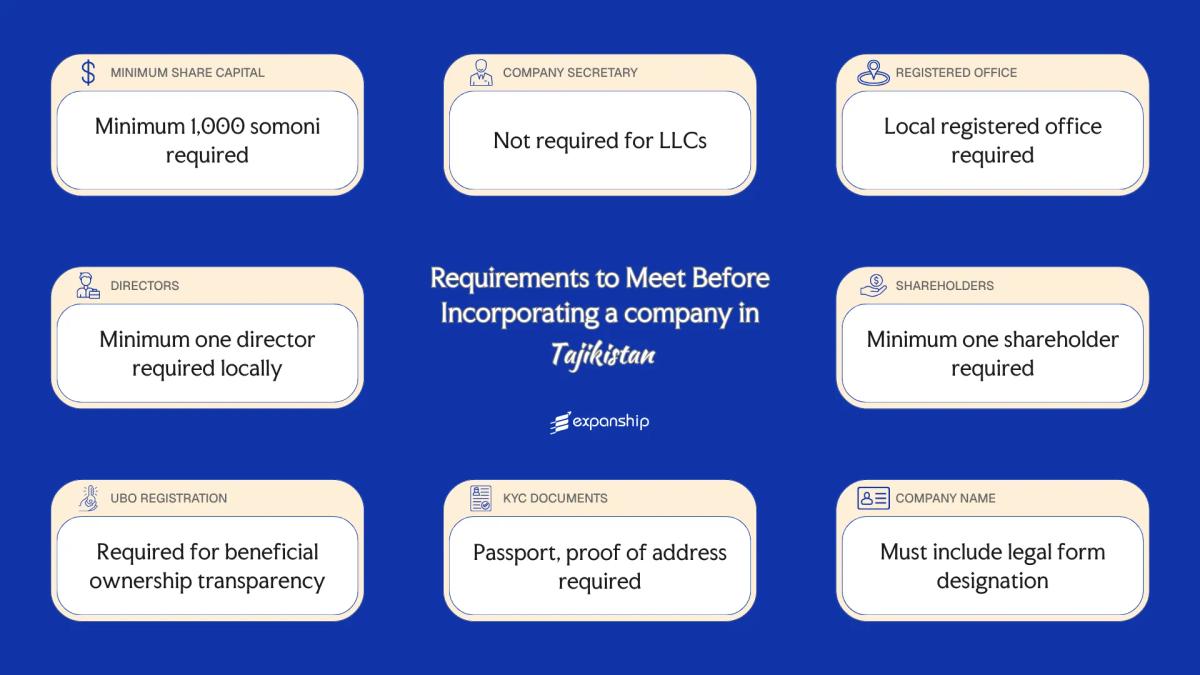
- The legal address provided at registration must correspond to a verified physical premises, not a nominal or virtual location, making address compliance a substantive registration condition rather than a formality.
- Beneficial ownership disclosure is a mandatory obligation for entities established in Tajikistan, reflecting the country's commitments to financial transparency and requiring UBO information to be submitted as part of the compliance framework.
- KYC documentation requirements carry particular weight for foreign-owned entities, meaning that shareholders and directors of non-Tajik origin must be prepared to supply verified identity and corporate documentation before the registration process can be completed.
Entity formation in Tajikistan is governed by the Civil Code of the Republic of Tajikistan and the Law on State Registration of Legal Entities and Individual Entrepreneurs, with the Ministry of Justice serving as the primary registration authority. Understanding the incorporation requirements in Tajikistan is essential before submitting any registration documents, as the framework sets out distinct conditions across ownership, capital, and documentation. Failure to satisfy these conditions results in rejection of the registration application or, where an entity operates without proper registration, exposure to administrative penalties under national law.
Requirements differ depending on the legal form chosen, such as a Limited Liability Company or a Joint Stock Company, and may also vary based on the industry sector or the structure of foreign investment involved. The Civil Code provides the foundational legal basis for these obligations.
Foreign investors and business owners establishing a first presence in the country will find this article most directly applicable to their situation.
Minimum Share Capital Requirements in Tajikistan
Under Tajikistan's Civil Code and the Law on Limited Liability Companies, minimum share capital requirements in Tajikistan are governed by specific statutory thresholds that apply at the point of registration. The Ministry of Justice maintains the Unified State Register of Legal Entities, which serves as the primary authority verifying capital declarations during incorporation.
Tajikistan operates on a par value share system. Authorized capital obligations are not a one-time formality — the declared capital must reflect the actual structure of the entity throughout its existence, as recorded in the founding documents.
| Parameter | Detail |
|---|---|
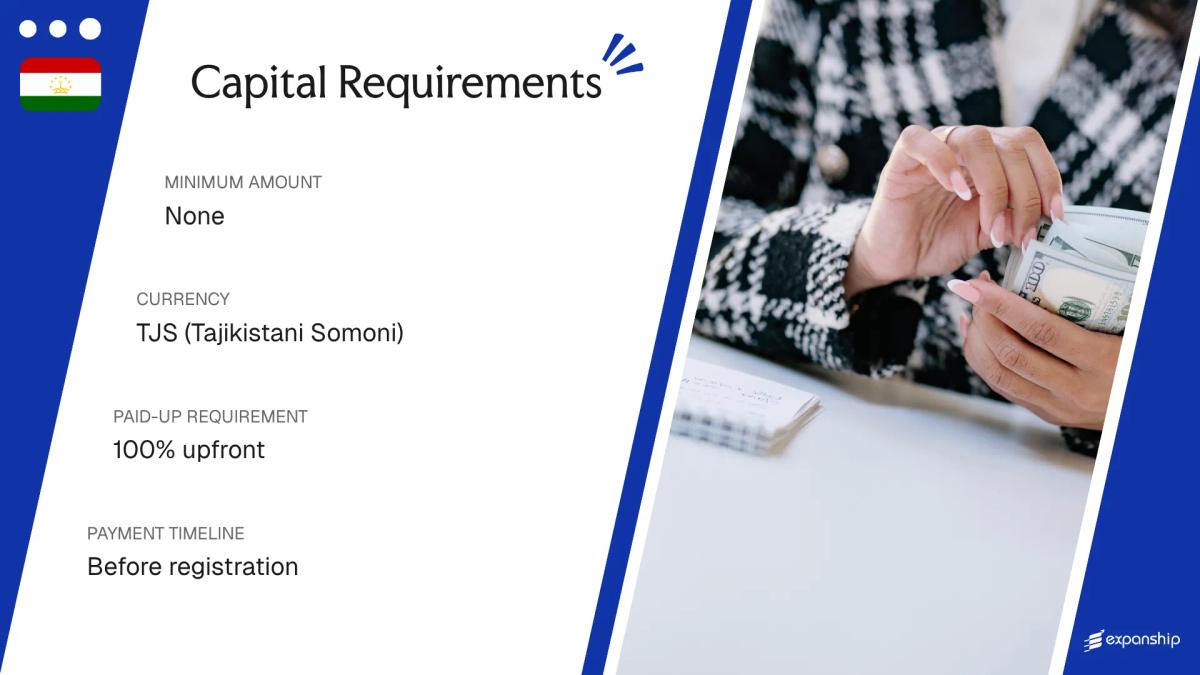
| Minimum Authorized Share Capital | TJS 500 (approximately) for an OOO (LLC equivalent) |
| Maximum Authorized Share Capital | No statutory maximum |
| Minimum Paid-Up Capital | No statutory requirement beyond the declared minimum |
| Paid-Up Requirement at Incorporation | Full contribution required within one year of registration |
| Accepted Currency | Tajikistani Somoni (TJS) |
| Accepted Forms of Contribution | Cash and non-cash assets (property, securities) |
| Timeframe to Deposit Capital | Within 12 months of state registration |
The authorized capital does not need to be fully deposited before registration, but failure to complete contribution within the statutory 12-month window can trigger legal consequences under the Law on Limited Liability Companies.
Company Secretary Requirements in Tajikistan
Under Tajikistan's legal framework, there is no statutory requirement for a dedicated "company secretary" role equivalent to what exists in common law jurisdictions. The company secretary requirements Tajikistan businesses must address are instead embedded in the general governance obligations applied to limited liability companies and joint-stock companies under civil and corporate legislation.
A designated responsible person within the firm typically handles record-keeping, maintains the company's statutory registers, and ensures timely submission of documents to the State Registration Service under the Ministry of Justice. Tajikistan corporate secretary obligations are, in practice, often fulfilled by a director or an appointed internal officer rather than a separately licensed individual.
Qualification criteria for who may serve in this administrative capacity:
- No formal licensing or professional certification is required under general corporate rules.
- The role may be filled by a resident or non-resident individual, subject to the company's internal charter.
- A legal entity may perform these functions if authorized under the company's constituent documents.
- The person must have legal capacity under civil law to act on behalf of the entity.

Incorporate a Company in Tajikistan
Set up your legal entity in Tajikistan with full compliance support, from document preparation to state registration.
Legal Address Requirements in Tajikistan
Legal address requirements in Tajikistan mandate that every registered company maintain a physical address within the country that serves as its official location for correspondence from state authorities and regulatory bodies.
- A physical address at a real premises is required; a P.O. box alone does not satisfy the registered office requirement.
- Virtual offices are generally not recognized as a compliant registered address under Tajik company law.
- The address must be located within Tajikistan; foreign addresses are not permitted.
- Documentary evidence of the right to use the premises, such as a lease agreement or title document, must be submitted to the State Registration Service.
- The registered address is publicly recorded in the Unified State Register of Legal Entities and is accessible to third parties.
- Any change to the registered office address requires formal notification to the State Registration Service, with updated documentation filed accordingly.
- Operating with a non-compliant or fictitious address can result in administrative penalties and may expose the entity to suspension of its registration status.
Director Requirements in Tajikistan
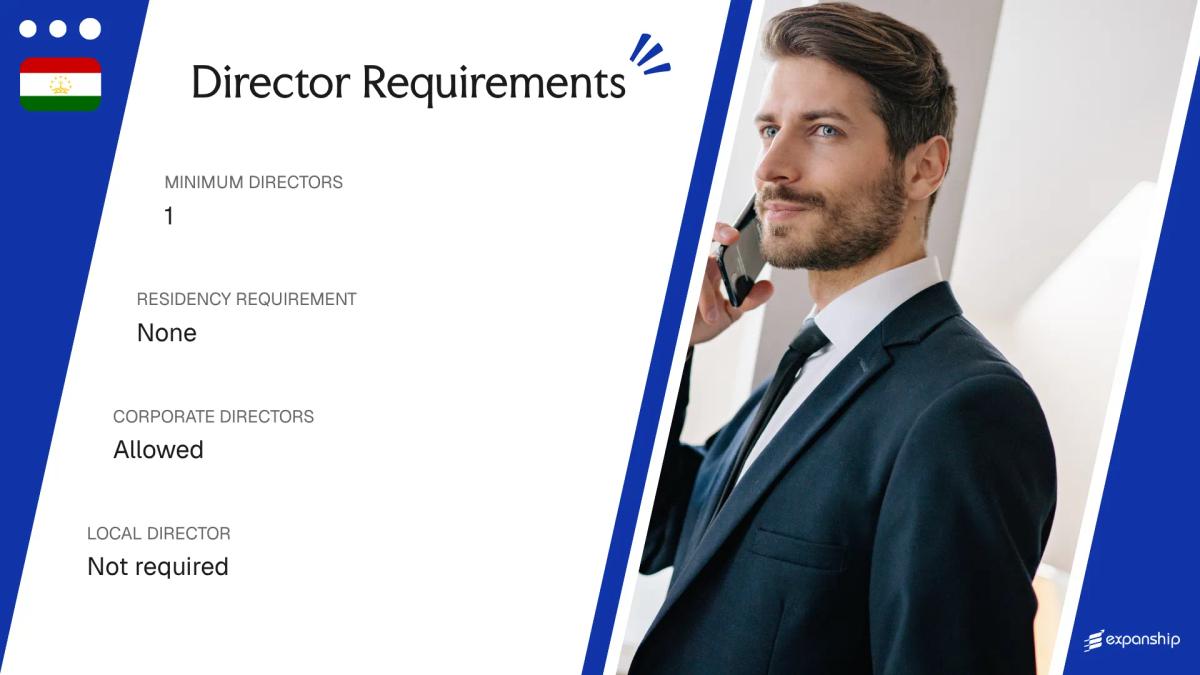
Under the Civil Code of the Republic of Tajikistan and the Law on Limited Liability Companies, director requirements Tajikistan company structures impose on appointees include direct fiduciary duties to act in the entity's interests, maintain accurate financial records, and bear personal liability for decisions that cause demonstrable harm to the firm or its creditors.
| Parameter | Detail |
|---|---|
| Minimum Number of Directors | One director is required. |
| Maximum Number of Directors | No statutory maximum is prescribed. |
| Local/Resident Director Required | No residency requirement exists under current legislation. |
| Nationality Restrictions | No nationality restrictions apply; foreign nationals may serve. |
| Minimum Age Requirement | Directors must have reached the age of legal capacity, generally 18 years. |
| Corporate Directors Permitted | No statutory provision expressly permits corporate directors; natural persons are the standard. |
| Director Must Be a Shareholder | No statutory requirement for a director to hold shares in the business. |
| Publicly Listed on Registry | Director information is recorded with the State Registration Service under the Ministry of Justice. |
| Disqualification Conditions | Persons declared legally incapacitated by a court, or those subject to a judicial ban from holding managerial positions, are disqualified. |
Despite having no residency requirement, Tajikistan's Law on Limited Liability Companies holds the sole director personally liable for damages arising from decisions made in bad faith, with no statutory cap on that liability.
Shareholder Requirements in Tajikistan
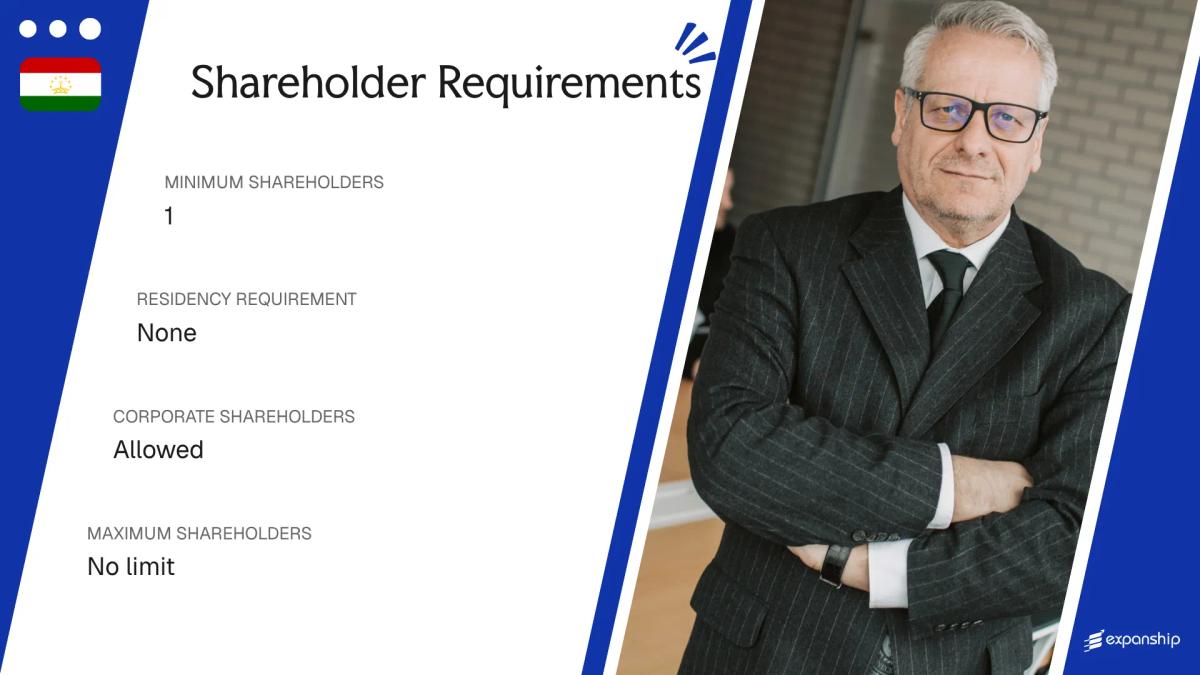
Under Tajikistan company law, a Limited Liability Company (OOO) may be established by a single individual, making a sole shareholder structure permissible. The maximum number of shareholders is capped at 30; exceeding this threshold triggers an obligation to reorganize the entity into a joint-stock company.
Nationality and Residency Restrictions
Shareholder requirements in Tajikistan impose no nationality or residency conditions on shareholders. Foreign nationals and non-resident entities may hold ownership interests without percentage-based restrictions under the general LLC framework.
Corporate Shareholders
Legal entities, including foreign corporations, may act as shareholders in a Tajikistan-registered OOO. No special conditions are imposed solely on the basis of corporate shareholder status, though the firm must still meet standard registration requirements.
Shareholder Liability
Liability is limited to each shareholder's contribution to the charter capital. Tajikistan company ownership rules do not extend personal liability beyond that contribution under ordinary circumstances.
Register of Shareholders
An internal register of shareholders must be maintained by the OOO. This register is not publicly accessible, though changes in ownership composition must be reflected in updated filings with the Ministry of Justice.
Structuring Your Shareholder Setup for Tajikistan Incorporation
Get guidance on ownership arrangements, foreign shareholder eligibility, and compliance obligations when setting up a company in Tajikistan.
UBO / Beneficial Ownership Disclosure Requirements in Tajikistan
Beneficial ownership disclosure Tajikistan requirements are governed by the Law on Combating the Legalisation of Proceeds from Crime and Financing of Terrorism, which obliges legal entities to identify and disclose individuals who ultimately own or control 25% or more of the business.
- Identify the beneficial owner during the company registration process, applying the 25% ownership or control threshold.
- Submit UBO information to the State Registration Service under the Ministry of Justice at the point of incorporation.
- Retain internal UBO records and make them available to the Financial Monitoring Department upon request.
- Update disclosed information whenever ownership or control changes occur.
| Parameter | Detail |
|---|---|
| Ownership Threshold for UBO Status | 25% of shares or equivalent control rights |
| Filing Authority | State Registration Service, Ministry of Justice |
| Disclosure Deadline at Incorporation | At the point of registration |
| Publicly Accessible Register | No publicly accessible register confirmed |
| Penalties for Non-Disclosure | Administrative penalties applicable under anti-money laundering legislation |
| Ongoing Update Obligation | Required upon any change in beneficial ownership |
KYC / Document Requirements in Tajikistan
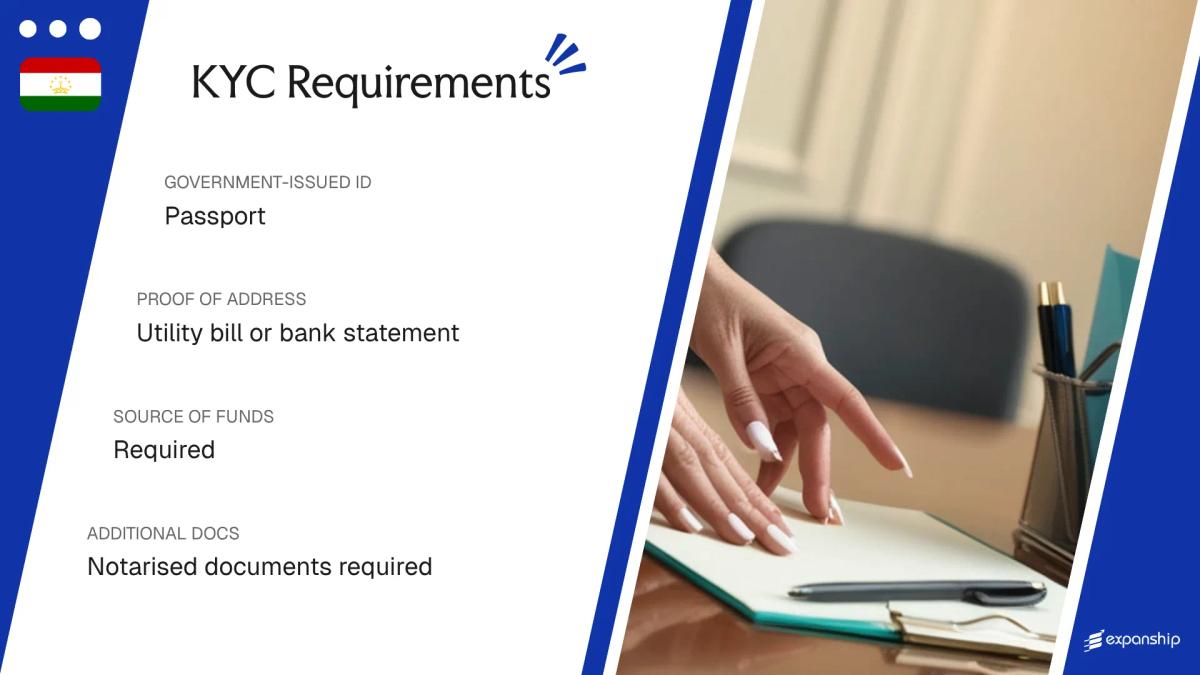
KYC document requirements in Tajikistan are governed primarily by the Law of the Republic of Tajikistan on Counteracting the Legalisation of Criminally Obtained Income and Financing of Terrorism, administered by the Financial Monitoring Department under the Ministry of Finance. All parties to an incorporation — directors, shareholders, and beneficial owners — must submit identity and supporting documentation before registration proceeds.
Individual / Personal Documents
- Valid passport or national identity document for each individual director, shareholder, or beneficial owner
- Proof of residential address issued within the past three months (utility bill, bank statement, or equivalent)
- Completed and signed personal information form as required by the registration authority
- Recent passport-sized photograph may be required depending on the filing agent or notary
Corporate Documents
- Certificate of incorporation or equivalent constitutional document of the corporate shareholder or director
- Articles of association or charter of the corporate entity
- Register of directors and shareholders of the parent company
- Proof of the corporate entity's registered address
Source of Funds Documentation
- Bank statements covering a minimum of three to six months prior to incorporation
- Audited financial statements where the entity has an established operating history
- Written declaration explaining the origin of capital to be introduced
Notarisation and Apostille Requirements
- Foreign-issued documents generally require notarisation and an apostille under the Hague Convention
- Official Tajik translation by a certified translator is required for all documents not in Russian or Tajik
- Notarised copies must be prepared before submission to the Ministry of Justice
Incomplete or uncertified translation of foreign corporate documents is the most frequent cause of registration rejection or delay.
Company Name Requirements in Tajikistan
Proposed company name requirements Tajikistan submissions are reviewed during the registration process, with the relevant state authority assessing each name for uniqueness and compliance before incorporation proceeds.
Names must be presented in Tajik or Russian and include a legal suffix that reflects the chosen entity form, such as "ООО" for a limited liability company. No specific character limit is publicly codified, but the name must be clear and unambiguous.
Certain words tied to state institutions, government bodies, or national symbols require official authorisation before use. Names that imply a connection to international organisations or suggest a regulated activity without the corresponding licence are generally prohibited.
Name reservation is available through the registration authority prior to formal incorporation. Reservations are typically granted for a limited period, during which the name is held exclusively for your business pending submission of full registration documents.
Compliance Services for Companies in Tajikistan
Stay aligned with Tajikistan's regulatory requirements, from annual filings to ongoing corporate maintenance.
Conclusion
Meeting the incorporation requirements in Tajikistan involves navigating a defined set of conditions established under the Civil Code and the Law on State Registration of Legal Entities and Individual Entrepreneurs. Among the more consequential requirements are UBO disclosure obligations, which reflect Tajikistan's commitments to financial transparency, and the mandatory local legal address, which must be a verified physical premises rather than a nominal registration point. KYC documentation standards also carry weight, particularly for foreign-owned entities. Once these conditions are understood, the practical work of preparing compliant documentation and engaging with the Ministry of Justice begins.
Expanship's Corporate Services for Tajikistan Expansion
Tajikistan's incorporation framework, from Ministry of Justice registration through to tax authority enrolment, involves multiple government touchpoints that can be time-consuming to coordinate without local familiarity. Expanship's Tajikistan company incorporation services are designed to reduce that operational burden by managing the procedural steps on your behalf, so your team can focus on the business itself.
Beyond formation, our corporate services cover the full lifecycle of your entity's compliance obligations in Tajikistan:
- We prepare and file all registration documents with the relevant Tajik authorities on your behalf.
- Our registered agent and office provision satisfies the mandatory local address requirement.
- We handle direct liaison with government bodies and regulatory offices throughout the process.
- Ongoing post-incorporation compliance management keeps your entity in good standing.
- Where appropriate, we facilitate introductions to banking institutions active in Tajikistan.
- Tax registration and coordination with the State Tax Committee is included as part of our service scope.
Reach out through Expanship Tajikistan to discuss what your expansion requires.
Frequently Asked Questions (FAQ)
A foreign national can serve as director of a Tajik LLC, but the individual must hold a valid work permit issued under Tajikistan's labour legislation if they are actively managing the company from within the country. If the director operates from abroad without physically working in Tajikistan, the work permit requirement may not apply, though the entity still needs a locally reachable point of contact for correspondence with state bodies such as the State Registration Service.
An invalid or lapsed legal address puts your company in breach of registration requirements under Tajik civil legislation, and state authorities use that address for all official notices and tax correspondence. Failure to maintain a valid address can result in fines and complications during annual filings or licence renewals. You must update the registered address through the State Registration Service before the existing address lapses.
Beneficial ownership information in Tajikistan is submitted to the relevant state authority rather than published in a fully open public register, meaning access is restricted compared to jurisdictions with centralised public UBO databases. The disclosure obligation still requires identifying any individual who ultimately owns or controls 10% or more of the company. Non-disclosure or misrepresentation carries penalties under Tajik anti-money laundering legislation.
No residency requirement applies to shareholders of a Tajik LLC, meaning both foreign individuals and foreign legal entities can hold shares without needing Tajik residency or a local representative in that capacity. However, the shareholder's identity must be verified through the KYC process at the time of incorporation, and supporting documents may need apostille certification or notarised translation into Tajik or Russian. The State Registration Service reviews these documents as part of the formation process.
The State Registration Service will reject the application if the proposed name is identical or confusingly similar to an already registered entity. Beyond the administrative delay this causes, repeated submission of non-compliant names can slow down your entire incorporation timeline. Conducting a name availability check through the official register before submitting your application is the standard way to avoid this outcome.
Yes, corporate shareholders face additional documentary requirements beyond what is asked of individual shareholders. In addition to identity documents, a corporate shareholder must typically provide its certificate of incorporation, constitutional documents, and proof of good standing from its home jurisdiction, all translated into Tajik or Russian and appropriately certified. Individual shareholders generally need certified passport copies and, depending on their nationality, documents establishing their residential address.
Legal Disclaimer
The information provided in this article is for general informational purposes only and does not constitute legal, tax, or professional advice. While we strive to ensure the accuracy and timeliness of the content, laws and regulations are subject to change, and the application of laws can vary widely based on specific facts and circumstances.
Readers should not act upon this information without seeking professional counsel tailored to their individual situation. Expanship and its authors disclaim any liability for actions taken or not taken based on the content of this article.
For specific advice regarding your business setup, compliance requirements, or any legal matters, please consult with qualified legal and tax professionals in the relevant jurisdiction.