
Key Takeaways
- Foreign investors operating under Tajikistan's Law on State Registration of Legal Entities and Individual Entrepreneurs must navigate a multi-agency registration process that adds administrative layers not present in more streamlined jurisdictions.
- Currency conversion risks tied to the Tajikistani somoni's limited international convertibility can restrict a foreign entity's ability to repatriate profits or settle cross-border obligations efficiently.
- Weak enforcement mechanisms for intellectual property rights mean that businesses holding trademarks, patents, or proprietary technology face limited practical recourse against infringement within the country.
- Tax administration managed through the Tax Committee involves compliance burdens that disproportionately affect foreign entities unfamiliar with local procedural requirements, increasing both cost and exposure to audit-related disputes.
Tajikistan operates under an evolving regulatory framework, where commercial activity is governed primarily by the Civil Code and the Law on State Registration of Legal Entities and Individual Entrepreneurs. The disadvantages of incorporating in Tajikistan span several categories, from financial infrastructure and foreign ownership restrictions to tax administration and enforcement gaps.
The weight of these disadvantages is not uniform. A small trading firm will encounter different friction points than a foreign investor entering a capital-intensive sector, and your exposure to specific risks depends on the structure and purpose of your entity.
This article is most relevant to foreign investors and internationally operating businesses considering a formal presence in the country. The primary legal framework governing business formation can be referenced in the Civil Code.
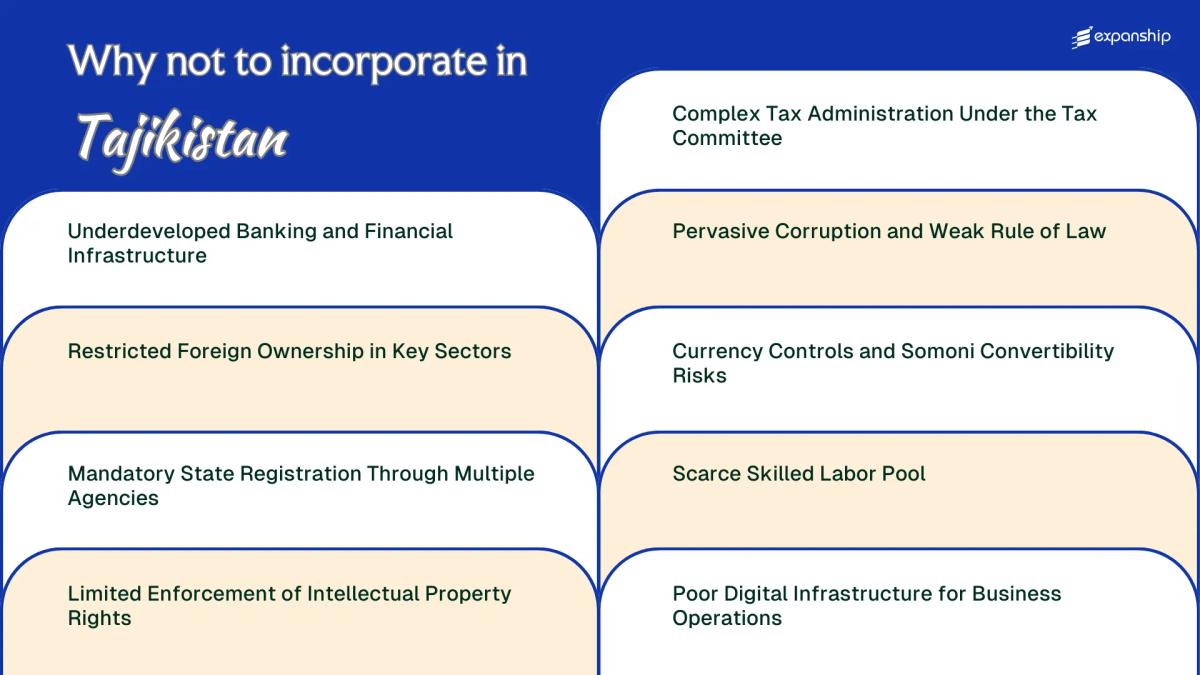
Underdeveloped Banking and Financial Infrastructure
Tajikistan banking infrastructure limitations affect foreign businesses from the moment they attempt to open a corporate account. The financial system remains one of the least developed in Central Asia, creating structural obstacles that extend well beyond basic account access.
Concentrated and Undercapitalized Banking Sector
The National Bank of Tajikistan oversees a sector dominated by a small number of state-influenced banks with limited capital bases and restricted international correspondent relationships. Your ability to receive foreign wire transfers or execute cross-border payments reliably depends on whether your bank maintains active correspondent arrangements, which many local institutions do not.
Foreign currency transactions often require prior documentation and face processing delays that can disrupt supplier payments or investor distributions.
Limited Access to Credit and Financial Services
Trade finance instruments that businesses in more developed markets rely on, such as letters of credit and bank guarantees, are either unavailable or prohibitively expensive through most domestic banks. Working capital financing for foreign-owned entities is similarly constrained, with local lenders applying conservative underwriting standards and demanding collateral that newly incorporated firms rarely hold.
Your firm's inability to access standard international banking instruments locally can delay operations and force reliance on costly offshore financial arrangements.
Restricted Foreign Ownership in Key Sectors
Foreign ownership restrictions in Tajikistan apply across several sectors that many international investors specifically target, which means structural barriers can appear before your business even begins operating.
Under the Law on Foreign Investment, certain industries reserve majority or full ownership for the state or domestic entities. These include subsoil resources, energy generation, and specific segments of the financial sector, effectively limiting a foreign firm to minority stakes or partnership arrangements rather than full operational control.
Sectors where these restrictions create direct friction for foreign business owners include:
- Majority foreign ownership in natural resource extraction is prohibited, forcing you into joint ventures where a local or state partner holds decision-making authority
- Banking licenses for foreign-controlled entities require additional approval from the National Bank of Tajikistan, adding time and cost to market entry
- Broadcasting and telecommunications activities face ownership caps that restrict how a foreign entity can structure its equity
Minority positioning is not simply a structural formality. It exposes your business to decisions made by partners whose commercial interests may not align with yours, and whose position is often protected by domestic law.

Company Incorporation in Tajikistan
Understand ownership structures, sector restrictions, and registration requirements before establishing your entity in Tajikistan.
Mandatory State Registration Through Multiple Agencies
Tajikistan state registration challenges begin before your company conducts a single transaction. Rather than a single filing window, new entities must engage with multiple government bodies sequentially, and delays at any stage stall the entire process.
Under the Law on State Registration of Legal Entities and Individual Entrepreneurs, registration formally runs through the Ministry of Justice. Yet in practice, your firm must also interact with the State Tax Committee for tax identification, the statistical authorities for a statistical code, and relevant social fund bodies. Each agency operates on its own timeline with no shared processing system binding them together.
| Agency | Requirement | Typical Processing Delay |
|---|---|---|
| Ministry of Justice | Charter submission and legal entity registration | Up to 5 business days per resubmission if documents rejected |
| State Tax Committee | Tax Identification Number issuance | Separate queue; 3-7 additional days |
| Statistics Agency | Statistical code assignment | No unified deadline; discretionary processing |
| Social Insurance Fund | Employer registration | Must be completed before payroll can legally begin |
Document rejection is a genuine operational risk. Minor formatting errors or incomplete notarization cause full resubmissions rather than corrections, multiplying the time cost disproportionately.
For a foreign-owned entity, all foundational documents must be notarized and, in most cases, apostilled or legalized before submission. That requirement adds external costs and weeks of preparation that domestic founders do not face to the same degree.
Limited Enforcement of Intellectual Property Rights
Intellectual property risks in Tajikistan are a genuine operational concern for any foreign business entering the market. The country acceded to the World Intellectual Property Organization (WIPO) and joined key treaties, yet formal membership has not translated into consistent on-the-ground enforcement.
The National Center for Patents and Information under the government administers IP registration. Registration alone, however, does not guarantee protection in practice.
Counterfeiting and unauthorized use of trademarks persist across consumer goods sectors. Weak judicial capacity means that even registered rights are difficult to defend through civil litigation, and outcomes remain unpredictable.
Patent disputes can take years to resolve, imposing sustained legal costs on the rights holder with no assured outcome. For a foreign firm relying on proprietary technology or brand equity, this uncertainty directly erodes the commercial value of those assets.
- IP rights must be registered locally to have any standing before Tajik courts or regulators.
- Civil enforcement actions require engaging local legal counsel, with proceedings conducted in Tajik or Russian.
- No specialized IP tribunal exists; cases pass through general commercial courts with limited IP expertise.
- Border enforcement against counterfeit imports operates through the State Customs Service, with inconsistent application.
- Criminal IP enforcement thresholds under the Criminal Code are high, limiting prosecution of small-scale infringement.
Tajikistan's IP legal framework formally mirrors several WIPO standards, yet the country consistently ranks among Central Asia's weakest in actual IP enforcement outcomes.
Complex Tax Administration Under the Tax Committee
Tajikistan tax administration challenges stem primarily from the Tax Committee of the Republic of Tajikistan, which oversees a multi-layered filing regime that imposes significant compliance costs on foreign-owned entities.
Structural Burden of the Tax Code
Tajikistan's Tax Code requires businesses to file multiple periodic declarations covering profit tax, VAT, social contributions, and withholding obligations, each on separate schedules and often submitted to different administrative units. For a foreign firm without in-country tax expertise, managing concurrent filing deadlines across these obligations generates ongoing legal exposure.
VAT registration is compulsory once annual turnover exceeds a prescribed threshold, after which quarterly declarations become mandatory regardless of whether the entity is generating profit.
Compliance Risks for Foreign Entities
Tax audits conducted by the Tax Committee can be initiated with limited advance notice, and the burden of documentary proof falls on the taxpayer. Inconsistencies in bookkeeping, even those arising from translation or currency conversion issues, can trigger penalties under the Tax Code's enforcement provisions.
Foreign directors managing Tajikistan corporate tax filing remotely face particular difficulty, since local tax correspondence is conducted in Tajik or Russian, requiring dedicated translation and local representation to avoid procedural non-compliance.
Support for Managing Tax Compliance Challenges in Tajikistan
Our team assists foreign businesses in understanding their filing obligations under the Tax Committee's requirements and establishing the local representation needed to maintain compliance.
Pervasive Corruption and Weak Rule of Law
Corruption risks for businesses in Tajikistan consistently rank among the most documented obstacles foreign investors report. Transparency International's Corruption Perceptions Index places the country near the bottom of regional rankings, reflecting systemic governance failures that directly affect day-to-day business operations.
- Your firm may face demands for informal payments during interactions with the State Registration Service, the Tax Committee, and licensing bodies, turning routine administrative processes into unpredictable cost centers.
- Judicial independence is structurally compromised, meaning commercial disputes filed in Tajik courts carry no reliable expectation of impartial resolution, particularly when a state-linked entity is the opposing party.
- The Anti-Corruption Agency (known locally as the Agency for State Financial Control and Combating Corruption) holds broad investigative authority, yet enforcement is selectively applied in ways that can expose foreign-owned entities to disproportionate scrutiny.
- Weak rule of law means contractual protections you secure on paper carry limited practical enforceability against well-connected local counterparts.
Currency Controls and Somoni Convertibility Risks
Tajikistan currency controls and risks represent a structural constraint that directly affects how foreign companies move money in and out of the country. The Tajikistani somoni (TJS) is not freely convertible on international markets, which means your ability to repatriate profits depends on the availability of foreign currency at licensed banks and the National Bank of Tajikistan's prevailing exchange policies.
Foreign exchange transactions are governed by the Law of the Republic of Tajikistan "On Currency Regulation and Currency Control," which grants the National Bank authority to impose restrictions on capital account operations. This creates uncertainty around the timing and volume of transfers your firm can execute.
- Foreign currency purchases often require documentary justification submitted to an authorized bank
- Repatriation of dividends can face queuing delays when hard currency liquidity tightens
- Exchange rate spreads at local banks tend to widen during periods of somoni depreciation
Somoni convertibility risks for foreign companies are compounded by the currency's historical vulnerability to external shocks, particularly fluctuations in remittance inflows from Russia, which significantly influence domestic liquidity conditions.
Hypothetical scenario: A foreign firm generating TJS 500,000 in quarterly profit attempts to convert and repatriate funds during a period of constrained USD liquidity. After a six-week delay at its authorized bank, the conversion executes at a rate 4% below the rate available at the time of the original request, reducing the effective repatriated amount by approximately USD 2,200 on that single transaction cycle.
Scarce Skilled Labor Pool
Tajikistan skilled labor shortage is a structural constraint, not a cyclical one. The country's emigration rate is among the highest in Central Asia, with an estimated 1 to 1.5 million working-age nationals employed abroad, primarily in Russia and Kazakhstan. That outflow strips the domestic market of mid-career professionals before your firm can compete for them.
Tertiary enrollment and technical education outputs remain limited relative to the demands of finance, engineering, IT, and legal services. Foreign businesses operating in sectors requiring specialized credentials routinely report difficulty filling roles without importing expatriate staff, which compounds payroll costs and triggers work permit obligations under the Law on Labor Migration.
The State Migration Service administers foreign labor quotas that cap the proportion of non-national employees a registered entity may hire. Exceeding those thresholds carries administrative penalties and can jeopardize your firm's operating license.
- Qualified accountants familiar with Tajik tax reporting standards are in short supply outside Dushanbe.
- English-proficient professionals with commercial law backgrounds are particularly scarce.
- Technical specialists in sectors like energy or construction often must be sourced regionally, adding relocation costs.
The State Migration Service enforces nationality-based staffing quotas on registered entities, meaning your business may be legally barred from filling skill gaps through foreign hires beyond a defined threshold, regardless of demonstrated local unavailability.
Poor Digital Infrastructure for Business Operations
Tajikistan digital infrastructure limitations directly affect how efficiently a foreign-owned entity can conduct day-to-day operations. Internet penetration remains among the lowest in Central Asia, with fixed broadband speeds and reliability falling well below regional peers such as Kazakhstan or Uzbekistan.
Unreliable connectivity is not simply an inconvenience. For a business dependent on cloud-based accounting, remote team coordination, or real-time communication with overseas offices, poor internet connectivity risks in Tajikistan translate into measurable operational delays and added costs.
Power outages compound the problem. Electricity supply instability, particularly outside Dushanbe, means that digital systems face frequent interruptions without adequate backup infrastructure in place.
- E-government services, including filings with the Tax Committee, are partially digitized but inconsistently accessible.
- Electronic payment infrastructure remains underdeveloped, limiting cashless transaction options for business clients and suppliers.
- Mobile data networks outside major urban centers offer limited bandwidth, restricting field operations for firms with distributed teams.
Overcoming Incorporation Challenges in Tajikistan
Overcoming incorporation challenges in Tajikistan requires accepting that structural barriers are institutional in nature, not incidental. Addressing them means aligning your entity's setup with the country's specific regulatory requirements from the outset.
- Register your legal entity through the Tax Committee under the single-window registration procedure to reduce delays across multiple agencies.
- Open corporate accounts only with banks that maintain correspondent relationships with international financial institutions, given the limited interbank connectivity documented in this blog.
- Structure your share ownership to comply with sector-specific foreign ownership restrictions under Tajik investment legislation before submitting incorporation documents.
- Apply for intellectual property protection directly through the National Patent Information Centre of Tajikistan as early as possible, given enforcement limitations in this jurisdiction.
- Maintain dual-currency accounting practices from incorporation to account for somoni convertibility restrictions under existing currency control regulations.
- Recruit locally for non-specialist roles early, given the documented shortage of qualified professionals in the labor market.
These steps operate within a regulatory environment governed by the Tax Committee, the National Bank of Tajikistan, and sector-specific ministries, each functioning with considerable administrative independence. Coordination across these bodies remains an ongoing operational requirement, not a one-time compliance exercise.
Tajikistan's Business Viability Despite Drawbacks
Tajikistan business viability despite drawbacks is a question best answered by examining what the country actually offers against what the preceding sections have documented. The regulatory environment is demanding, institutional reliability is inconsistent, and infrastructure gaps are real. For the right operational profile, however, the combination of low labor costs, a young population, and proximity to Central Asian and Chinese markets still makes the jurisdiction a functional choice.
| Consideration | Challenge |
|---|---|
| Low operating and labor costs | Skilled labor remains scarce, limiting the value of that cost base |
| Access to Central Asian and Chinese trade corridors | Currency controls on the somoni restrict cross-border capital movement |
| Young, growing population as a consumer base | Digital infrastructure is underdeveloped, constraining e-commerce and remote operations |
| Hydropower resources supporting industrial activity | Restricted foreign ownership applies in several strategically significant sectors |
| Registration is a defined, codified process | Multiple agencies are involved, and corruption risks extend into administrative procedures |
| Tajikistan has a formal tax code under the Tax Committee | Enforcement is inconsistent, and IP protections offer limited practical recourse |
Market risks vs opportunities rarely present themselves in clean separation, and that holds here. Your assessment should be grounded in whether your business model can absorb procedural friction and institutional unpredictability without depending on conditions that the country does not yet reliably provide.
Compliance Services for Companies in Tajikistan
Maintain your legal standing in Tajikistan with structured compliance support covering tax filings, regulatory reporting, and ongoing corporate obligations under Tajik law.
Conclusion
Tajikistan company incorporation cons summary points to a jurisdiction that presents genuine structural friction for foreign investors. Banking access limitations and the absence of broad Somoni convertibility create persistent capital management difficulties. Corruption indicators, consistently reflected in Transparency International's assessments, undermine predictable contract enforcement and regulatory treatment.
Structural barriers are not incidental. They are embedded across agencies including the Tax Committee and the State Registration Service. For businesses where certainty of process and legal predictability carry material weight, those barriers warrant careful evaluation before committing resources to incorporation here. Specialist guidance remains relevant at every stage.
Expanship's Support for Your Tajikistan Expansion
Expanship Tajikistan business expansion support is structured around the specific compliance burdens your firm will face when incorporating under Tajik law, from registering with the State Committee on Investments and State Property Management to meeting the Tax Committee's documentation requirements. These obligations create real operational friction, and Expanship's role is to reduce that burden, not to sidestep the regulations themselves.
Our service scope covers the full incorporation and post-registration cycle.
- Your company registration documents are prepared in accordance with Tajik statutory requirements.
- A registered agent and local office address are provided to satisfy residency obligations.
- We handle government filings and liaise directly with the relevant regulatory bodies on your behalf.
- Ongoing compliance management is maintained after your entity is formally registered.
- Banking introductions are facilitated to help your business establish a functional local account.
- Tax registration with the Tax Committee and coordination with local authorities is managed for you.
Reach out to Expanship Tajikistan to discuss your incorporation requirements.
Frequently Asked Questions (FAQ)
All commercially active entities registered in Tajikistan, regardless of ownership structure or legal form, fall under the Tax Committee of the Republic of Tajikistan. Foreign-owned limited liability companies and joint ventures face the same audit exposure and reporting obligations as domestic firms, with no simplified track for foreign investors. Inconsistent interpretation of the Tax Code by individual inspectors compounds the administrative burden further.
Tajikistan's IP enforcement infrastructure is weak in practice, even where legislation technically exists. If a local party infringes your trademark or copies proprietary processes, pursuing a remedy through domestic courts is slow, costly, and uncertain in outcome. Foreign firms with high-value IP are therefore exposed to reputational and financial losses that may not be recoverable through the local judicial system.
The National Bank of Tajikistan has authority to adjust foreign exchange regulations, and the rules governing repatriation of profits and currency conversion have shifted in response to macroeconomic pressure. The Tajikistani somoni is not freely convertible, which means your ability to move capital out of the country is structurally constrained, not just conditionally restricted. Sudden policy changes can freeze or delay outward transfers with little advance warning.
Tajikistan's banking sector presents more acute risks than Kazakhstan or Uzbekistan for foreign entities. Correspondent banking relationships are limited, access to international payment systems is restricted for many local banks, and foreign currency accounts face operational constraints that don't exist to the same degree in neighboring markets. This directly affects your firm's ability to receive international payments and settle cross-border obligations efficiently.
Registration requires sequential engagement with the Ministry of Justice, the Tax Committee, and statistical authorities, among others, and delays at any stage push back your operational start date. Unlike jurisdictions with a single-window incorporation system, Tajikistan has not fully unified these processes, so coordinating between agencies often requires local legal support. Businesses that underestimate this timeline risk missing contractual deadlines or incurring holding costs while awaiting clearance.
Skilled labor scarcity is particularly acute in sectors requiring technical, financial, or legal expertise, where the local talent pool is narrow and competition for qualified professionals is intense. Importing foreign workers introduces additional permit and visa obligations under Tajikistan's labor migration rules, adding cost and administrative complexity. For a professional services firm or technology company, this constraint can directly limit your capacity to deliver contracted work.
A joint venture with a local partner can allow a foreign firm to operate in sectors where direct foreign ownership is capped or prohibited, but it does not eliminate the underlying restriction. The foreign ownership ceiling still applies to your equity stake within the joint venture, and you remain subject to licensing requirements administered by sector-specific regulators. This approach transfers some risk to your local partner relationship rather than removing the structural limitation.
Legal Disclaimer
The information provided in this article is for general informational purposes only and does not constitute legal, tax, or professional advice. While we strive to ensure the accuracy and timeliness of the content, laws and regulations are subject to change, and the application of laws can vary widely based on specific facts and circumstances.
Readers should not act upon this information without seeking professional counsel tailored to their individual situation. Expanship and its authors disclaim any liability for actions taken or not taken based on the content of this article.
For specific advice regarding your business setup, compliance requirements, or any legal matters, please consult with qualified legal and tax professionals in the relevant jurisdiction.