
Key Takeaways
- Foreign-owned entities in Tajikistan benefit from a 13% corporate income tax rate under the Tax Code of the Republic of Tajikistan, providing a measurable cost advantage over higher-tax jurisdictions in the region.
- Companies established within Tajikistan's designated Special Economic Zones gain access to expanded tax exemption regimes that reduce the effective tax burden beyond the standard statutory rate.
- Bilateral investment treaties in force give foreign investors legally enforceable protections for capital deployed in Tajikistan, making the jurisdiction viable for capital-intensive operations across a range of sectors.
- Registration through the Ministry of Justice, combined with broad foreign ownership rights requiring no mandatory local partnership in most sectors, means qualifying businesses can establish a fully foreign-held LLC without the structural compromises required in many comparable markets.
Tajikistan is a landlocked, independent republic in Central Asia, bordered by Afghanistan, China, Kyrgyzstan, and Uzbekistan. The country operates under a civil law system, and company registration falls under the authority of the Ministry of Justice. Foreign investors most commonly establish a Limited Liability Company when setting up a local presence. The general tax posture is low-tax, with a graduated corporate income tax structure governed by the Tax Code of the Republic of Tajikistan.
Foreign ownership of businesses is broadly permitted under national law, and the government has taken steps through investment legislation to signal openness to inbound capital. Foreign nationals can hold equity in locally registered entities without mandatory local partnership in most sectors.
The benefits of incorporating in Tajikistan span tax efficiency, cost structure, market access, and legal protections — and this article examines each of those factors in detail.
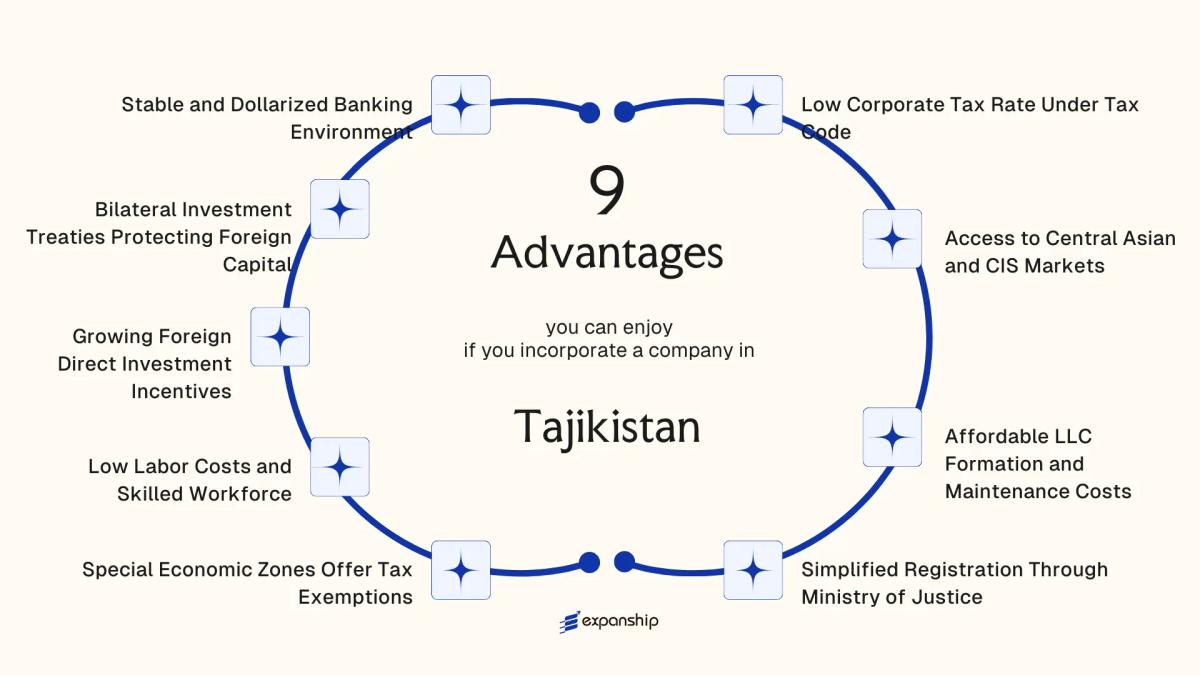
Low Corporate Tax Rate Under Tax Code
Tajikistan corporate tax rate advantages begin with a statutory profit tax rate of 18% on taxable income for most legal entities, as established under the Tax Code of the Republic of Tajikistan. For foreign investors accustomed to higher-tax regimes, this rate represents a structurally lower baseline cost of doing business.
What the Tax Code Sets Out
Under the Tax Code, resident legal entities, including foreign-owned limited liability companies registered in the country, are subject to profit tax on worldwide income, while non-residents are taxed only on Tajikistan-sourced income. This distinction matters practically: a foreign firm establishing a local subsidiary can contain its Tajik tax exposure to operations conducted within the territory.
Reduced Rates for Specific Activities
Certain business categories qualify for reduced profit tax rates under the Tax Code, including small enterprises meeting defined turnover thresholds, which may be taxed under a simplified regime. Your entity's eligibility depends on its annual revenue, activity type, and organizational form, so the applicable rate is not uniform across all structures.
An 18% statutory profit tax rate, with potential reductions under the simplified regime, gives your company a lower recurring tax burden than many comparable emerging-market jurisdictions.
Access to Central Asian and CIS Markets
Tajikistan's geographic position gives your business direct connectivity to a regional bloc of over 280 million people. Bordering China, Afghanistan, Uzbekistan, and Kyrgyzstan, a company registered here sits at a junction where Central Asian trade corridors converge. That positioning is not incidental — it has real consequences for how goods move, how contracts are structured, and which markets you can access without additional legal entities.
As a member of the Commonwealth of Independent States, the country participates in agreements that reduce trade friction across former Soviet republics. CIS market access through a Tajikistan company means your firm can engage with preferential trade arrangements that govern goods, services, and in some cases capital flows across member states. These frameworks are administered under multilateral CIS agreements rather than bilateral deals, giving them broader application.
Why this matters for a foreign-owned entity specifically:
- CIS membership creates a recognized legal standing across multiple markets from a single registration point
- Proximity to the Chinese border supports supply chain arrangements that would otherwise require a separate regional subsidiary
- Existing free trade protocols under CIS reduce customs duties on qualifying goods moving between member states
- The absence of a domestic large consumer market pushes most registered entities toward export-oriented structures from the outset, which aligns naturally with regional trading strategies

Company Incorporation in Tajikistan
Register your business in Tajikistan and access Central Asian and CIS markets through a properly structured legal entity.
Affordable LLC Formation and Maintenance Costs
Tajikistan LLC formation cost advantages stand out when measured against practical entry barriers for foreign founders. Registering an OOO (Общество с ограниченной ответственностью) carries a state registration fee that remains modest by regional standards, and the minimum authorized capital requirement is low enough that it does not function as a meaningful financial barrier to entry. For a foreign investor comparing incorporation costs across post-Soviet markets, this translates directly into lower capital tied up before the business generates any revenue.
| Cost Element | General Position |
|---|---|
| State Registration Fee | Low fixed fee payable to Ministry of Justice |
| Minimum Charter Capital | No prohibitive statutory minimum for most activities |
| Annual State Reporting Fees | Minimal; filed through Tax Committee of Tajikistan |
| Notarization Costs | Required for founding documents; locally priced |
Ongoing compliance costs also remain contained. Annual accounting obligations, tax filings with the Tax Committee of Tajikistan, and statutory reporting do not require extensive local legal infrastructure to manage, which reduces the recurring overhead your business carries year over year.
Affordable Tajikistan OOO incorporation benefits extend beyond the initial outlay. Local professional service fees, including accountants and legal consultants, are priced according to the local market, meaning the cost of maintaining compliance stays proportionate to the operating environment rather than inflated by Western-market fee structures.
Simplified Registration Through Ministry of Justice
Tajikistan Ministry of Justice registration benefits are directly tied to a centralized, single-window system that reduces the administrative burden on foreign founders. Under the Law on State Registration of Legal Entities and Individual Entrepreneurs, new entities are registered through the Ministry of Justice, which acts as the primary authority for incorporation. This consolidation means your business does not need to visit multiple agencies to complete the registration process.
The practical value here is time. Registration is completed within a defined statutory period, avoiding the open-ended timelines common in other Central Asian jurisdictions. For a foreign investor coordinating across time zones and legal representatives, a predictable registration window translates directly into lower setup costs and faster operational entry.
The simplified business registration Tajikistan offers also means that post-incorporation filings, such as amendments to charter documents or changes in ownership, are processed through the same authority. That consistency reduces the coordination overhead for compliance maintenance over time.
Key points to keep in mind:
- Registration is administered by the Ministry of Justice
- The legal basis is the Law on State Registration of Legal Entities and Individual Entrepreneurs
- Charter documents must be submitted in Tajik or Russian
- A registered legal address within the country is required at the time of application
- Foreign founders must have documents notarized and apostilled before submission
The Ministry of Justice also maintains the unified state register of legal entities, meaning incorporation and public record creation happen simultaneously through a single filing.
Special Economic Zones Offer Tax Exemptions
Tajikistan special economic zone tax exemptions represent one of the more structurally significant incentives available to foreign-owned entities operating in the country. Four designated SEZs currently operate under the Law on Special Economic Zones of the Republic of Tajikistan: Sughd, Dangara, Ishkoshim, and Panj. Businesses registered within these zones are generally exempt from corporate income tax, property tax, and VAT on goods produced and sold within or exported from the zone, for periods that can extend up to 25 years depending on the zone and investment terms.
What the Tax Structure Means for Your Operating Costs
For a manufacturing or export-oriented firm, this multi-tax exemption removes a substantial portion of the recurring fiscal burden that typically compounds over the early years of operation. The combined relief across income, property, and consumption taxes means your entity retains a materially higher share of revenue during the exemption period than it would under the standard Tax Code regime.
Customs duties on imported equipment and raw materials used in production are also suspended for SEZ residents. This directly reduces capital expenditure at the setup stage, which is when cost exposure tends to be highest for new foreign entrants.
Eligibility and Administrative Entry
SEZ residency requires registration with the relevant zone administration authority and approval of an investment project meeting minimum investment thresholds, which vary by zone. Once registered, your firm operates under a dedicated legal regime separate from the general Tax Code, providing a degree of regulatory predictability over the investment horizon.
Plan Your SEZ Entry in Tajikistan
Find out which special economic zone fits your investment structure and what exemptions your business can qualify for under Tajikistan's SEZ legal framework.
Low Labor Costs and Skilled Workforce
Tajikistan low labor costs for businesses represent a measurable structural advantage, particularly for foreign firms with headcount-intensive operations. Monthly wages in the country remain among the lowest in the post-Soviet space, and when combined with a workforce that carries technical education credentials from Soviet-era polytechnic institutions, the cost-to-skill ratio becomes relevant for businesses in manufacturing, IT services, and professional outsourcing.
- Minimum wage levels are set under the Labour Code of Tajikistan and have historically remained modest in absolute terms. For a foreign entity registering locally, payroll obligations translate to significantly lower fixed costs compared to regional peers such as Kazakhstan or Russia.
- The working-age population has a relatively high rate of secondary and technical education. Fields including civil engineering, mathematics, and applied sciences have maintained institutional training programs, which gives your business access to qualified candidates without the premium salaries typically required in higher-cost CIS jurisdictions.
- Social insurance contributions paid by employers are governed by national social protection legislation. Your firm's total employment cost per worker, including statutory contributions, remains contained relative to what a comparable operation would incur in Western or Eastern European jurisdictions.
- Hiring through a locally registered entity rather than a foreign employer of record arrangement gives you direct access to this cost structure under Tajik labor law, without intermediary markups.
Growing Foreign Direct Investment Incentives
Tajikistan foreign direct investment incentives have expanded meaningfully since the country adopted the Law on Foreign Investment (2016), which grants foreign investors the same legal protections as domestic entities and prohibits discriminatory treatment in licensing, taxation, and asset ownership.
Under that law, your business is protected against unilateral changes to investment conditions for a defined period after entry, a provision that reduces regulatory uncertainty during the early operating phase. Dispute resolution can be referred to international arbitration, which matters when local enforcement mechanisms are unfamiliar.
The government has also worked to increase FDI inflows through the National Investment Strategy, administered in part through the Agency for Investment and State Property Management under the Government of the Republic. This body serves as a coordination point for foreign firms seeking entry approvals, sector-specific permits, and operational guidance.
- Foreign investors may repatriate profits, dividends, and capital in freely convertible currency under the Law on Foreign Investment.
- Priority sectors, including energy, mining, and agro-processing, attract targeted state support and expedited administrative processing.
A foreign-owned enterprise operating in a priority sector under the 2016 Law on Foreign Investment may benefit from a combination of customs duty exemptions on imported equipment and a temporary profit tax reduction, potentially cutting first-year tax obligations by a material margin compared to the standard 18% corporate rate.
Bilateral Investment Treaties Protecting Foreign Capital
Tajikistan bilateral investment treaty protections give foreign investors a layer of legal security that domestic contract law alone cannot provide. The country has signed BITs with over 30 states, including Germany, China, Iran, Turkey, and several CIS members, each establishing baseline standards for the treatment of foreign-owned capital.
Under these agreements, your business typically benefits from:
- Fair and equitable treatment obligations on the host state
- Protection against expropriation without prompt and adequate compensation
- Access to international arbitration (commonly ICSID or UNCITRAL) in the event of a dispute with state authorities
- Most-favored-nation and national treatment provisions that prevent discriminatory regulatory treatment
The arbitration access clause is particularly significant. Rather than relying solely on Tajik courts to resolve investment disputes, eligible foreign investors can escalate claims to neutral international tribunals, reducing jurisdictional risk on high-value transactions.
Treaty coverage also varies by nationality of the investing entity. The protections available to a German shareholder, for instance, may differ from those available under the China-Tajikistan BIT, so the corporate structure you choose determines which treaty applies to your investment.
BIT protections are tied to the nationality of the investor or the incorporating entity, not the business activity, so verify that your home jurisdiction has an active treaty in force before assuming coverage applies.
Stable and Dollarized Banking Environment
Tajikistan banking environment benefits for businesses are rooted in a structural feature that most Central Asian jurisdictions do not offer at the same level: widespread acceptance of foreign currency, particularly the US dollar, within the formal banking system. The National Bank of Tajikistan, which regulates all licensed commercial banks, permits companies to hold and operate multi-currency accounts, including USD and EUR-denominated accounts, alongside the national currency, the Tajik Somoni (TJS).
For a foreign business owner, this matters because it reduces exposure to local currency volatility. Your firm can receive payments, hold reserves, and pay international suppliers in USD without mandatory conversion into Somoni, which preserves the real value of capital held in-country.
Foreign currency accounts are available to registered legal entities, including limited liability companies, under the foreign exchange regulations governed by the Law of the Republic of Tajikistan on Currency Regulation and Currency Control. This legal framework gives your entity a defined basis for holding foreign currency rather than relying on informal arrangements.
Practical access points for corporate banking include:
- Multi-currency current accounts through licensed banks such as Amonatbonk and Orienbank
- International wire transfer capabilities for cross-border settlements
- USD-denominated trade finance instruments for import and export transactions
Because a significant share of domestic commercial transactions in the country are conducted in USD, foreign-owned entities can engage local contractors and vendors with reduced friction around currency conversion, lowering transactional overhead on day-to-day operations.
Why Tajikistan Stands Out Among Central Asian Jurisdictions
Tajikistan's advantages over Central Asian jurisdictions become clearer when measured against the countries a foreign investor would most plausibly evaluate alongside it: Uzbekistan, Kyrgyzstan, and Kazakhstan. These three share geographic proximity, overlapping CIS treaty networks, and broadly similar incorporation structures targeting small-to-medium foreign-owned entities. The comparison is not about ranking but about isolating where structural differences produce material consequences for an investor's cost base, legal protections, or operational flexibility.
What the table below reflects is that why choose Tajikistan over other Central Asian countries often comes down to cost architecture and treaty density rather than headline tax rates alone. Corporate tax parity with Kyrgyzstan and a lower standard rate than Kazakhstan's 20% are meaningful, but the combination of low statutory labor costs, a network of bilateral investment treaties, and functional Special Economic Zones creates a cost and compliance profile that distinguishes this jurisdiction from regional peers at comparable stages of economic development.
| Parameter | Tajikistan | Uzbekistan | Kyrgyzstan | Kazakhstan |
|---|---|---|---|---|
| Standard Corporate Tax Rate | 18% | 15% | 10% | 20% |
| Special Economic Zones | Yes (multiple, with tax exemptions) | Yes | Limited | Yes |
| Bilateral Investment Treaties | 30+ | 50+ | 40+ | 50+ |
| Minimum Share Capital (LLC) | No statutory minimum | No statutory minimum | No statutory minimum | No statutory minimum |
| Primary Registration Body | Ministry of Justice | Ministry of Justice | Ministry of Justice | Ministry of Justice |
| IMF/World Bank Membership | Yes | Yes | Yes | Yes |
Compliance Services for Companies in Tajikistan
Maintain your Tajikistan entity in good standing with ongoing compliance support, including annual filings, statutory reporting, and regulatory monitoring.
Conclusion
Tajikistan's case for foreign incorporation rests on a combination of structural tax advantages, low operational costs, and treaty-backed investment protections that are codified in enforceable domestic and international frameworks. The 13% corporate income tax rate under the Tax Code of the Republic of Tajikistan, combined with the expanded tax exemption regimes available within designated Special Economic Zones, gives foreign-owned entities a measurable cost advantage from the point of registration.
Not every business will extract equal value from these conditions. A firm with significant payroll requirements benefits disproportionately from the low labor cost environment, while an export-oriented entity may place greater weight on preferential access to CIS markets under existing trade agreements. The bilateral investment treaties in force provide a legal baseline that makes the jurisdiction viable for capital-intensive operations, regardless of the specific sector.
For businesses whose structure and objectives align with what this jurisdiction offers, the decision to incorporate here is supported by documented regulatory frameworks, not assumptions. Knowing which legal instruments apply to your specific entity type, and how Ministry of Justice registration procedures interact with sector-specific licensing requirements, determines how efficiently these advantages translate into operational reality.
Start Your Tajikistan Company with Expanship Today
Expanship supports foreign investors through the full cycle of company formation in Tajikistan, from preparing incorporation documents to liaising with the Ministry of Justice under the Law on State Registration of Legal Entities. The benefits covered in this blog, including the 13% corporate income tax rate, SEZ exemptions, and protections under bilateral investment treaties, are directly relevant to how your entity is structured and maintained from day one.
Expanship Tajikistan company formation services cover each stage of the process:
- Document preparation, notarization, and legalization for the Ministry of Justice filing
- Registered agent and registered office provision throughout the company's operational life
- Government filing and direct liaison with state registration authorities
- Post-incorporation compliance management, including annual reporting obligations under the Tax Code
- Banking introduction assistance to support account opening with licensed commercial banks
To start your Tajikistan company with Expanship, contact Expanship Tajikistan to discuss your incorporation requirements.
Frequently Asked Questions (FAQ)
The standard corporate income tax rate under the Tax Code of Tajikistan is 18% for most legal entities. Businesses operating within designated Special Economic Zones may qualify for reduced rates or full exemptions, depending on the specific SEZ regime and the nature of the registered activity. Rates applicable to small businesses and simplified tax regime participants differ from the standard rate.
Registration of a limited liability company through Tajikistan's Ministry of Justice generally takes between one and five business days under the current one-stop-shop registration procedure. The timeline assumes all required documents are properly notarized and translated where applicable. Delays can occur if corporate documents from a foreign jurisdiction require additional legalization.
Bilateral investment treaties (BITs) signed by Tajikistan generally protect investments made by nationals of the contracting states, including investments channeled through a locally incorporated entity. Protection typically covers expropriation without compensation and guarantees access to international arbitration. The scope of coverage depends on the specific treaty text with the investor's home country.
Businesses registered and operating within one of Tajikistan's Special Economic Zones may receive exemptions from corporate income tax, VAT, and customs duties for a defined period, subject to the governing regulations of the specific SEZ. The exemptions are conditional on the company conducting qualifying activities within the zone's geographic boundaries. Operations conducted outside the SEZ perimeter are generally subject to the standard Tax Code provisions.
The Tajikistani somoni is not fully freely convertible on international markets, which can create constraints on repatriating profits or converting large sums of foreign currency. In practice, many commercial transactions and banking arrangements involving foreign businesses are conducted in US dollars or euros, which provides a degree of operational stability. Foreign investors should review current National Bank of Tajikistan regulations on currency operations before structuring cross-border payments.
Without a bilateral investment treaty between Tajikistan and the investor's home country, the foreign-owned entity still operates under domestic protections established by the Law on Foreign Investment, which includes general guarantees against unlawful expropriation. However, the investor would not have automatic access to international arbitration under a BIT framework and would need to rely on domestic courts or any dispute resolution clauses in applicable contracts. Structuring the investment through a holding entity in a jurisdiction that does hold a BIT with Tajikistan is one approach some investors use to address this gap.
Legal Disclaimer
The information provided in this article is for general informational purposes only and does not constitute legal, tax, or professional advice. While we strive to ensure the accuracy and timeliness of the content, laws and regulations are subject to change, and the application of laws can vary widely based on specific facts and circumstances.
Readers should not act upon this information without seeking professional counsel tailored to their individual situation. Expanship and its authors disclaim any liability for actions taken or not taken based on the content of this article.
For specific advice regarding your business setup, compliance requirements, or any legal matters, please consult with qualified legal and tax professionals in the relevant jurisdiction.