
Key Takeaways
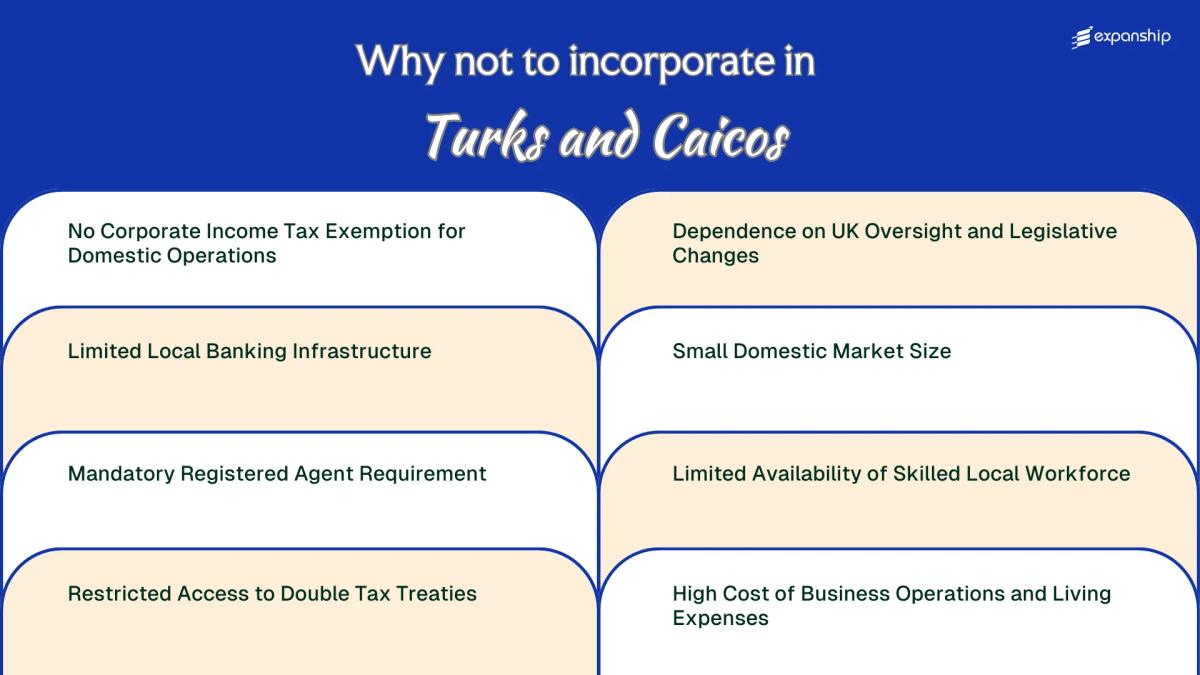
- Companies incorporated for domestic operations in Turks and Caicos do not benefit from a blanket corporate income tax exemption, meaning locally active businesses face a direct tax burden that purely offshore structures avoid.
- Under the Companies Ordinance administered through tcilaws.com, all registered entities must maintain a licensed registered agent in the territory, creating an ongoing compliance cost that cannot be eliminated regardless of company activity level.
- Turks and Caicos has not entered into a meaningful network of double tax treaties, leaving businesses without the treaty protections available in comparable jurisdictions and exposing cross-border transactions to potential double taxation.
- As a British Overseas Territory, TCI's legislative and regulatory framework remains subject to changes imposed by UK oversight, introducing a layer of legal uncertainty that falls outside the control of locally incorporated businesses or their directors.
Turks and Caicos operates under a relatively stable but externally dependent regulatory framework, governed in large part by its status as a British Overseas Territory. The Companies Ordinance sets out the foundational rules for company formation and ongoing compliance, and the territory's financial services sector falls under the supervision of the Financial Services Commission.
The disadvantages of incorporating in Turks and Caicos span operational, financial, and structural categories — each examined separately in this article.
Not every drawback will apply equally to your business. The relevance of each disadvantage shifts depending on whether you are forming a domestic trading company, an international business entity, or a holding structure.
This article is most relevant to foreign investors and internationally mobile entrepreneurs who are evaluating TCI as a jurisdiction for active business operations rather than passive asset holding.
No Corporate Income Tax Exemption for Domestic Operations
Turks and Caicos domestic tax limitations create a structural problem that many business owners overlook until after incorporation. The tax-free status that attracts foreign investors applies specifically to offshore structures, not to companies conducting substantive operations within the islands.
Where the Exemption Ends
Under the Companies Ordinance and the general fiscal framework of TCI, exempted companies benefit from zero corporate income tax on foreign-sourced income. Once a business generates income from local customers, employs staff on-island, or delivers services domestically, that activity falls outside the scope of offshore exemption protections, exposing the entity to potential local tax and levy obligations.
The Cost to Domestically Active Foreign Firms
For a foreign firm that needs a physical presence to serve local clients, the assumption of full tax exemption is incorrect and can distort financial projections significantly. TCI corporate tax exemption restrictions are tied to the source of income, not simply to the legal structure of the entity.
Foreign businesses that conduct any revenue-generating activity within TCI's domestic market should not assume blanket tax exemption applies, as income sourced locally is not protected under the offshore exemption framework.
Limited Local Banking Infrastructure
Turks and Caicos banking infrastructure challenges affect foreign-owned companies from the moment of incorporation. Only a small number of licensed commercial banks operate within the territory, and most maintain conservative onboarding policies that treat offshore-structured entities with heightened scrutiny.
Opening a business bank account for a TCI-registered company is not straightforward. Banks operating under the Financial Services Commission's oversight apply strict due diligence requirements, and foreign directors or beneficial owners frequently face extended processing times or outright rejection.
This creates direct operational friction:
- Your company may remain unable to receive client payments or settle supplier invoices for weeks or months after incorporation.
- Correspondent banking relationships between TCI banks and major international financial institutions are limited, increasing the risk of payment delays on cross-border transactions.
- Foreign business owners without a physical presence on the islands often cannot satisfy in-person verification requirements, forcing reliance on third-party intermediaries at additional cost.
- Offshore banking problems compound when your business operates in sectors flagged as higher-risk, since local banks may decline onboarding entirely without detailed justification.
Businesses that require multi-currency accounts or integration with international payment processors will find that local banking options do not support those needs without supplementary arrangements made elsewhere.

Company Incorporation in Turks and Caicos
Understand the full scope of incorporating a company in Turks and Caicos, including regulatory requirements, entity types, and compliance obligations.
Mandatory Registered Agent Requirement
The Turks and Caicos registered agent requirement is not optional. Under the Companies Ordinance, every company incorporated in TCI must appoint and continuously maintain a licensed registered agent. That agent must be physically based in the territory and hold a license issued under the Financial Services Commission Act.
| Requirement | Detail | Burden for Foreign Owner |
|---|---|---|
| Agent licensing authority | TCI Financial Services Commission | No self-appointment; third-party dependency is mandatory |
| Physical presence of agent | Must be locally based in TCI | Remote or foreign agents are not permitted |
| Continuity obligation | Agent must be maintained at all times | Lapse triggers non-compliance, even if business is dormant |
| Typical annual agent fee | USD 500 to USD 1,500+ depending on service scope | Recurring cost that cannot be eliminated through structure |
Because you cannot self-appoint or use a foreign-based representative, your business is structurally dependent on a local intermediary for official correspondence and regulatory filings. This dependency means any breakdown in the relationship with your agent, whether due to fee disputes or service withdrawal, can put your company in immediate non-compliance.
TCI registered agent costs and restrictions compound when the entity is dormant or holding only passive assets. You continue paying mandatory annual fees regardless of commercial activity, with no reduced-rate exemption for inactive companies under current regulations.
Restricted Access to Double Tax Treaties
Turks and Caicos double tax treaty limitations represent one of the more consequential structural gaps for foreign businesses operating through this jurisdiction. The territory has not entered into any standalone double taxation agreements (DTAs) with other countries.
As a British Overseas Territory, TCI falls under the UK's tax treaty network in limited respects, but that coverage does not automatically extend to corporate structures incorporated locally. Your company cannot claim treaty benefits simply by virtue of TCI's constitutional relationship with the UK.
This absence creates direct exposure. Dividends, royalties, or interest payments flowing out of or into TCI may be subject to full withholding tax rates in the counterparty country, with no treaty mechanism available to reduce or eliminate that liability.
For businesses with operations or shareholders in jurisdictions that impose withholding taxes, this gap translates into measurable additional cost on every cross-border payment.
Key obligations and restrictions this disadvantage imposes:
- No bilateral DTAs exist that a TCI-incorporated entity can invoke directly
- Withholding tax on cross-border payments must be assessed under domestic law in each counterparty jurisdiction
- UK treaty relief, where theoretically referenced, is subject to specific eligibility conditions that TCI entities often cannot satisfy
- Tax structuring must account for full statutory withholding rates across all target markets
- Treaty shopping through TCI is generally ineffective and may trigger anti-avoidance rules elsewhere
You can review the UK treaty list to confirm which agreements extend to British Overseas Territories and under what conditions.
Did You Know? Despite having no corporate income tax, TCI-incorporated entities can end up paying more in aggregate tax than companies in jurisdictions with moderate tax rates, purely due to unrelieved foreign withholding taxes on cross-border transactions.
Dependence on UK Oversight and Legislative Changes
Turks and Caicos UK oversight risks are a structural feature of the territory's legal framework, not an occasional external pressure. As a British Overseas Territory, the TCI operates under a constitution that reserves significant powers for the UK government, including the authority to suspend elected governance entirely.
The Scope of UK Constitutional Authority Over TCI
The UK's power over TCI legislative risks was demonstrated concretely in 2009, when the UK government suspended the islands' constitution and reimposed direct rule from London following findings of systemic corruption. Under the TCI Constitution Order 2011, the UK Privy Council retains the right to override or amend local legislation, meaning any law governing your company's structure or obligations can change without input from local representatives.
Practical Exposure for Foreign Business Owners
British Overseas Territory legislative risks translate directly into structural unpredictability for registered entities. A shift in UK policy — whether related to beneficial ownership registers, financial services standards, or offshore compliance frameworks — can be imposed on TCI companies without the usual legislative process that a sovereign jurisdiction would require.
Navigating Regulatory and Oversight Risks in Turks and Caicos
Understand how UK constitutional authority affects your TCI entity and what structural considerations matter before you incorporate.
Small Domestic Market Size
Turks and Caicos small market size limitations make the jurisdiction structurally unsuitable for businesses that depend on local consumer demand to generate revenue. The resident population sits at approximately 45,000 people, confining the addressable domestic market to a scale that cannot sustain most commercial operations.
- The small resident population creates a revenue ceiling that forces most registered entities to depend almost entirely on foreign-sourced income, eliminating the domestic growth trajectory that justifies incorporation costs in larger jurisdictions.
- Seasonal tourism patterns mean that consumer activity contracts sharply outside peak periods, exposing businesses tied to local spending to irregular and unpredictable cash flow cycles.
- TCI domestic market growth challenges are compounded by limited inter-island connectivity across the archipelago, raising distribution costs for any firm attempting to serve customers beyond Providenciales.
- A limited consumer base means that pricing power is constrained, as the pool of competing buyers is too small to absorb premium positioning across most non-luxury sectors.
Limited Availability of Skilled Local Workforce
Turks and Caicos skilled workforce limitations present a structural hiring problem that directly affects your ability to staff a business locally. The islands have a small resident population, and the domestic labor pool for roles requiring technical, financial, legal, or managerial expertise is thin.
When qualified local candidates are unavailable, your firm must recruit internationally. That triggers the work permit process under the Immigration Ordinance, administered by the Turks and Caicos Islands Immigration Board, which adds cost, processing time, and administrative overhead before a single hire can begin.
Work permits are issued per employee, per role, and are subject to renewal. Dependency on permit cycles introduces operational risk, since a delayed renewal can leave a position vacant during a critical period.
- Permit applications require proof that no qualified Belonger was available for the role
- Each permit carries government fees that compound across a larger workforce
- Permit holders are tied to a specific employer, limiting workforce flexibility
A foreign-owned financial services firm hiring five specialist staff from abroad could face work permit fees, legal costs, and recruitment expenses exceeding $30,000 USD before those employees are operational, based on standard government fee schedules and typical regional recruitment costs.
High Cost of Business Operations and Living Expenses
The high cost of business operations in Turks and Caicos stems from a structural dependence on imports. The islands produce virtually no goods locally, so nearly all materials, equipment, and consumer goods are shipped in, with import duties adding directly to operating overheads.
Office space, particularly in Providenciales, commands rental rates comparable to mid-tier urban centers in North America. For a foreign firm establishing a physical presence, this translates into overhead costs that are disproportionate to the size of the local market.
Utilities present a separate cost burden. Electricity in TCI is supplied primarily by FortisTCI and is among the more expensive in the Caribbean region, reflecting the cost of diesel-powered generation across the islands.
Staff costs compound the problem further. Expatriate salaries must account for the elevated cost of living, including housing and imported goods, pushing total compensation packages well above what equivalent roles would cost in most offshore financial centers.
- Diesel-dependent power infrastructure drives electricity costs above regional averages
- Import duties on equipment and supplies increase setup and recurring operational costs
- Housing costs for expatriate staff are a significant component of total employment expense
If your business model depends on cost-efficient physical operations, the combination of FortisTCI electricity rates and import duty obligations can materially erode margins before your entity reaches operational scale.
Strategies to Overcome These Challenges
Overcoming Turks and Caicos incorporation challenges requires structural preparation rather than reactive adjustments. The jurisdiction's regulatory framework, governed by the Financial Services Commission, sets firm boundaries that foreign businesses must account for before entity formation.
- Register your company under the Companies Ordinance and appoint a licensed registered agent from the FSC-approved list to satisfy mandatory compliance requirements.
- Open corporate banking relationships through correspondent banking arrangements with international banks that maintain ties to TCI-based institutions, given the limited local banking infrastructure.
- Structure your entity as an international business company if domestic tax exposure is a concern for operations conducted outside TCI.
- Identify workforce requirements early and apply through the work permit system administered by the Department of Border Control and Labour to address skilled labour shortages.
- Monitor UK legislative updates that may affect Orders in Council applicable to TCI, given the jurisdiction's constitutional relationship with the Crown.
These steps address structural and compliance gaps that arise directly from TCI's regulatory and economic profile. No single measure resolves all constraints, and each requires alignment with the Financial Services Commission's current licensing and registration requirements.
Turks and Caicos Still Worth Considering
The drawbacks outlined across this blog are real and, for some business profiles, disqualifying. That said, the question of whether Turks and Caicos is worth incorporating in despite those drawbacks depends almost entirely on what your business actually needs from a jurisdiction. For companies structured around international holding, asset protection, or offshore activity, the TCI framework under the Companies Ordinance still offers a legally grounded, politically stable environment backed by UK constitutional oversight.
| Pros | Cons |
|---|---|
| No corporate income tax, capital gains tax, or withholding tax on qualifying offshore entities | Domestic operations do not benefit from the same tax exemptions |
| Political and legal stability through British Overseas Territory status | UK Parliament retains authority to impose legislative changes without local consent |
| Established company registry with recognized legal structures | Mandatory registered agent requirement adds a recurring operational cost |
| USD as the official currency removes foreign exchange risk | Limited local banking infrastructure restricts day-to-day financial operations |
| Absence of exchange controls facilitates cross-border capital movement | No access to double tax treaty network increases withholding tax exposure |
| Straightforward incorporation process under the Companies Ordinance | Small domestic market and limited skilled workforce constrain local business activity |
Operating costs remain elevated relative to many competing offshore jurisdictions.
Compliance Services for Companies in Turks and Caicos
Stay current with TCI regulatory obligations, from annual returns and registered agent requirements to ongoing corporate maintenance under the Companies Ordinance.
Conclusion
Turks and Caicos presents a structurally sound environment for international business formation, yet the Turks and Caicos incorporation drawbacks summary outlined across this blog reflects real operational constraints. Limited access to double tax treaties reduces the entity's utility for certain cross-border structures. Dependence on UK oversight introduces legislative uncertainty that falls outside your control. High operating costs compound the challenge for firms without sufficient transaction volume to justify the setup. Structural planning and informed professional support remain the most effective means of managing these constraints before committing to registration.
Expanship's Support for Your Turks and Caicos Expansion
Expanship Turks and Caicos company formation support is structured around the specific compliance obligations that make TCI incorporation more demanding than it first appears. From satisfying the Financial Services Commission's licensing conditions to maintaining a continuously appointed registered agent under the Companies Ordinance, the operational requirements add up quickly. Expanship helps your business manage that ongoing burden without overstating what outside support can change about the jurisdiction itself.
Our service scope covers the full incorporation and post-formation cycle across TCI.
- Your company registration and document preparation are handled from the outset, reducing back-and-forth with local authorities.
- We provide registered agent and local office provision to satisfy the mandatory requirements under TCI law.
- Government filings and FSC liaison are managed on your behalf throughout the corporate lifecycle.
- Post-incorporation compliance management keeps your entity in good standing as obligations evolve.
- Banking introduction assistance connects your business to institutions familiar with TCI-incorporated entities.
- Tax registration and local authority liaison are coordinated to align with your operational structure.
Reach out through Expanship Turks and Caicos to discuss your incorporation requirements.
Frequently Asked Questions (FAQ)
The requirement applies broadly across TCI company structures, including International Business Companies formed under the Companies Ordinance. Every incorporated entity must maintain a registered agent and a registered office address within the jurisdiction at all times. Failure to maintain this requirement puts the company at risk of administrative strike-off by the Companies Registry.
Operating costs in TCI are materially higher than in competing offshore centres such as the British Virgin Islands or Seychelles, driven by the elevated cost of professional services, government fees, and general living and logistics expenses on the islands. Annual government renewal fees, registered agent retainers, and compliance costs combine to make TCI one of the more expensive smaller offshore jurisdictions to maintain. Businesses should budget for these recurring costs before committing to the structure.
Without a valid registered agent on record, the Companies Registry can move to strike the entity off the register, effectively dissolving it administratively. Reinstatement is possible but involves additional fees, paperwork, and potential gaps in the company's legal standing that can create complications for banking relationships or counterparty contracts. The registered agent is also the designated point of contact for regulatory and legal correspondence, so any lapse creates a direct compliance exposure.
Yes, the risk profile is structurally different. As a British Overseas Territory, the Turks and Caicos Islands operates under UK constitutional oversight, and Westminster retains the power to legislate for the territory or direct changes to its domestic framework. This was demonstrated in 2009 when direct UK rule was imposed, suspending the local government entirely. A fully sovereign jurisdiction such as Seychelles or Mauritius carries no equivalent risk of external constitutional intervention.
Local banking infrastructure in the Turks and Caicos is limited, with few institutions actively onboarding corporate clients, particularly non-resident IBCs with international transaction profiles. Most businesses incorporating in TCI end up operating accounts with banks in other jurisdictions, which introduces additional compliance requirements including demonstrating the TCI entity's beneficial ownership structure to foreign banking institutions. This is not a theoretical inconvenience; it is a routine operational challenge that adds both cost and timeline to getting a new entity fully functional.
A company that fails to pay its annual fees or meet filing obligations loses its good standing status, which can result in administrative dissolution by the Companies Registry under the Companies Ordinance. Once dissolved, the entity cannot legally enter into contracts, hold assets, or conduct business, and any transactions entered into during that period may be legally unenforceable. Restoration requires a formal application, payment of outstanding fees and penalties, and in some cases re-submission of constitutional documents.
Legal Disclaimer
The information provided in this article is for general informational purposes only and does not constitute legal, tax, or professional advice. While we strive to ensure the accuracy and timeliness of the content, laws and regulations are subject to change, and the application of laws can vary widely based on specific facts and circumstances.
Readers should not act upon this information without seeking professional counsel tailored to their individual situation. Expanship and its authors disclaim any liability for actions taken or not taken based on the content of this article.
For specific advice regarding your business setup, compliance requirements, or any legal matters, please consult with qualified legal and tax professionals in the relevant jurisdiction.