
Key Takeaways
- The Exempt Company is the most commonly registered entity in Turks and Caicos, preferred by non-resident investors for its tax-neutral status under the Companies Ordinance.
- Business structures in Turks and Caicos are governed by distinct ordinances, principally the Companies Ordinance and the Limited Liability Companies Ordinance, with oversight from the Financial Services Commission.
- Turks and Caicos applies no corporate income tax, capital gains tax, or withholding tax on profits across its recognised entity types.
- Exempted Limited Partnerships are specifically structured for fund vehicles, while LLCs formed under the Limited Liability Companies Ordinance offer contractual flexibility in profit and management allocation.
Introduction to Entity Types in Turks and Caicos
Located in the northwestern Caribbean, the Turks and Caicos Islands sit southeast of the Bahamas and north of Haiti and the Dominican Republic. As a British Overseas Territory, the Islands operate under a legal framework derived from English common law, with company registration governed by the Financial Services Commission and administered through the General Registry.
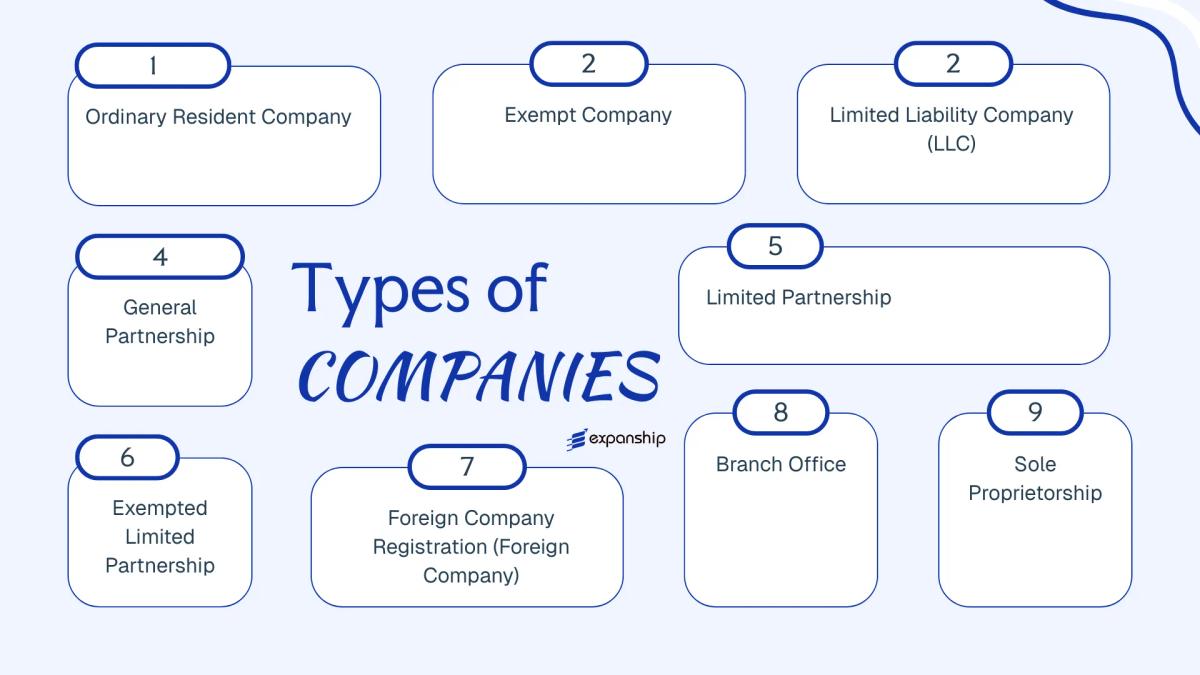
Several business entity types Turks and Caicos law recognizes are available to both residents and foreign investors. These include the Ordinary Resident Company, Exempt Company, Limited Liability Company, General Partnership, Limited Partnership, Exempted Limited Partnership, registered Foreign Company, Branch Office, and Sole Proprietorship. Each structure is created and regulated under distinct ordinances — principally the Companies Ordinance and the Limited Liability Companies Ordinance.
The Islands apply no corporate income tax, no capital gains tax, and no withholding tax on profits. This zero-tax posture applies broadly across entity types, though the specific implications vary by structure and activity. Each entity type covered in this article is examined against that backdrop, with attention to formation requirements, liability treatment, and practical use cases.
An Overview of Business Structures in Turks and Caicos
Several distinct entity types are available under the corporate law framework of the Turks and Caicos Islands, governed primarily by the Companies Ordinance, the Limited Liability Companies Ordinance, and the Exempted Limited Partnership Ordinance. The Financial Services Commission (FSC) serves as the principal regulatory authority overseeing registration and ongoing compliance for most structures. Each entity type carries different rules on liability, tax treatment, and permitted activities.
Business Structures at a Glance
| Entity Type | Legal Form | Liability | Tax Status | Local Trading | Minimum Members | Regulatory Authority | Governing Act |
|---|---|---|---|---|---|---|---|
| Ordinary Resident Company | Corporate | Limited | Taxable | Permitted | 1 shareholder | FSC / Registry | Companies Ordinance |
| Exempt Company | Corporate | Limited | Exempt | Restricted | 1 shareholder | FSC / Registry | Companies Ordinance |
| LLC | Hybrid | Limited | Exempt | Permitted | 1 member | FSC / Registry | LLC Ordinance |
| General Partnership | Partnership | Unlimited | Taxable | Permitted | 2 partners | Registry | Partnership Ordinance |
| Limited Partnership | Partnership | Mixed | Taxable | Permitted | 1 GP + 1 LP | Registry | Partnership Ordinance |
| Exempted Limited Partnership | Partnership | Mixed | Exempt | Restricted | 1 GP + 1 LP | FSC / Registry | ELP Ordinance |
| Foreign Company (Branch) | Branch | Unlimited | Taxable | Permitted | N/A | FSC / Registry | Companies Ordinance |
| Sole Proprietorship | Sole trader | Unlimited | Taxable | Permitted | 1 person | Registry | Business Licensing Ordinance |
Each of these structures is examined in full in the sections below.
Ordinary Resident Company under the Companies Ordinance
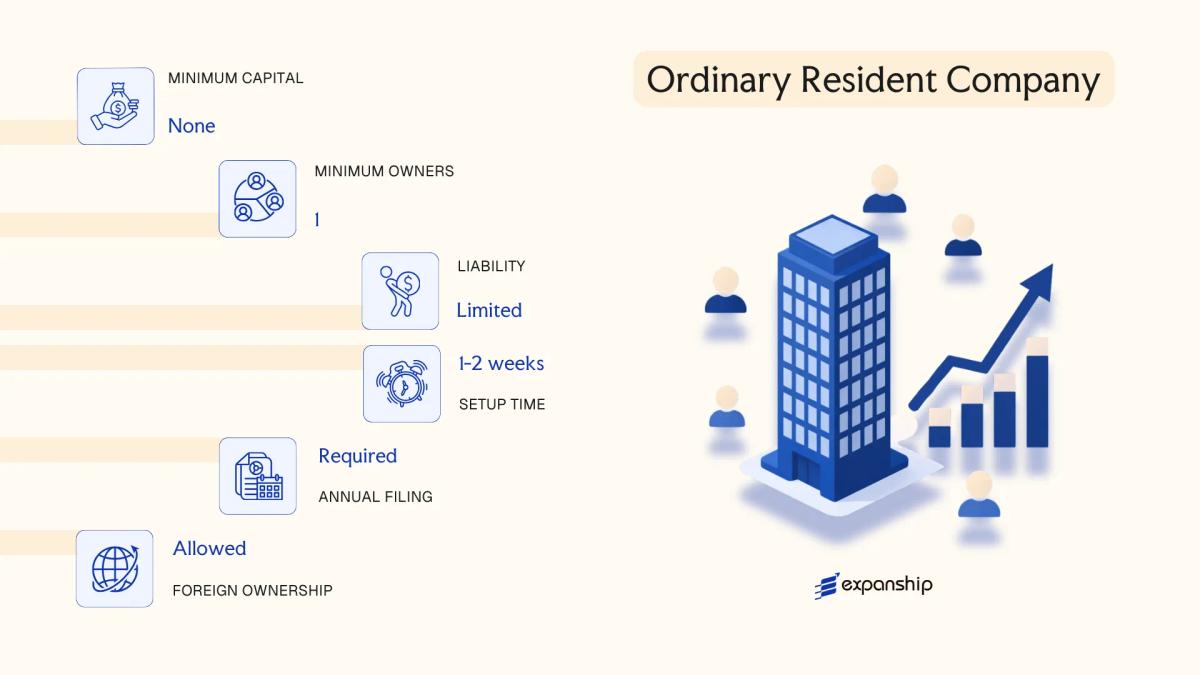
An ordinary resident company in Turks and Caicos is incorporated under the Companies Ordinance (Chapter 40), the primary legislation governing domestic company formation in the territory. This structure carries separate legal personality, meaning the entity exists independently of its shareholders, and liability is limited to each member's subscribed capital.
Resident companies are permitted to conduct business both locally and internationally, making this a genuinely hybrid structure rather than one restricted to either domestic or offshore activity.
Key Characteristics
| Requirement | Detail | Notes |
|---|---|---|
| Legal Form | Private or Public Company Limited by Shares | Separate legal personality; liability limited to unpaid share capital |
| Governed By | Companies Ordinance, Chapter 40 | Administered through the Financial Services Commission (FSC) |
| Directors | Minimum 1 director; no maximum | No residency requirement for directors |
| Shareholders | Minimum 1; no statutory maximum | Corporate shareholders permitted |
| Registered Agent & Office | Mandatory registered office in TCI | Must be maintained at all times |
| Share Capital | No minimum capital requirement; denominated in any currency | Shares may be issued at par or no-par value |
| Privacy | Shareholder and director details on public record | Beneficial ownership held in a central register |
Focus Points
- Taxation: The TCI imposes no corporate income tax, no capital gains tax, no withholding tax, and no VAT, though government fees and import duties may apply.
- Economic Substance: Resident companies conducting relevant activities are subject to economic substance requirements under the Economic Substance Ordinance.
- Annual Compliance: Annual returns must be filed with the FSC; failure to file can result in striking off.
- Restrictions: Resident companies intending to operate locally must hold a valid business licence under the Business Licensing Ordinance.
- Conversion: A resident company may apply to re-register as an exempt company, subject to meeting the eligibility criteria under the Companies Ordinance.
Suitable Uses and Limitations
A resident company suits businesses trading locally, holding assets within the territory, or requiring a structure that can operate in both domestic and international markets. The primary limitation is that public disclosure of directors and shareholders reduces confidentiality compared to exempt company structures.
This structure is best suited for businesses with active commercial operations in TCI or those requiring a locally recognised entity to obtain licences or enter contracts with government bodies.

Company Incorporation in Turks and Caicos
Incorporate a resident or exempt company in Turks and Caicos with full compliance support from Expanship.
Exempt Company under the Companies Ordinance
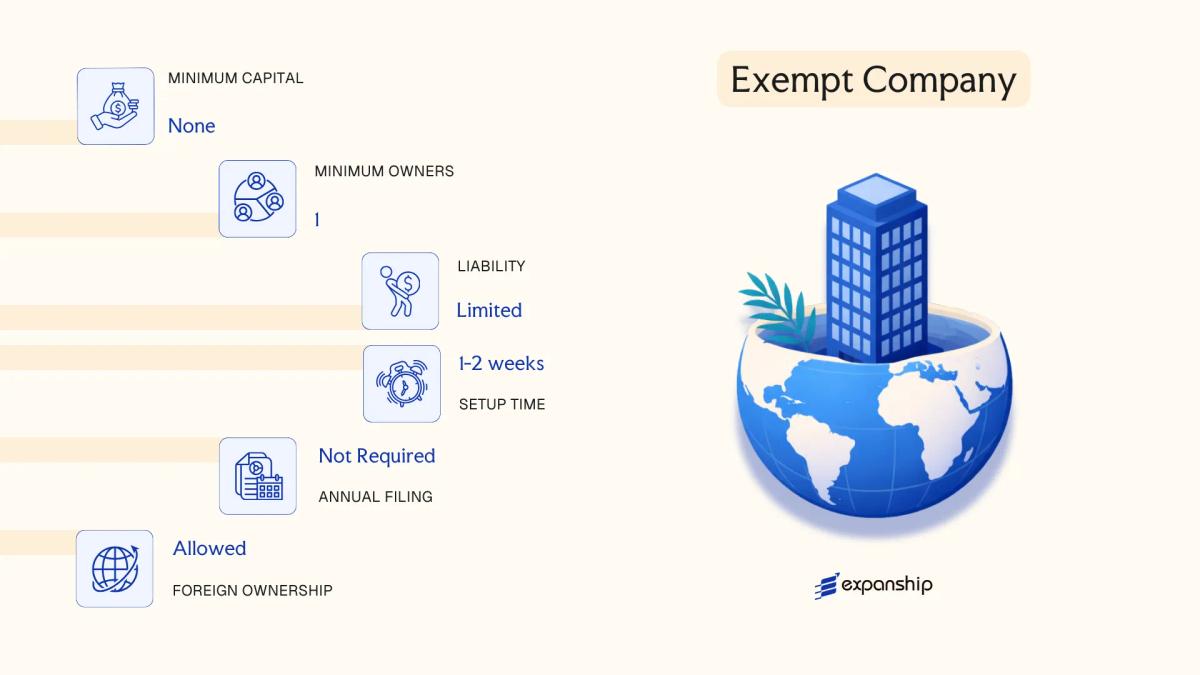
An exempt company Turks and Caicos Islands is incorporated under the Companies Ordinance and structured primarily for international business rather than domestic trade. It carries separate legal personality, meaning the entity holds rights and obligations distinct from its shareholders, and members benefit from limited liability confined to their share capital.
Designed for cross-border use, a TCI exempt company under the Companies Ordinance is prohibited from conducting business with Turks and Caicos residents or owning local real property, except for maintaining a registered office. This restriction is central to its classification as an offshore vehicle.
Key Characteristics
| Requirement | Detail | Notes |
|---|---|---|
| Legal Form | Private company limited by shares | Separate legal personality; shareholder liability limited to share capital |
| Members | Shareholders (min. 1, no maximum) | Corporate shareholders permitted; bearer shares are prohibited |
| Directors | Min. 1 director; no residency requirement | Corporate directors generally permitted |
| Local Presence | Registered Agent and Registered Office required | Must be maintained at all times; provided by a licensed agent in TCI |
| Share Capital | No minimum capital; denominated in any currency | No par value shares permitted |
| Privacy | Beneficial ownership held on a central register | Register not publicly accessible; directors and shareholders not on public record |
Focus Points
- Taxation: No corporate income tax, capital gains tax, withholding tax, VAT, or stamp duty on share transfers for exempt companies.
- Economic Substance: Exempt companies conducting relevant activities as defined under TCI's economic substance regime must satisfy substance requirements or face penalties.
- Annual Compliance: Annual renewal fee payable to the Financial Services Commission; no requirement to file audited financial statements publicly.
- Treaty Access: Turks and Caicos Islands has no double taxation treaty network, limiting relief on cross-border income flows.
- Restrictions: Prohibited from carrying on business with TCI residents, owning local immovable property, or conducting banking, insurance, or trust business without separate licensing.
Closing
Turks and Caicos offshore exempt companies are most commonly used as holding vehicles, special purpose entities, or structures for international asset management where privacy and zero direct taxation are operational priorities. The absence of a public register of members is a structural advantage, though the lack of tax treaty access limits its utility for income-generating structures sensitive to withholding taxes at the source jurisdiction level.
This entity suits non-resident investors and international operators who require a tax-neutral holding or SPV structure with strong privacy protections and no intention of trading locally.
Limited Liability Company (LLC) under the Limited Liability Companies Ordinance
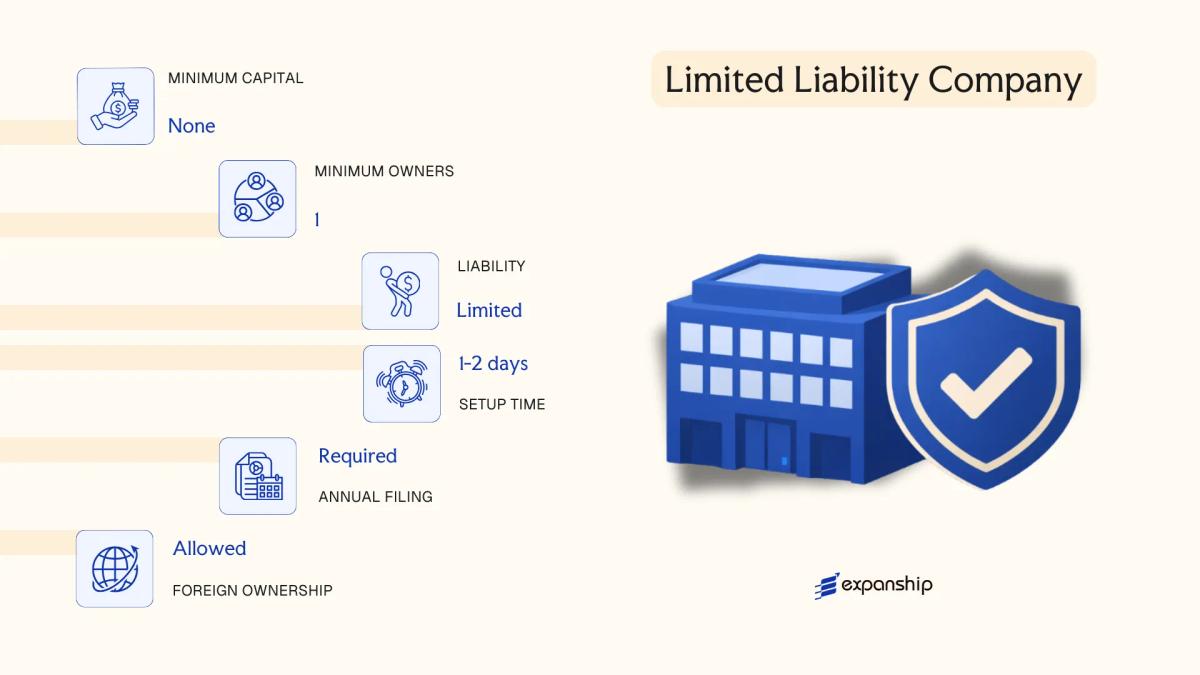
Turks and Caicos LLC formation is governed by the Limited Liability Companies Ordinance, 2017. The LLC is a hybrid entity that combines the limited liability protection of a company with the contractual flexibility of a partnership, and it carries separate legal personality distinct from its members.
Unlike a standard company, the LLC's internal governance is defined primarily through a members' agreement rather than articles of association. This structure makes it particularly suited to joint ventures and fund vehicles where bespoke profit-sharing and management arrangements are required.
Key Characteristics
| Requirement | Detail | Notes |
|---|---|---|
| Legal Form | Limited Liability Company (LLC) | Separate legal personality; governed by the LLC Ordinance 2017 |
| Members | Minimum 1 member; no maximum | Members may be individuals or legal entities of any nationality |
| Management | Managed by members or appointed managers | Governance terms set out in the members' agreement, not fixed by statute |
| Local Presence | Registered agent required in TCI | No requirement for a local director or officer |
| Capital | No minimum capital; USD is standard | No par value requirement; contributions can be cash, property, or services |
| Privacy | Member and manager names not on public record | Register of members held privately by the registered agent |
Focus Points
- Taxation: No corporate income tax, capital gains tax, withholding tax, or VAT applies; stamp duty may apply to certain property transfers.
- Economic Substance: LLCs conducting relevant activities must satisfy economic substance requirements under the Economic Substance Ordinance.
- Annual Compliance: Annual renewal fees are payable; no audited accounts or annual returns are required by default.
- Treaty Access: TCI has no double tax treaty network, so LLC structures do not benefit from reduced withholding rates in counterparty jurisdictions.
- Conversion: An LLC may be converted to or from a company or partnership under applicable TCI legislation.
Closing
The LLC is commonly used for private equity co-investments, joint ventures, and holding structures where flexible economic arrangements between parties are a priority. The absence of a rigid statutory governance framework is a clear structural advantage, though the same flexibility means disputes may hinge entirely on how well the members' agreement is drafted.
This entity type suits sophisticated investors and multi-party ventures that require tailored profit-sharing, management rights, or carried interest arrangements not easily achieved through a standard company structure.
Partnerships in Turks and Caicos [General Partnership, Limited Partnership, Exempted Limited Partnership]
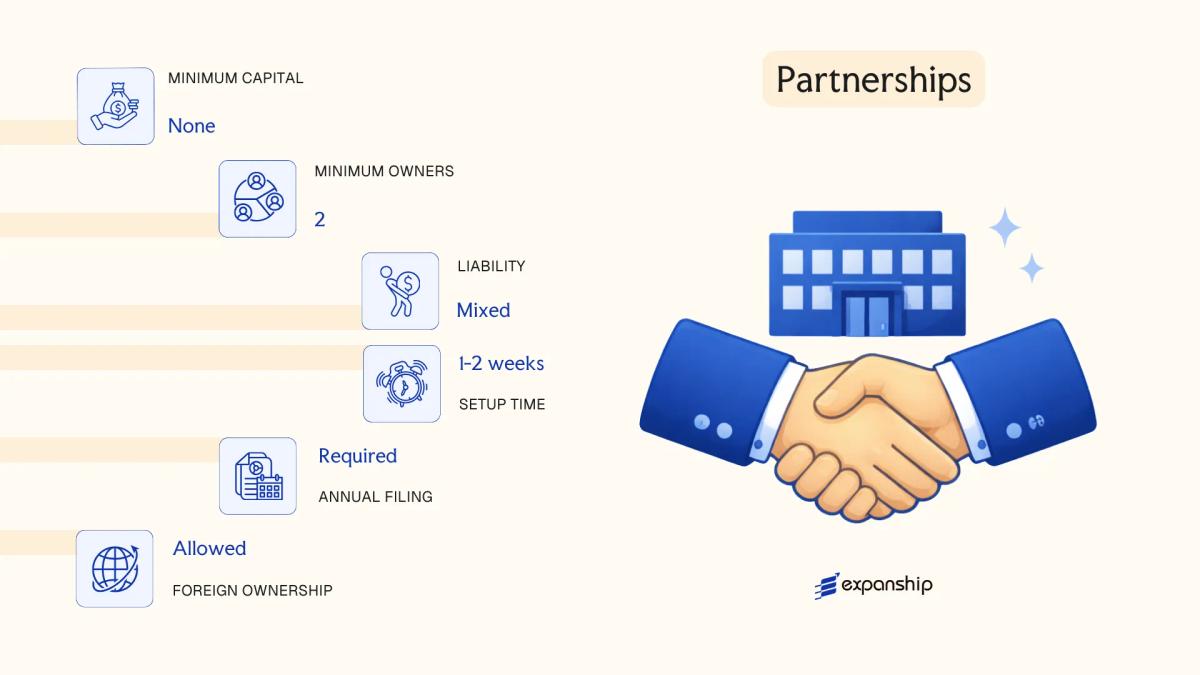
Three partnership structures are available under TCI law: the general partnership, the limited partnership, and the exempted limited partnership. The latter, governed by the Exempted Limited Partnerships Ordinance, is the most commercially significant and is frequently used in private equity and fund structures. General and limited partnerships fall under the Partnership Ordinance.
Partnerships in TCI are generally not treated as separate legal persons; rights and obligations attach to the partners themselves. The exempted limited partnership Turks and Caicos framework is an exception in practice, as it allows for a contractual structure with clearly defined liability separation between general and limited partners, without conferring full corporate personality.
Key Characteristics
| Requirement | Detail | Notes |
|---|---|---|
| Legal Form | Partnership (contractual) | Exempted LPs are not separate legal persons |
| Members | General Partners and Limited Partners | Minimum 1 GP and 1 LP for limited and exempted LP structures |
| Local Presence | Registered Agent required | Physical registered office address in TCI mandatory |
| Capital | No statutory minimum; USD typical | Capital contributions defined in the partnership agreement |
| Privacy | Partner details not on public register | Exempted LP register not publicly accessible |
Focus Points
- Taxation: No corporate income tax, capital gains tax, withholding tax, or VAT applicable to partnerships in TCI.
- Economic Substance: Partnerships engaged in relevant activities may be subject to the Economic Substance Ordinance 2018.
- Annual Compliance: Annual renewal fees payable; exempted LPs must maintain a partnership agreement and registered agent.
- Treaty Access: TCI does not maintain an independent tax treaty network; access to treaties is limited.
- Conversion: A limited partnership may not automatically convert to an exempted LP; restructuring typically requires dissolution and re-registration.
Sub-Types
General Partnership
All partners carry unlimited joint and several liability for the firm's obligations. This structure suits small, domestically operating businesses where formal liability separation is not required.
Limited Partnership
Formed under the Partnership Ordinance, this structure allows limited partners to contribute capital while capping their liability to that contribution, provided they do not participate in management. The general partner retains unlimited liability.
Exempted Limited Partnership
Designed for international investment vehicles, this structure under the Exempted Limited Partnerships Ordinance is exempt from most local business licensing requirements. It is the preferred vehicle for private equity funds, venture capital structures, and collective investment schemes targeting non-resident investors.
Closing
Partnership structures in TCI are used primarily for fund formation, joint ventures, and holding arrangements where pass-through treatment is preferred over corporate taxation. The exempted limited partnership offers structural flexibility for investment activity, though the unlimited liability of the general partner remains a fixed constraint that must be managed, typically by interposing a limited liability company as GP.
Exempted limited partnerships are best suited for fund managers and international investors structuring collective investment vehicles or private equity arrangements targeting non-resident capital.
Foreign Business Structures in Turks and Caicos [Foreign Company Registration, Branch Office]
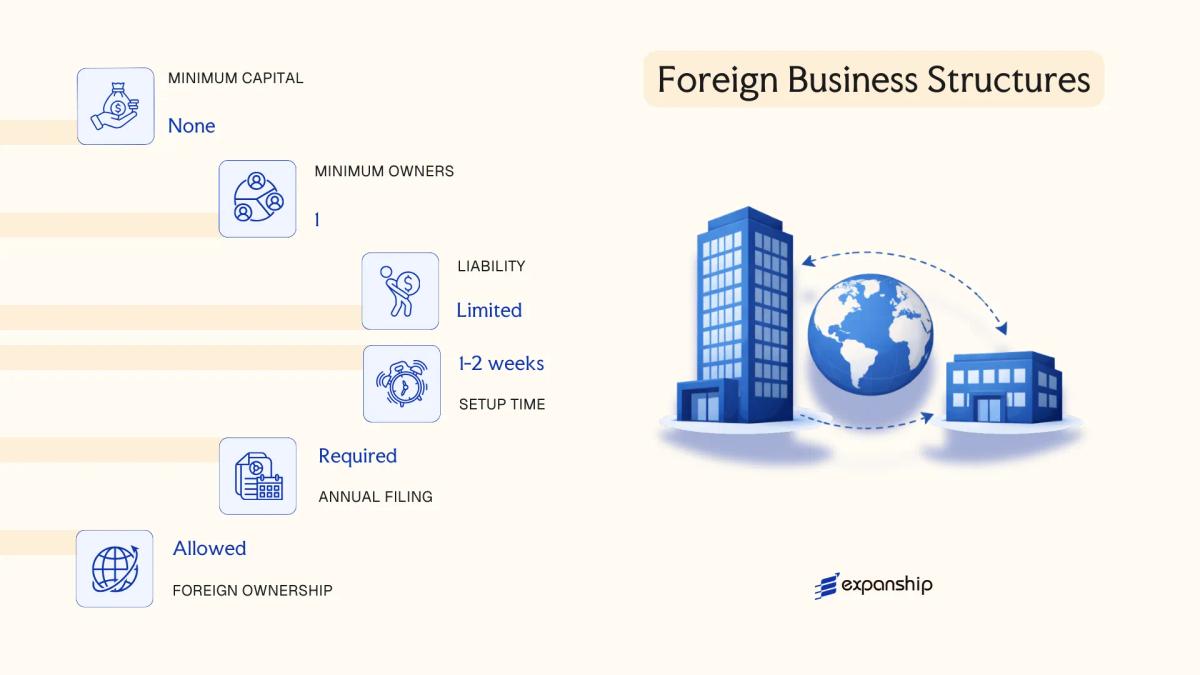
Foreign companies seeking to operate in TCI without incorporating a new local entity have two primary routes available: registering as a foreign company or establishing a branch office. Both are governed by the Companies Ordinance, which requires overseas businesses to formally register with the Turks and Caicos Islands Financial Services Commission (FSC) before conducting business locally.
A registered foreign company does not create a separate legal entity — the parent company remains fully liable for the branch's obligations. This structure is common where operational continuity with the parent is preferred over local legal separation.
Key Characteristics
| Requirement | Detail | Notes |
|---|---|---|
| Legal Form | Branch of a foreign company | No separate legal personality; parent bears full liability |
| Governing Body | Directors of the parent company | Local representative or agent typically required |
| Local Presence | Registered Agent and registered office in TCI | FSC-mandated requirement |
| Capital | No minimum prescribed locally | Subject to parent company's home jurisdiction requirements |
| Documentation | Certified constitutional documents of parent entity | Must be filed with the FSC upon registration |
| Privacy | Parent company details become part of public record | Less privacy than a locally incorporated exempt company |
Focus Points
- Taxation: TCI imposes no corporate income tax, withholding tax, or VAT on branch operations; however, the parent entity may face tax exposure in its home jurisdiction on profits attributable to TCI activities.
- Economic Substance: Branches conducting relevant activities must satisfy the Economic Substance Ordinance requirements applicable to their sector.
- Annual Compliance: Annual renewal of the foreign company registration is required; failure to renew can result in deregistration by the FSC.
- Treaty Access: TCI has no broad double tax treaty network, limiting treaty-based benefits for cross-border transactions.
- Restrictions: Foreign companies cannot conduct business beyond the scope declared at registration without notifying the FSC.
Closing
Foreign company registration in TCI suits multinational businesses that need a local operational presence while maintaining a unified global corporate structure, though the absence of liability separation between branch and parent is a significant structural constraint.
Best suited for established international businesses requiring a formal TCI presence for operational or regulatory purposes rather than asset protection or tax planning.
Sole Proprietorship under the Business Licensing Ordinance
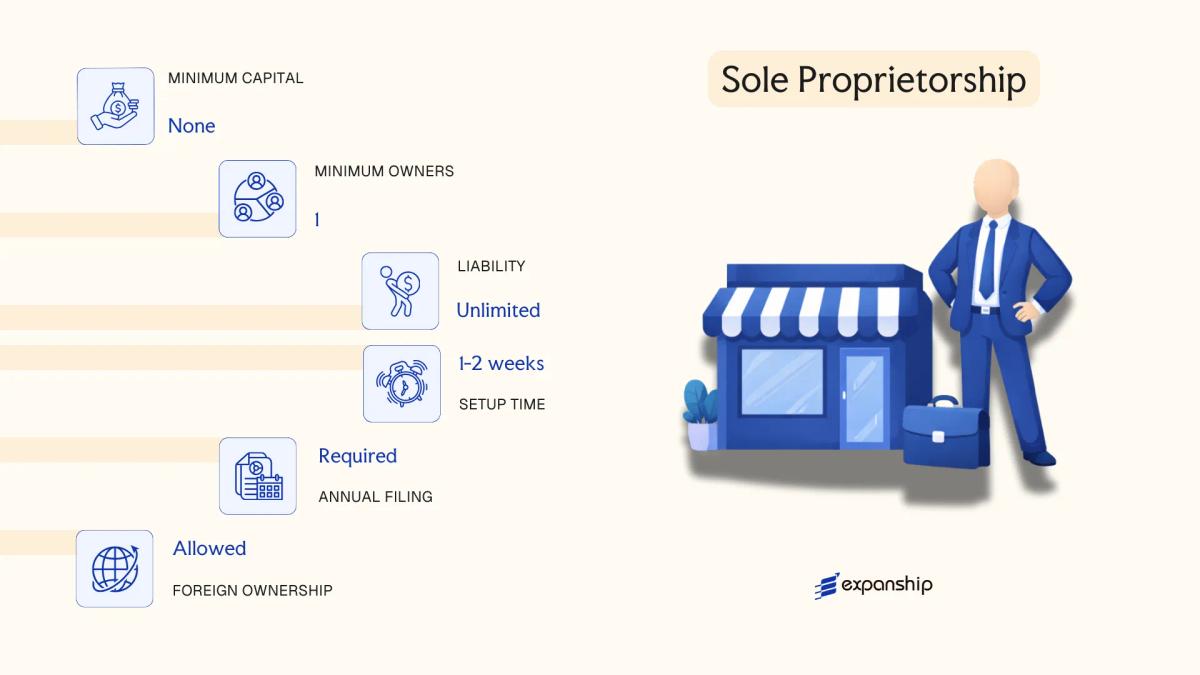
Operating as a sole proprietorship in Turks and Caicos Islands is governed primarily by the Business Licensing Ordinance, which requires any individual conducting business within the territory to hold a valid business licence. Unlike incorporated structures, a sole proprietorship carries no separate legal personality — the individual and the business are treated as the same legal person, meaning personal assets are directly exposed to business liabilities.
Registration is straightforward relative to other structures. You trade under your own name or a registered trade name, and your obligations centre on maintaining an active licence rather than filing corporate governance documents.
Key Characteristics
| Requirement | Detail | Notes |
|---|---|---|
| Legal Form | Unincorporated sole trader | No separate legal entity; owner and business are legally identical |
| Owner Reference | Proprietor | Single individual only; no co-owners permitted under this structure |
| Local Presence | Business licence issued by the Trade & Business Licensing Board | Physical address in TCI required for licence application |
| Capital | No statutory minimum; TCI Dollar (USD equivalent) | Entirely at proprietor's discretion |
| Privacy | Owner's name is publicly associated with the business | No shareholder register, but licence records are accessible |
Focus Points
- Taxation: No corporate income tax, capital gains tax, VAT, or withholding tax applies; profits are treated as personal income of the proprietor, which is also untaxed under current TCI law.
- Annual Compliance: Business licence must be renewed annually through the Trade & Business Licensing Board; failure to renew results in unlawful trading.
- Economic Substance: No economic substance obligations apply, as this structure falls outside the scope of the Economic Substance Ordinance.
- Conversion: Converting to a limited company or LLC requires separately incorporating a new entity; there is no formal statutory conversion mechanism.
- Restrictions: Non-residents and foreign nationals face additional scrutiny and may require specific approvals before a licence is granted.
Closing
A sole proprietorship suits locally based self-employed individuals and small-scale service providers who operate with minimal complexity and do not require liability protection or external investment. The principal drawback is unlimited personal liability, which makes this structure unsuitable for activities carrying material financial or legal risk.
Local sole traders and self-employed individuals in TCI conducting low-risk, owner-operated businesses with no intent to scale or bring in co-owners.
How to Choose the Right Entity Type in Turks and Caicos
Selecting the wrong structure at the outset has concrete legal and financial consequences that are difficult to reverse after incorporation.
Why Your Entity Choice Matters
- Registering an Exempt Company under the Companies Ordinance when you intend to trade locally places you in breach of the Ordinance's residency trading restrictions, which can result in striking off or regulatory penalties.
- Choosing a tax-exempt structure when your counterparties require treaty-reduced withholding rates means those reductions are unavailable to you, since TCI has no double taxation treaty network to draw from regardless of entity type.
- Selecting an entity without the capacity to maintain local substance when Economic Substance reporting obligations apply exposes the company to reporting failures and associated financial penalties under the Economic Substance Regulations.
- Structuring through a company when your objectives are asset protection or succession planning creates ongoing shareholder obligations — annual returns, director registers, and general meeting requirements — that would not apply under a trust arrangement.
Key Factors to Consider
- Business Activity: Passive asset holding, active trading, and regulated activities such as banking or fund management each correspond to a distinct structure under TCI law.
- Local vs. Offshore Operations: Transacting with TCI residents requires an Ordinary Resident Company; operating exclusively outside the islands permits use of an Exempt Company or LLC.
- Ownership and Management: Multi-party ventures requiring formal governance point toward a company structure, while single-owner or flexible arrangements may be better served by an LLC or limited partnership.
- Privacy Requirements: Exempt Companies and LLCs offer greater confidentiality than Ordinary Resident Companies, whose details appear on the public register.
- Substance Capacity: If you cannot realistically place employees or decision-making functions in the jurisdiction, verify whether your chosen entity type falls within the scope of the Economic Substance Regulations before incorporating.
- Exit Strategy: Not all TCI structures permit redomiciliation or conversion; confirm continuance and winding-up provisions before committing to a particular form.
Corporate Compliance Services in Turks and Caicos
Ongoing compliance support for companies incorporated in the Turks and Caicos Islands, including annual returns, economic substance reporting, and regulatory filings.
Conclusion
Incorporating in Turks and Caicos Islands requires selecting a structure that aligns with the operational profile and residency status of your business. The Exempt Company remains the most registered entity type in the territory, favoured by non-resident investors for its tax-neutral status under the Companies Ordinance. Ordinary Resident Companies serve businesses conducting trade locally; LLCs formed under the Limited Liability Companies Ordinance suit those requiring contractual flexibility in profit and management allocation. General and Limited Partnerships carry joint or tiered liability respectively, while Exempted Limited Partnerships are structured for fund vehicles. Foreign firms may register directly or establish a branch under the Foreign Companies provisions.
TCI continues to develop its regulatory framework through the Financial Services Commission, with ongoing alignment to international transparency standards signalling a maturing offshore environment. Selecting the right structure from the outset affects your compliance obligations, tax exposure, and operational capacity within the jurisdiction. Expanship's corporate services team works directly with these entity types across the formation and maintenance lifecycle.
How Expanship Can Assist You
Expanship's Turks and Caicos company formation services cover every structure discussed in this guide — from an Exempt Company under the Companies Ordinance to an Exempted Limited Partnership or LLC registered with the Turks and Caicos Islands Financial Services Commission. Our team handles the specifics of each entity type, including the compliance obligations tied to each one.
From initial document preparation through to post-incorporation filings, our scope includes:
- Document preparation and notarization
- Registered agent and registered office provision in TCI
- Government filing and liaison with the Companies Registry
- Ongoing compliance management, including annual return filings
- Business license applications under the Business Licensing Ordinance
- Banking introduction assistance for newly incorporated entities
Contact Expanship Turks and Caicos to discuss which structure fits your objectives and what the registration process involves for your specific situation.
Frequently Asked Questions (FAQ)
The Exempt Company, formed under the Companies Ordinance, is the most frequently incorporated structure for non-resident use. Its exemption from local income, capital gains, and withholding taxes for a guaranteed period makes it the default choice for international holding and trading structures.
An Exempt Company cannot trade with TCI residents or own local real estate without prior approval, whereas an Ordinary Resident Company faces no such restrictions and may conduct business domestically. On the compliance side, resident companies are subject to a broader set of local regulatory requirements. The tax treatment also differs: resident companies do not carry the formal tax exemption guarantee available to exempt entities.
The Exempt Company provides the greatest level of confidentiality. Beneficial ownership details are not part of the public register, and nominee directors and shareholders are permitted under the Companies Ordinance. The registered agent holds underlying ownership information, but this is not disclosed publicly.
A single individual can incorporate an Exempt Company or an Ordinary Resident Company, as both require just one director and one shareholder. An LLC under the Limited Liability Companies Ordinance can also be formed by a sole member. General Partnerships, Limited Partnerships, and Exempted Limited Partnerships each require a minimum of two partners, so sole formation is not possible for those structures.
Foreigners may incorporate an Exempt Company, an LLC, or register a foreign company under the Companies Ordinance without being resident in the islands. Ordinary Resident Companies are also open to foreign shareholders, though engaging in local trade may trigger Business Licensing Ordinance requirements. A sole proprietorship is available but requires a business licence, and the licensing criteria may impose residency-related conditions depending on the business activity.
The Companies Ordinance permits continuation and re-registration procedures in defined circumstances, including the conversion of an Ordinary Resident Company to Exempt status where eligibility conditions are met. Foreign companies may also re-domicile into the jurisdiction under applicable provisions. Conversion between a company and an LLC or partnership form is not a straightforward administrative process and would generally require dissolution and re-incorporation.
Companies formed under the Companies Ordinance and LLCs under the Limited Liability Companies Ordinance each carry separate legal personality, meaning they can contract, hold assets, and incur liabilities independently of their members. General Partnerships do not have separate legal personality under TCI law, leaving partners personally exposed to the firm's obligations. Limited Partnerships and Exempted Limited Partnerships offer partial separation, protecting limited partners while general partners retain personal liability.
The Exempt Company carries a comparatively light ongoing compliance burden: there is no requirement to file public accounts, and annual obligations are largely limited to maintaining a registered agent, paying the annual fee, and keeping statutory records current. The LLC under the Limited Liability Companies Ordinance operates under a similarly streamlined regime. By contrast, an Ordinary Resident Company faces more extensive local regulatory interaction.
Legal Disclaimer
The information provided in this article is for general informational purposes only and does not constitute legal, tax, or professional advice. While we strive to ensure the accuracy and timeliness of the content, laws and regulations are subject to change, and the application of laws can vary widely based on specific facts and circumstances.
Readers should not act upon this information without seeking professional counsel tailored to their individual situation. Expanship and its authors disclaim any liability for actions taken or not taken based on the content of this article.
For specific advice regarding your business setup, compliance requirements, or any legal matters, please consult with qualified legal and tax professionals in the relevant jurisdiction.