
Key Takeaways
- The Turks and Caicos Islands impose no corporate income tax, capital gains tax, or withholding tax, allowing foreign-owned entities to retain earnings without any statutory tax drag at the territorial level.
- Oversight by the Financial Services Commission under a British Overseas Territory constitutional framework means corporate entities benefit from common law legal continuity rather than the regulatory uncertainty associated with smaller or newly established offshore centres.
- Because TCI recognises no foreign ownership restrictions and requires no local partner or resident shareholder, a business can be structured as wholly foreign-held from the outset without navigating co-ownership arrangements.
- Conducting all transactions in USD as the official currency eliminates the exchange rate exposure that affects entities incorporated in Caribbean jurisdictions operating under local or pegged currencies.
Situated in the northwestern Caribbean, the Turks and Caicos Islands operate as a British Overseas Territory under the sovereignty of the United Kingdom. This political status gives the territory a stable constitutional framework while maintaining its own legislative and regulatory autonomy. Company registration is overseen by the Financial Services Commission, the body responsible for licensing and supervising corporate entities operating within the jurisdiction.
Foreign businesses incorporating here most commonly do so through an International Business Company. The territory maintains a zero-tax posture, applying no corporate income tax, capital gains tax, or withholding tax on most categories of income. There are no statutory restrictions on foreign ownership, meaning your business can be fully foreign-held without requiring a local partner or resident shareholder.
The benefits of incorporating in Turks and Caicos span tax efficiency, privacy protections, structural flexibility, and legal certainty — this article examines each in detail. Whether you're structuring a holding company or managing cross-border operations, the territory presents a defined and well-regulated environment for foreign direct investment.
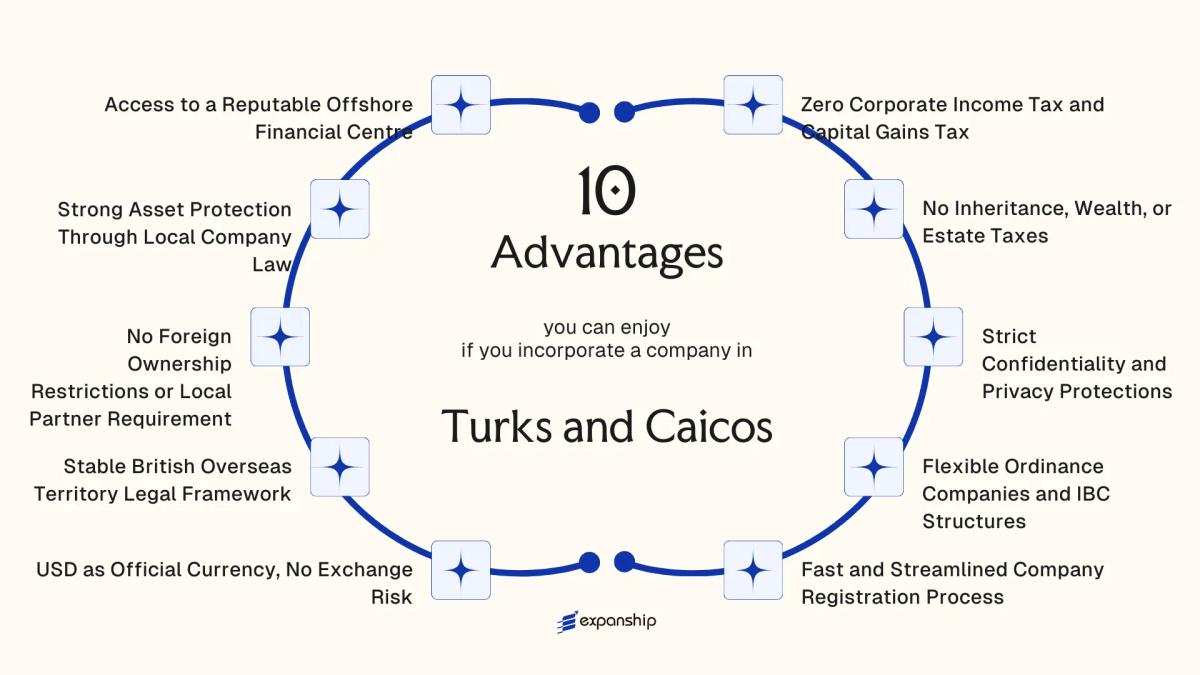
Zero Corporate Income Tax and Capital Gains Tax
Turks and Caicos imposes no corporate income tax on companies incorporated under its domestic framework. That single structural feature means profits generated by your business remain entirely intact at the entity level.
What the Tax Regime Actually Looks Like
Under the Companies Ordinance and the International Business Companies Ordinance, neither locally registered companies nor IBCs are subject to tax on corporate profits. No withholding tax applies to dividends paid out to foreign shareholders, which means distributions to non-resident owners are not reduced at source.
Why This Matters Beyond the Zero Rate
The absence of Turks and Caicos zero corporate income tax obligations eliminates the need for complex tax provisioning, deferred tax calculations, or local tax filings entirely. For businesses with cross-border revenue streams, no capital gains tax on asset disposals or equity transactions means the full proceeds from a sale or restructuring flow directly to shareholders without local tax erosion.
Profits, dividends, and capital gains realised through your TCI entity are not reduced by any local corporate or gains-based tax charge.
No Inheritance, Wealth, or Estate Taxes
There is no inheritance tax, estate tax, or wealth tax in Turks and Caicos. For foreign investors and business owners, the absence of no inheritance or estate tax in Turks and Caicos means that accumulated assets held through a local company or trust structure are not subject to transfer levies upon death or generational handover.
This has direct consequences for succession planning. Wealth passed to heirs — whether held in shares, real property, or corporate assets — is not reduced by estate duties at the territorial level. That matters particularly for high-net-worth individuals structuring long-term holdings across multiple jurisdictions.
Compared to jurisdictions such as the United Kingdom, where the standard inheritance tax rate reaches 40% above the nil-rate band, or the United States, where federal estate tax applies at rates up to 40% on taxable estates above the exemption threshold, the contrast is significant.
Several features make this framework straightforward from a planning perspective:
- No annual wealth tax applies to corporate or personal holdings
- No gift tax mechanism exists to claw back lifetime transfers
- No local capital transfer tax applies on restructuring or asset migration
This does not eliminate obligations in your country of residence or domicile, where domestic estate or inheritance rules may still apply to worldwide assets.

Company Incorporation in Turks and Caicos
Establish your company in Turks and Caicos and benefit from a tax-neutral structure with no estate, inheritance, or wealth tax obligations at the territorial level.
Strict Confidentiality and Privacy Protections
Turks and Caicos company confidentiality protections are grounded in statute, not merely administrative practice. Under the Companies Ordinance and the related framework governing International Business Companies, neither shareholder names nor director details are entered into any publicly searchable register. This means third parties cannot trace ownership of your company through government records.
| Privacy Element | Public Disclosure Required | Governing Framework |
|---|---|---|
| Shareholder identities | No | Companies Ordinance (TCI) |
| Director names | No | IBC regulatory framework |
| Beneficial owner information | Held by registered agent only | Anti-Money Laundering Regulations |
| Financial statements | No public filing | TCI corporate law |
Beneficial ownership information is maintained by the licensed registered agent in the territory, not filed with any public authority. This structure keeps sensitive ownership data out of publicly accessible records while still satisfying the compliance obligations imposed on regulated intermediaries under the territory's Anti-Money Laundering Regulations.
For foreign investors operating in sectors where discretion matters, such as family wealth holding, intellectual property ownership, or cross-border joint ventures, the absence of a public beneficial ownership register carries direct operational value. Competitors, counterparties, or litigants in other jurisdictions cannot establish ownership structure through a routine public records search.
Offshore privacy laws in Turks and Caicos are maintained within a framework that also meets international AML and FATF-aligned standards, meaning the privacy benefit does not come at the cost of correspondent banking relationships or reputational standing.
Flexible Ordinance Companies and IBC Structures
Two distinct legislative frameworks give the Turks and Caicos IBC and Ordinance company benefits their structural depth. Under the Companies Ordinance, a standard domestic company follows familiar common law corporate mechanics. International Business Companies, governed by the International Business Companies Ordinance, operate under a separate set of rules designed specifically for cross-border commercial activity.
The separation matters. An IBC is not required to hold annual general meetings locally, and its register of directors and shareholders is not publicly accessible. For a foreign business owner managing operations across multiple jurisdictions, this reduces administrative friction without sacrificing legal standing.
Flexible company structures in Turks and Caicos also allow for variation in share capital arrangements. IBCs can issue shares with or without par value, in multiple classes, and in any currency. This gives holding structures, investment vehicles, and joint ventures the room to reflect their actual commercial agreements rather than conforming to rigid statutory templates.
Keep the following in mind:
- IBCs cannot conduct business within the Turks and Caicos Islands with local residents
- The Ordinance permits redomiciliation, allowing foreign companies to migrate in or out
- Nominee structures are permissible under local law, subject to underlying beneficial ownership records
An IBC incorporated under the International Business Companies Ordinance can be converted into an Ordinance company without dissolution, preserving its legal history and contractual obligations throughout the transition.
Fast and Streamlined Company Registration Process
Incorporating in Turks and Caicos moves at a pace that directly reduces the time between deciding to form a business and actually operating it. The fast company registration benefits Turks and Caicos offers stem from a combination of straightforward statutory requirements and an administration structured to process applications without extended backlogs.
Statutory Framework That Removes Unnecessary Friction
Under the Companies Ordinance, company formation does not require prior government approval in the sense of a discretionary licensing process for standard business structures. Your application is processed against defined criteria rather than queued for ministerial review. That distinction matters because approval timelines become predictable, allowing you to plan operational start dates with reasonable accuracy.
Registered companies can typically be constituted within a matter of days once documentation is submitted through an authorized registered agent. Agents licensed under the Financial Services Commission Act hold a defined role in the registration chain, which consolidates the filing process rather than requiring you to interface directly with multiple agencies.
What Speed Means in Practical Terms
A shorter formation window reduces holding costs and defers no revenue-generating activity longer than necessary. For foreign investors coordinating multi-jurisdictional structures, a firm that is registered and in good standing quickly can execute contracts, open accounts, and enter commercial relationships on schedule.
The Turks and Caicos quick incorporation advantages also carry through to post-registration maintenance, where annual obligations are clearly defined by statute rather than subject to ongoing administrative discretion.
Start Incorporating in Turks and Caicos
Speak with an Expanship specialist about registering your company in Turks and Caicos and navigating local requirements efficiently.
USD as Official Currency, No Exchange Risk
The USD official currency advantage Turks and Caicos offers is straightforward: the territory adopted the US dollar as its official currency, meaning all corporate transactions, contracts, and financial records are denominated in USD by default. There is no local currency to convert into or out of, and no central bank issuing a competing monetary instrument.
- Your business records, invoices, and statutory filings are all in USD, eliminating the accounting complexity that comes with multi-currency reconciliation.
- Foreign investors holding USD assets face no conversion costs when capitalizing a company or repatriating funds, since no exchange transaction is required at the jurisdictional level.
- Contracts governed under TCI law and priced in USD carry no embedded currency risk for counterparties operating in dollar-denominated markets, which covers a significant portion of global trade and finance.
- No exchange rate risk in Turks and Caicos business operations also means financial projections remain stable over time, unaffected by currency fluctuation between the incorporation date and the operating period.
- For US-based founders or investors, the absence of a foreign currency layer removes a category of regulatory reporting that would otherwise apply when dealing with non-USD jurisdictions.
Stable British Overseas Territory Legal Framework
The Turks and Caicos British Overseas Territory legal status anchors the entire legal system to English common law. Courts apply principles established through centuries of English jurisprudence, which means contract enforceability, property rights, and corporate governance follow a body of law that international legal counsel can interpret with confidence.
Governance of the territory falls under a constitution granted by the United Kingdom, and ultimate judicial appeal runs to the Privy Council in London. For a foreign business owner, that appellate structure matters: disputes are not resolved by a local judiciary alone but can ultimately reach one of the world's most established common law courts.
The Financial Services Commission regulates corporate and financial activity under local ordinances. Your entity operates within a framework that is neither self-invented nor experimental, which reduces the legal uncertainty that can otherwise accompany offshore structures in less-established jurisdictions.
A hypothetical scenario: A foreign shareholder in a dispute over contractual obligations can pursue appeals through to the Judicial Committee of the Privy Council in London, accessing the same appellate body available to companies incorporated in the Cayman Islands or the British Virgin Islands, without needing to rely solely on local judicial resolution.
No Foreign Ownership Restrictions or Local Partner Requirement
There are no foreign ownership restrictions in Turks and Caicos under the Companies Ordinance. A non-resident investor can hold 100 percent of shares in a local entity without appointing a resident director, local partner, or nominee shareholder to satisfy any statutory ownership threshold.
This structure has a direct operational consequence: your firm answers entirely to its actual owners. Jurisdictions that require a local partner as a legal condition introduce a third party whose interests may diverge from yours. That friction does not exist here.
Under the International Business Companies Ordinance, an IBC can be wholly owned by foreign nationals or foreign corporate entities. No licensing authority or trade ministry review is triggered solely by foreign ownership.
Key ownership features relevant to foreign investors:
- No minimum local shareholding requirement
- No mandatory resident director condition tied to foreign ownership rules
- Corporate shareholders from any jurisdiction are permitted
- Single-shareholder companies are allowed under the Ordinance
Certain regulated activities, such as financial services or real estate, may require separate licensing that carries its own fit-and-proper or residency criteria independent of the general ownership rules.
Strong Asset Protection Through Local Company Law
Turks and Caicos asset protection company law benefits are grounded in a legal framework that draws from English common law principles, giving your offshore entity a level of structural credibility that purely civil law jurisdictions cannot replicate. Courts in the territory apply established case law to resolve disputes, which means creditor claims and enforcement actions face a well-defined, predictable legal process rather than an uncertain one.
Separation of Liability Under the Companies Ordinance
Under the Companies Ordinance, shareholders of a limited liability company are not personally liable for the debts or obligations of the business beyond their contributed capital. This structural separation means your personal assets remain legally distinct from those of the corporate entity, regardless of where the underlying commercial activity occurs.
Protection Against Foreign Judgments
Foreign judgments are not automatically enforceable against a company incorporated in the territory. A creditor seeking to pursue assets held within a local entity must initiate fresh proceedings under the territorial jurisdiction, which creates a meaningful procedural barrier. For asset-holding structures, this barrier directly reduces exposure to overseas litigation.
Registered Charges and Security Interests
The Companies Ordinance also provides a formal mechanism for registering charges over company assets. Secured creditors who comply with registration requirements hold priority over unregistered claims, which allows shareholders to structure lending arrangements in a way that protects specific assets from unsecured third-party claims.
- Shareholder liability is capped at the amount unpaid on their shares
- Foreign court orders require local proceedings before enforcement
- Registered charges take priority over subsequently registered or unregistered claims
- Asset-holding companies can hold property, intellectual rights, or financial instruments under this structure
Access to a Reputable Offshore Financial Centre
Turks and Caicos operates as a credible offshore financial centre with a regulatory structure overseen by the Financial Services Commission (FSC), the statutory body responsible for licensing and supervising financial services providers in the territory. That institutional oversight gives your business a verifiable compliance framework, not just a low-tax address.
For foreign investors, this matters because counterparties, banks, and institutional partners scrutinize the regulatory standing of a jurisdiction before engaging. Firms incorporated under the Companies Ordinance or as International Business Companies can point to FSC oversight as evidence of regulatory legitimacy, which reduces friction when opening correspondent bank accounts or entering cross-border agreements.
The territory's access to reputable offshore banking and finance advantages is underpinned by its status as a British Overseas Territory. That constitutional relationship with the United Kingdom gives the jurisdiction a legal credibility that fully independent offshore centres cannot claim by default.
Among the practical consequences of operating from this financial centre:
- Licensed trust companies, corporate service providers, and financial intermediaries operate under FSC-issued licences, giving clients a regulated point of contact
- The territory maintains anti-money laundering and know-your-customer frameworks aligned with FATF standards, which supports cross-border banking relationships
- Financial institutions here transact in USD, eliminating currency conversion layers that complicate cross-border financial management
- The legal system, grounded in English common law, provides a recognized framework for dispute resolution that international counterparties are familiar with
Firms that require a credible offshore jurisdiction for holding structures, treasury functions, or regional finance operations benefit from these institutional conditions as much as from the tax position itself.
Why Turks and Caicos Stands Out Among Offshore Jurisdictions
Chosen for comparison here are the British Virgin Islands, the Cayman Islands, and the Bahamas. All three are Caribbean offshore centres that attract a similar profile of foreign investor: those seeking tax neutrality, flexible corporate structures, and English-language legal systems. A reader evaluating the Turks and Caicos advantages over other offshore jurisdictions would realistically be weighing these same options.
What the table below cannot convey is the legal context that underpins the comparison. The TCI operates under the Companies Ordinance, which gives its corporate framework direct grounding in British statutory tradition, with access to Privy Council appeals. That lineage matters to investors who need a jurisdiction where legal outcomes are predictable and courts apply established common law principles, not merely a civil code adapted for offshore use.
| Parameter | Turks and Caicos | British Virgin Islands | Cayman Islands | Bahamas |
|---|---|---|---|---|
| Corporate Income Tax | 0% | 0% | 0% | 0% |
| Capital Gains Tax | None | None | None | None |
| Official Currency | USD (no conversion risk) | USD | KYD (pegged to USD) | BSD (pegged to USD) |
| Legal System | English common law, Privy Council appeal | English common law, Privy Council appeal | English common law, Privy Council appeal | English common law, Privy Council appeal |
| Annual Government Fee (IBC/Exempted) | Fixed flat fee structure | Tiered by authorised share capital | Tiered by share capital | Flat fee |
| Local Director Requirement | None | None | None | None |
| Minimum Paid-Up Capital | None | None | None | None |
| FATF Status | Compliant member jurisdiction | Compliant | Compliant | Previously grey-listed; removed 2024 |
Compliance Services for Companies in Turks and Caicos
Maintain good standing under the Companies Ordinance with annual filings, registered agent requirements, and regulatory reporting managed on your behalf.
Conclusion
The benefits of incorporating in Turks and Caicos rest on a foundation that few offshore jurisdictions can replicate: a zero-tax environment backed by British Overseas Territory legal standing, not an experimental framework but a system with constitutional continuity. For foreign business owners, that combination means your entity operates under a credible common law structure without carrying a corporate income tax or capital gains liability.
Two features stand out above the rest. The absence of foreign ownership restrictions means your business can be wholly foreign-owned without local partner arrangements. Pair that with the use of USD as the official currency, and you remove a layer of financial risk that affects entities structured elsewhere in the Caribbean.
That said, the right structure depends on your specific circumstances. An Ordinance company and an IBC do not carry identical compliance obligations, and your industry, the location of your clients, and your home country's controlled foreign corporation rules will all shape how effectively you can use a TCI entity.
For those whose situation aligns with what this jurisdiction offers, the next practical step is working with a firm that understands the local regulatory environment, including the Financial Services Commission's requirements, and can structure the entity correctly from the outset.
Start Your Turks and Caicos Company with Expanship Today
Expanship assists with Turks and Caicos company formation, covering the full incorporation cycle from entity selection under the Companies Ordinance to filing with the Turks and Caicos Islands Financial Services Commission. The structures discussed throughout this blog, including Exempted Companies and International Business Companies, each carry distinct registration requirements and ongoing compliance obligations that Expanship manages directly on your behalf.
From initial document preparation through to post-incorporation maintenance, the firm's scope of service covers each operational stage:
- Preparation and legalization of incorporation documents
- Registered agent and registered office provision within the territory
- Government filing and liaison with the Financial Services Commission
- Ongoing compliance management, including annual return obligations
- Director and shareholder record maintenance
- Banking introduction assistance for corporate account establishment
Expanship Turks and Caicos is available to discuss your incorporation requirements directly.
Frequently Asked Questions (FAQ)
The corporate income tax rate is zero. The Turks and Caicos Islands does not impose corporate income tax, capital gains tax, inheritance tax, or wealth tax on companies incorporated there, including IBCs. This tax-neutral position is established by the territory's fiscal framework and has remained consistent given its status as a British Overseas Territory.
The Companies Ordinance governs standard resident companies, while the International Business Companies Ordinance provides a separate framework designed for entities that conduct business primarily outside the territory. IBCs benefit from certain structural flexibilities, including streamlined reporting requirements, making them a common choice for holding structures, international trading companies, and asset-holding vehicles.
Beneficial ownership and certain director details are not publicly accessible in the same manner as in many onshore jurisdictions, and the territory maintains statutory confidentiality provisions. Disclosure obligations exist to the regulatory authorities, but public registers exposing full ownership details are not a feature of the IBC framework. The specific scope of these protections is governed by the applicable ordinance and any relevant financial services regulations issued by the Financial Services Commission.
The territory is a British Overseas Territory subject to UK oversight on constitutional matters, and its financial services sector is regulated by the Financial Services Commission. It is not listed on the FATF blacklist and has engaged with international tax transparency initiatives, including the OECD's Common Reporting Standard. That said, due diligence requirements from correspondent banks and business partners vary, and the perception of any offshore jurisdiction depends on the counterparty's own compliance standards.
As a British Overseas Territory, the jurisdiction operates under a legal system derived from English common law, with its own local legislature enacting company and tax legislation. Structural changes to the territory's constitutional relationship with the UK would require significant political processes and are not a common occurrence. Historical regulatory updates, such as adjustments to beneficial ownership reporting requirements, have generally provided transition periods, though companies should monitor regulatory developments through the Financial Services Commission.
Incorporation timelines depend on the registered agent processing the application and whether all required documentation is in order at submission. In practice, straightforward IBC registrations can be completed within a few business days. Delays typically arise from incomplete due diligence documentation rather than administrative backlogs at the registry.
There is no legal requirement for a Turks and Caicos IBC to maintain a bank account within the territory. Many IBCs operate through accounts held in other jurisdictions, and the use of USD as the official currency eliminates conversion friction when transacting with US-dollar-denominated banks elsewhere. The choice of banking jurisdiction is a practical and compliance-driven decision rather than a statutory one.
Legal Disclaimer
The information provided in this article is for general informational purposes only and does not constitute legal, tax, or professional advice. While we strive to ensure the accuracy and timeliness of the content, laws and regulations are subject to change, and the application of laws can vary widely based on specific facts and circumstances.
Readers should not act upon this information without seeking professional counsel tailored to their individual situation. Expanship and its authors disclaim any liability for actions taken or not taken based on the content of this article.
For specific advice regarding your business setup, compliance requirements, or any legal matters, please consult with qualified legal and tax professionals in the relevant jurisdiction.