
Key Takeaways
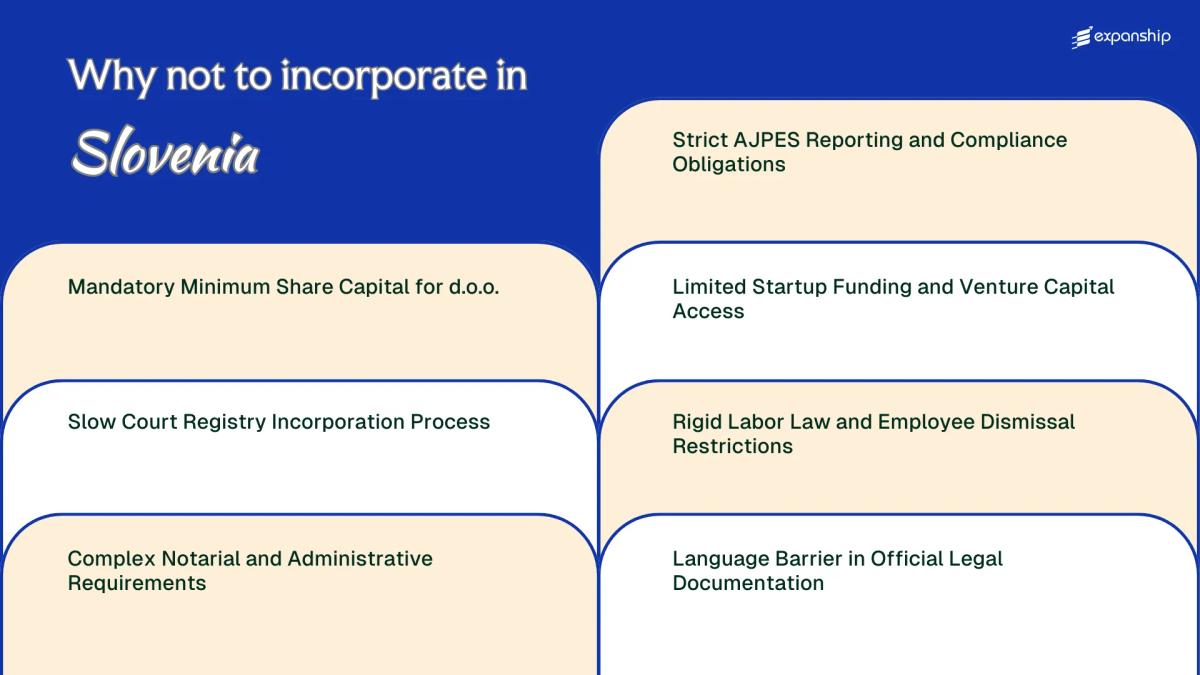
- Under the Zakon o gospodarskih družbah (ZGD-1), founders of a d.o.o. must commit a minimum share capital of €7,500 before the company can be registered, tying up capital before any commercial activity begins.
- Incorporation through Slovenia's court registry system involves notarial deed requirements and multi-step administrative procedures that extend the setup timeline beyond what investors typically encounter in comparable EU jurisdictions.
- AJPES, the Slovenian agency responsible for financial data reporting, imposes structured annual disclosure obligations that create an ongoing compliance burden even for dormant or low-activity companies.
- Slovenian labor law places significant procedural restrictions on employee dismissal, meaning businesses that hire locally must account for termination costs and notice requirements that reduce operational flexibility in downturns.
Slovenia operates under a well-developed, EU-aligned regulatory framework governed primarily by the Zakon o gospodarskih družbah (Companies Act, ZGD-1), placing it firmly among the more formally structured corporate environments in Central Europe.
The disadvantages of incorporating in Slovenia span multiple dimensions, from capital requirements and administrative processes to labor regulations and access to financing.
Not every constraint applies equally across all business models. A tech startup with no local staff faces a different compliance burden than a manufacturing firm with permanent employees and physical assets in the country.
This article is most relevant to foreign entrepreneurs and non-EU investors considering a d.o.o. (družba z omejeno odgovornostjo) as their primary operating vehicle, particularly those unfamiliar with the procedural requirements of Slovenian corporate law.
Mandatory Minimum Share Capital for d.o.o.
Under Slovenian law, a družba z omejeno odgovornostjo (d.o.o.) requires a minimum share capital of EUR 7,500. Meeting the Slovenia d.o.o. minimum share capital requirements is a threshold condition before registration can proceed through the court registry.
Capital Must Be Deposited Before Incorporation Completes
The full EUR 7,500 must be paid in prior to registration, meaning your funds are locked into the entity before it generates any revenue. For a foreign founder testing market viability, this represents committed capital with no operational return in the early stage.
Each shareholder's individual contribution must meet a minimum of EUR 50. This per-contribution floor adds friction when structuring multi-shareholder arrangements, particularly for distributed ownership models common in early-stage foreign ventures.
The Financial Barrier Relative to Business Risk
While EUR 7,500 is modest in absolute terms, it is non-trivial when combined with notarial fees, administrative costs, and cross-border banking requirements that foreign founders typically face. The capital does not remain freely accessible once deposited, as Slovenian company law governs its use and distribution throughout the firm's life.
If your d.o.o. is dissolved, the EUR 7,500 share capital is subject to creditor claims before any amount is returned to shareholders, making early-stage capital loss a real exposure for foreign investors.
Slow Court Registry Incorporation Process
Slovenia court registry incorporation delays are a recurring friction point for foreign entrepreneurs registering a d.o.o. (družba z omejeno odgovornostjo). Registration is processed through the court registry (sodni register), administered by district courts, before being forwarded to AJPES for the business register entry. This two-stage institutional handoff extends timelines in ways that online portals alone cannot fully resolve.
While Slovenia introduced the e-VEM portal to accelerate standard registrations, complex formations involving foreign shareholders, non-resident directors, or notarially certified founding acts frequently fall outside the fast-track pathway.
For foreign business owners, the slow company registration process in Slovenia creates concrete operational costs:
- Delays in obtaining a tax identification number push back VAT registration, blocking your ability to invoice clients from day one.
- Pending registration prevents opening a corporate bank account, leaving subscribed share capital inaccessible during the waiting period.
- Extended timelines force foreign founders to maintain holding structures or personal arrangements longer than anticipated, increasing interim legal costs.
- Court backlogs vary by district, making registration timelines genuinely unpredictable across different locations in the country.

Company Incorporation in Slovenia
Register your Slovenian d.o.o. with support from specialists who manage court registry filings, notarial requirements, and AJPES coordination on your behalf.
Complex Notarial and Administrative Requirements
Slovenia notarial requirements for company formation add a layer of procedural cost that many jurisdictions have eliminated. Forming a d.o.o. requires a notarized founding act, and that notarization must be performed by a Slovenian notary public operating under the Notaries Act (Zakon o notariatu), meaning remote or foreign notarization is not accepted.
Notary fees are set by a statutory tariff rather than by market competition, so you cannot reduce this cost by shopping around. For a standard d.o.o. formation, notarial fees alone can reach several hundred euros before any court registration or state administrative charges are added.
| Requirement | Obligation | Burden |
|---|---|---|
| Founding act notarization | Mandatory Slovenian notary | Cannot be fulfilled abroad or digitally by foreign founders |
| Notary fee structure | Governed by statutory tariff | Non-negotiable; no cost reduction through competitive selection |
| Identity verification | In-person or certified representation | Requires physical presence or a locally authorized proxy |
| Court registration fee | Paid to AJPES / court registry | Adds to upfront formation cost beyond notarial charges |
Any changes to the company's articles of association after formation, including amendments to ownership structure or business scope, also require fresh notarization. This means ongoing administrative costs extend well beyond the initial incorporation event.
Foreign founders who cannot appear in person must appoint a Slovenian-resident proxy holding a notarized power of attorney, which itself carries additional notarial costs. The combined procedural requirements impose a fixed administrative overhead that falls disproportionately on non-resident investors with no local presence.
Strict AJPES Reporting and Compliance Obligations
AJPES reporting obligations Slovenia companies extend well beyond a basic annual return. Every d.o.o. must submit audited or unaudited financial statements, a business report, and an income statement to the Agency of the Republic of Slovenia for Public Legal Records and Related Services, known as AJPES, within defined statutory deadlines under the Companies Act (ZGD-1).
The volume of filings is the burden. A foreign-owned firm must comply with the same disclosure requirements as a domestic entity, with no reduced regime for small foreign-managed companies.
AJPES publishes submitted financials in a publicly accessible database. This means your company's revenue figures, liabilities, and profit margins are visible to competitors, suppliers, and the public without any restriction.
Non-compliance carries direct penalties. Fines under ZGD-1 for failure to file on time apply to the company and to its directors personally, creating individual liability exposure that many foreign founders do not anticipate.
- Annual financial statements must be filed with AJPES within 3 months of the financial year end (by 31 March for calendar-year entities)
- Directors face personal fines for late or missing filings, separate from any company-level penalties
- All submitted financials become publicly accessible through the AJPES register immediately upon publication
- A statutory auditor may be required if the entity crosses two of three size thresholds under ZGD-1 (assets, revenue, employee count)
Slovenia's public financial disclosure rules mean a single-shareholder micro-company's full income statement is freely searchable online by anyone, including your direct competitors.
Limited Startup Funding and Venture Capital Access
Limited venture capital access in Slovenia remains a structural constraint for early-stage companies, particularly those seeking growth-stage investment beyond seed rounds.
A Thin Institutional Investor Base
Slovenia's private equity and venture capital market is small relative to most Western European economies. The Slovenian Enterprise Fund (Slovenski podjetniški sklad) administers public co-investment instruments, but institutional private capital is limited, meaning your firm competes for a narrow pool of funding with limited negotiating leverage on terms.
Practical Consequences for Foreign-Founded Startups
Founders incorporating a d.o.o. who expect to raise multiple funding rounds often find that local investors lack the ticket sizes or sector appetite common in markets like Germany or the Netherlands. Relocating fundraising activities to a larger EU market is a common workaround, but doing so introduces cross-border structuring costs that erode early-stage capital efficiency.
The absence of a deep angel investor network compounds this further, since pre-seed funding typically depends on personal networks rather than organized syndicates. Foreign founders without existing connections to Slovenian business communities face a steeper path to early capital than comparable EU incorporation destinations.
Navigating Incorporation Challenges in Slovenia
Understand the structural funding limitations and corporate setup constraints before committing to a Slovenian entity.
Rigid Labor Law and Employee Dismissal Restrictions
Slovenia labor law employee dismissal restrictions impose some of the strictest termination frameworks in Central Europe, governed primarily by the Employment Relationships Act (ZDR-1). Employers face a legally dense process before any dismissal can take effect.
- ZDR-1 requires documented, substantiated grounds for termination, meaning you cannot end an employment relationship at will, even during a probationary period that has formally concluded.
- Mandatory notice periods can extend up to 60 days depending on the employee's length of service, forcing your business to carry payroll costs well after a dismissal decision.
- Employees dismissed for business reasons are entitled to severance pay calculated on their average monthly salary, creating a direct financial liability that scales with tenure.
- Works councils, where established, hold consultation rights before collective redundancies proceed, adding procedural delays to workforce restructuring.
- Wrongful dismissal claims are adjudicated through the labour courts, and reinstatement, not compensation, is a standard judicial remedy under ZDR-1.
Language Barrier in Official Legal Documentation
Slovenia language barriers in legal documentation represent a concrete operational cost for foreign business owners, not just an inconvenience. The Official Language Act (Zakon o uradnem jeziku) mandates that all official documents, court submissions, and regulatory filings must be produced in Slovenian. Your English-language contracts, resolutions, or corporate records carry no legal standing in their original form.
Every document submitted to the Slovenian Business Register (AJPES) or the courts must be in Slovenian. For foreign-owned entities, this means engaging certified translators for articles of association, shareholder agreements, and any correspondence with the Commercial Court in Ljubljana.
Translation costs accumulate quickly, and any error in a certified translation can trigger rejection by AJPES or delay registry proceedings. The burden falls disproportionately on firms without Slovenian-speaking legal counsel, as there is no official concession for EU-language submissions under current registry practice.
A hypothetical foreign-owned d.o.o. filing a standard set of incorporation documents, including articles of association, identity documents, and a notarial deed, could realistically incur EUR 400–800 in certified translation fees before a single regulatory step is completed.
Overcoming Incorporation Challenges in Slovenia
Overcoming incorporation challenges in Slovenia requires structural preparation rather than reactive problem-solving. Foreign founders who understand the regulatory architecture in advance are better positioned to manage procedural friction.
- Pre-fund your d.o.o. with the EUR 7,500 minimum share capital before engaging the court registry, ensuring capital is documented and ready for the notarial deed.
- Engage a certified notary (notar) early in the process to prepare compliant founding documents, since notarial authentication is a mandatory step under Slovenian company law.
- Register with AJPES before commencing operations to establish your statutory reporting baseline and avoid penalties tied to annual disclosure obligations.
- Arrange certified Slovenian translations of all foreign-language founding documents prior to submission to the court registry.
- Review collective labor agreements applicable to your sector before hiring, given the constraints on employee dismissal under Slovenian labor legislation.
These steps operate within a regulatory environment governed by the Zakon o gospodarskih družbah (ZGD-1) and administered across multiple bodies, including the court registry and AJPES. Structural compliance from the outset reduces exposure to delays and administrative rejection.
Slovenia's Overall Investment Appeal
Slovenia investment appeal despite drawbacks is a reasonable framing for a jurisdiction that sits within the EU single market, uses the euro, and maintains a stable legal system grounded in civil law. The structural friction covered throughout this blog, from share capital requirements to rigid labor protections, is real. For the right business profile, however, these constraints are neither unusual nor prohibitive by Central European standards.
| Pros | Cons |
|---|---|
| EU membership provides access to the single market and EU legal frameworks | Court registry incorporation through AJPES can extend timelines beyond what online systems suggest |
| The euro is the official currency, eliminating exchange rate exposure within the eurozone | The €7,500 minimum share capital for a d.o.o. must be paid up before registration is complete |
| Bilateral tax treaties with numerous countries reduce withholding tax exposure | Notarial requirements add procedural layers and cost that many comparable jurisdictions have removed |
| Slovenia's geographic position offers proximity to Western, Central, and Balkan markets | Labor law under the Employment Relationships Act limits dismissal flexibility and increases severance obligations |
| AJPES provides a centralized, publicly accessible register of companies and financial data | All official filings and corporate documentation must be submitted in Slovenian |
Access to venture capital remains constrained relative to Western EU hubs, which affects early-stage firms dependent on equity funding.
Compliance Services for Companies in Slovenia
Stay aligned with AJPES reporting obligations, annual filing deadlines, and Slovenian regulatory requirements for foreign-owned entities.
Conclusion
The cons of Slovenia company formation summary point to a jurisdiction with genuine operational friction for foreign investors. The EUR 7,500 minimum share capital requirement for a d.o.o., combined with a court-administered registration process through the District Court, adds both cost and time before trading can begin. Compliance obligations under AJPES and the Slovenian Labour Code impose ongoing administrative demands that require local expertise to manage reliably. Structural challenges exist. Whether those challenges are manageable depends on the resources and local support your business secures before incorporation.
Expanship's Slovenia Incorporation Support
Expanship's Slovenia company incorporation support is structured around the specific operational realities that foreign founders encounter here — from meeting the EUR 7,500 minimum share capital threshold for a d.o.o. to satisfying ongoing AJPES reporting cycles and court registry filing protocols. Expanship's role is to reduce the administrative burden those requirements create, not to change how Slovenian law operates.
Beyond formation, the firm supports your business across the full compliance lifecycle in Slovenia.
- Preparing incorporation documents and coordinating your d.o.o. registration with the relevant authorities.
- Providing a registered agent and local office address for official correspondence.
- Handling government filings and liaising directly with regulatory bodies on your behalf.
- Managing post-incorporation compliance obligations as your business evolves.
- Facilitating introductions to local banking institutions to support account opening.
- Registering your entity for tax purposes and coordinating with local authorities on related filings.
To discuss your situation directly, contact Expanship Slovenia.
Frequently Asked Questions (FAQ)
AJPES, the Agency of the Republic of Slovenia for Public Legal Records and Related Services, enforces mandatory annual report submissions under the Companies Act (ZGD-1). Missing deadlines can result in financial penalties against both the company and its responsible officers. Persistent non-compliance can trigger compulsory strike-off proceedings initiated by the court registry.
The notarial requirement under ZGD-1 applies broadly to d.o.o. formation, though a single-member company using the standardized articles of association template can bypass the notary and register through the e-VEM portal. Any deviation from the standard template, additional shareholder agreements, or non-cash capital contributions will reintroduce the notarial requirement. This means most foreign investors structuring a customized entity will still face notarial costs and delays.
Slovenia's incorporation timeline through the District Court registry typically runs five to ten business days under standard conditions, which is slower than Estonia's e-residency-based registration that can complete within hours. Czech and Slovak limited liability companies can also be registered faster through notarial or online channels. The Slovenian process involves court review rather than a purely administrative registration, which structurally extends the timeline.
Under the Employment Relationships Act (ZDR-1), unlawful dismissal can expose your company to reinstatement orders and back-pay liability covering the entire period of wrongful termination. Labor courts in Slovenia have consistently ruled in favor of employees where procedural dismissal requirements were not followed, including mandatory notice periods and written justification. The financial exposure is open-ended, as back-pay obligations accumulate until a final court judgment is issued.
A foreign director can legally hold the position, but all filings with AJPES, the court registry, and tax authorities must be submitted in Slovene. Contracts, employment agreements, and regulatory correspondence that carry legal weight in Slovenia must also be in the official language, meaning you will need certified translation for most foundational documents. This creates recurring costs and delays that do not apply in jurisdictions where English is an accepted official language for corporate filings.
Slovenia's venture capital market is materially smaller than ecosystems in the Netherlands, Germany, or the Baltic states. The majority of early-stage funding available domestically comes through the Slovenian Enterprise Fund (Slovenski podjetniški sklad) and EU-backed instruments, both of which carry eligibility criteria and sector restrictions. Private institutional venture capital is limited, which means growth-stage companies in Slovenia frequently need to seek funding from foreign investors or relocate their holding structure to access deeper capital markets.
Legal Disclaimer
The information provided in this article is for general informational purposes only and does not constitute legal, tax, or professional advice. While we strive to ensure the accuracy and timeliness of the content, laws and regulations are subject to change, and the application of laws can vary widely based on specific facts and circumstances.
Readers should not act upon this information without seeking professional counsel tailored to their individual situation. Expanship and its authors disclaim any liability for actions taken or not taken based on the content of this article.
For specific advice regarding your business setup, compliance requirements, or any legal matters, please consult with qualified legal and tax professionals in the relevant jurisdiction.