

Key Takeaways
- Foreign investors face sector-specific ownership ceilings enforced under Sri Lanka's negative lists, which can bar or cap equity participation in industries such as coastal fishing, mass communication, and certain retail activities.
- Under the Companies Act No. 7 of 2007, incorporated entities must meet ongoing annual compliance obligations — including audited accounts, annual returns, and board resolutions — that impose a recurring administrative and cost burden on foreign-managed companies without a local operational team.
- Sri Lanka's corporate income tax rate presents a meaningful cost consideration for foreign investors, particularly when combined with a limited double taxation treaty network that leaves many cross-border earnings exposed to potential dual taxation.
- Registration timelines at the Registrar of Companies can extend the pre-operational period for foreign businesses, delaying the point at which a company can legally enter into contracts, open bank accounts, or commence regulated activities.
Sri Lanka operates under an evolving but increasingly prescriptive regulatory framework, where corporate governance obligations are codified primarily through the Companies Act No. 7 of 2007 and administered through the Registrar of Companies.
Understanding the disadvantages of incorporating in Sri Lanka requires looking across several distinct categories — structural, financial, operational, and regulatory — each of which affects foreign businesses differently depending on their industry and intended setup.
A manufacturing firm, a fintech startup, and a holding company will not encounter the same friction points. The cons of setting up a company in Sri Lanka shift considerably based on the sector you operate in and the ownership structure you intend to use.
This article is most directly relevant to foreign investors and internationally oriented business owners seeking to establish or acquire a company in Sri Lanka without a pre-existing local presence or established regulatory relationships.
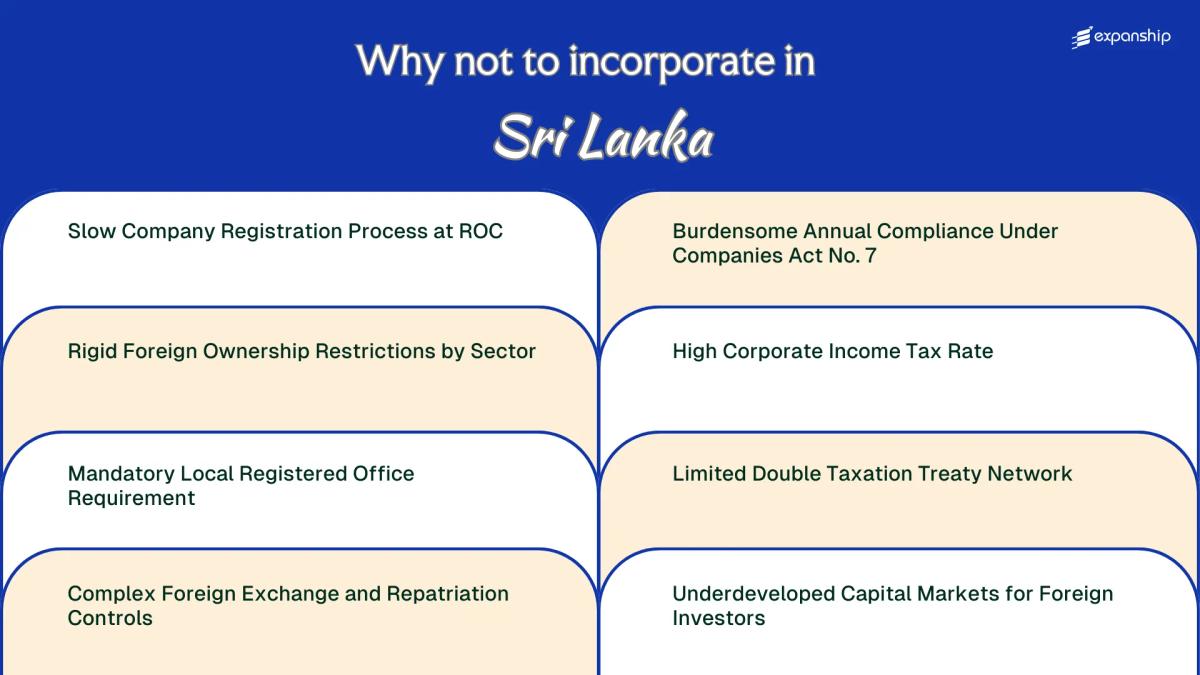
Slow Company Registration Process at ROC
The slow company registration Sri Lanka ROC process is a documented friction point for foreign investors attempting to establish a legal presence quickly. Timelines that extend beyond initial estimates translate directly into delayed market entry and rising pre-operational costs.
Registration Delays at the Department of the Registrar of Companies
Under the Companies Act No. 7 of 2007, incorporation requires submitting prescribed forms, a memorandum and articles of association, and statutory declarations to the Department of the Registrar of Companies (DROC). Processing times can stretch from several weeks to over two months depending on document completeness, officer workload, and any requisitions raised by the DROC for corrections.
For a foreign business owner, this timeline means your entity cannot open a bank account, sign contracts, or employ staff until the certificate of incorporation is issued.
Systemic Backlogs and Manual Verification
Despite partial digitisation through the DROC's online portal, manual document verification remains embedded in the process, creating bottlenecks that digital submission alone does not resolve. Name reservation, director verification, and registered office confirmation each pass through separate review stages, compounding the overall delay.
Until the DROC issues the certificate of incorporation, your company has no legal standing in Sri Lanka, meaning every day of processing delay is a day your business cannot operate, contract, or generate revenue.
Rigid Foreign Ownership Restrictions by Sector
Foreign ownership restrictions Sri Lanka sectors impose are among the most structurally significant barriers foreign investors encounter. Under the Strategic Development Projects Act and the framework administered by the Board of Investment (BOI), certain industries are either fully closed to foreign capital or subject to ownership caps that prevent majority control.
Prohibited and restricted sectors include activities where your firm cannot hold a majority stake or any equity at all:
- Coastal fishing businesses, where foreign ownership is barred entirely, forcing you to exit or restructure before operations begin
- Retail trade with capital below USD 5 million, which excludes smaller foreign retailers from operating independently
- Non-citizen land ownership restrictions that complicate property-intensive business models requiring direct asset holding
- Money lending and pawn broking, which remain closed to foreign entities regardless of BOI registration status
These restrictions are not uniformly published in a single consolidated register, which means your legal due diligence costs increase simply to confirm eligibility before incorporation. Sectors that appear accessible may carry conditions that only surface during BOI screening.

Company Incorporation in Sri Lanka
Set up your business entity in Sri Lanka with guidance on BOI compliance, sector eligibility, and ownership structuring.
Mandatory Local Registered Office Requirement
Under the Companies Act No. 7 of 2007, every company incorporated in Sri Lanka must maintain a registered office within the country at all times. This address must be a physical location where statutory correspondence from the Registrar of Companies can be received, and it cannot be a post office box. For a foreign investor with no existing local presence, this Sri Lanka registered office requirement creates an immediate structural cost before commercial operations begin.
| Requirement | Detail | Burden for Foreign Firms |
|---|---|---|
| Office type | Physical address only; PO boxes prohibited | Forces lease or service agreement from day one |
| Notification obligation | Any change of address must be filed with the Registrar | Administrative cost per address change |
| Statutory documents on-site | Register of members and directors must be accessible at the address | Requires a permanent local custodian or agent |
| Compliance window | Address must be active from date of incorporation | No grace period for establishing local presence |
The registered address also functions as the location where certain statutory records must be kept accessible, including the register of members and directors. Your business effectively needs a reliable local agent or office manager to receive official notices, since missing a statutory communication can trigger compliance defaults. This mandatory physical presence requirement foreign firms face adds recurring overhead that jurisdictions offering virtual registered address arrangements do not impose.
Complex Foreign Exchange and Repatriation Controls
Sri Lanka foreign exchange repatriation controls are governed by the Foreign Exchange Act No. 12 of 2017, administered by the Central Bank of Sri Lanka (CBSL). While the Act replaced the older Exchange Control Act, restrictions on converting and transferring funds abroad remain a structural friction point for foreign-owned entities.
Repatriating profits requires documentation demonstrating tax compliance, audited accounts, and CBSL approval in certain cases. This approval process introduces delays that directly affect your ability to move capital on your own timeline.
The 2022 foreign currency crisis, which led to temporary suspension of outward remittances, exposed how quickly CBSL restrictions can tighten under economic stress. A foreign investor has no contractual guarantee that current repatriation permissions will remain unchanged.
Current account transactions are generally permitted, but capital account transactions, including dividend remittances above certain thresholds, remain subject to CBSL oversight under the FEA framework.
- Outward remittances require supporting documentation proving tax clearance
- Capital account transfers are subject to CBSL review, not automatic approval
- Currency conversion depends on prevailing foreign exchange availability
- Dividend repatriation timelines are not contractually fixed or guaranteed
Sri Lanka suspended outward capital remittances during its 2022 economic crisis, meaning foreign investors legally could not repatriate funds regardless of their company's compliance status.
Burdensome Annual Compliance Under Companies Act No. 7
Companies incorporated under the Companies Act No. 7 of 2007 face a structured set of annual obligations that generate recurring administrative costs. For foreign-owned entities, meeting these requirements from abroad adds a layer of operational friction that is rarely anticipated at the formation stage.
Statutory Filing Obligations and Their Frequency
Every company registered with the Registrar of Companies must file an Annual Return, audited financial statements, and a solvency statement within prescribed deadlines each year. Missing these deadlines triggers penalty provisions under the Act, and repeated non-compliance can result in the Registrar initiating strike-off proceedings against the entity.
Cost Implications for Foreign-Owned Entities
Audited accounts must be prepared by a qualified auditor registered in Sri Lanka, which means your business cannot rely on offshore accounting arrangements already in place elsewhere. This mandatory local audit requirement imposes a fixed annual cost regardless of the company's revenue or operational activity, making dormant or holding structures disproportionately expensive to maintain over time.
Managing Annual Compliance Obligations for Your Sri Lanka Entity
Get structured guidance on meeting your statutory filing deadlines under the Companies Act No. 7 of 2007, so your entity stays in good standing with the Registrar of Companies.
High Corporate Income Tax Rate
The high corporate tax rate in Sri Lanka places a measurable cost burden on foreign investors that is difficult to offset without structural planning. At the standard rate of 30% under the Inland Revenue Act No. 24 of 2017, your business faces one of the heavier corporate income tax rates in South Asia.
- The standard 30% CIT rate applies to most commercial entities, meaning foreign-owned companies outside designated incentive sectors absorb a tax charge that directly reduces distributable profit.
- Qualifying industries such as exports and IT services access concessionary rates as low as 15%, but most general trading and service businesses do not qualify, leaving the 30% rate as the operative liability.
- Unlike jurisdictions with territorial tax systems, Sri Lanka taxes resident companies on worldwide income, which can expose your foreign-sourced earnings to domestic tax where treaty relief is unavailable.
- The Inland Revenue Department administers quarterly estimated tax payments, creating a recurring cash flow obligation before actual profits are confirmed.
Limited Double Taxation Treaty Network
Sri Lanka's limited double tax treaty network covers roughly 45 jurisdictions, which is significantly narrow compared to regional peers such as Singapore (over 90 treaties) or India (over 90 treaties). For foreign companies routing income through or out of the country, this gap directly exposes profits to double taxation with no treaty relief available.
Dividends, royalties, and service fees paid to parent companies in non-treaty countries are subject to withholding tax under the Inland Revenue Act No. 24 of 2017, with no mechanism to reduce that rate through a bilateral agreement. That withholding cost compounds annually, making certain ownership structures economically inefficient.
Key treaty gaps that create practical exposure include payments to entities in:
- United States
- Germany
- Most Gulf Cooperation Council states
- Many Southeast Asian markets outside Singapore
Even where treaties exist, some agreements are dated and do not reflect modern OECD standards on permanent establishment or beneficial ownership, which can create interpretive uncertainty during tax assessments.
A foreign firm paying a 14% withholding tax on royalties remitted to a U.S. parent company receives no treaty reduction, since no Sri Lanka-U.S. tax treaty exists. On USD 500,000 in annual royalty payments, that amounts to USD 70,000 in irrecoverable withholding tax each year.
Underdeveloped Capital Markets for Foreign Investors
Sri Lanka underdeveloped capital markets risks are a tangible constraint for foreign firms seeking equity financing or public exit strategies after incorporation. The Colombo Stock Exchange (CSE) lists fewer than 300 companies, a relatively thin pool that limits price discovery, secondary market liquidity, and institutional participation compared to regional exchanges such as the Bursa Malaysia or the Stock Exchange of Thailand.
For a foreign-incorporated entity, shallow trading volumes mean that raising growth capital through a public offering is not a realistic near-term option. Private equity and venture capital markets are similarly underdeveloped, leaving debt financing as often the only accessible route, which increases financial risk for capital-intensive businesses.
The Securities and Exchange Commission of Sri Lanka (SEC) governs capital market activity under the Securities and Exchange Commission Act, but regulatory capacity has not translated into market depth. Foreign institutional investors also face restrictions and disclosure requirements that add friction when entering or exiting positions on the CSE.
- Thin secondary market liquidity constrains exit options for foreign equity investors
- Limited institutional investor base reduces demand for foreign-incorporated entities seeking listings
- Absence of a mature derivatives market removes hedging tools that foreign firms typically rely on
Foreign companies considering a CSE listing must satisfy specific eligibility thresholds set by the CSE Listing Rules, and the SEC retains discretionary authority over approvals, meaning a listing is not guaranteed regardless of financial standing.
Overcoming Sri Lanka's Incorporation Challenges
Overcoming Sri Lanka's incorporation challenges requires structural preparation rather than reactive adjustments after registration is underway.
- Submit your company registration application through the Registrar of Companies online portal to reduce processing delays tied to manual filing.
- Review the Foreign Exchange Act No. 12 of 2017 and applicable Central Bank directions before structuring your capital remittance and repatriation arrangements.
- Verify your intended business activity against the Board of Investment's restricted and prohibited sector list prior to determining your ownership structure.
- Appoint a locally maintained registered office address in Sri Lanka at the point of incorporation to satisfy the Companies Act No. 7 of 2007 requirement.
- Build your annual compliance calendar around the statutory deadlines for annual returns and audited financial statements under the Companies Act No. 7 of 2007.
The steps above operate within a regulatory environment shaped by multiple overlapping authorities, including the BOI, the Central Bank, and the Inland Revenue Department. Each layer introduces distinct obligations that compound the compliance burden for foreign-owned entities.
Sri Lanka's Overall Investment Appeal
Sri Lanka's investment appeal despite drawbacks is real, though it applies to a specific range of business profiles rather than all foreign entrants. The Board of Investment of Sri Lanka actively facilitates qualified foreign investors, and the country's strategic location in the Indian Ocean, its educated English-speaking workforce, and its export-oriented incentive structures remain concrete factors that sustain interest.
| Pros | Cons |
|---|---|
| BOI-registered entities can access tax holidays and concessionary rates under negotiated agreements | Corporate income tax rate of 30% applies to most businesses outside preferential regimes |
| English is widely used in business and legal documentation, reducing transactional friction | Company registration through the Registrar of Companies is slow, with manual processes extending timelines |
| Sri Lanka's geographic position supports regional trade and logistics-focused operations | Foreign ownership is restricted or capped in several sectors under the Strategic Development Projects Act and related frameworks |
| Export-oriented sectors can qualify for reduced tax treatment and duty exemptions | The double taxation treaty network is limited, increasing withholding tax exposure for cross-border structures |
| A resident population of over 22 million provides a domestic consumer base | Foreign exchange repatriation involves Central Bank of Sri Lanka approval requirements that add procedural complexity |
Annual compliance obligations under Companies Act No. 7 of 2007 add recurring administrative cost regardless of business activity level. Underdeveloped capital markets further constrain exit options for foreign shareholders seeking liquidity events.
Compliance Services for Companies in Sri Lanka
Managing annual filings, statutory returns, and regulatory obligations under Companies Act No. 7 of 2007 requires consistent attention. This service covers the ongoing compliance requirements for foreign-owned entities registered in Sri Lanka.
Conclusion
The Sri Lanka company incorporation cons summary points to a jurisdiction with genuine structural friction. Foreign ownership caps enforced across reserved and regulated sectors under the Board of Investment framework, combined with a corporate tax rate that reaches 30% for certain categories of business, create a measurable cost of entry. The limited bilateral tax treaty network compounds exposure for cross-border structures. For your business, the question is not whether these constraints exist, but how they interact with your specific sector, ownership model, and repatriation requirements. Specialist guidance on local regulatory compliance becomes a practical necessity, not an optional step.
Expanship's Sri Lanka Expansion Support
From managing the Registrar of Companies filing queue to maintaining annual compliance under Companies Act No. 7 of 2007, the administrative weight of operating in Sri Lanka is real. Expanship Sri Lanka company formation support is designed to reduce that operational burden, handling the procedural groundwork so your team can focus on building the business rather than managing bureaucracy.
Our scope covers the full formation and maintenance cycle across Sri Lanka:
- Preparing and submitting company registration documents with the ROC
- Providing a registered agent and a compliant local registered office address
- Liaising with government bodies and regulatory authorities on your behalf
- Managing ongoing compliance obligations after your entity is incorporated
- Facilitating introductions to local banking institutions
- Handling tax registration and coordination with the Inland Revenue Department
Reach out to Expanship Sri Lanka to discuss how we can support your entry into this market.
Frequently Asked Questions (FAQ)
The Foreign Exchange Act No. 12 of 2017 restricts capital account transactions, meaning repatriation of profits, dividends, and loan repayments all require compliance with Central Bank of Sri Lanka regulations. Current account transactions, such as payments for goods and services, face fewer restrictions, but capital movements remain tightly controlled. Foreign businesses that need to move funds across borders regularly will find this a recurring compliance burden rather than a one-time hurdle.
Under the Companies Act No. 7 of 2007, failure to file annual returns or financial statements on time exposes the company and its directors to fines, and persistent non-compliance can result in the ROC striking the company off the register. Directors bear personal liability for certain filing defaults, which is a significant exposure for foreign nationals serving in directorial roles. Reinstatement after a strike-off requires a court application, adding cost and time to an already disruptive outcome.
Sri Lanka's standard corporate income tax rate of 30% sits above rates in several competing jurisdictions in the region, including Singapore at 17% and Malaysia at 24%. Some preferential rates apply to specific sectors, such as small and medium enterprises or qualifying exports, but most foreign-owned companies operating in general commerce face the full 30% rate. For businesses evaluating South and Southeast Asian incorporation options purely on tax efficiency, Sri Lanka's rate is a material disadvantage.
Sri Lanka has concluded double taxation agreements with approximately 40 countries, which is considerably fewer than hubs such as Singapore, which has over 90 treaties, or Mauritius, which has built its treaty network specifically to serve as a gateway jurisdiction. Businesses that operate across multiple jurisdictions and rely on treaty benefits to reduce withholding tax on dividends, royalties, or interest will find Sri Lanka's network insufficient for many common cross-border structures. The absence of a treaty with a key trading partner can meaningfully increase the effective tax cost of operating through a Sri Lanka entity.
Foreign ownership restrictions do not apply uniformly. Certain sectors, including large-scale retail trading, coastal fishing, and businesses on the Board of Investment's negative list, prohibit or cap foreign equity. Outside restricted sectors, 100% foreign ownership is permitted, but identifying whether your specific business activity falls under a restriction requires careful review of the relevant regulatory schedules. Misclassifying your activity and proceeding without the correct approvals creates a compliance exposure that can affect the validity of the incorporation itself.
The Colombo Stock Exchange has a relatively shallow pool of institutional investors and limited liquidity compared to exchanges in Singapore, Hong Kong, or even Mumbai. A foreign firm seeking to raise equity capital, list debt instruments, or attract institutional funding through Sri Lanka's domestic market will find the options significantly constrained. This means most foreign-incorporated entities in Sri Lanka must rely entirely on offshore financing or internal group funding, which reintroduces the foreign exchange control issues that already complicate capital repatriation.
Yes, both locally incorporated companies and registered foreign branch offices must maintain a physical registered office address in Sri Lanka that is on record with the ROC at all times. A virtual address may satisfy the statutory requirement in some cases, but the address must be capable of receiving official correspondence and regulatory notices. Failing to maintain or update a valid registered office address is a filing default under the Act and can attract penalties for the company and its officers.
Legal Disclaimer
The information provided in this article is for general informational purposes only and does not constitute legal, tax, or professional advice. While we strive to ensure the accuracy and timeliness of the content, laws and regulations are subject to change, and the application of laws can vary widely based on specific facts and circumstances.
Readers should not act upon this information without seeking professional counsel tailored to their individual situation. Expanship and its authors disclaim any liability for actions taken or not taken based on the content of this article.
For specific advice regarding your business setup, compliance requirements, or any legal matters, please consult with qualified legal and tax professionals in the relevant jurisdiction.