
Key Takeaways
- Under the Inland Revenue Act No. 24 of 2017, foreign companies operating in Sri Lanka are taxed only on Sri Lanka-source profits, structurally limiting tax exposure for internationally operating entities.
- Full foreign equity ownership is permitted across most sectors under the Board of Investment of Sri Lanka's regulatory framework, eliminating the need for local partnership arrangements that reduce operational control.
- Sri Lanka's geographic position in the Indian Ocean places incorporated businesses within direct commercial reach of both South Asian and Southeast Asian trade corridors, compressing logistics and market-entry timelines.
- The Registrar of Companies administers incorporation under the Companies Act No. 7 of 2007 with comparatively low formation costs, reducing the capital commitment required to establish a legal presence in the jurisdiction.
Sri Lanka is an independent island nation situated in the Indian Ocean, off the southern tip of the Indian subcontinent, and operates as a constitutional republic. Company registration falls under the purview of the Registrar of Companies, which administers incorporation under the Companies Act No. 7 of 2007. Foreign businesses most commonly establish a presence through a private limited company.
The country maintains a territorial tax posture, with corporate income taxed on Sri Lanka-source profits under the Inland Revenue Act No. 24 of 2017. Foreign direct investment is broadly permitted, and the Board of Investment of Sri Lanka serves as the principal body facilitating and regulating inward investment across a wide range of sectors.
Understanding the benefits of incorporating in Sri Lanka requires examining the regulatory, fiscal, and structural features that shape its business environment. This article covers the key advantages that make the jurisdiction a viable option for foreign entrepreneurs and corporate entities considering formation here.
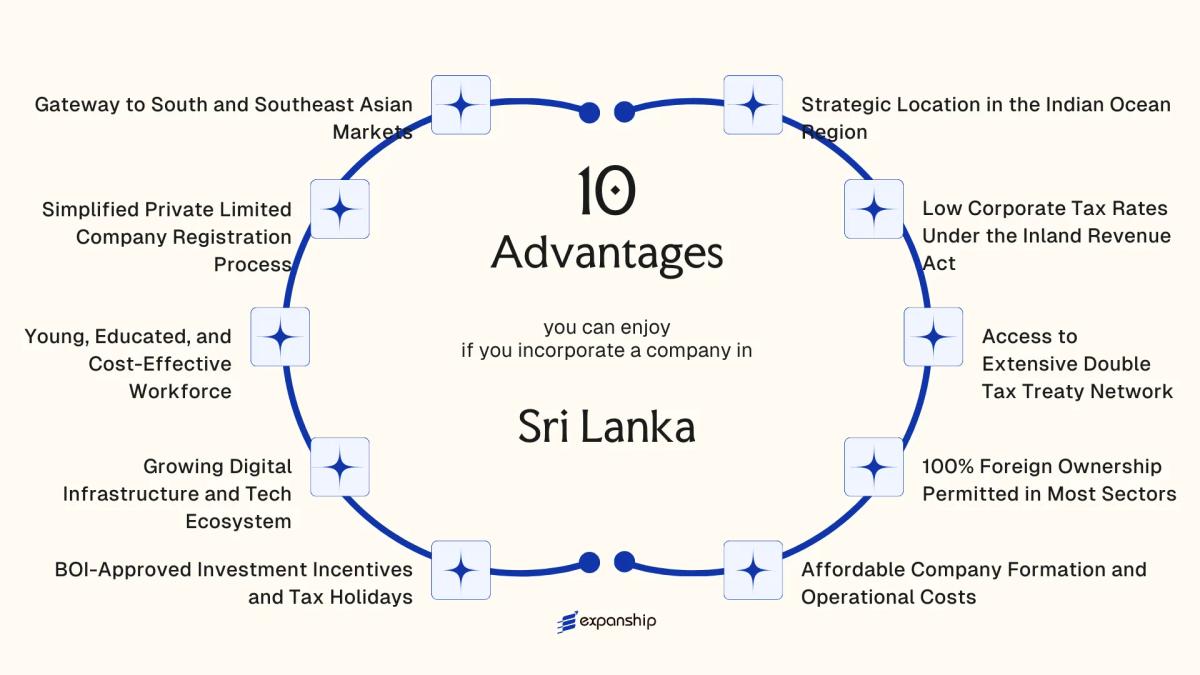
Strategic Location in the Indian Ocean Region
Sri Lanka's geographic position in the Indian Ocean gives it a Sri Lanka strategic location Indian Ocean advantage that translates directly into reduced transit times and lower logistics costs for goods moving between Asia, the Middle East, and East Africa.
Proximity to Major Shipping Lanes
The Port of Colombo sits on one of the world's most heavily trafficked east-west shipping routes, placing your business within reach of a corridor that handles a significant share of global container traffic. Vessels traveling between Europe, the Gulf, and East Asia pass within close range without requiring route deviation, which reduces freight costs meaningfully for import-export operations.
Access to Regional Markets Within Hours
Colombo's Bandaranaike International Airport and its growing air freight capacity place your business within a four-hour flight radius of major commercial centers including Mumbai, Singapore, and Dubai. For regional distribution or time-sensitive supply chains, this geographic proximity reduces dependence on longer transit corridors compared to landlocked alternatives in South Asia.
Companies incorporated here can use Colombo as a cost-efficient transshipment and distribution base to serve Indian Ocean regional markets without establishing separate entities across multiple countries.
Low Corporate Tax Rates Under the Inland Revenue Act
Sri Lanka's corporate tax structure is defined by the Inland Revenue Act No. 24 of 2017, which consolidated and modernised the country's direct tax framework. The standard corporate income tax rate sits at 30%, but this headline figure does not reflect the actual rate most foreign-owned businesses face. Qualifying companies in priority sectors are taxed at 14%, a rate that applies to a defined range of activities including information technology, tourism, education, and certain export-oriented services.
For an investor structuring a regional operation, a 14% effective rate carries real weight. That is less than half the 30% standard rate and meaningfully lower than comparable economies in the region.
The preferential rate structure under the Inland Revenue Act is not incidental. It reflects a deliberate policy to channel investment into specific sectors, which means the rate your business qualifies for is largely predictable from incorporation.
Conditions that make this framework practical for foreign businesses:
- The 14% rate applies based on the nature of business activity, not company age or minimum capital requirements
- The qualifying sector list covers industries where foreign operators commonly establish regional hubs
- Tax residency is determined by place of incorporation and management, giving you structural clarity
- The Inland Revenue Act provides a codified basis for these rates, reducing interpretive uncertainty

Incorporate a Company in Sri Lanka
Set up your Sri Lanka private limited company with full guidance on tax classification, sector eligibility, and Inland Revenue Act compliance.
Access to Extensive Double Tax Treaty Network
Sri Lanka's double tax treaty network benefits foreign businesses by reducing withholding taxes on dividends, interest, and royalties paid across borders. The country has concluded tax treaties with over 40 jurisdictions, including the United Kingdom, India, Germany, Singapore, China, and Australia. These agreements are administered under the Inland Revenue Act No. 24 of 2017 and take precedence over domestic tax provisions where they offer more favorable treatment, giving your entity a degree of certainty that domestic legislation alone cannot provide.
| Treaty Partner | Dividends (%) | Interest (%) | Royalties (%) |
|---|---|---|---|
| United Kingdom | 15 | 10 | 10 |
| India | 15 | 10 | 10 |
| Singapore | 15 | 10 | 10 |
| Germany | 15 | 10 | 10 |
| China | 10 | 10 | 10 |
| Australia | 15 | 10 | 10 |
For a foreign firm repatriating profits or paying management fees to a parent entity, treaty protection directly reduces the tax cost of cross-border transactions. Without treaty access, withholding taxes apply at standard domestic rates, which can erode the economics of intra-group arrangements or investor returns.
Treaty benefits are generally available to entities that qualify as tax residents under the relevant agreement. Establishing genuine substance in the country is therefore a prerequisite, not an optional consideration, for accessing reduced rates under these double taxation avoidance agreements.
100% Foreign Ownership Permitted in Most Sectors
Under the Companies Act No. 7 of 2007, foreign nationals can hold up to 100% equity in a private limited company registered in Sri Lanka, without requiring a local partner or shareholder. One of the primary 100 percent foreign ownership Sri Lanka benefits is that you retain full decision-making authority over your entity from day one, without diluting control through mandatory joint-venture structures.
This ownership framework applies broadly across commerce, manufacturing, IT services, tourism, and logistics. Sectors involving strategic national interests, including certain land ownership arrangements and coastal fishing, carry restrictions, but the majority of commercially active industries fall outside those limitations.
The Board of Investment of Sri Lanka (BOI), operating under the BOI Act No. 4 of 1978, acts as the primary approval body for foreign-owned enterprises seeking strategic registration. Entities incorporated outside the BOI framework register directly through the Registrar of Companies, still retaining full foreign ownership eligibility under the Companies Act.
Keep these points in mind:
- Confirm your target sector is not on the restricted or reserved industries list before structuring ownership
- Foreign ownership does not automatically confer land ownership rights; those are governed by separate legislation
- BOI registration is optional but unlocks specific incentive packages for qualifying foreign-owned firms
- Certain regulated industries such as banking and insurance require prior approval from sector-specific authorities
Sri Lanka permits 100% foreign ownership even in most retail and wholesale trade activities, a restriction that many comparable emerging-market jurisdictions still impose on foreign investors.
Affordable Company Formation and Operational Costs
Affordable company formation costs in Sri Lanka are among the more quantifiable advantages for foreign investors assessing entry into South Asia. Registration fees, statutory capital requirements, and recurring compliance costs sit well below what comparable structures demand in Singapore, India, or Malaysia, which directly reduces the capital outlay required before a business begins generating revenue.
Formation Costs and Minimum Capital Requirements
A private limited company registered under the Companies Act No. 7 of 2007 carries no prescribed minimum share capital, meaning you can incorporate with a nominal amount. This absence of a capital floor eliminates a barrier that, in many jurisdictions, locks up working capital during the pre-operational phase.
Registration is processed through the Registrar of Companies under the Department of the Registrar of Companies, with government filing fees that remain modest relative to the region. Professional and statutory costs to complete incorporation are generally recoverable within months of commencing operations.
Recurring Operational Expenditure
Office space in Colombo's secondary business districts and emerging commercial zones outside the Western Province costs a fraction of equivalent space in regional hubs. This gap in occupancy costs has a direct effect on your firm's fixed cost base over a multi-year horizon.
Utility rates and general overhead for service-oriented businesses remain low, partly due to government-regulated pricing structures across several sectors. For a foreign entity establishing a back-office, holding structure, or regional coordination function, the cumulative savings on operational expenditure are structurally built into the cost model from day one.
Understand the Full Cost Structure Before You Incorporate in Sri Lanka
Speak with an Expanship specialist to get a clear picture of formation fees, ongoing compliance costs, and how to structure your entity for cost efficiency under Sri Lankan law.
BOI-Approved Investment Incentives and Tax Holidays
The Board of Investment (BOI) of Sri Lanka operates under the BOI Act No. 4 of 1978 and functions as a one-stop approval authority for qualifying foreign investments. BOI-approved status unlocks a structured package of fiscal concessions that are not available under the standard Inland Revenue Act framework, making BOI registration a distinct and commercially significant pathway for eligible enterprises. The specific incentives granted depend on the investment amount, sector, and project category, but several core benefits apply broadly across approved entities.
- Qualifying BOI enterprises can receive corporate income tax holidays ranging from 3 to 25 years, depending on the scale of investment and designated sector. A project invested in an identified priority sector with a minimum capital threshold may qualify for the longer end of this range, deferring tax liability during the critical growth phase of the business.
- BOI-approved companies are exempt from customs duties and other import levies on capital goods and project-related materials, reducing initial capital expenditure on plant, machinery, and equipment.
- Approved entities may be entitled to full repatriation of profits, dividends, and capital, backed by guarantees enshrined in the BOI Act itself, providing contractual certainty rather than relying solely on general foreign exchange regulations.
- VAT concessions and exemptions on specified inputs may apply to BOI projects operating within designated Economic Processing Zones, further reducing operational overhead during the production or service-delivery phase.
Growing Digital Infrastructure and Tech Ecosystem
Sri Lanka digital infrastructure benefits for businesses are grounded in measurable government investment. The Information and Communication Technology Agency (ICTA) has led national digitisation programs covering broadband expansion, e-government services, and digital public infrastructure across the island. For a foreign firm establishing operations here, this translates to functional connectivity and administrative systems rather than analogue bottlenecks.
The IT and BPO sector has been designated a priority export industry under the Board of Investment framework. This classification gives qualifying technology and software businesses access to tax concessions and facilitated operational setup, reducing the cost of entry for foreign investors in the digital economy.
Colombo's emergence as a tech hub is supported by a cluster of IT parks, co-working facilities, and incubators concentrated in areas such as Trace Expert City. These purpose-built environments allow foreign companies to establish offices without committing to conventional commercial real estate costs from the outset.
Sri Lanka's IT and BPO exports exceeded USD 1.7 billion in recent years, according to the Sri Lanka Association of Software and Service Companies (SLASSCOM), indicating an established export-oriented digital services market that a foreign entity can enter, supply, or partner within.
Young, Educated, and Cost-Effective Workforce
The Sri Lanka educated workforce advantage for businesses is grounded in measurable structural conditions. Adult literacy exceeds 92%, and the country produces a substantial annual output of university graduates across engineering, IT, accounting, and management disciplines, supplied through a network of state universities overseen by the University Grants Commission.
Salary benchmarks for skilled professionals sit considerably below comparable talent pools in India's metropolitan centres or Southeast Asian hubs like Malaysia. For a foreign business hiring locally, this gap directly reduces operating expenditure without requiring trade-offs on educational attainment.
English proficiency is relatively high among graduate-level candidates, particularly in professional services sectors. This reduces onboarding friction for foreign-managed entities that operate in English as the primary business language.
- A significant share of the working-age population falls below 35, which supports sustained hiring pipelines for growth-stage operations.
- Graduates in fields such as software development and finance are increasingly familiar with international work standards, partly due to the volume of outsourcing activity the country hosts.
Employment terms, minimum wage thresholds, and mandatory contributions under the Employees' Provident Fund (EPF) and Employees' Trust Fund (ETF) apply to all locally hired staff, and these obligations fall on the registered entity.
Simplified Private Limited Company Registration Process
Sri Lanka private limited company registration benefits begin with the registration framework itself. Under the Companies Act No. 07 of 2007, a private limited company, designated with the suffix "(Pvt) Ltd", can be incorporated with a minimum of one shareholder and one director. Neither is required to be a Sri Lankan resident, which removes a structural barrier that exists in many other jurisdictions in the region.
Registration is administered through the Registrar of Companies under the Department of the Registrar of Companies (DRAC). The process is conducted via the eROC online portal, which accepts applications, supporting documents, and payment electronically. For straightforward applications, incorporation can be completed within a matter of days once documentation is in order.
The statutory minimum share capital requirement is LKR 1, meaning there is no prescribed paid-up capital floor that a foreign investor must meet before the entity becomes operational. This low threshold reduces the capital commitment required at the formation stage.
A single person can simultaneously hold the roles of director and shareholder, which simplifies the governance structure for sole founders or small foreign-owned enterprises that do not require a multi-person board from inception.
Required formation documents include:
- Consent of the first directors
- Application for reservation of company name
- Articles of Association (or adoption of standard articles under the Act)
- Declaration of compliance
Once incorporated, the firm receives a certificate of incorporation and a Company Registration Number, which are required to open a corporate bank account and obtain business licenses.
Gateway to South and Southeast Asian Markets
Situated between South Asia and Southeast Asia, Sri Lanka functions as a natural transit and commercial junction for companies seeking to serve multiple regional markets without maintaining separate legal entities in each one. The Sri Lanka gateway to South Asian markets benefit is structural, not incidental — the island's position in the Indian Ocean places your business within 3.5 hours by air of major commercial centres including Mumbai, Chennai, Singapore, and Kuala Lumpur.
Under the Board of Investment of Sri Lanka (BOI), registered entities can conduct regional distribution, re-export, and service operations that target both SAARC and ASEAN-adjacent markets from a single base. This reduces the operational cost of managing multi-market exposure, since a company incorporated under the Sri Lanka Companies Act No. 7 of 2007 can be structured to hold regional contracts and intellectual property centrally.
The country maintains preferential trade arrangements that extend its commercial reach:
- The Indo-Sri Lanka Free Trade Agreement (ISFTA) provides duty concessions on a range of goods exported to India, one of the world's largest consumer markets by population.
- The Pakistan-Sri Lanka Free Trade Agreement (PSFTA) extends further preferential access into South Asia.
- Ongoing negotiations under the proposed Economic and Technology Cooperation Agreement (ETCA) with India, if concluded, would deepen services trade access.
- Colombo Port, one of the busiest transshipment hubs in the Indian Ocean, supports physical goods businesses with direct connectivity to major Asian and European shipping lanes.
For firms targeting South Asian market access advantages without the regulatory burden of incorporating directly in India or Pakistan, this combination of trade frameworks and geographic position creates measurable operational value.
Why Sri Lanka Stands Out Against Regional Competitors
Businesses comparing South Asia incorporation options tend to evaluate Sri Lanka alongside India, Bangladesh, and Singapore. India and Bangladesh are included here because they represent the two largest economies in the immediate region, with overlapping investor demographics. Singapore, while more developed, is a realistic alternative for investors weighing a higher-cost, higher-prestige structure against a more cost-accessible base in the Indian Ocean corridor. What the comparison reveals is not merely that Sri Lanka is cheaper in certain categories, but that its regulatory framework, under statutes such as the Inland Revenue Act No. 24 of 2017 and the Companies Act No. 7 of 2007, offers a degree of structural clarity that regional peers at similar cost levels do not consistently match.
At a standard corporate tax rate of 30% for most sectors, India sits above Sri Lanka's general rate, while also imposing dividend distribution tax and more complex transfer pricing compliance. Bangladesh applies a 27.5% rate for listed companies but higher rates for unlisted entities, alongside more restrictive foreign equity rules in certain sectors. Singapore's 17% headline rate is lower, but operational and establishment costs are substantially higher, making it a structurally different proposition for cost-sensitive investors.
| Parameter | Sri Lanka | India | Bangladesh | Singapore |
|---|---|---|---|---|
| Standard Corporate Tax Rate | 14%–30% (sector-dependent) | 22%–25% (base rate) | 27.5%–30% (listed/unlisted) | 17% |
| 100% Foreign Ownership | Permitted in most sectors | Sector-specific FDI caps apply | Restricted in several sectors | Permitted in most sectors |
| Double Tax Treaties | 40+ treaties active | 90+ treaties active | ~30 treaties active | 90+ treaties active |
| BOI-Equivalent Investment Body | BOI Sri Lanka | Invest India | BIDA | EDB Singapore |
| Minimum Paid-Up Capital (General) | No statutory minimum | No statutory minimum (private) | BDT 1 minimum (nominal) | SGD 1 minimum |
| Company Registration Timeline | 1–3 business days (online) | 10–15 business days (average) | 10–20 business days (average) | 1–3 business days (online) |
Compliance Services for Companies in Sri Lanka
Maintain good standing with Sri Lanka's regulatory requirements, including annual returns, tax filings, and BOI reporting obligations.
Conclusion
Sri Lanka offers a structurally sound case for foreign incorporation, built on verifiable legal and fiscal foundations rather than reputation alone. The benefits of incorporating in Sri Lanka converge around three factors that directly affect cost, control, and commercial reach: a tax framework shaped by the Inland Revenue Act No. 24 of 2017, unrestricted foreign equity in most sectors under the Board of Investment of Sri Lanka's regulatory mandate, and geographic positioning that places your business within operational proximity to both South Asian and Southeast Asian trade corridors.
These advantages carry different weight depending on what your business does. A technology firm exporting services benefits disproportionately from the concessionary tax treatment available to qualifying exporters, while a manufacturing entity may find greater value in the BOI-approved incentive structures and competitive labour costs. The Registrar of Companies administers a registration process that keeps entry costs low, which matters particularly for smaller entities testing a new market.
Sri Lanka's case for incorporation rests on the combination of fiscal efficiency, ownership freedom, and market access operating within a codified legal structure. The right fit depends on your specific sector, ownership model, and long-term commercial objectives. Getting those details aligned with the correct entity type and regulatory pathway from the outset determines whether these structural advantages translate into practical outcomes for your business.
Start Your Sri Lanka Company with Expanship Today
Expanship supports foreign investors through every stage of incorporating a Private Limited Company in Sri Lanka, from initial name reservation with the Registrar of Companies under the Companies Act No. 7 of 2007, through to maintaining annual statutory obligations. The benefits covered in this blog, including BOI incentives, the double tax treaty network, and foreign ownership provisions, each carry specific documentation, filing, and compliance requirements that vary by sector and investment structure.
Expanship's services for your Sri Lanka entity include:
- Document preparation, notarization, and apostille legalization
- Registered agent and registered office provision
- Filing and liaison with the Registrar of Companies and the Board of Investment
- Post-incorporation compliance management, including annual returns and audit coordination
- Corporate secretarial support under the Companies Act
- Banking introduction assistance with local and international financial institutions
For questions about your specific structure or to begin the incorporation process, contact Expanship Sri Lanka.
Frequently Asked Questions (FAQ)
Registration with the Registrar of Companies, operated under the Department of the Registrar of Companies, typically takes between one and three business days when documents are submitted online through the eROC portal. The timeline assumes all required documents — including the Articles of Association and director identification — are in order at the time of submission. Delays generally arise from incomplete filings or name reservation issues, not from the process itself.
The standard corporate income tax rate under the Inland Revenue Act No. 24 of 2017 is 30%, though preferential rates apply to qualifying sectors. Small and medium enterprises and certain industries such as agriculture and education are taxed at lower rates, and BOI-approved entities may be eligible for concessionary rates or fixed-period tax holidays depending on their investment agreement. The applicable rate for your business depends on the industry classification and whether BOI registration has been obtained.
The Companies Act No. 7 of 2007 requires a private limited company to have at least one director, but does not explicitly mandate that this individual be a Sri Lankan resident. However, for practical compliance purposes — including tax filings with the Inland Revenue Department and dealings with the Department of the Registrar of Companies — having a locally present director or authorised representative can reduce administrative delays. Certain regulated sectors may impose additional residency requirements on directors.
A company that fails to fulfil the terms of its agreement with the Board of Investment of Sri Lanka risks losing the tax holidays, duty concessions, and other incentives granted under that agreement. The BOI retains the authority to cancel or revoke investment approvals, which would expose the entity to standard tax rates retroactively in some cases. The specific consequences depend on the terms written into the individual investment agreement signed at the time of BOI registration.
Sri Lanka maintains double taxation agreements with over 40 countries, which can reduce or eliminate withholding taxes on dividends, royalties, and interest paid across borders. For a foreign investor, this means that income repatriated to a treaty partner country may be taxed at a reduced treaty rate rather than the domestic withholding rate. The precise benefit depends on the specific treaty in force between Sri Lanka and the investor's country of residence.
Incorporation fees and annual compliance costs in Sri Lanka are materially lower than those in Singapore or the UAE, particularly in terms of government registration fees and minimum capital requirements. Unlike Singapore, Sri Lanka does not impose a mandatory paid-up capital threshold for private limited companies under the Companies Act No. 7 of 2007, and professional service costs reflect a lower general cost base. That said, Sri Lanka's financial infrastructure and international banking access are less developed than those of Singapore, which is a relevant consideration for businesses with high cross-border transaction volumes.
Legal Disclaimer
The information provided in this article is for general informational purposes only and does not constitute legal, tax, or professional advice. While we strive to ensure the accuracy and timeliness of the content, laws and regulations are subject to change, and the application of laws can vary widely based on specific facts and circumstances.
Readers should not act upon this information without seeking professional counsel tailored to their individual situation. Expanship and its authors disclaim any liability for actions taken or not taken based on the content of this article.
For specific advice regarding your business setup, compliance requirements, or any legal matters, please consult with qualified legal and tax professionals in the relevant jurisdiction.