


Key Takeaways
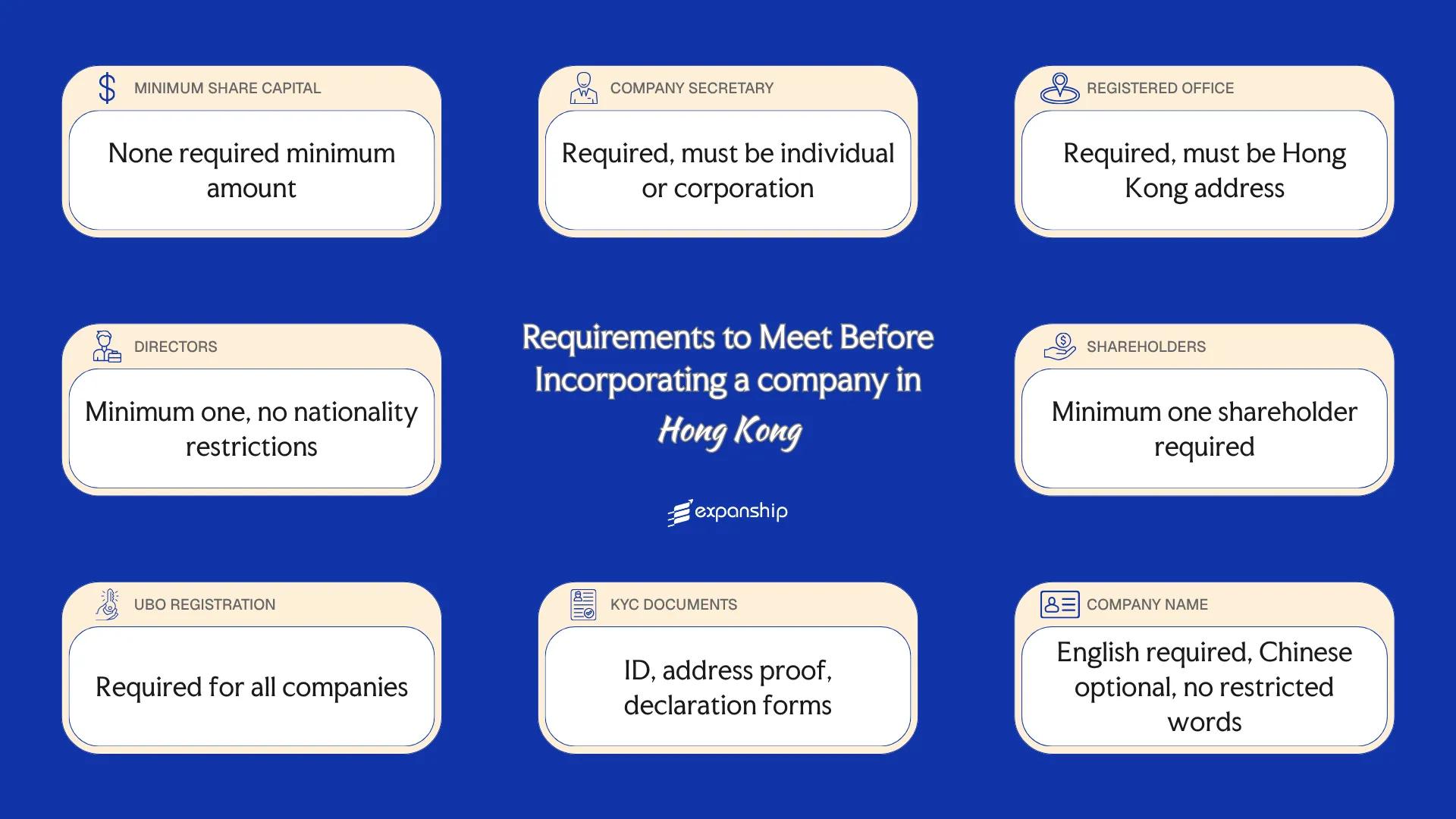
- Every private company limited by shares incorporated in Hong Kong must appoint a company secretary who is either a Hong Kong resident individual or a locally registered corporate entity, as required under the Companies Ordinance (Cap. 622).
- A significant controllers register must be maintained at the registered office or a designated location in Hong Kong, imposing an ongoing beneficial ownership disclosure obligation that survives the point of incorporation.
- The registered office address must be a physical location in Hong Kong — not a P.O. box — and must be notified to the Companies Registry at the time of incorporation and kept current throughout the company's existence.
- Directors of a Hong Kong private company are subject to minimum residency and appointment rules under Cap. 622, and at least one natural person must serve on the board at all times.
Entity formation in Hong Kong is governed by the Companies Ordinance (Cap. 622), with the Companies Registry serving as the statutory body responsible for processing and approving incorporation applications.
This article covers the structural, documentary, and compliance-based requirements applicable to private companies limited by shares, the most common vehicle used by foreign investors.
Failure to satisfy these requirements results in rejection of the incorporation application or, where non-compliance occurs post-registration, potential deregistration and legal liability under Cap. 622.
Specific requirements may differ depending on the entity type selected, the nature of the business activity, and the investor's home jurisdiction.
This article is most relevant to foreign nationals and overseas-registered businesses seeking to establish a locally incorporated entity for the first time.
Minimum Share Capital Requirements in Hong Kong
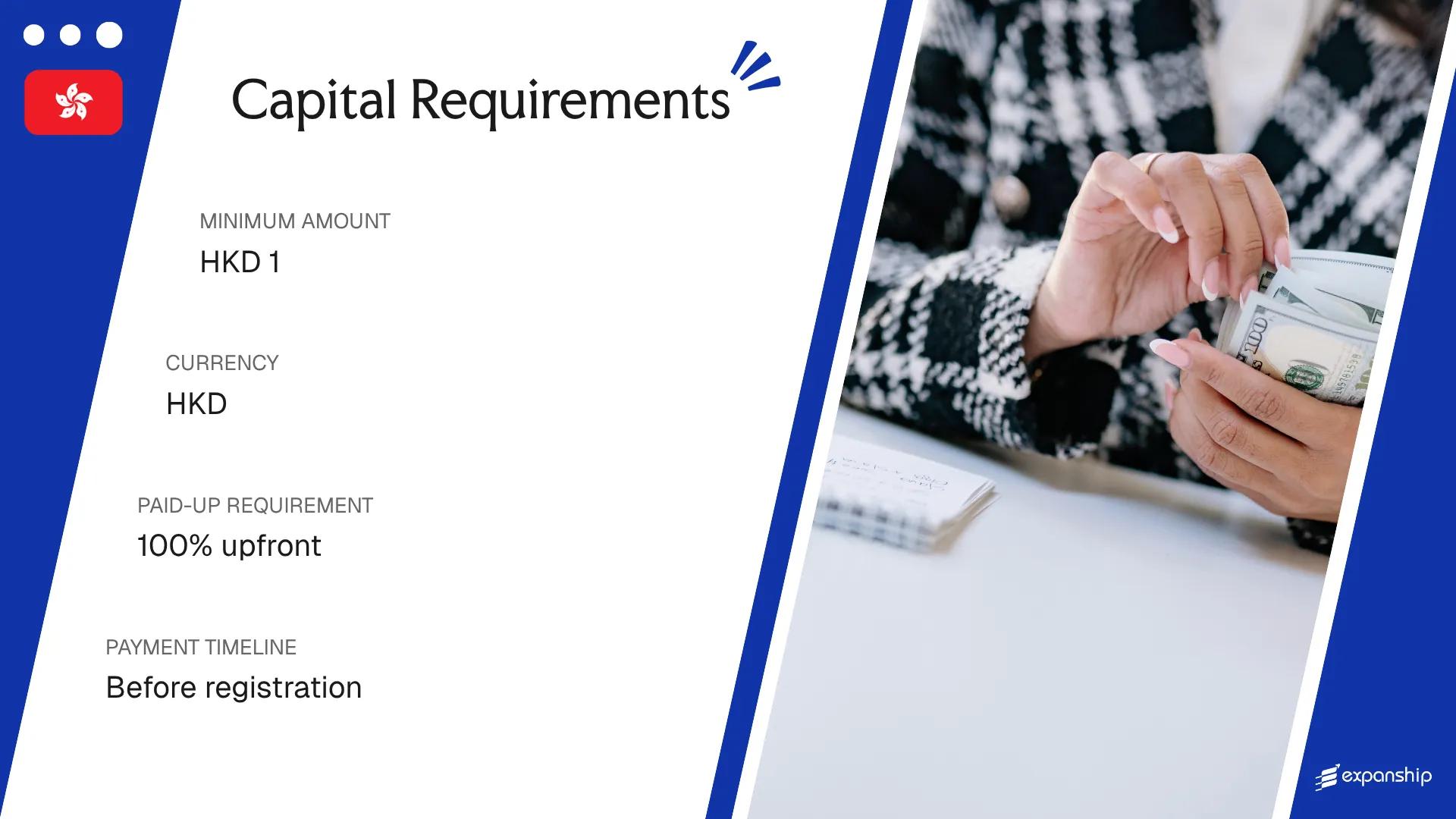
Under the Companies Ordinance (Cap. 622), there are no Hong Kong minimum share capital requirements — no statutory minimum amount must be subscribed or paid up before or after incorporation. The ordinance also abolished the concept of authorized share capital and par value when it came into force in March 2014, shifting all local private and public companies to a no-par value share system.
Share capital structure is disclosed in the incorporation documents filed with the Companies Registry, which acts as the primary registry for company formation. The Registry does not verify or enforce a capital threshold at the point of registration; it confirms that the required statutory filings are in order.
| Parameter | Detail |
|---|---|
| Minimum Authorized Share Capital | No statutory requirement |
| Maximum Authorized Share Capital | No statutory requirement |
| Minimum Paid-Up Capital | No statutory requirement |
| Paid-Up Requirement at Incorporation | No statutory requirement |
| Accepted Currency | Hong Kong Dollar (HKD) or any foreign currency |
| Accepted Forms of Contribution | Cash or non-cash consideration (including property and services) |
| Timeframe to Deposit Capital | No statutory deadline |
No minimum capital requirement does not mean share capital is optional. Your company must still issue at least one share upon incorporation, and that share must carry defined rights within the articles of association.
Company Secretary Requirements in Hong Kong
Every company incorporated in Hong Kong must appoint a company secretary, as required under the Companies Ordinance (Cap. 622). This is a mandatory position, not an optional compliance measure.
The company secretary holds responsibility for maintaining statutory registers, filing annual returns with the Companies Registry, and ensuring the firm meets its obligations under Cap. 622. Timely notification of any changes in directors, share structure, or registered particulars also falls within the secretary's scope of duties.
Qualification criteria for who may serve as company secretary:
- A natural person must ordinarily reside in Hong Kong to qualify as an individual secretary.
- A corporate body must have its registered or principal office in Hong Kong to serve in this role.
- A sole director of the entity cannot simultaneously act as the company secretary.
- There is no formal licensing requirement, but professional competence in corporate compliance is expected in practice.
- Professional firms such as solicitors, certified public accountants, or corporate services providers commonly fulfill this role.

Incorporate Your Company in Hong Kong
Set up a Hong Kong private limited company with full compliance support, including company secretary appointment and Companies Registry filing.
Registered Office Requirements in Hong Kong
Registered office requirements in Hong Kong are governed by the Companies Ordinance (Cap. 622), which mandates that every locally incorporated company maintain a registered office address at all times to receive official correspondence and legal notices from the Companies Registry. Failure to maintain a compliant address can result in the firm being struck off the register or subject to prosecution under the Ordinance.
- A physical address is required; a P.O. Box alone does not satisfy the registered office requirements Hong Kong law imposes under Cap. 622.
- The address must be located within Hong Kong; overseas addresses are not accepted by the Companies Registry.
- Virtual office addresses are permitted, provided they correspond to a physical location where documents can be received and served.
- No ownership of the premises is required; a leased or licensed address is acceptable, including addresses provided through third-party virtual office arrangements.
- The registered address is publicly listed on the Companies Registry and accessible through its online search portal.
- Any change to the registered office address must be notified to the Companies Registry by filing Form NR1 within 15 days of the change taking effect.
Director Requirements in Hong Kong
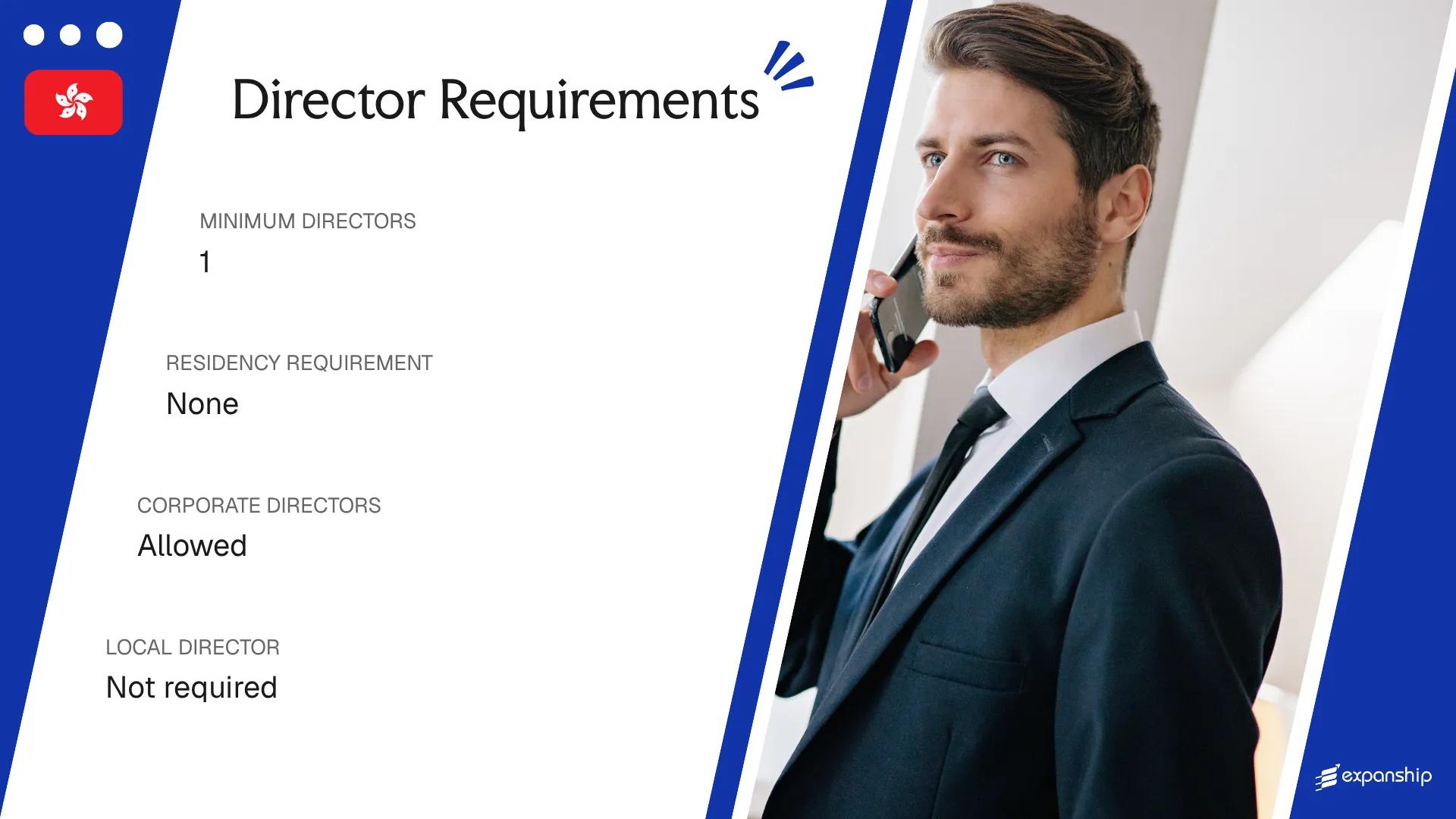
Under the Companies Ordinance (Cap. 622), directors of a Hong Kong company assume statutory duties including acting in good faith in the best interests of the entity, exercising reasonable care and skill, and avoiding conflicts of interest. Breach of these obligations can expose directors to personal liability, disqualification proceedings, or criminal prosecution under the Ordinance.
| Parameter | Detail |
|---|---|
| Minimum Number of Directors | One director is required for a private company. |
| Maximum Number of Directors | No statutory maximum applies for private companies. |
| Local/Resident Director Required | No statutory requirement for a Hong Kong-resident director. |
| Nationality Restrictions | No nationality restrictions are imposed on directors. |
| Minimum Age Requirement | Directors must be at least 18 years of age. |
| Corporate Directors Permitted | Corporate directors are not permitted; at least one natural person must serve as director. |
| Director Must Be a Shareholder | No requirement for a director to hold shares in the company. |
| Publicly Listed on Registry | Director information is filed with the Companies Registry and is publicly accessible. |
| Disqualification Conditions | Disqualification may arise from insolvency-related misconduct, conviction of relevant offences, or a court order under the Companies (Winding Up and Miscellaneous Provisions) Ordinance. |
Despite Hong Kong's international business profile, it does not require a single locally resident director — a requirement that many comparable jurisdictions mandate as standard.
Shareholder Requirements in Hong Kong
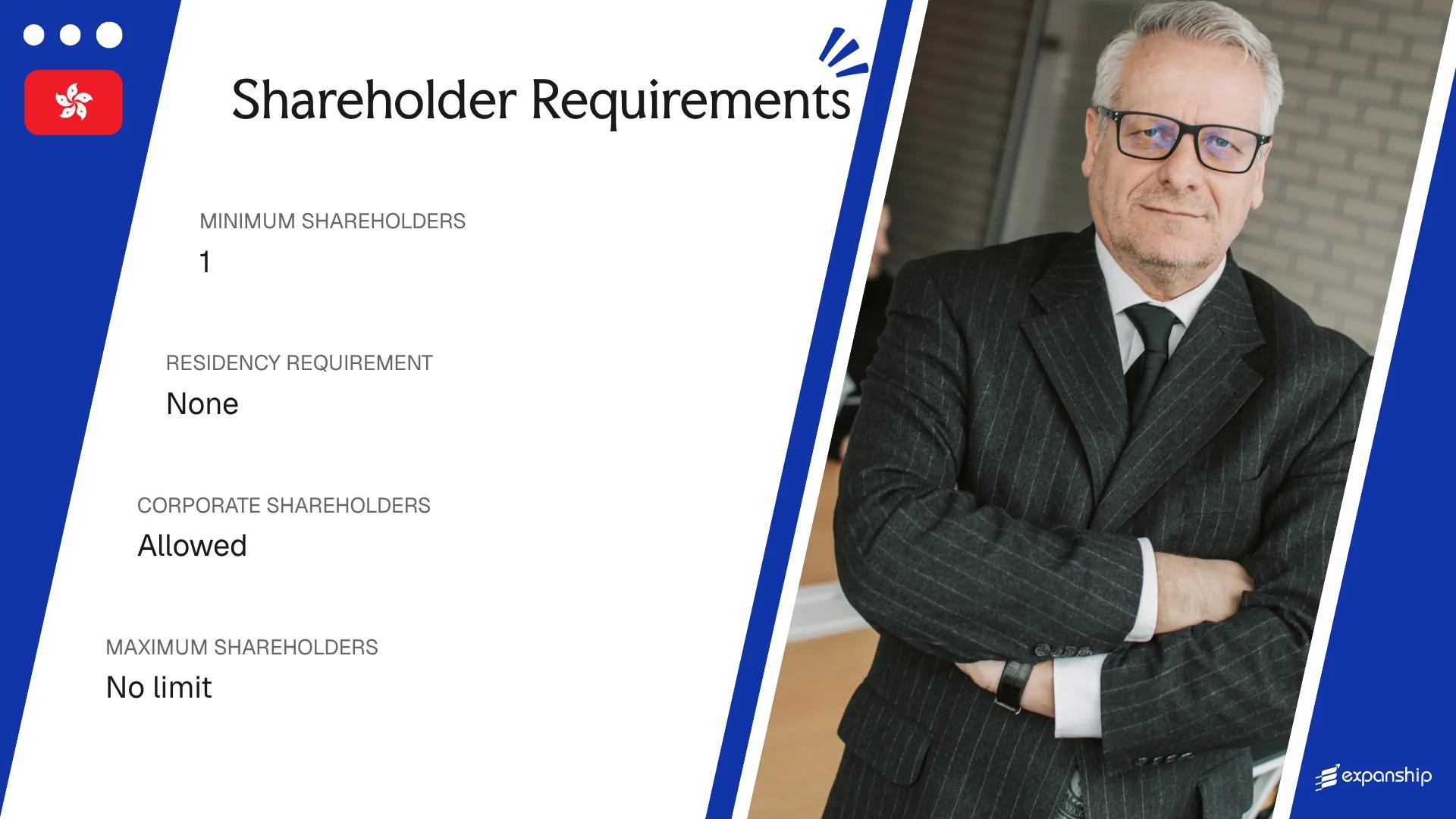
A Hong Kong private limited company requires a minimum of one shareholder and permits a maximum of 50, as set out in the Companies Ordinance (Cap. 622). A sole shareholder structure is fully permitted, meaning a single individual or entity can hold all issued shares.
Nationality and Residency Restrictions
Shareholders face no nationality or residency requirements under Hong Kong law. Foreign individuals and overseas entities may hold 100% of the share capital without restriction.
Corporate Shareholders
Corporate entities are permitted to act as shareholders in a Hong Kong private limited company. No additional conditions specific to corporate shareholding are imposed at the point of incorporation.
Shareholder Liability
Liability is limited to the amount unpaid on a shareholder's shares. Outside of fraud, wrongful trading, or a court piercing the corporate veil, shareholders bear no personal liability for the company's debts.
Register of Shareholders
Under the Companies Ordinance, every company must maintain a register of members at its registered office or a prescribed place. The register is not publicly accessible through a central government database, though certain details may be filed with the Companies Registry upon incorporation or following subsequent changes.
Shareholder Structure Guidance for Your Hong Kong Incorporation
Get clarity on shareholder eligibility, corporate shareholder arrangements, and register obligations before incorporating your entity in Hong Kong.
UBO / Beneficial Ownership Registration Requirements in Hong Kong
Under the Companies Ordinance (Cap. 622), every Hong Kong private company must maintain a Significant Controllers Register (SCR), identifying individuals or legal entities that hold significant control over the firm. Beneficial ownership registration requirements in Hong Kong are governed by Part 2A of the Ordinance, with the Companies Registry overseeing compliance.
- Identify each significant controller, defined as any person holding more than 25% of shares or voting rights, or who otherwise exercises significant influence or control.
- Record the controller's full name, correspondence address, identity document details, the date control was acquired, and the nature of that control.
- Maintain the SCR at the company's registered office or a designated location notified to the Companies Registry.
- Make the SCR available to law enforcement and specified public officers upon request.
- Update the register within seven days of becoming aware of any change.
| Parameter | Detail |
|---|---|
| Ownership Threshold for UBO Status | More than 25% of shares or voting rights |
| Filing Authority | Companies Registry (register kept internally; not filed centrally) |
| Disclosure Deadline at Incorporation | Within seven days of becoming aware of a registrable person |
| Publicly Accessible Register | No; accessible only to law enforcement and specified authorities |
| Penalties for Non-Disclosure | Fines up to HKD 25,000 and a daily default fine |
| Ongoing Update Obligation | Within seven days of any change in controller information |
KYC / Document Requirements in Hong Kong
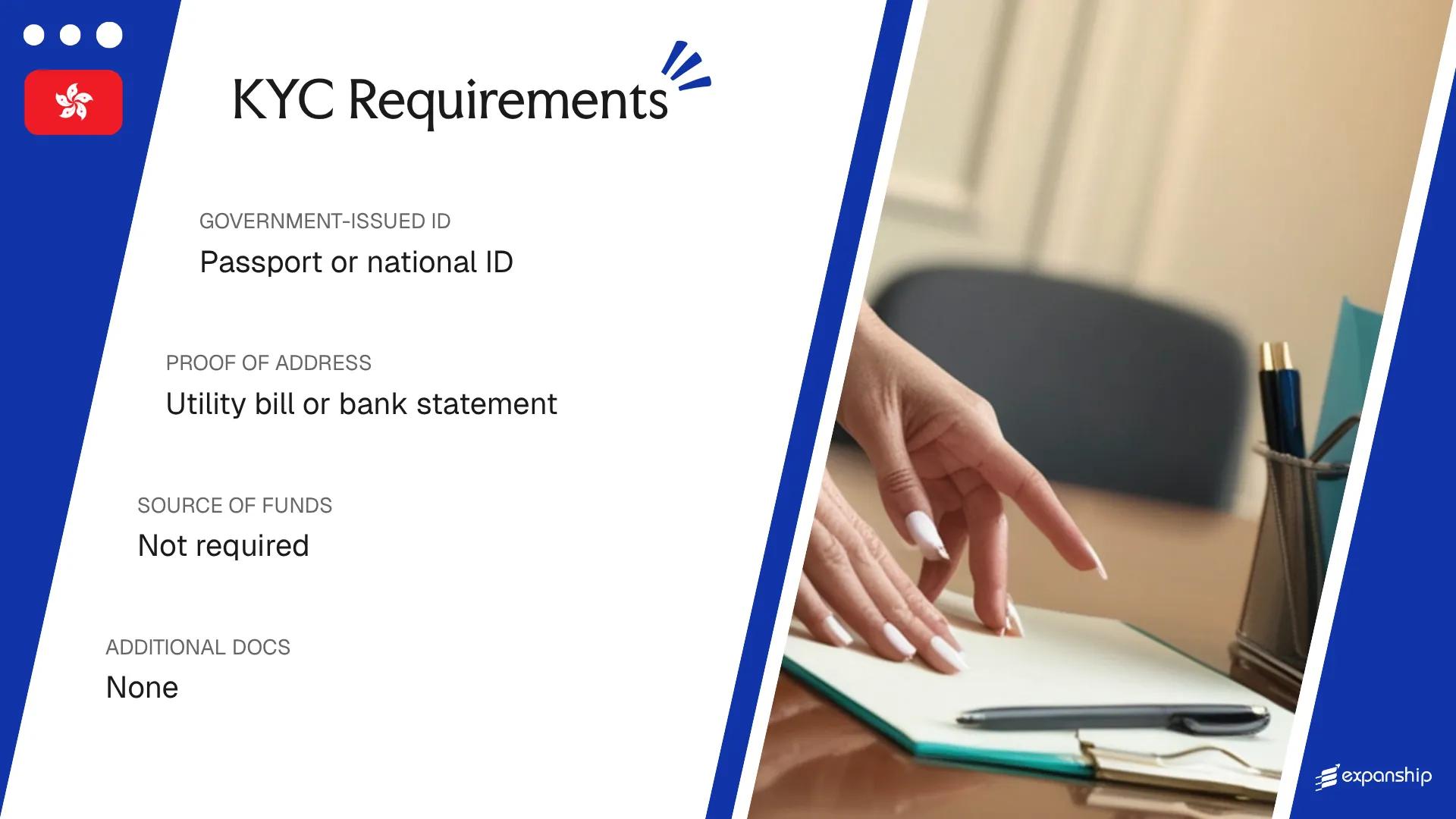
KYC requirements for Hong Kong company incorporation are governed by the Anti-Money Laundering and Counter-Terrorist Financing Ordinance (Cap. 615), administered by the FSTB.
Individual / Personal Documents
- Valid government-issued photo ID (passport or Hong Kong Identity Card)
- Proof of residential address dated within three months (utility bill or bank statement)
- Completed KYC declaration or self-certification form as required by the registered agent
- Recent passport-sized photograph may be required by some corporate service providers
Corporate Documents
- Certificate of incorporation of the corporate shareholder or director entity
- Constitutional documents (articles of association or equivalent)
- Register of directors of the corporate entity
- Proof of registered address of the corporate entity (official correspondence or utility document)
Source of Funds Documentation
- Bank statements covering the most recent three to six months
- Audited financial statements or management accounts where applicable
- Written declaration of the source of funds if documentary evidence is limited
Notarisation and Apostille Requirements
- Foreign-issued identity documents are generally required to be notarised by a notary public
- Corporate documents issued outside Hong Kong must be certified or apostilled per the Hague Convention where applicable
- Certified English translations are required for any document not in English or Chinese
Inconsistent or incomplete beneficial ownership information is the most frequent cause of incorporation rejection or delay.
Company Name Requirements in Hong Kong
Company name requirements Hong Kong companies must meet are assessed by the Companies Registry, which evaluates proposed names against established criteria before incorporation is approved. A name will be rejected if it is identical to one already on the register or otherwise deemed undesirable.
Names may be submitted in English, Chinese, or both, but a combination of English and Chinese characters within a single name is not permitted. English names must end with "Limited" and Chinese names with the equivalent character "有限公司."
Certain words require prior approval from designated authorities before the Registry will accept them. Words such as "bank," "trust," and "insurance" imply regulatory oversight, while terms like "royal," "imperial," or references to government bodies may be refused outright.
Name reservation is available through the Companies Registry prior to formal incorporation. A reserved name is held for a specified period, during which no other applicant may register it, giving your business time to complete the incorporation process.
Compliance Services for Companies in Hong Kong
Maintain your Hong Kong company's good standing with ongoing compliance support, from annual filings to statutory record management.
Conclusion
Hong Kong company incorporation requirements are governed primarily by the Companies Ordinance (Cap. 622), administered by the Companies Registry. The framework sets out defined conditions across ownership, governance, and registered presence that every applicant must satisfy before a company is formally registered.
Among the requirements covered, the mandatory appointment of a locally resident company secretary and the obligation to maintain a registered office address in Hong Kong carry direct operational consequences. Beneficial ownership disclosure under the significant controllers register also imposes ongoing obligations beyond the point of incorporation.
Once these requirements are understood, the practical work of assembling compliant documentation and engaging with the Companies Registry begins.
Expanship's Corporate Services for Hong Kong Expansion
Handling Hong Kong company incorporation compliance services involves meeting specific obligations under the Companies Ordinance (Cap. 622), from maintaining a locally resident company secretary to keeping a statutory register of significant controllers. Expanship works alongside your business to manage that administrative weight, so your team can focus on operations rather than filing deadlines and regulatory correspondence.
Our Hong Kong corporate services cover the full setup and ongoing compliance cycle:
- We prepare and submit all incorporation documents to the Companies Registry on your behalf.
- Our team provides a registered office address and acts as your resident company secretary.
- We handle direct liaison with the Companies Registry, IRD, and other relevant government bodies.
- Post-incorporation obligations, including annual returns and statutory record maintenance, are managed through our ongoing compliance service.
- We provide introductions to banking institutions familiar with newly incorporated Hong Kong entities.
- Tax registration with the Inland Revenue Department and any required local authority filings are coordinated through us.
Reach out to Expanship Hong Kong to discuss how we can support your expansion into this jurisdiction.
Frequently Asked Questions (FAQ)
A virtual office address is acceptable as the registered office address in Hong Kong, provided it is a physical address within the territory where official correspondence can be received. A P.O. box alone does not satisfy the requirement under the Companies Ordinance. Many businesses use a professional service provider's address for this purpose, particularly during the early stages of incorporation.
Failing to maintain a register of significant controllers is a criminal offence under the Companies Ordinance (Cap. 622), and the company and its responsible officers are liable to a fine. The register must be kept at the registered office or the office of the designated representative and must be available for inspection by law enforcement authorities upon request. Non-compliance is not treated as a minor administrative oversight.
No minimum paid-up capital is required before your company can commence operations. Hong Kong companies are commonly incorporated with a single ordinary share at HK$1, and the issued share capital can remain at that level indefinitely. There is no statutory obligation to increase paid-up capital unless required by a specific licensed activity, such as obtaining a money service operator licence.
Every company incorporated in Hong Kong, whether private or public, must appoint a company secretary under the Companies Ordinance (Cap. 622). For a private company with a sole director, that director cannot also serve as the company secretary, meaning a separate individual or a corporate service provider must fill the role. The secretary must either ordinarily reside in Hong Kong or, if a body corporate, have its registered office or principal place of business in Hong Kong.
Foreign individual shareholders are generally required to provide a certified copy of a valid passport and proof of residential address, such as a recent utility bill or bank statement. Corporate shareholders must supply certified constitutional documents, proof of registration in their home jurisdiction, and identification for the underlying beneficial owners. The specific standards align with the anti-money laundering guidelines issued by the Companies Registry and relevant professional bodies.
Certain words require prior approval or are outright prohibited in a Hong Kong company name. Words such as "Bank," "Trust," "Insurance," and "Royal" require consent from the relevant regulatory authority before the Companies Registry will accept the name. A Chinese name, if used, must be a recognised Chinese character name and cannot be a direct transliteration of the English name.
Legal Disclaimer
The information provided in this article is for general informational purposes only and does not constitute legal, tax, or professional advice. While we strive to ensure the accuracy and timeliness of the content, laws and regulations are subject to change, and the application of laws can vary widely based on specific facts and circumstances.
Readers should not act upon this information without seeking professional counsel tailored to their individual situation. Expanship and its authors disclaim any liability for actions taken or not taken based on the content of this article.
For specific advice regarding your business setup, compliance requirements, or any legal matters, please consult with qualified legal and tax professionals in the relevant jurisdiction.