

Key Takeaways
- Entities incorporated in Equatorial Guinea under the OHADA Uniform Act on Commercial Companies and Economic Interest Groups must maintain a minimum share capital of XAF 1,000,000 to validly establish a Société à Responsabilité Limitée (SARL).
- A physical registered office address within Equatorial Guinea is a mandatory incorporation requirement, and a postal address does not satisfy this obligation.
- Beneficial ownership disclosure represents a distinct compliance layer that must be addressed in addition to the standard structural and documentary requirements under the OHADA framework.
- Foreign investors are required to engage with the Centre de Promotion des Investissements en Guinée Équatoriale (CPIGE) as the primary institutional point of contact, while company registration itself is processed through the commercial registry under the Ministry of Justice.
Entity formation in Equatorial Guinea is governed by the OHADA Uniform Act on Commercial Companies and Economic Interest Groups, which the country adopted as a member state of the Organisation for the Harmonisation of Business Law in Africa. The Centre de Promotion des Investissements en Guinée Équatoriale (CPIGE) serves as the primary institutional point of contact for investors, while company registration is processed through the relevant commercial registry under the Ministry of Justice.
Meeting the incorporation requirements Equatorial Guinea mandates is a prerequisite for legal operation. Failure to satisfy these conditions results in rejection of the registration application or, in cases of non-compliance post-incorporation, potential penalties and loss of legal standing.
This article addresses the structural, documentary, and governance requirements applicable to entities being formed under the OHADA framework.
Requirements can differ depending on the chosen entity type, the sector in which the business operates, and whether foreign investment restrictions apply to a specific industry. Foreign entrepreneurs and corporate investors establishing a presence for the first time will find this article most directly applicable to their situation.
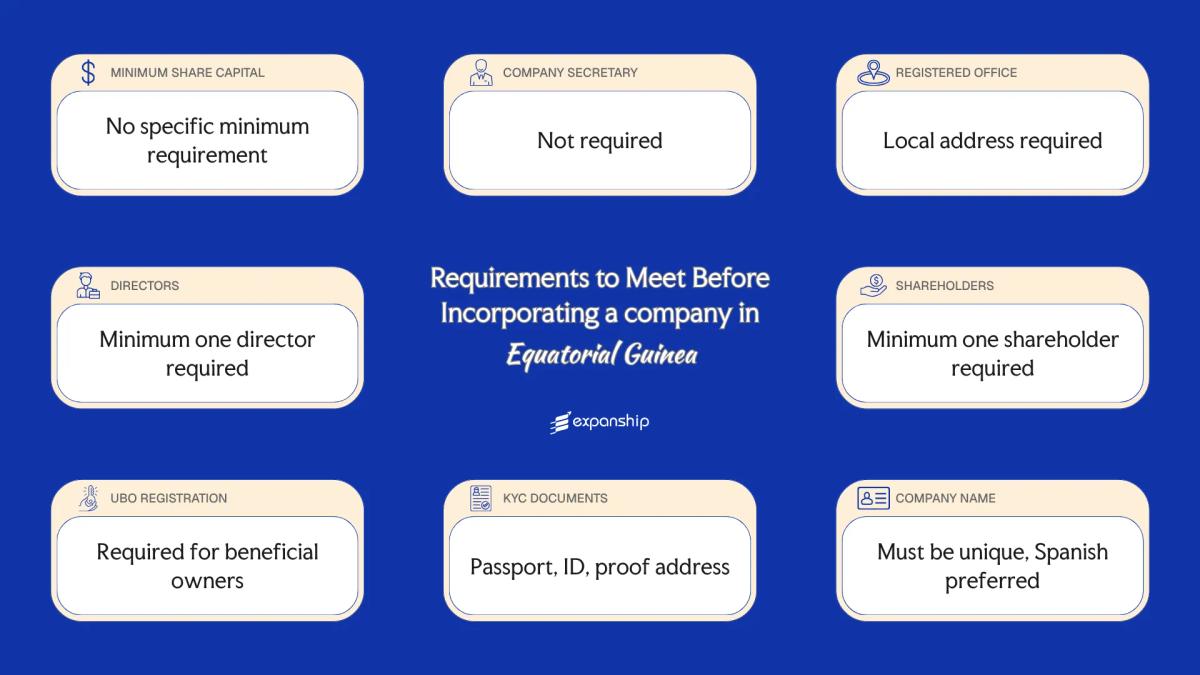
Minimum Share Capital Requirements in Equatorial Guinea
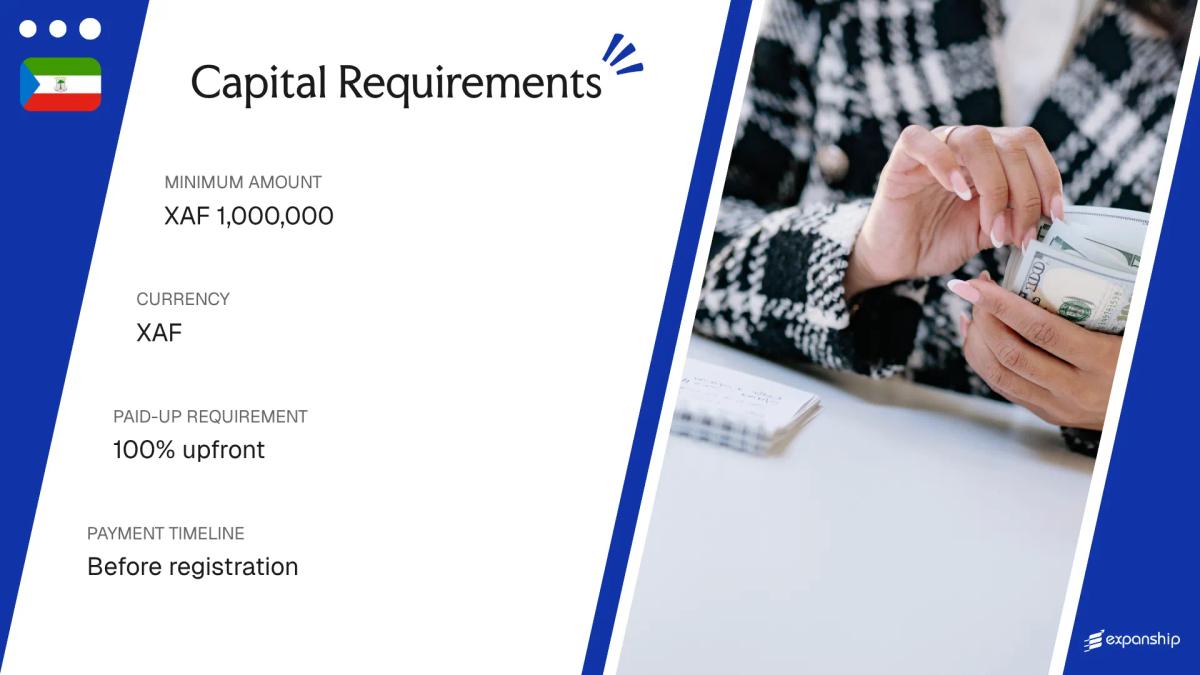
Equatorial Guinea operates on a par value share system, meaning each share must carry a stated nominal value reflected in the company's statutes. The minimum share capital requirements in Equatorial Guinea are governed under the OHADA Uniform Act on Commercial Companies and Economic Interest Groups, which Equatorial Guinea adopted as a member state.
Capital deposit obligations are verified at the point of registration through the Centre de Formalités des Entreprises (CFE), which coordinates with a licensed local bank to confirm that required funds are in place before the entity receives its formal registration certificate. Once deposited and the firm is incorporated, the capital requirement is not an ongoing statutory obligation in the same sense, though any reduction in authorized capital requires a formal amendment process.
| Parameter | Detail |
|---|---|
| Minimum Authorized Share Capital | XAF 1,000,000 for a Société à Responsabilité Limitée (SARL); XAF 10,000,000 for a Société Anonyme (SA) |
| Maximum Authorized Share Capital | No statutory maximum |
| Minimum Paid-Up Capital | 25% of subscribed share capital at incorporation for an SA; full amount for a SARL |
| Paid-Up Requirement at Incorporation | Yes; partial for SA, full for SARL |
| Accepted Currency | Central African CFA franc (XAF) |
| Accepted Forms of Contribution | Cash contributions and contributions in kind; industry contributions not permitted for share capital purposes |
| Timeframe to Deposit Capital | Prior to filing for registration with the CFE |
Meeting the minimum authorized capital figure does not satisfy the paid-up requirement automatically. For an SA, at least 25% of each share's nominal value must be deposited in a blocked bank account before registration, with the remainder callable within five years.
Company Secretary Requirements in Equatorial Guinea
Under Equatorial Guinea's corporate framework, the company secretary requirements Equatorial Guinea businesses must satisfy are governed primarily through the OHADA Uniform Act on Commercial Companies, which the country adopted as part of its membership in the OHADA treaty zone. A formally appointed company secretary or equivalent officer is not universally mandated for all entity types, though certain corporate governance obligations require a designated person responsible for statutory recordkeeping and regulatory correspondence.
For those entity types where the role applies, Equatorial Guinea corporate secretary obligations typically include maintaining minutes of shareholders' and directors' meetings, ensuring statutory registers are kept current, and coordinating filings with the Centre de Formalités des Entreprises (CFE).
Qualification criteria for who may serve in this capacity include:
- The individual or entity must have legal capacity under OHADA member state law.
- Corporate secretarial functions may be fulfilled by a natural person or a duly authorized legal entity.
- No specific national residency requirement is mandated under the OHADA framework for this role.
- Professional licensing is not formally prescribed, though legal or accounting practitioners commonly fill the position.
- Appointment is subject to approval by the board or equivalent governing body of the company.

Incorporate a Company in Equatorial Guinea
Set up your business entity in Equatorial Guinea with structured guidance on registration, documentation, and ongoing compliance obligations.
Registered Office Requirements in Equatorial Guinea
Registered office requirements in Equatorial Guinea mandate that every registered company maintain a physical address within the country, used as the official point of contact for government correspondence, regulatory notices, and legal service of process. Failure to maintain a compliant local address can result in administrative sanctions from the Ministerio de Hacienda y Presupuestos or the relevant commercial registry, including potential suspension of the company's legal standing.
- A physical street address is required; a P.O. box alone does not satisfy the domicile obligation.
- The address must be located within Equatorial Guinea; foreign addresses are not accepted.
- Virtual offices are generally not recognised as compliant registered addresses under local commercial law.
- Supporting documentation, such as a lease agreement or proof of ownership, is required to verify the address.
- The registered address is recorded in the Registro Mercantil and forms part of the publicly accessible company record.
- Any change to the registered address must be formally notified to the Registro Mercantil through a filing amendment; undisclosed address changes do not carry legal effect.
Director Requirements in Equatorial Guinea
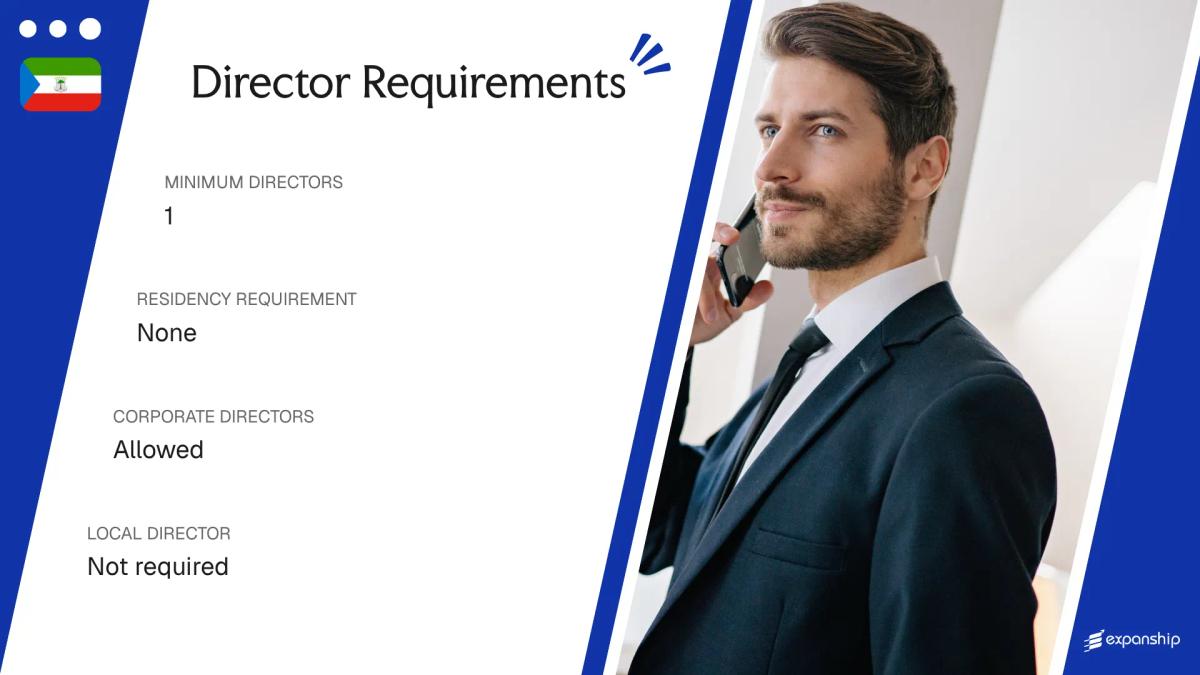
Upon appointment, directors of a company incorporated under Equatorial Guinea's OHADA-aligned corporate framework assume statutory duties of loyalty and diligence toward the entity, and bear personal liability for decisions that contravene the Acte Uniforme relatif au droit des sociétés commerciales et du groupement d'intérêt économique (AUDSCGIE). Meeting director requirements Equatorial Guinea company law imposes is a prerequisite to lawful governance from the date of registration.
| Parameter | Detail |
|---|---|
| Minimum Number of Directors | One director is required for a Société à Responsabilité Limitée (SARL); a Société Anonyme (SA) requires a board of at least three directors. |
| Maximum Number of Directors | For an SA, the OHADA framework generally caps the board at twelve directors. |
| Local/Resident Director Required | No statutory residency requirement exists under the OHADA AUDSCGIE as applicable in Equatorial Guinea. |
| Nationality Restrictions | No nationality restrictions are imposed; foreign nationals may serve as directors. |
| Minimum Age Requirement | Directors must be at least eighteen years of age under OHADA general principles. |
| Corporate Directors Permitted | Corporate directors are permitted under the OHADA framework, subject to the appointment of a permanent representative. |
| Director Must Be a Shareholder | No statutory requirement for a director to hold shares in the company. |
| Publicly Listed on Registry | Director information is filed with the Registre du Commerce et du Crédit Mobilier (RCCM) and forms part of the public commercial record. |
| Disqualification Conditions | Persons subject to a judicial prohibition from managing a commercial entity, or those convicted of certain financial offences, are disqualified from directorship. |
Despite Equatorial Guinea's reputation as a heavily state-influenced economy, the OHADA framework it shares with 16 other African nations imposes no requirement for a local resident or national to sit on the board of a privately held company.
Shareholder Requirements in Equatorial Guinea
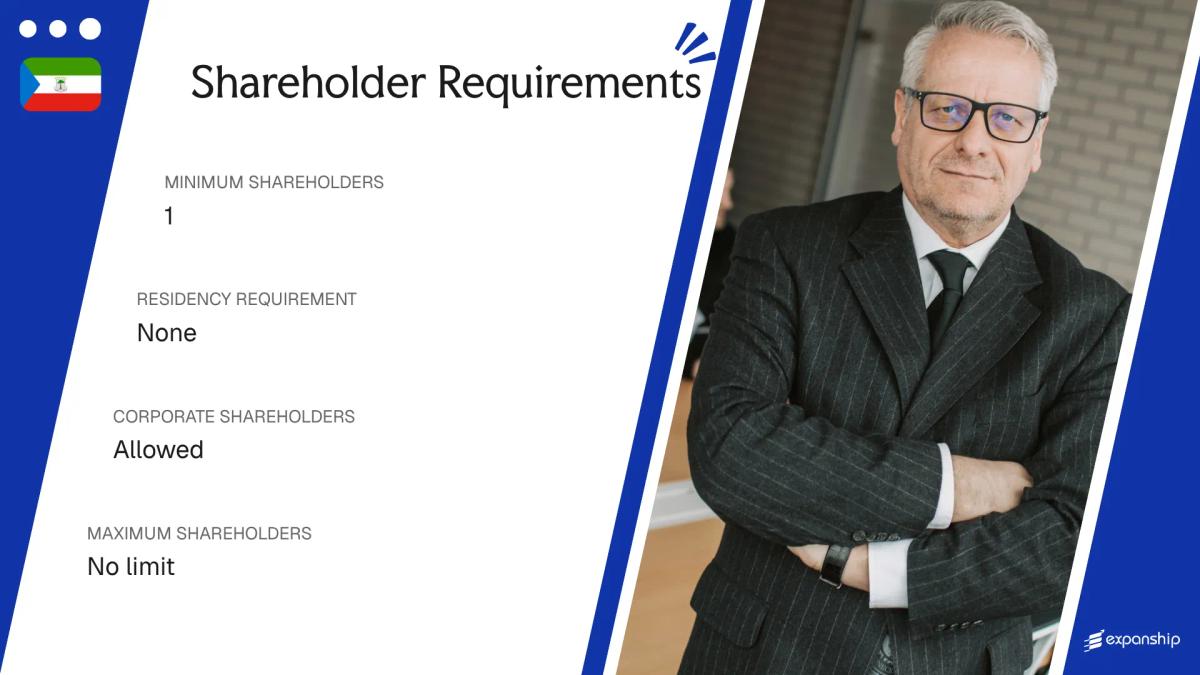
Under Equatorial Guinea's OHADA-aligned corporate framework, a Société à Responsabilité Limitée (SARL) requires a minimum of one shareholder, permitting sole shareholder structures. No statutory maximum applies to the number of shareholders in a standard limited liability company.
Nationality and Residency Restrictions
Shareholders are not required to be Equatoguinean nationals or residents. Foreign ownership is generally permitted, though certain regulated sectors may impose local participation requirements under sector-specific licensing conditions.
Corporate Shareholders
Corporate entities may act as shareholders in an Equatorial Guinea company. No general prohibition exists against foreign corporate shareholders, provided the entity meets standard KYC and documentation requirements during incorporation.
Shareholder Liability
Shareholder liability is limited to each party's capital contribution. Extended personal liability does not ordinarily arise unless a court finds evidence of fraudulent conduct or improper commingling of personal and corporate assets.
Register of Shareholders
A register of shareholders must be maintained at the company's registered office. Filing obligations with the Centre de Formalités des Entreprises apply when ownership changes occur, though the register is not generally accessible to the public.
Shareholder Structure Guidance for Setting Up in Equatorial Guinea
Get tailored advice on structuring your company's ownership to meet local incorporation requirements in Equatorial Guinea.
UBO / Beneficial Ownership Disclosure Requirements in Equatorial Guinea
Formal UBO legislation in Equatorial Guinea remains limited in its public documentation, and no comprehensive statutory beneficial ownership registration framework equivalent to FATF standards has been confirmed as enacted. The OHADA commercial law framework, which governs company law in Equatorial Guinea, does not currently impose a codified UBO disclosure requirement with a defined threshold or mandatory registry.
| Parameter | Detail |
|---|---|
| Ownership Threshold for UBO Status | No statutory requirement |
| Filing Authority | No statutory requirement |
| Disclosure Deadline at Incorporation | No statutory requirement |
| Publicly Accessible Register | No statutory requirement |
| Penalties for Non-Disclosure | No statutory requirement |
| Ongoing Update Obligation | No statutory requirement |
KYC / Document Requirements in Equatorial Guinea
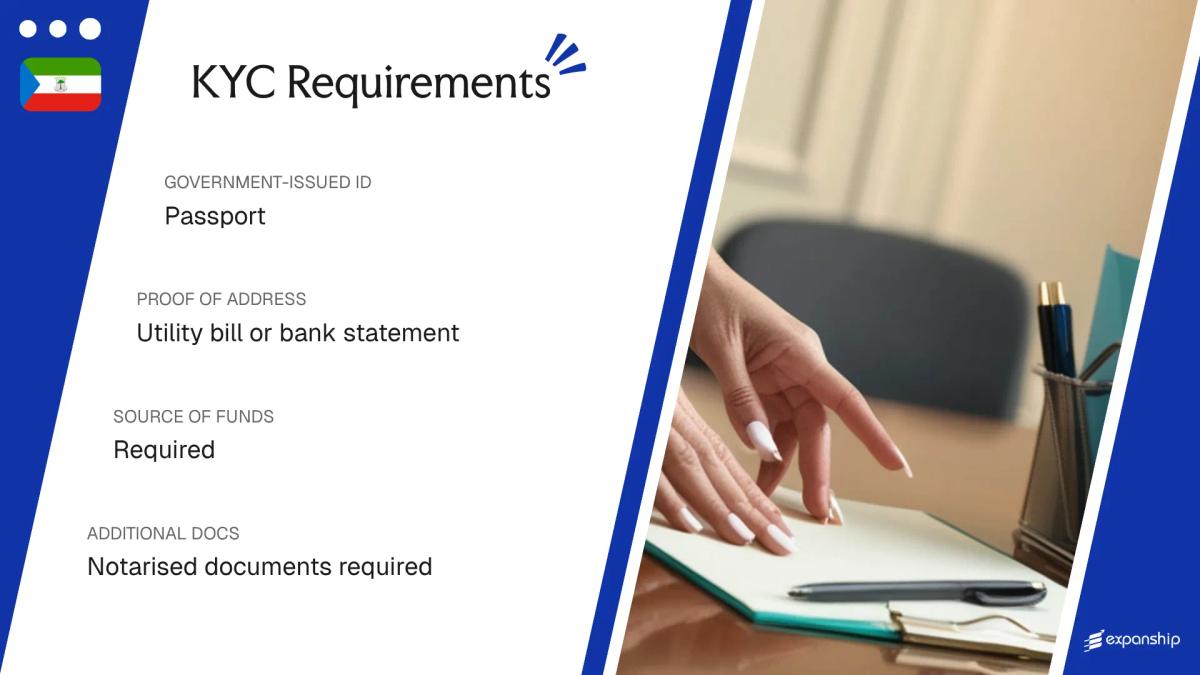
KYC requirements Equatorial Guinea incorporation are governed by the Anti-Money Laundering framework administered by the ANIF, the country's Financial Intelligence Unit, which mandates identity and source-of-funds verification for all parties involved at the point of company formation.
Individual / Personal Documents
- Valid government-issued passport or national identity card for each individual director, shareholder, or beneficial owner
- Proof of residential address dated within three months, such as a utility bill or official bank statement
- Completed KYC declaration form identifying the individual's role within the entity
- Recent passport-sized photograph may be required by the registering agent or notary
Corporate Documents
- Certificate of incorporation of the corporate shareholder or director, certified as a true copy
- Constitutional documents, including articles of association or equivalent
- Current register of directors of the corporate entity
- Proof of the corporate entity's registered office address
Source of Funds Documentation
- Bank statements covering a minimum of three to six months prior to incorporation
- Audited financial accounts where the corporate shareholder has existing trading history
- A signed declaration of source of funds for individual subscribers introducing capital
Notarisation and Apostille Requirements
- Documents originating outside Equatorial Guinea generally require notarisation and an apostille under the Hague Convention
- Official translations into Spanish or French are required for documents issued in other languages
- Translations must be certified by a sworn translator recognised in the jurisdiction
Incomplete or uncertified source of funds documentation is the most frequently cited reason for delays in the registration process.
Company Name Requirements in Equatorial Guinea
Proposed company name requirements Equatorial Guinea follow an approval-based process administered at the point of incorporation. The designated commercial registry reviews each submitted name to confirm it is available and meets formal criteria before registration proceeds.
Names must be rendered in Spanish, the official administrative language, and must include a legal suffix that reflects the chosen entity type, such as "S.A." for a Sociedad Anónima or "S.R.L." for a Sociedad de Responsabilidad Limitada.
Certain words are prohibited or subject to prior authorisation. Terms implying a connection to the state, financial institutions, or regulated professions generally require documented approval from the relevant supervisory authority before use.
Name reservation is available prior to formal incorporation. Your business can apply through the registry to hold a proposed name for a defined period, preventing third-party registration while incorporation formalities are completed.
Compliance Services for Companies in Equatorial Guinea
Ongoing compliance support for entities incorporated in Equatorial Guinea, covering statutory filings, regulatory obligations, and corporate record maintenance.
Conclusion
Equatorial Guinea's incorporation requirements are governed primarily by the OHADA Uniform Act on Commercial Companies, which sets the legal baseline for entity formation across member states, including minimum capital thresholds, director appointments, and shareholder obligations. Among the most consequential requirements are the SARL's minimum share capital of XAF 1,000,000 and the mandatory registered office within the country, which must be a physical address rather than a postal one. Beneficial ownership disclosure obligations add a further compliance layer. Once these requirements are understood, the practical work of assembling documentation, appointing local representatives, and filing with the relevant registry begins.
Expanship's Corporate Services for Equatorial Guinea Expansion
Equatorial Guinea's incorporation framework, from OHADA-aligned capital requirements to the RCCM registration process and ANIF's beneficial ownership obligations, involves multiple regulatory touchpoints. Expanship's Equatorial Guinea corporate services expansion support is designed to help your business manage that administrative load without losing sight of local compliance realities. Our role is to reduce the coordination burden these requirements create, not to suggest the process is without complexity.
Beyond formation, Expanship offers a structured range of services to support your entity from registration through to ongoing operation:
- We prepare and file all company registration documentation with the relevant Equatorial Guinean authorities.
- Registered agent and local office provision is available to satisfy your statutory address requirements.
- We liaise directly with government bodies and regulatory agencies on your behalf throughout the filing process.
- Post-incorporation compliance obligations, including annual filings, are managed on a continuing basis.
- Banking introduction assistance is provided to help your firm establish local financial infrastructure.
- Tax registration and coordination with local fiscal authorities is handled as part of your setup.
To discuss your requirements, contact Expanship Equatorial Guinea.
Frequently Asked Questions (FAQ)
Failure to meet beneficial ownership disclosure obligations can result in administrative sanctions, fines, and potential suspension of the company's legal standing. Equatorial Guinea's anti-money laundering framework, aligned with GABAC (the Central Africa Anti-Money Laundering Action Group) standards, treats non-disclosure as a serious compliance breach. In practice, this can also affect the entity's ability to open or maintain bank accounts in-country.
A foreign national can serve as a director under OHADA rules, which do not mandate local director residency for a SARL or SA. However, if your business operates in a regulated sector such as hydrocarbons, additional licensing conditions imposed by sector-specific authorities may effectively require a locally present representative. This distinction between general corporate law and sector regulation is material for foreign investors.
The registered office must be a physical, verifiable address in Equatorial Guinea where official correspondence and regulatory notices can be received. A purely virtual or mail-forwarding arrangement without a genuine operational presence at that address does not reliably satisfy the requirement as interpreted by the Registre du Commerce et du Crédit Mobilier (RCCM). Authorities can challenge registrations where the declared address cannot be substantiated.
Company name approval in Equatorial Guinea runs through the RCCM, which checks for conflicts with existing registered names at the national level. The OHADA Uniform Act sets the legal framework for name restrictions, including prohibitions on names that mislead as to the entity's legal form or sector. There is no separate national trademark-style clearance required at the point of incorporation, though name reservation does not confer trademark rights.
A foreign corporate shareholder must provide certified constitutional documents, such as its articles of association or certificate of incorporation, along with proof of its registered address and evidence of the authority of the signatory acting on its behalf. These documents typically require apostille certification or legalization depending on whether the issuing country is a party to the Hague Convention, followed by a sworn French translation given Equatorial Guinea's civil law system. The RCCM will not process a registration where the legal existence and authority of a corporate shareholder cannot be verified from the submitted documents.
General commercial entities submit KYC documentation through the standard RCCM registration process, which covers identity verification, address confirmation, and source-of-funds declarations. Companies seeking to operate in the hydrocarbons sector face an additional layer of scrutiny from the Ministry of Mines and Hydrocarbons, which imposes its own vetting and approval requirements before a firm can legally engage in extraction or related activities. The two processes run in parallel rather than sequentially, meaning sector clearance cannot substitute for standard corporate registration.
Legal Disclaimer
The information provided in this article is for general informational purposes only and does not constitute legal, tax, or professional advice. While we strive to ensure the accuracy and timeliness of the content, laws and regulations are subject to change, and the application of laws can vary widely based on specific facts and circumstances.
Readers should not act upon this information without seeking professional counsel tailored to their individual situation. Expanship and its authors disclaim any liability for actions taken or not taken based on the content of this article.
For specific advice regarding your business setup, compliance requirements, or any legal matters, please consult with qualified legal and tax professionals in the relevant jurisdiction.