
Key Takeaways
- Equatorial Guinea's territorial tax system means corporate income earned outside the country's borders is generally excluded from local tax liability, offering a structurally advantageous position for firms with cross-border revenue streams.
- Foreign investors benefit from the procedural predictability of the OHADA Uniform Acts, a supranational legal framework that standardises commercial law across member states and reduces jurisdictional uncertainty in contract enforcement and corporate governance.
- The Société Anonyme structure permits full or majority foreign ownership across most sectors, giving international investors direct equity control rather than requiring joint-venture arrangements with local partners.
- With a low density of registered corporate entities relative to the country's resource base and OPEC membership, businesses entering the Equatorial Guinean market through the Centre de Promotion des Investissements de Guinée Equatoriale face limited existing corporate competition in sectors such as energy services, logistics, and infrastructure.
Equatorial Guinea is a sovereign nation on the west coast of Central Africa, comprising a mainland territory — Río Muni — and several islands, including Bioko, where the capital Malabo is located. Company registration falls under the jurisdiction of the Ministerio de Hacienda, which oversees commercial registration through the Registro Mercantil. Foreign businesses entering this market typically do so through a Sociedad Anónima.
The country operates a territorial tax system, meaning income generated outside its borders is generally not subject to local corporate tax. Foreign direct investment is formally recognized and regulated, with the legal framework permitting full or majority foreign ownership across most sectors, subject to sector-specific licensing conditions.
The benefits of incorporating in Equatorial Guinea are shaped by a specific combination of resource wealth, legal structure, and regional membership that distinguishes this jurisdiction from others in the Gulf of Guinea. This article examines those advantages in detail to help you assess whether forming a business here aligns with your operational objectives.
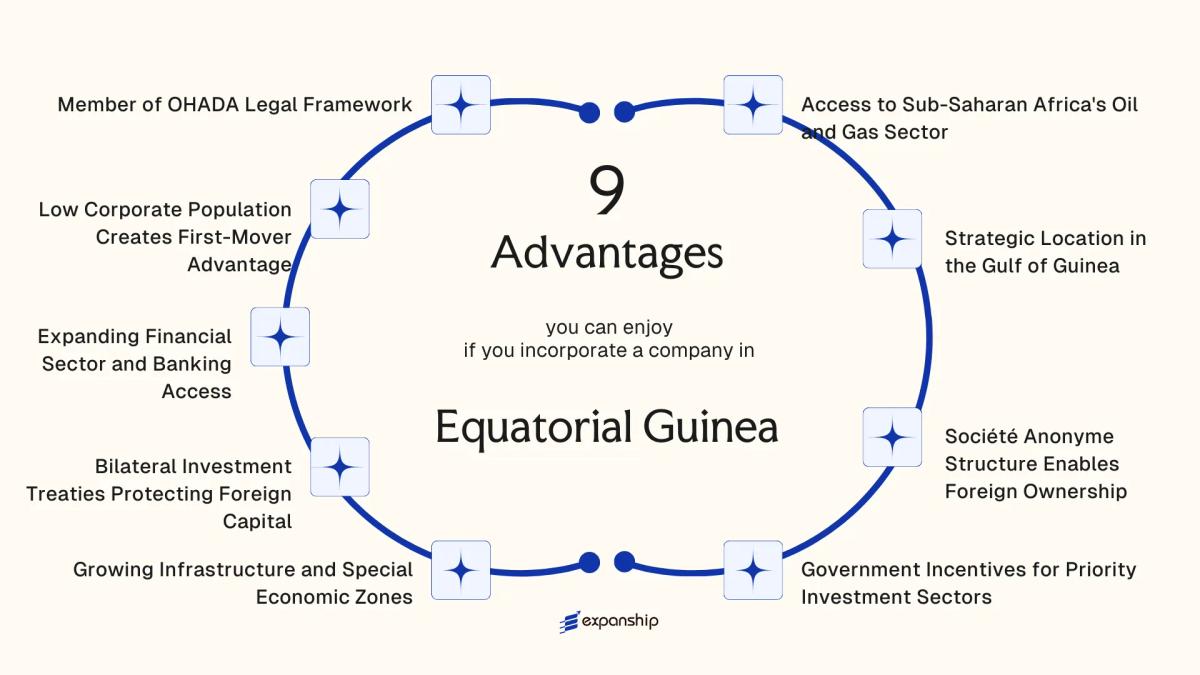
Access to Sub-Saharan Africa's Oil and Gas Sector
Equatorial Guinea sits at the center of one of Africa's most productive offshore hydrocarbon zones. For foreign companies targeting the petroleum sector, incorporating locally is not a preference — it is often a legal requirement for participation.
Direct Access to Licensed Hydrocarbon Blocks
Under the Hydrocarbons Law (Law No. 8/2006) and its subsequent amendments, foreign firms operating in the upstream sector must establish a legal presence in-country to hold or participate in production sharing contracts administered by the Ministerio de Minas e Hidrocarburos. Without a registered entity, you cannot hold a direct contractual position with GEPetrol or Sonagas, the state hydrocarbon companies that co-participate in most licensed blocks. That requirement alone makes local incorporation a structural prerequisite, not merely a procedural formality.
Why This Matters Beyond Oil Majors
The Equatorial Guinea oil and gas sector advantages for foreign investors extend to mid-size service companies and subcontractors. Operators under production sharing contracts are typically required to prioritize locally registered suppliers for equipment, logistics, and technical services. A locally incorporated entity positions your business within that procurement chain, opening access that a foreign-registered firm cannot legally occupy.
A locally incorporated entity is the minimum legal threshold for contractual access to hydrocarbon operations governed by Law No. 8/2006.
Strategic Location in the Gulf of Guinea
Positioned along the central West African coastline, Equatorial Guinea sits at the geographical midpoint of the Gulf of Guinea, placing it within direct maritime reach of Nigeria, Cameroon, Gabon, and São Tomé and Príncipe. For a foreign entity operating in Central or West Africa, this positioning reduces transit times and logistics costs across a region where overland freight remains slow and expensive.
The country's main commercial port at Bata, combined with Malabo's port infrastructure on Bioko Island, provides two distinct access points into CEMAC markets. A firm registered here can realistically service both coastal and inland Central African markets from a single corporate base, without needing secondary entities in each target country.
Membership in CEMAC means your business operates within a monetary union using the CFA franc (XAF), a currency pegged to the euro. That peg reduces exchange rate volatility for firms billing European counterparties or sourcing euro-denominated inputs.
Geographic positioning here creates specific operational advantages:
- Bioko Island's deepwater access supports offshore logistics that landlocked Central African capitals cannot offer
- Proximity to the CEMAC free-circulation zone reduces customs friction for intra-regional distribution
- Direct air links to Madrid and Paris from Malabo Airport support European corporate management of local operations

Company Incorporation in Equatorial Guinea
Establish your company in Equatorial Guinea with Expanship's end-to-end incorporation service, covering entity registration, documentation, and ongoing compliance support.
Société Anonyme Structure Enables Foreign Ownership
The Equatorial Guinea Société Anonyme foreign ownership benefits begin with a structural fact: the SA allows 100% foreign ownership of shares, with no statutory requirement for a local shareholder partner. Under OHADA Uniform Act on Commercial Companies and Economic Interest Groups, which governs company law across all member states including Equatorial Guinea, the SA is designed to accommodate international capital without mandating domestic equity participation. That means your business retains full control over its shareholding structure from day one.
| Feature | SA Requirement |
|---|---|
| Minimum shareholders | 1 (following OHADA reforms) |
| Foreign ownership ceiling | None (100% permitted) |
| Local shareholder required | No |
| Minimum share capital | XAF 10,000,000 |
| Shares transferability | Freely transferable |
Shares in an SA are freely transferable by default, which gives foreign investors meaningful flexibility when restructuring equity, onboarding new partners, or preparing an exit. This transferability is codified under the OHADA Uniform Act rather than national discretion, so it cannot be unilaterally restricted by local regulatory interpretation. For an investor managing a multi-jurisdiction portfolio, that consistency matters.
Board composition rules under the SA also permit foreign nationals to serve as directors, removing a practical barrier that other entity types in the region can impose. Combined with the absence of a residency requirement for shareholders, your corporate governance structure can be administered from outside the country while still meeting statutory obligations under Equatoguinean-registered law.
Government Incentives for Priority Investment Sectors
Equatorial Guinea government investment incentives for businesses are codified primarily under the Investment Law, which grants preferential treatment to foreign capital directed at government-designated priority sectors. These sectors have historically included hydrocarbons, agriculture, fisheries, tourism, and manufacturing. Firms operating in approved sectors may qualify for tax holidays, reduced corporate income tax rates, and customs duty exemptions on imported capital equipment.
The practical value is direct: your firm's effective tax burden during early operational years can be substantially lower than the standard corporate rate, preserving working capital at the stage when expenditure is highest.
Incentive grants are administered through GIDE, the agency responsible for investment promotion under the Ministry of Mines and Hydrocarbons, and formal approval is required before benefits take effect. Eligibility typically depends on minimum investment thresholds and documented alignment with a priority sector.
Keep these points in mind:
- Confirm your sector qualifies as priority under current regulations before structuring your tax position
- Obtain written approval from GIDE; verbal assurances carry no legal weight
- Customs duty exemptions generally apply to capital goods, not consumables or operational supplies
- Tax holidays are time-limited; confirm the duration in your approval certificate
- Incentive frameworks can be revised by ministerial decree without extended public notice
Foreign-owned entities in approved sectors can access incentives on equal legal footing with domestic companies, a parity provision that is not universal across Central African jurisdictions.
Growing Infrastructure and Special Economic Zones
Equatorial Guinea special economic zones business benefits have become more concrete following the development of the Malabo II Industrial Zone and the Bata Industrial Zone, both of which offer designated land, pre-built facilities, and streamlined licensing procedures for qualifying industrial and manufacturing operations. For foreign companies, access to purpose-built zones removes the friction of locating compliant commercial premises in a market where general real estate infrastructure remains limited.
Physical Infrastructure Supporting Commercial Operations
Significant port upgrades at Bata and Malabo have expanded cargo handling capacity, which directly reduces logistics costs for businesses moving goods through the Gulf of Guinea corridor. The Bata Port expansion, in particular, has improved container throughput, making the country a more functional transit and distribution point for Central African trade routes.
Road and energy infrastructure investment, partly channeled through the national development program known as Horizon 2035, has extended reliable electricity and transport access to previously underserved economic corridors. Businesses operating outside the capital can now reach supply chains and labor markets that were structurally inaccessible a decade ago.
Zone-Specific Advantages for Foreign Entities
Companies established within designated industrial zones may qualify for exemptions on import duties for capital equipment and raw materials under applicable investment incentive frameworks. This materially reduces startup capital requirements for manufacturing or processing operations.
The combination of zone-based duty relief and improving logistics connectivity creates a structural cost advantage that compounds over time for firms with capital-intensive operations.
Plan Your Entry Into Equatorial Guinea's Growth Zones
Expanship can help you assess zone eligibility, structure your entity, and coordinate incorporation to position your business within Equatorial Guinea's developing industrial framework.
Bilateral Investment Treaties Protecting Foreign Capital
Equatorial Guinea's bilateral investment treaties protection benefits are limited in number but carry practical weight for foreign capital. The country has signed BITs with several partner states, including France and Spain, which establish binding protections that domestic legislation alone cannot guarantee.
- Treaty protections typically include guarantees against expropriation without compensation, free transfer of profits and capital repatriation, and access to international arbitration outside local courts. For a foreign investor, this means disputes with the state are not confined to the domestic judicial system, which reduces jurisdictional risk.
- BITs with France and Spain are particularly relevant given the significant presence of French and Spanish-linked businesses operating in the country's extractive and services sectors. Firms incorporated under these nationalities may access treaty protections that apply directly to their investment structures.
- Where a BIT includes Most-Favoured-Nation clauses, your entity may be entitled to protections granted under other treaties the state has concluded, broadening coverage beyond the specific bilateral agreement under which you qualify.
- International arbitration access, commonly through ICSID (International Centre for Settlement of Investment Disputes), removes the requirement to exhaust local remedies before escalating a claim, a procedural advantage that materially affects how quickly disputes can be resolved.
Expanding Financial Sector and Banking Access
Equatorial Guinea banking sector advantages for foreign businesses are grounded in its membership in the BEAC monetary zone (Banque des États de l'Afrique Centrale), which pegs the CFA franc (XAF) to the euro at a fixed rate. That peg eliminates currency conversion volatility between your operating account and eurozone transactions, reducing a risk that businesses in other Central African markets absorb routinely.
Commercial banking in the country is served by regional and international institutions including BGFI Bank, Ecobank, and CCEI Bank GE. These banks offer corporate account services to registered entities, including foreign-owned firms, and operate under prudential supervision by BEAC. Access to trade finance, letters of credit, and corporate lending is tied directly to your company's legal standing in the national registry.
The CEMAC financial integration framework, which governs the six-member zone including Equatorial Guinea, also allows for cross-border capital flows within the bloc under harmonised rules. For a firm using the country as a regional hub, this reduces administrative friction when moving funds between subsidiaries in member states.
A foreign company incorporated in Equatorial Guinea and operating within the CEMAC zone can transact in XAF across six member states under a single monetary authority, without exposure to intra-regional exchange rate risk, a structural benefit absent in dollarised or multi-currency markets of comparable size.
Low Corporate Population Creates First-Mover Advantage
Equatorial Guinea first-mover advantage for foreign investors stems directly from the country's thin corporate registry. Formal business registration remains concentrated around the hydrocarbon sector, leaving adjacent industries, distribution, professional services, and consumer markets, with relatively few incorporated entities competing for the same clients or contracts.
Under the OHADA Uniform Act on Commercial Companies, a Société Anonyme or Société à Responsabilité Limitée can be registered with the Registre du Commerce et du Crédit Mobilier (RCCM). Because fewer firms are on that registry outside of oil and gas, your entity enters markets where supplier relationships, government procurement lists, and distributor networks have not yet been locked up by established competitors.
Low corporate competition benefits extend beyond market share. Regulatory relationships with bodies such as the Agencia Reguladora de Inversiones de Guinea Ecuatorial (ARIGE) are easier to develop when the volume of registered foreign firms is low, and your business is more visible to institutional counterparts from the outset.
- Early entrants can establish local partnerships before regional firms replicate the model.
- Supplier and distributor agreements carry longer negotiation leverage when alternatives are scarce.
First-mover benefits are sector-specific; industries outside the priority investment list defined under the Investment Law may face licensing conditions that extend your timeline to market entry.
Member of OHADA Legal Framework
Equatorial Guinea OHADA legal framework benefits for investors stem from the country's membership in the Organisation pour l'Harmonisation en Afrique du Droit des Affaires, which standardizes commercial law across 17 member states. Adopted through a series of Uniform Acts, OHADA replaces fragmented national statutes with a single, codified body of business law covering company formation, contract enforcement, securities, insolvency, and arbitration.
Predictable Legal Environment for Foreign Entities
For a foreign investor, operating under OHADA's Uniform Acts means your company is governed by rules that are identical in structure to those applied in Senegal, Côte d'Ivoire, Cameroon, and other member states. That consistency reduces the legal due diligence burden when structuring cross-border transactions within the OHADA zone. You engage with a legal framework that regional lawyers, banks, and counterparties already understand.
Arbitration Under OHADA Rules
OHADA includes a dedicated arbitration mechanism administered by the Common Court of Justice and Arbitration (CCJA), based in Abidjan. Commercial disputes can be referred to the CCJA rather than resolved exclusively through domestic courts, which gives foreign firms access to a supranational adjudication body. This option is particularly relevant when contractual counterparties are domiciled across multiple OHADA jurisdictions.
Standardized Company and Contract Law
The OHADA Uniform Act on Commercial Companies and Economic Interest Groups governs the formation and operation of Equatorial Guinean business entities. Because the Uniform Acts are directly applicable without requiring national transposition, your firm benefits from legal certainty that does not depend on local legislative gaps or delays.
Why Equatorial Guinea Stands Out Against Regional Competitors
Comparing Equatorial Guinea against its CEMAC neighbours reveals advantages that are structural rather than incidental. Cameroon and Gabon attract higher volumes of incorporation activity, but that scale brings regulatory congestion and more competitive market entry conditions. The Republic of the Congo presents a similar oil-sector profile without the same depth of bilateral investment protections. For a foreign firm evaluating Equatorial Guinea advantages over regional competitors, the relevant question is not which jurisdiction processes the most incorporations, but which one offers conditions that are harder to replicate once you are established.
What the comparison below shows is that on parameters directly relevant to foreign capital, the country holds a defensible position within the CEMAC bloc. Lower corporate entity density means less competition for licences, concessions, and government contracts in priority sectors. Membership in the OHADA framework, shared with Cameroon and Gabon, ensures that legal familiarity does not require a separate learning curve when operating across borders.
| Parameter | Equatorial Guinea | Cameroon | Gabon |
|---|---|---|---|
| OHADA Member | Yes | Yes | Yes |
| Société Anonyme (SA) structure available | Yes | Yes | Yes |
| Bilateral Investment Treaties (BITs) | Active treaties in force | Active treaties in force | Active treaties in force |
| Corporate entity density | Low | High | Moderate |
| Special Economic Zone framework | Yes (ZOFRI equivalent zones) | Yes | Yes |
| Priority sector investment incentives | Yes, via Investment Charter | Yes | Yes |
Compliance Services for Companies in Equatorial Guinea
Maintain your Equatorial Guinea entity in good standing with ongoing compliance support, including annual filings, statutory reporting, and regulatory obligations under local law.
Conclusion
Equatorial Guinea's case for foreign incorporation rests primarily on sector access rather than tax minimisation alone. The country's position as a producing member of OPEC, combined with the investor protections embedded in its bilateral investment treaties and the procedural predictability of the OHADA Uniform Acts, gives foreign-owned entities a structural foundation that few neighbouring jurisdictions can match at this stage of development.
The Société Anonyme framework permits full foreign ownership, and the low density of registered corporate entities means your business enters a market before competitive saturation sets in. For firms operating in energy services, infrastructure, or logistics, that combination of legal accessibility and limited existing competition carries measurable commercial weight.
The fit depends on your firm's industry exposure, risk tolerance, and operational timeline. A business with direct ties to the hydrocarbons sector or regional trade through the Central African Economic and Monetary Community will find more applicable pathways than one without those connections. Determining the right corporate structure under OHADA rules, registering with the Centre de Promotion des Investissements de Guinée Equatoriale, and meeting ongoing compliance obligations each require precise local knowledge. Engaging qualified corporate formation support is the practical next step for turning this jurisdictional analysis into an active entity.
Let Expanship Handle Your Equatorial Guinea Company Formation
Forming a Société Anonyme or a Société à Responsabilité Limitée in Equatorial Guinea involves engaging directly with the Centre de Promotion des Investissements Privés (CPIP) and meeting the notarization and registration requirements under OHADA's Uniform Act on Commercial Companies. Expanship manages that process on your behalf, coordinating every procedural step from document preparation through to certificate of incorporation, so your business is properly constituted before it begins operating.
Our services across this jurisdiction include:
- Preparation and legalization of incorporation documents in accordance with OHADA requirements
- Registered agent and registered office provision for ongoing statutory compliance
- Filing liaison with the CPIP and relevant trade registry authorities
- Post-incorporation compliance management, including annual obligations and shareholder maintenance
- Banking introduction assistance to support your entity's operational setup in-country
Expanship's familiarity with the specific filing sequences, notarial requirements, and sector-linked investment code obligations reduces the administrative friction that commonly delays foreign-owned entities from becoming operational. Where your structure involves priority sector designations or special economic zone registration, those additional approval layers are handled as part of the same engagement.
Reach out to Expanship Equatorial Guinea to discuss your incorporation requirements.
Frequently Asked Questions (FAQ)
Under the OHADA treaty, which Equatorial Guinea ratified, commercial disputes can be escalated to the Common Court of Justice and Arbitration (CCJA) based in Abidjan. This gives your entity access to a supranational arbitration mechanism rather than relying solely on domestic courts. The CCJA applies uniform procedural rules, which provides a degree of predictability that purely domestic proceedings may not offer.
Equatorial Guinea's investment incentive regime targets sectors including agriculture, tourism, fishing, and non-oil manufacturing, as identified under its national economic diversification agenda. Qualifying businesses may receive tax exemptions or reduced rates for defined periods, though the precise terms depend on the investment amount and the specific activity. Applications are typically processed through the relevant ministry or investment promotion authority rather than a single centralized agency.
Bilateral Investment Treaties (BITs) to which Equatorial Guinea is a party provide treaty-level protections including fair and equitable treatment, protection against expropriation without compensation, and access to international arbitration. These protections apply to covered investments made by nationals of the treaty partner country, so your eligibility depends on the jurisdiction in which your holding entity or you personally are based. Reviewing the specific BIT relevant to your nationality is necessary to confirm the scope of protection available.
Formation timelines vary depending on the entity type and the completeness of submitted documentation, but registration of a Société Anonyme generally involves notarial deed preparation, deposit of share capital, and filing with the Centre de Formalités des Entreprises (CFE). Under the OHADA framework, member states are encouraged to reduce registration timelines, though practical processing times in Equatorial Guinea can extend beyond the regional benchmarks due to administrative capacity. Engaging a locally registered agent familiar with CFE procedures reduces delays caused by document deficiencies.
Foreign-owned entities registered in Equatorial Guinea can open corporate bank accounts with commercial banks operating in the country, several of which are affiliates of regional banking groups active across Central Africa. Account opening requirements typically include notarized corporate documents, identification for beneficial owners, and evidence of registered address. Correspondent banking relationships with international institutions vary by bank, so confirming international wire transfer capabilities before selecting a banking partner is advisable.
The total number of formally registered companies in Equatorial Guinea remains low relative to comparable oil-producing jurisdictions in the region, which means less competitive saturation in sectors outside upstream hydrocarbons. A business establishing itself now can build supplier relationships, government familiarity, and market positioning before those sectors attract broader commercial interest. This dynamic is particularly relevant in services, logistics, and light manufacturing, where demand tied to the energy sector exists but local supply remains limited.
Legal Disclaimer
The information provided in this article is for general informational purposes only and does not constitute legal, tax, or professional advice. While we strive to ensure the accuracy and timeliness of the content, laws and regulations are subject to change, and the application of laws can vary widely based on specific facts and circumstances.
Readers should not act upon this information without seeking professional counsel tailored to their individual situation. Expanship and its authors disclaim any liability for actions taken or not taken based on the content of this article.
For specific advice regarding your business setup, compliance requirements, or any legal matters, please consult with qualified legal and tax professionals in the relevant jurisdiction.