
Key Takeaways
- Equatorial Guinea's Commercial Code imposes local shareholder participation requirements that structurally limit a foreign investor's ability to retain full ownership and operational control over an incorporated entity.
- The country's narrow double taxation treaty network means most foreign businesses cannot rely on treaty relief to reduce withholding tax exposure on cross-border income flows.
- Persistent weaknesses in judicial independence and rule of law create material uncertainty around contract enforcement and dispute resolution for foreign-incorporated entities.
- Banking sector constraints — including limited correspondent banking relationships and restricted access to trade finance — impose practical barriers on foreign firms trying to conduct routine treasury and payment operations in-country.
Equatorial Guinea operates under an evolving regulatory framework, shaped significantly by its hydrocarbon-driven economy and ongoing institutional development. The disadvantages of incorporating in Equatorial Guinea span areas including ownership restrictions, financial access, and judicial reliability, among others covered in this article.
The Commercial Code governs core aspects of business formation and conduct in the country. Not every disadvantage applies equally to all business types — a foreign firm entering the oil and gas sector faces a materially different set of constraints than one operating in retail or professional services.
This article is most relevant to foreign investors and internationally registered entities considering a physical or legal presence in the country, particularly those unfamiliar with the specific compliance demands of Central African regulatory environments.
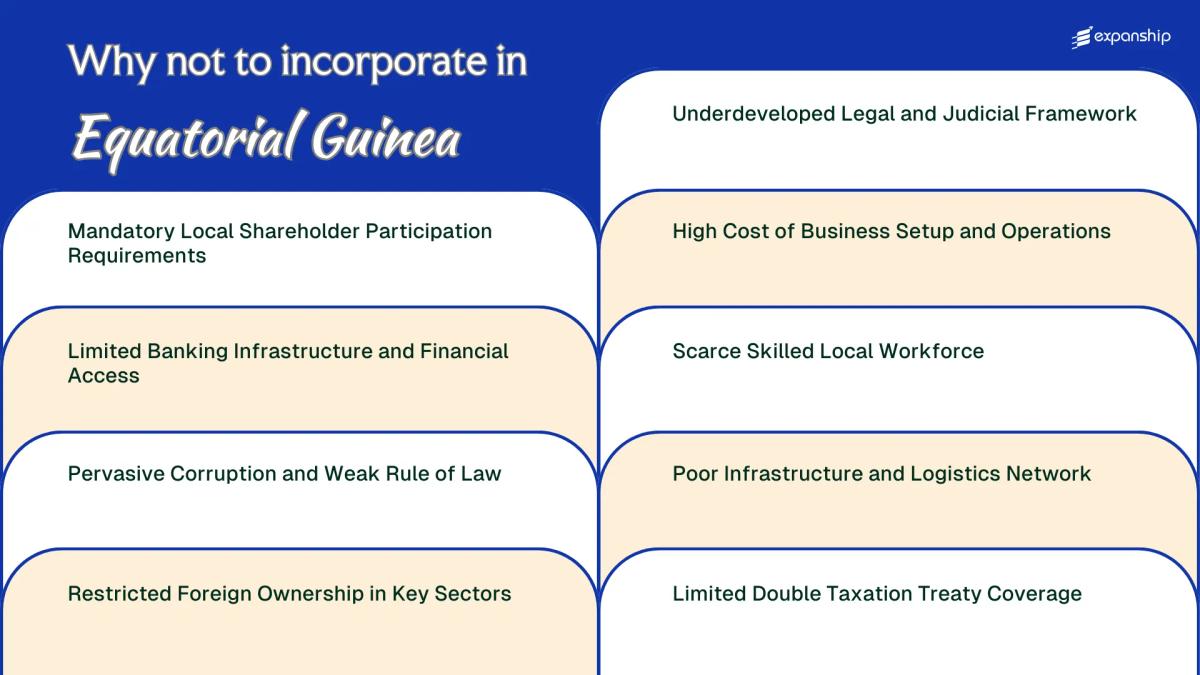
Mandatory Local Shareholder Participation Requirements
Equatorial Guinea local shareholder restrictions apply across multiple sectors and directly limit the ownership structure your firm can adopt from the moment of incorporation.
Minimum Local Equity Thresholds
Under the OHADA Uniform Act on Commercial Companies, which Equatorial Guinea applies as a member state, a Sociedad Anónima can be structured with foreign majority ownership in general commerce. However, sector-specific legislation mandates local participation at rates that can reach 35% or higher, requiring you to identify, vet, and formalize a local partner before operations begin. This search process is neither straightforward nor cheap in a market where vetted local investors with sufficient capital are scarce.
Finding a qualifying local partner often takes months and introduces a co-owner whose interests may not align with yours.
Structural and Governance Risks
Mandatory local partner requirements Equatorial Guinea imposes through sector regulations translate directly into shared governance rights, profit-sharing obligations, and potential veto exposure at shareholder meetings. A foreign investor holding less than the supermajority threshold cannot unilaterally approve key resolutions, which limits strategic control over the entity. The Ministry of Industry and Commerce oversees company registration, but no centralized mechanism exists to arbitrate shareholder disputes efficiently.
A mandatory local equity stake cannot be held nominally; enforcement authorities may scrutinize arrangements where local shareholders hold shares without genuine economic contribution, exposing the structure to legal challenge.
Limited Banking Infrastructure and Financial Access
Equatorial Guinea banking infrastructure challenges are among the most operationally disruptive barriers a foreign business will encounter after incorporation. The country's banking sector operates under the oversight of the Banque des États de l'Afrique Centrale (BEAC), the regional central bank for the CEMAC zone, yet local correspondent banking relationships remain thin and unreliable.
Opening a corporate account can take weeks or months, with banks requesting extensive documentation that must often be notarized abroad and apostilled before submission.
Practical burdens this creates for your business include:
- Delayed payroll and supplier payments when transaction processing backlogs occur at the limited number of licensed commercial banks operating in-country
- Restricted access to trade finance instruments, forcing your firm to rely on foreign banks for letters of credit and guarantees, adding intermediary costs
- Difficulty repatriating profits due to BEAC foreign exchange controls governing CEMAC member states
- Limited digital banking functionality, meaning routine treasury operations require physical branch attendance
Foreign currency transactions face regulatory scrutiny under BEAC's exchange control framework. This means even routine cross-border transfers can stall your operations for days.
Firms in extractive industries may access better banking terms through specialized arrangements, but most other sectors operate without such accommodations.

Company Incorporation in Equatorial Guinea
Understand the full process and requirements for registering a company in Equatorial Guinea before committing capital.
Pervasive Corruption and Weak Rule of Law
Corruption risks doing business in Equatorial Guinea rank among the most serious structural problems foreign investors encounter. Transparency International's Corruption Perceptions Index has consistently placed the country near the bottom of its global rankings, reflecting systemic public-sector misconduct that affects contract enforcement, licensing, and day-to-day regulatory interactions.
Public procurement and licensing decisions frequently involve unofficial payments. Your firm may face demands at multiple points in the approval chain, from ministry-level authorizations to municipal-level operating permits, with no reliable institutional mechanism to challenge or refuse those demands without risking delays or outright denial.
| Business Stage | Corruption Risk | Practical Consequence |
|---|---|---|
| Company registration | Unofficial facilitation fees | Delays without informal payment |
| Operating license approvals | Discretionary ministerial authority | Unpredictable timelines and costs |
| Tax administration | Selective enforcement by AGIP | Arbitrary assessments, limited appeal |
| Contract enforcement | Judicial susceptibility to influence | Rulings not reliably merit-based |
| Customs clearance | Inspector-level discretionary power | Shipment holds pending informal resolution |
Equatorial Guinea has enacted anti-corruption legislation, but enforcement against senior officials or politically connected individuals remains rare. The governing family's documented control over major oil revenues, widely reported by bodies including the U.S. Senate Permanent Subcommittee on Investigations, illustrates how deeply embedded this dynamic is.
Your compliance obligations do not stop at local law. Firms incorporated in or operating through the jurisdiction remain subject to the U.S. Foreign Corrupt Practices Act or the UK Bribery Act, meaning exposure to unofficial payment demands creates dual legal liability.
Restricted Foreign Ownership in Key Sectors
Equatorial Guinea foreign ownership sector restrictions are most acute in hydrocarbons, where the state oil company GEPetrol and the regulatory body GEPetrol/Ministry of Mines enforce mandatory state participation requirements. Foreign oil companies cannot hold full operational control; production sharing agreements typically require a state equity stake, which reduces your effective return on capital before operations begin.
Beyond hydrocarbons, foreign firms in fisheries and telecommunications face similar structural caps. These restrictions are not case-by-case discretionary decisions — they reflect deliberate sectoral policy, meaning your ownership ceiling is fixed before you enter negotiations.
For investors outside the extractive industries, the restrictions still impose indirect costs. Partnering with state entities or locally approved shareholders to satisfy participation thresholds creates governance complexity and dilutes decision-making authority.
- State participation is mandatory in hydrocarbon production sharing agreements.
- Foreign ownership ceilings apply across fisheries and telecommunications sectors.
- Minority foreign ownership positions may reduce your legal control over key operational decisions.
- Sector-specific investment approvals are required beyond standard incorporation filings.
- State equity partners in restricted sectors may carry pre-negotiated rights that override standard shareholder arrangements.
Equatorial Guinea's state entity GEPetrol can hold participating interests in private oil ventures even when it contributes no upfront capital to the project.
Underdeveloped Legal and Judicial Framework
Equatorial Guinea's weak judicial framework risks are structural, not incidental. The country's legal system is rooted in Spanish civil law tradition, yet institutional capacity to apply it consistently remains severely limited.
Structural Gaps in the Legal System
Judicial appointments in Equatorial Guinea lack transparent, merit-based processes, and the courts operate with limited independence from the executive branch. For a foreign-incorporated entity, this means that even a well-drafted contract under local law offers limited assurance of enforcement if a dispute arises.
Equatorial Guinea contract enforcement problems are compounded by the absence of a functioning commercial arbitration infrastructure. Most jurisdictions with comparable GDP profiles maintain at least a regional arbitration center; no such institution exists domestically here, leaving foreign firms without a neutral dispute resolution mechanism.
Consequences for Foreign Business Operations
Your firm's contractual rights depend on the same underdeveloped judiciary that handles all civil and commercial matters, with no specialized commercial court to expedite business disputes. Proceedings can extend for years, creating operational and financial uncertainty that directly affects how you structure agreements and partnerships.
Civil procedure timelines are not publicly benchmarked, so predicting litigation outcomes or duration is not feasible. This opacity raises the due diligence burden and legal costs for any foreign business maintaining operations in-country.
Legal and Operational Guidance for Your Equatorial Guinea Setup
Get structured advice on managing judicial and contractual risks when incorporating and operating in Equatorial Guinea.
High Cost of Business Setup and Operations
High business setup costs in Equatorial Guinea extend well beyond registration fees, creating sustained financial pressure throughout the operational lifecycle of a foreign-owned entity.
- Minimum capital requirements for certain company structures impose immediate upfront costs before any commercial activity begins, tying up funds that smaller foreign firms may not easily absorb.
- Mandatory notarisation and legalisation of incorporation documents through the Ministry of Justice and Religion generates layered administrative fees at each stage of the process.
- Registering with the Agencia Tributaria de Guinea Ecuatorial for tax purposes involves compliance costs that recur annually, adding to your firm's fixed overhead.
- Operational costs are compounded by the near-total dependence on imported goods and equipment, as limited local supply chains force businesses to absorb high logistics and customs duties.
- Hiring qualified expatriate staff to fill technical roles carries significant visa and work permit costs under the country's labour regulations, a burden that persists for as long as those roles remain unfilled by local candidates.
Scarce Skilled Local Workforce
The Equatorial Guinea skilled workforce shortage is one of the most operationally disruptive constraints foreign businesses encounter. Despite oil revenues funding public spending for decades, investment in vocational training and tertiary education has not produced a deep pool of technically qualified local professionals.
The country's small population of roughly 1.5 million limits the available talent base from the outset. Sectors requiring specialized competencies, including finance, engineering, and information technology, face particularly acute shortages that translate directly into higher recruitment costs and longer hiring timelines for your business.
Foreign firms operating under the Labor Law framework are expected to prioritize hiring Equatoguinean nationals, which intensifies the hiring difficulties foreign companies face when qualified local candidates are not available. Relying on expatriate staff triggers work permit obligations, relocation costs, and ongoing compliance requirements that add material overhead to your payroll.
- Specialized roles often require expatriate hires, each subject to work authorization processing through the Ministry of Labor
- Training costs fall on employers where local candidates require significant upskilling before reaching required competency levels
A foreign engineering firm hiring five expatriate specialists, each requiring work permits, housing allowances, and international compensation packages, could realistically incur $300,000 or more annually in additional staffing costs compared to sourcing equivalent talent in a jurisdiction with a developed local labor market.
Poor Infrastructure and Logistics Network
Equatorial Guinea infrastructure limitations create direct operational costs for foreign businesses, particularly those dependent on reliable freight movement, power supply, or telecommunications. Outside of Malabo and Bata, road conditions deteriorate sharply, and interisland connectivity between Bioko and the mainland region of Río Muni is inconsistent and subject to delays.
Port capacity at Malabo and Bata handles the majority of import activity, but congestion and limited handling equipment extend clearance times considerably. Your supply chain timelines cannot be planned with the same precision that more developed port infrastructure elsewhere would allow.
Power reliability is a persistent operational burden. Businesses typically must invest in independent generation capacity to maintain continuity, adding capital expenditure that is not a fixed cost in more developed markets.
- Telecommunications infrastructure outside urban centers remains patchy, limiting remote operations and digital connectivity.
- Cold chain logistics are functionally absent in most areas, restricting certain categories of trade entirely.
- Domestic air freight options are narrow, with limited scheduled capacity available for time-sensitive cargo.
Landlocked supply routes through Cameroon introduce additional customs touchpoints and transit risk that most operators do not account for at the planning stage.
Even if your business operates primarily in Malabo or Bata, dependence on imported inputs means that port congestion and inconsistent customs processing under the Direction Générale des Douanes et Droits Indirects will directly affect your operational costs and delivery timelines regardless of your firm's location.
Limited Double Taxation Treaty Coverage
Equatorial Guinea double taxation treaty limitations are among the most concrete tax risks your business will face when structuring cross-border operations here. The country has signed very few bilateral tax treaties, leaving most dividend, interest, and royalty payments exposed to full withholding tax rates under domestic law rather than reduced treaty rates.
Withholding tax on dividends paid to foreign shareholders can reach 25% under the General Tax Code, with no treaty mechanism available to most investors to reduce that rate. For a foreign parent company repatriating profits, that cost is unrecoverable in many home jurisdictions that rely on tax treaty exemptions or credits.
Royalty payments to foreign entities face similar exposure, meaning intellectual property arrangements and intercompany service fees carry a heavy tax burden that jurisdictions with wider treaty networks simply do not impose. Countries with comparable economic profiles but broader treaty coverage, such as Mauritius or Rwanda, present meaningfully lower withholding friction for multinational structures.
Strategies to Overcome These Challenges
Overcoming Equatorial Guinea business challenges requires structural preparation before incorporation, not reactive adjustments after the fact. The jurisdiction's legal and commercial environment leaves limited room for improvisation.
- Register your entity type correctly from the outset under the OHADA Uniform Act on Commercial Companies, as the choice between a SARL and SA has direct implications for capital requirements and shareholder structure.
- Satisfy the local shareholding requirements imposed on foreign investors in regulated sectors by formally documenting partner agreements and equity arrangements with the Agency for the Promotion of Investment prior to incorporation.
- Open corporate banking relationships through regional institutions operating under BEAC's monetary framework before commencing operations, given the limited correspondent banking access documented for this market.
- Obtain sector-specific operating authorisations from the relevant ministry early, as administrative delays in approvals directly compound setup costs.
- Maintain a dedicated compliance calendar aligned with CEMAC reporting obligations to avoid penalties under the regional tax framework.
These steps address the structural disadvantages described above, but they do not remove the underlying constraints embedded in the country's regulatory and judicial environment. Your firm's exposure to enforcement gaps and governance risks remains a function of how formal commitments are documented and maintained within the applicable legal framework.
Equatorial Guinea's Overall Business Viability
Equatorial Guinea business viability risks are real and well-documented, but the country is not without economic rationale for a narrow set of foreign businesses. Hydrocarbon revenues have funded physical infrastructure upgrades, and the government has expressed formal commitment to economic diversification through Vision 2035.
| Pro | Con |
|---|---|
| Oil-backed government revenues provide some fiscal stability | Corruption is pervasive, with weak enforcement of anti-bribery laws |
| Membership in CEMAC offers a common currency and regional trade framework | Double taxation treaty coverage is extremely limited, raising cross-border tax exposure |
| Strategic Atlantic coastline supports energy sector logistics | Banking infrastructure is underdeveloped, restricting financial access for foreign entities |
| Government-stated diversification policy opens select non-oil sectors | Foreign ownership is restricted in key industries, requiring local partner arrangements |
| CFA franc provides monetary stability and convertibility | The local skilled workforce is scarce, increasing reliance on costly expatriate hires |
For the right business profile, a presence here is feasible. The operational and legal friction, however, is substantial enough that market entry feasibility must be assessed with a clear-eyed view of the structural barriers this blog has outlined.
Compliance Services for Companies in Equatorial Guinea
Maintain good standing with local regulatory requirements, including annual filings, reporting obligations, and ongoing corporate administration under Equatoguinean law.
Conclusion
The Equatorial Guinea incorporation cons summary is straightforward: this is a jurisdiction where structural barriers are deep-rooted and not easily offset by sector-specific opportunity. Mandatory local participation requirements, limited access to functional banking, and a judicial system that offers little reliable recourse collectively create a high-risk operating environment. For most firms, the cost of establishing and maintaining compliance here exceeds initial projections. Structural expert support, combined with detailed pre-entry due diligence on CEMAC regulations and BEAC requirements, remains the most practical path for any business seriously evaluating company formation in this market.
Expanship's Equatorial Guinea Expansion Services
Incorporating in Equatorial Guinea carries real operational weight — from mandatory local shareholder participation under Equatoguinean commercial law to coordination with the Agencia de Regulación de Inversiones Privadas (ARIP). Expanship's Equatorial Guinea company formation services are structured around these specific obligations, reducing the administrative burden your business carries at each stage of the process.
Beyond registration, our support covers the broader compliance cycle that follows incorporation.
- We prepare and file all company registration documents with the relevant authorities.
- Our team provides a registered agent and local office address in Equatorial Guinea.
- We handle government filings and liaise directly with ARIP and other regulatory bodies on your behalf.
- Post-incorporation compliance management keeps your entity in good standing over time.
- Banking introduction assistance helps connect your business with local financial institutions.
- We manage tax registration and coordinate with local authorities on your behalf.
To discuss your Equatorial Guinea expansion, contact Expanship Equatorial Guinea.
Frequently Asked Questions (FAQ)
The local participation requirement applies broadly to foreign-owned entities, though the specific threshold can vary depending on the sector and the nature of the activity being registered. In sectors linked to natural resources, the state-owned entity GEPetrol or the government itself may claim a participation stake by default under the hydrocarbons framework. Even outside extractive industries, structuring a company without any local involvement is rarely straightforward in practice.
Non-compliance can result in the denial or revocation of operating licenses issued by the Ministerio de Hacienda y Presupuestos or the relevant sectoral authority. Beyond administrative penalties, non-compliant entities risk contract nullification, particularly in government-linked projects where local content verification is a contractual condition. There is limited judicial recourse if a dispute arises, given the underdeveloped state of the court system.
Equatorial Guinea consistently underperforms relative to regional peers such as Rwanda, Mauritius, and even some larger economies like Senegal on business environment indicators. The World Bank's historical Doing Business assessments placed Equatorial Guinea among the weakest performers in contract enforcement, starting a business, and getting credit. The combination of limited banking infrastructure, poor logistics, and an opaque regulatory environment makes it more restrictive than most alternative incorporation destinations in the region.
Setup costs in Equatorial Guinea are elevated by mandatory notarial fees, capital requirements, and the practical necessity of engaging local legal counsel familiar with the Ministerio de Hacienda y Presupuestos processes. Operational costs compound this, since unreliable infrastructure forces many firms to invest in private power generation, water supply, and logistics solutions that would be publicly provided elsewhere. Annual compliance maintenance, including local audit requirements and renewal fees, adds further cost that is difficult to predict given inconsistent regulatory enforcement.
In the hydrocarbons sector, foreign companies are required to operate through production sharing contracts with the government, and GEPetrol holds a statutory participation right in upstream activities under the Hydrocarbon Law. Fishing and certain agricultural concessions also carry restrictions that effectively limit the degree of control a foreign entity can exercise. Outside these sectors, restrictions are less codified but are applied with significant administrative discretion, which creates its own form of unpredictable limitation.
Equatorial Guinea has an extremely limited double taxation treaty network, meaning income earned across borders is likely subject to taxation in both Equatorial Guinea and the counterpart jurisdiction without any relief mechanism. This creates a structurally inefficient holding position for businesses with regional or international revenue streams. Unlike jurisdictions with broad treaty networks, there is no withholding tax reduction available on dividends, royalties, or interest payments flowing out of the country to most foreign partners.
Yes, directly and materially. The court system lacks the procedural independence and technical capacity to reliably enforce commercial agreements, particularly those involving foreign counterparties, which means contractual disputes may go unresolved for extended periods or be subject to outcomes influenced by factors outside the legal merits. International arbitration clauses offer partial protection, but enforcement of foreign arbitral awards within Equatorial Guinea remains uncertain given the country's inconsistent engagement with international enforcement frameworks.
Legal Disclaimer
The information provided in this article is for general informational purposes only and does not constitute legal, tax, or professional advice. While we strive to ensure the accuracy and timeliness of the content, laws and regulations are subject to change, and the application of laws can vary widely based on specific facts and circumstances.
Readers should not act upon this information without seeking professional counsel tailored to their individual situation. Expanship and its authors disclaim any liability for actions taken or not taken based on the content of this article.
For specific advice regarding your business setup, compliance requirements, or any legal matters, please consult with qualified legal and tax professionals in the relevant jurisdiction.