

Key Takeaways
- Under the Ley de Sociedades de Capital, founders must deposit a minimum share capital of €3,000 for a Sociedad Limitada or €60,000 for a Sociedad Anónima before the public deed of incorporation can be executed before a notary.
- Beneficial ownership information must be registered with the Registro Mercantil and kept current throughout the life of the company, making UBO disclosure an ongoing compliance obligation rather than a one-time formation step.
- Companies incorporating in Spain must maintain a registered office address within Spanish territory, as this address determines which provincial Registro Mercantil holds jurisdiction over the entity's filings.
- Foreign nationals serving as directors or shareholders are subject to additional documentary requirements, including obtaining a Spanish tax identification number (NIE), before the registration process with the Registro Mercantil can be completed.
Entity formation in Spain is governed by the Ley de Sociedades de Capital, which consolidates the rules applicable to capital-based commercial structures. The Registro Mercantil Central, along with provincial mercantile registries, serves as the primary authority for company registration in Spain.
This article addresses the structural, documentary, and administrative incorporation requirements in Spain that apply across the formation process.
Failure to satisfy these conditions results in rejection of the registration application by the relevant Registro Mercantil, leaving the entity without legal standing to operate.
Spain business incorporation rules are not uniform across all situations. Specific obligations may differ based on the chosen legal form, the sector in which your business operates, and whether foreign capital is involved.
Foreign investors, non-resident founders, and internationally active businesses establishing a subsidiary or branch are the practitioners most likely to encounter these requirements when assessing company registration requirements in Spain.
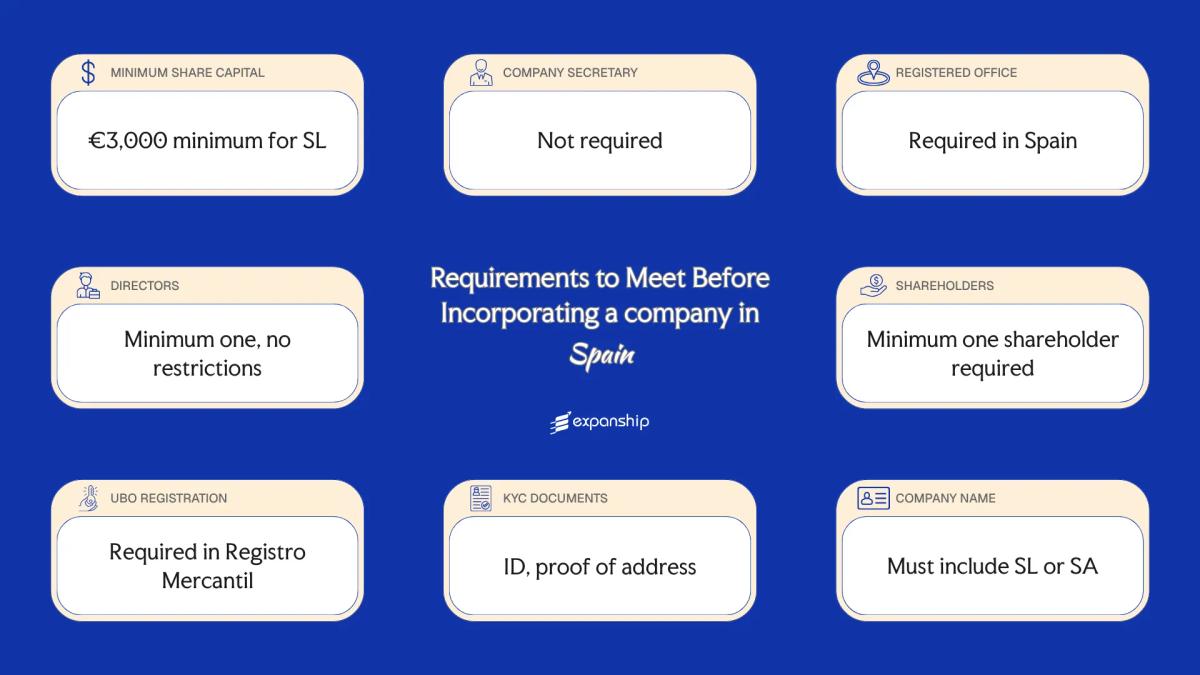
Minimum Share Capital Requirements in Spain

Minimum share capital requirements in Spain differ by entity type, with the Sociedad Limitada (SL) governed by the Ley de Sociedades de Capital (Royal Legislative Decree 1/2010). Under this statute, the SL carries a fixed minimum capital threshold that must be fully subscribed and paid up at the point of incorporation.
Capital is verified by the Registro Mercantil (Commercial Registry) during the registration process, typically through a bank certificate confirming the deposit. Once incorporated, the capital figure recorded in the public deed represents an ongoing statutory obligation — any subsequent reduction is subject to formal creditor protection procedures.
| Parameter | Detail |
|---|---|
| Minimum Authorized Share Capital | EUR 3,000 (Sociedad Limitada) |
| Maximum Authorized Share Capital | No statutory requirement |
| Minimum Paid-Up Capital | EUR 3,000 |
| Paid-Up Requirement at Incorporation | 100% must be fully paid up before registration |
| Accepted Currency | Euro (EUR) |
| Accepted Forms of Contribution | Monetary contributions; non-monetary contributions permitted if valued and documented |
| Timeframe to Deposit Capital | Prior to execution of the public deed of incorporation |
Fully paying up the EUR 3,000 at incorporation satisfies the legal minimum, but the company statutes must still define the nominal value per participación — the SL uses participaciones, not shares, and each must have an assigned par value.
Company Secretary Requirements in Spain
Under Spanish corporate law, company secretary requirements in Spain apply specifically to Sociedades Anónimas (SAs). For a Sociedad Limitada (SL), the appointment of a secretary is not a statutory obligation, though the board may elect to designate one internally.
In an SA, the secretary's role carries defined obligations under the Ley de Sociedades de Capital. Duties include certifying board resolutions, maintaining the minutes book, and ensuring that corporate documentation meets the standards required by the Registro Mercantil.
Qualification criteria for who may serve as secretary in an SA include:
- The secretary may be a board member or an external third party with no directorship.
- No mandatory professional qualification is prescribed by statute for the secretary role.
- Non-residents and foreign nationals are not excluded from serving as secretary.
- Legal entities may be appointed as secretary in certain corporate structures.
- The secretary must have legal capacity under Spanish civil law to act on behalf of the company.

Incorporate a Company in Spain
Set up your Spanish entity with full statutory compliance, from deed preparation to Registro Mercantil registration.
Registered Office Requirements in Spain
The registered office requirements in Spain center on the concept of the domicilio social, which must correspond to the location where the company conducts its administration or where its principal establishment is situated, as set out in Article 9 of the Real Decreto Legislativo 1/2010 (Ley de Sociedades de Capital). Providing a false or non-functional address can expose the entity to administrative sanctions and may result in the Registro Mercantil refusing to register subsequent filings or triggering a dissolution procedure under Article 363 of the same law.
- A physical address within Spanish territory is required; a P.O. box does not qualify as a valid domicilio social.
- Virtual office addresses are permitted provided they correspond to a real, accessible location where official notifications can be received.
- The address must be located in Spain; a foreign address cannot satisfy this requirement.
- No ownership of the premises is required; a lease or service agreement covering the address is acceptable.
- The registered address is publicly listed in the Registro Mercantil and accessible through official registry searches.
- Any change to the domicilio social must be approved by the competent corporate body and formally notified to the Registro Mercantil by way of a public deed (escritura pública).
Director Requirements in Spain

Under Spanish corporate law, director requirements for a Spain company follow rules set out primarily in the Ley de Sociedades de Capital (Royal Legislative Decree 1/2010). Upon appointment, directors assume fiduciary duties of loyalty and diligence toward the entity, and bear personal liability for damages caused by acts contrary to law, the company's bylaws, or resolutions of the general shareholders' meeting.
| Parameter | Detail |
|---|---|
| Minimum Number of Directors | One director is sufficient for an SL or SA, unless the bylaws specify a board structure. |
| Maximum Number of Directors | No statutory maximum for an SL; SA boards are governed by bylaws, though a board (consejo de administración) requires a minimum of three members. |
| Local/Resident Director Required | No statutory requirement for a Spanish-resident director. |
| Nationality Restrictions | No nationality restrictions apply to directors. |
| Minimum Age Requirement | Directors must have full legal capacity, which under Spanish civil law is attained at age 18. |
| Corporate Directors Permitted | Legal entities may serve as directors, but a natural person must be designated as the permanent representative under Article 212 bis of the Ley de Sociedades de Capital. |
| Director Must Be a Shareholder | No statutory requirement for directors to hold shares in the company. |
| Publicly Listed on Registry | Director appointments are registered in the Registro Mercantil and are publicly accessible. |
| Disqualification Conditions | Persons convicted of certain criminal offences, undischarged bankrupts, or those disqualified by court order under the Ley Concursal cannot serve as directors. |
A legal entity can be appointed as director of a Spanish company, but it must formally designate a human representative who is then personally liable alongside the corporate director itself.
Shareholder Requirements in Spain
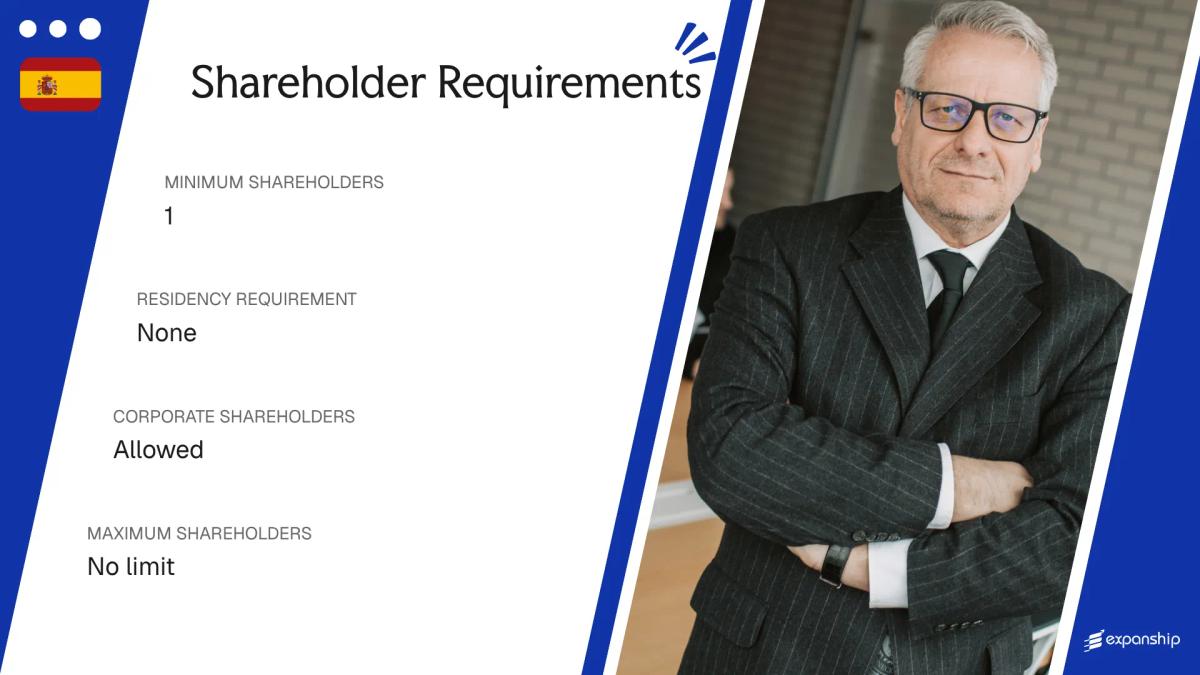
A Sociedad de Responsabilidad Limitada (SL) requires a minimum of one shareholder, permitting a single-member structure known as a Sociedad Unipersonal. No statutory maximum applies to the number of shareholders.
Nationality and Residency Restrictions
Spanish corporate law imposes no nationality or residency requirements on shareholders. Foreign individuals and entities may hold 100% of the participations without restriction.
Corporate Shareholders
Legal entities may act as shareholders in an SL. The corporate shareholder must provide standard identification documentation during incorporation, including evidence of legal existence in its home jurisdiction.
Shareholder Liability
Shareholder liability is limited to the amount each socio has contributed to the share capital. Liability may extend beyond this threshold only in specific circumstances, such as when a court applies the doctrine of lifting the corporate veil under Spanish case law.
Register of Shareholders
An SL must maintain a libro registro de socios, recording each shareholder's identity and participation. This register is not publicly accessible but must be kept current and made available to shareholders upon request.
Shareholder Structuring Support for Your Spanish Incorporation
Get tailored guidance on meeting socio requirements and structuring ownership correctly for your Spanish entity from the outset.
UBO / Beneficial Ownership Registration Requirements in Spain
Beneficial ownership registration Spain is governed by Law 10/2010 on the Prevention of Money Laundering and Terrorist Financing, which defines a beneficial owner as any natural person holding, directly or indirectly, 25% or more of the share capital or voting rights of a legal entity.
- Identify all natural persons meeting the 25% ownership or control threshold prior to incorporation.
- Submit UBO data to the Registro Mercantil (Commercial Registry) as part of the company incorporation filing.
- If no natural person meets the threshold, declare the senior managing official as the beneficial owner on record.
- File updates with the Registro Mercantil whenever ownership or control changes occur.
| Parameter | Detail |
|---|---|
| Ownership Threshold for UBO Status | 25% of share capital or voting rights |
| Filing Authority | Registro Mercantil |
| Disclosure Deadline at Incorporation | At the time of incorporation filing |
| Publicly Accessible Register | No statutory public access for UBO data |
| Penalties for Non-Disclosure | Administrative sanctions under Law 10/2010 |
| Ongoing Update Obligation | Required upon any change in ownership or control |
KYC / Document Requirements in Spain
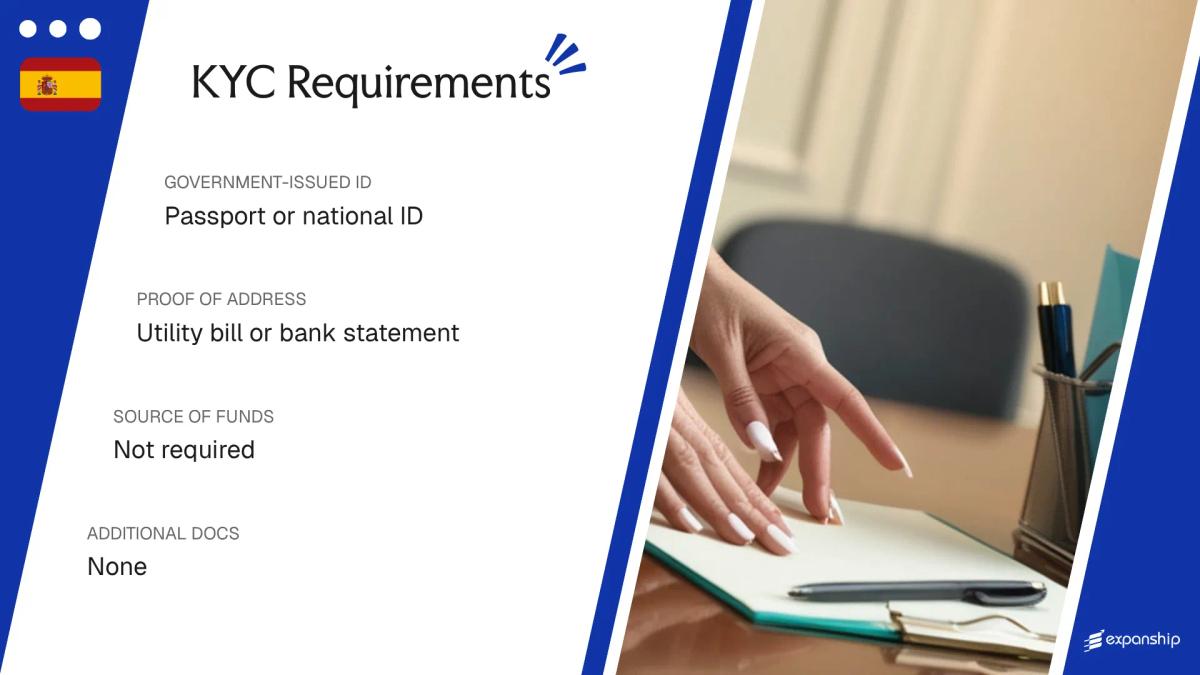
KYC document requirements Spain are governed primarily by Ley 10/2010, de 28 de abril, de prevención del blanqueo de capitales y de la financiación del terrorismo, administered by the SEPBLAC.
Individual / Personal Documents
- Valid government-issued photo ID (national identity document or passport) for each director, shareholder, and beneficial owner
- Proof of residential address dated within the last three months, such as a utility bill or official bank correspondence
- Completed and signed KYC/AML declaration form as required by the notary or formation agent
Corporate Documents
- Certificate of incorporation or equivalent constitutional document for any corporate shareholder or director
- Certified copy of the entity's articles of association or bylaws
- Current register of directors confirming authorised signatories
- Proof of registered address for the corporate entity
Source of Funds Documentation
- Recent bank statements covering a minimum of three months prior to incorporation
- Audited financial accounts where the subscribing entity has an established trading history
- Written declaration of the origin of capital if bank documentation is insufficient
Notarisation and Apostille Requirements
- Foreign public documents must carry an apostille under the 1961 Hague Convention
- All non-Spanish documents require a sworn translation into Spanish by a certified translator
- Notarised copies may be required by the Registro Mercantil for corporate constitutional documents
Mismatched names or addresses across identity documents are the most frequent cause of notarial rejection during the deed of incorporation.
Company Name Requirements in Spain
Company name requirements Spain follow a centralised clearance process: proposed names are checked against existing registrations before incorporation can proceed. Approval is granted by a national registry body, and identical or confusingly similar names to already-registered entities are rejected.
All commercial company names must include a legal form suffix corresponding to the chosen entity type, such as S.L. for a Sociedad de Responsabilidad Limitada or S.A. for a Sociedad Anónima. Names must be in any language using the Latin alphabet, though phonetic imitations of existing names are treated the same as direct copies.
Certain words are restricted and require prior authorisation from relevant public bodies before use in a firm's name. Terms suggesting a connection to government institutions, financial regulators, or internationally protected organisations fall into this category, as do words reserved for specific licensed industries.
Name reservation is available and must be requested directly from the central registry before submitting incorporation documents. A reservation certificate is issued and remains valid for a defined period, during which no other entity may register the same denominación social.
Compliance Services for Companies in Spain
Maintain ongoing regulatory compliance for your Spanish entity, from annual filings to statutory record-keeping obligations.
Conclusion
Spain company incorporation requirements span several regulatory layers, from share capital thresholds set under the Ley de Sociedades de Capital to director residency rules and UBO registration with the Registro Mercantil. Among the requirements covered, the minimum share capital distinction between the Sociedad Limitada and Sociedad Anónima carries direct structural consequences for how your entity is capitalized and governed. Beneficial ownership disclosure obligations add a further compliance layer that persists well beyond formation. Once these requirements are understood, the practical work of executing registration, satisfying notarial formalities, and maintaining ongoing compliance with Spanish tax and corporate authorities begins.
Expanship's Corporate Services for Spain Expansion
Forming a company in Spain involves meeting specific structural requirements set by the Registro Mercantil Central, from capital deposits to director appointments and UBO disclosures. Expanship supports your Spain company formation services engagement by managing the documentation, filings, and regulatory coordination these requirements demand. Our role is to reduce the administrative load, not to change what Spanish law requires of your business.
Beyond incorporation, Expanship offers a structured range of corporate services in Spain:
- We prepare and register your company documentation with the relevant Spanish authorities.
- Our team provides a registered agent and compliant office address for your entity.
- We handle government filings and liaise directly with bodies such as the AEAT and Registro Mercantil.
- Post-incorporation obligations, including annual compliance, are managed on your behalf.
- Banking introduction support is available to help your firm establish a local account.
- We coordinate tax registration and engage with local authorities as required.
To discuss your specific situation, contact Expanship Spain.
Frequently Asked Questions (FAQ)
Yes, the full €3,000 must be paid up at the time of incorporation, not in instalments. This is a firm requirement under the Ley de Sociedades de Capital (Real Decreto Legislativo 1/2010), which governs Spanish capital companies. The notary who authorises the public deed of incorporation will require proof of capital contribution before proceeding.
A non-resident foreign national can serve as sole director of an SL, but they must hold a valid Spanish tax identification number, specifically a NIE (Número de Identificación de Extranjero). Without a NIE, the appointment cannot be formalised through the notary or registered with the Registro Mercantil. There is no requirement for the director to be a Spanish resident or national.
Failure to comply with beneficial ownership registration requirements can result in administrative sanctions under Spain's anti-money laundering framework, which implements the EU's Fourth and Fifth Anti-Money Laundering Directives. The Registro Mercantil can refuse to process certain corporate acts for non-compliant entities. Persistent non-compliance may also attract scrutiny from the Servicio Ejecutivo de la Comisión de Prevención del Blanqueo de Capitales (SEPBLAC).
The Registro Mercantil Central handles company name reservations in Spain, and a reserved name is protected for six months from the date of certification. You must obtain a negative name certification confirming no identical or confusingly similar name exists before the notary can draft the incorporation deed. If incorporation is not completed within that window, the reservation lapses and a new certification must be requested.
A formally appointed company secretary is not a statutory requirement for a Sociedad Limitada under the Ley de Sociedades de Capital. The role becomes mandatory only for a Sociedad Anónima (SA) or when an SL has a board of directors rather than a sole administrator. In those cases, the secretary may be a non-board member and does not need to be a Spanish resident.
Non-EU shareholders face additional document authentication requirements, typically including apostilled or legalised identification documents and, where applicable, officially translated copies in Spanish. EU-based shareholders generally benefit from simplified recognition of identity documents under EU regulatory alignment, though notaries retain discretion to request supporting documentation in either case. The notary overseeing the public deed of incorporation is responsible for conducting these identity checks before formalising the entity.
Legal Disclaimer
The information provided in this article is for general informational purposes only and does not constitute legal, tax, or professional advice. While we strive to ensure the accuracy and timeliness of the content, laws and regulations are subject to change, and the application of laws can vary widely based on specific facts and circumstances.
Readers should not act upon this information without seeking professional counsel tailored to their individual situation. Expanship and its authors disclaim any liability for actions taken or not taken based on the content of this article.
For specific advice regarding your business setup, compliance requirements, or any legal matters, please consult with qualified legal and tax professionals in the relevant jurisdiction.