

Key Takeaways
- Spain's standard corporate income tax rate, enforced by the Agencia Tributaria, applies to resident companies without the low-rate alternatives available in competing EU jurisdictions, increasing the overall fiscal cost of operating through a local entity.
- The Ley de Sociedades de Capital imposes a minimum share capital of €60,000 for a Sociedad Anónima, creating a capital commitment threshold that can deter early-stage foreign investors who would otherwise prefer a lighter incorporation structure.
- Social Security contribution obligations fall heavily on employers, with payroll-linked rates that materially raise the cost of hiring relative to jurisdictions outside the Spanish labor framework.
- Autonomous communities such as the Basque Country and Navarre operate under distinct foral tax regimes, meaning that the effective compliance burden and applicable rates can differ significantly depending on where the entity establishes its registered seat or conducts economic activity.
Spain operates under a heavily regulated corporate and commercial framework, shaped by EU directives and domestic statutes enforced through bodies such as the Agencia Tributaria and the Registro Mercantil. Understanding the disadvantages of incorporating in Spain requires familiarity with overlapping obligations spanning tax, labor, and administrative law.
The drawbacks covered across this article fall into several distinct categories, from fiscal burdens to structural constraints tied to specific legal forms under the Ley de Sociedades de Capital.
Not every disadvantage applies equally to all entities. A sole-activity holding firm faces a different compliance profile than a trading company with employees, and the risks of doing business in Spain differ meaningfully by industry and chosen corporate structure.
This article is most relevant to foreign investors and non-resident founders considering the formation of a Sociedad Limitada or Sociedad Anónima as their primary operating vehicle in the Spanish market.
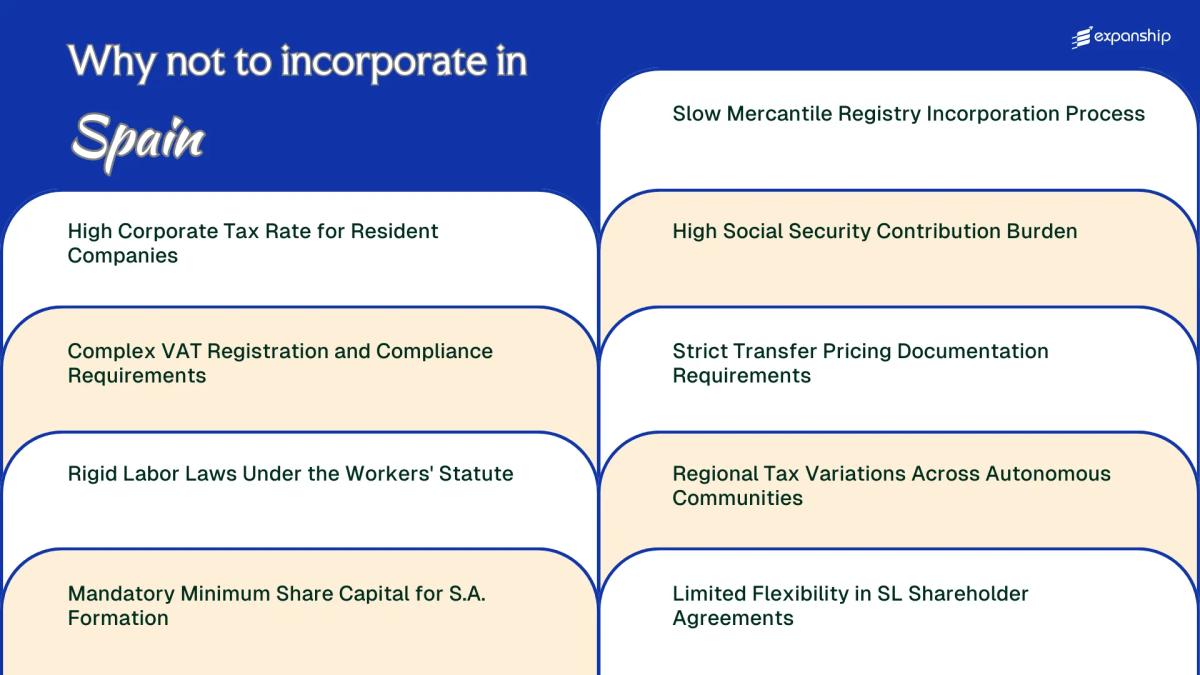
High Corporate Tax Rate for Resident Companies
Spain's standard corporate tax rate sits at 25%, applying to the worldwide income of resident companies under the Ley del Impuesto sobre Sociedades (Law 27/2014). For foreign investors establishing a resident entity, the Spain corporate tax rate drawbacks become apparent when comparing this rate against lower-tax EU alternatives.
A Rate That Compounds Operational Costs
Resident status is triggered by incorporation under Spanish law or by having the registered office or effective place of management within the country. This means a foreign-owned subsidiary incorporated as a Sociedad Limitada or Sociedad Anónima becomes fully liable on global profits, not just domestic earnings.
Reduced Rates Offer Limited Relief
Newly created entities may qualify for a 15% rate during the first two profitable tax periods, but this applies only once and does not offset the structural weight of the high Impuesto sobre Sociedades burden over a business's lifetime. The standard rate then applies indefinitely, regardless of profit scale or sector.
A foreign-owned resident company in Spain faces full Impuesto sobre Sociedades liability on its worldwide income from the moment residency is established, with no permanent reduced-rate mechanism available beyond the initial relief period.
Complex VAT Registration and Compliance Requirements
Spain VAT compliance challenges are among the most operationally demanding aspects of running a business in the country. The standard IVA rate is 21%, with reduced rates of 10% and 4% applying to specific categories, and administering these correctly across transactions requires consistent internal classification work that foreign-owned firms rarely anticipate.
The core burden for larger businesses is the Suministro Inmediato de Información (SII) system, operated by the Agencia Tributaria. Under SII, companies with annual turnover exceeding 6 million euros must submit electronic invoice records within four days of issuance or receipt. Missing that window triggers penalties, and the system requires technical integration between your accounting software and the tax authority's API.
Practically, this creates several friction points:
- Hiring or contracting SII-compliant accounting infrastructure before your firm generates any Spanish revenue
- Re-training or replacing bookkeeping staff unfamiliar with Agencia Tributaria's specific XML submission format
- Facing retroactive penalty exposure during the gap between incorporation and full system integration
- Managing separate VAT registration obligations if your entity operates across multiple autonomous communities with differing local surcharges
Businesses below the SII threshold still file monthly or quarterly IVA returns via Modelo 303, with an annual summary through Modelo 390. The filing frequency depends on your turnover, but either path demands consistent record-keeping that non-resident directors often underestimate until the first penalty notice arrives.

Company Incorporation in Spain
Understand the full compliance obligations before you incorporate. Expanship helps foreign businesses structure their Spain entity correctly from day one.
Rigid Labor Laws Under the Workers' Statute
Spain labor law restrictions for companies represent one of the more binding structural challenges for foreign employers operating through a local entity. The Estatuto de los Trabajadores (Workers' Statute), codified in Royal Legislative Decree 2/2015, governs virtually every dimension of the employment relationship, from contract types to termination procedures.
Dismissing a permanent employee classified as unfairly dismissed triggers mandatory severance of 33 days' salary per year of service, capped at 24 monthly payments. This exposure accumulates silently — a workforce of ten permanent employees hired over several years can represent a liability that did not exist on your balance sheet until a restructuring becomes necessary.
| Situation | Statutory Requirement | Implication for Employer |
|---|---|---|
| Unfair dismissal severance | 33 days/year of service (max 24 months' pay) | High exit cost for long-tenured staff |
| Objective dismissal notice | 15 calendar days minimum | Operational delays during restructuring |
| Collective redundancy (ERE) threshold | 10+ employees in 90 days (firms under 100) | Triggers mandatory consultation with workers' representatives |
| Temporary contract conversion | Automatic permanent status after 24 months in 30 | Unintended permanent headcount growth |
Collective redundancies above statutory thresholds trigger an Expediente de Regulación de Empleo (ERE), a formal process requiring negotiation with employee representatives and, in some cases, engagement with the Servicio Público de Empleo Estatal. This process can extend weeks beyond your intended timeline, removing the operational flexibility that workforce adjustments typically require.
Rigid employment rules in Spain also restrict how probationary periods and contract durations can be structured, limiting your ability to test new roles without incurring long-term obligations. For a foreign business scaling quickly, this inflexibility directly increases both cost and legal risk.
Mandatory Minimum Share Capital for S.A. Formation
Spain S.A. minimum share capital requirements set a significant financial threshold before your business can even begin operating. Under the Ley de Sociedades de Capital (Royal Legislative Decree 1/2010), forming a Sociedad Anónima requires a minimum subscribed capital of €60,000. At least 25% of that amount must be paid up at the time of incorporation, leaving the remainder callable later.
That €60,000 floor is a hard statutory barrier. For many early-stage foreign businesses or entrepreneurs testing the Spanish market, committing that level of capital upfront to a single legal entity is a direct cash flow constraint.
By contrast, forming a Sociedad de Responsabilidad Limitada requires only €3,000 in minimum capital. The gap between these two entity types is substantial, and where the S.A. structure is operationally necessary, such as for businesses planning a public share offering or those with specific investor requirements, there is no mechanism to reduce or defer this obligation.
- €60,000 minimum capital is required by statute; no discretionary reduction is available
- At least 25% (€15,000) must be fully paid on incorporation
- Capital must be verified by a notarial deed before registration at the Mercantile Registry
- In-kind contributions require an independent expert valuation report
- The full capital obligation applies regardless of the company's actual operational size or revenue
Spain's €60,000 S.A. minimum capital requirement is twelve times higher than the minimum required to form an S.A. in neighboring Portugal, which sets its threshold at just €50,000 — but several EU member states permit equivalent public company structures with no statutory minimum at all.
Slow Mercantile Registry Incorporation Process
Spain Mercantile Registry incorporation delays are a documented friction point for foreign businesses entering the market. Processing times at the Registro Mercantil vary by province and can extend several weeks beyond what founders typically anticipate.
Structural Bottlenecks in the Registration Process
Before any filing reaches the Registro Mercantil, company names must be pre-cleared through the Registro Mercantil Central, adding a sequential step that consumes additional days. Each stage gates the next, meaning delays compound rather than run concurrently.
A notarial deed of incorporation must also be executed before a public notary, then submitted for registration, a sequence that has no administrative shortcut under current Spanish company law.
Practical Consequences for Foreign Incorporations
Until registration is complete, your entity cannot open a corporate bank account or operate commercially under its registered identity. For foreign investors managing cross-border timelines or contractual deadlines, even a two-to-four-week delay in a single province can disrupt supplier agreements or investor commitments.
The slow company registration process in Spain is not uniform; provincial registries in Madrid and Barcelona tend to process filings faster than those in smaller regions, making jurisdiction selection within Spain a relevant operational variable.
Managing Incorporation Delays in Spain
Get guidance on structuring your Spain company formation timeline to account for Registro Mercantil processing requirements across different provinces.
High Social Security Contribution Burden
Spain's social security contributions burden ranks among the heaviest in the EU, with employers required to contribute approximately 29.9% of gross salary to the Tesorería General de la Seguridad Social (TGSS), covering contingencies such as unemployment, professional training, and the Fondo de Garantía Salarial (FOGASA).
- Employer contributions to the TGSS apply from the first day of employment, meaning payroll costs escalate immediately with each hire, leaving no transitional period for early-stage foreign entities to stabilize cash flow.
- The combined employer and employee contribution rate frequently pushes total payroll costs 35% or more above the agreed gross salary, compressing margins for labor-intensive businesses.
- High employer Social Security costs in Spain apply uniformly across most contract types, so structuring headcount flexibly offers limited relief from the base contribution obligation.
- TGSS deadlines are monthly and non-negotiable, creating a recurring administrative and liquidity obligation that foreign-owned firms without local treasury infrastructure find difficult to absorb.
Strict Transfer Pricing Documentation Requirements
Spain transfer pricing documentation risks are governed by Article 18 of the Corporate Income Tax Law (Ley 27/2014, del Impuesto sobre Sociedades), which requires related parties to maintain contemporaneous documentation supporting the arm's length nature of their transactions. This is not a passive record-keeping obligation — failure to maintain adequate documentation exposes your business to automatic penalties, regardless of whether the pricing itself is correct.
The Spanish Tax Agency (Agencia Tributaria) enforces a two-tiered documentation model aligned with OECD transfer pricing guidelines: a master file and a local file. Groups with consolidated revenues exceeding 750 million euros must also submit Country-by-Country Reports, adding another layer of Spanish transfer pricing compliance burden for multinational structures.
Penalties for non-compliance can reach 15% of the adjusted amount, with minimum penalty thresholds applied per undocumented transaction. Foreign-owned entities with intercompany service agreements, IP licensing, or intragroup financing arrangements face the heaviest scrutiny.
A foreign subsidiary billing management fees to its Spanish entity at 8% of revenue — without a transfer pricing study on file — could face a penalty of 15% of the entire billed amount upon audit, independent of any tax adjustment. That penalty exposure exists solely due to missing documentation, not pricing error.
Regional Tax Variations Across Autonomous Communities
Spain regional tax variation challenges stem directly from its constitutional structure. Under Article 156 of the Spanish Constitution, the 17 autonomous communities hold significant fiscal authority, meaning your business faces a fragmented tax environment rather than a single national regime.
The Basque Country and Navarre operate under the régimen foral, a separate tax arrangement granting them full competence over corporate income tax. A firm established in either territory files under locally administered rules, not the national Ley 27/2014 del Impuesto sobre Sociedades, which introduces a parallel compliance track that foreign businesses rarely anticipate.
Beyond the foral territories, other communities vary on wealth tax rates, inheritance and gift tax, and certain surcharges applied to personal income tax. For foreign directors or shareholders with Spanish tax exposure, this means the community where your entity registers materially affects your overall fiscal position.
Determining the correct community for registration is not purely a commercial decision. It carries direct tax consequences that require legal analysis specific to each territory.
If your business has any connection to the Basque Country or Navarre, whether through a registered office, permanent establishment, or significant operations, you fall under the régimen foral and cannot assume that national corporate tax rules, rates, or filing procedures apply to your entity.
Limited Flexibility in SL Shareholder Agreements
Spain SL shareholder agreement limitations stem primarily from the Ley de Sociedades de Capital (LSC), which governs the Sociedad Limitada structure. Many provisions of this law are mandatory, meaning your shareholder agreement cannot override them regardless of what the parties have agreed.
SL share transfer restrictions in Spain illustrate this rigidity directly. The LSC grants existing shareholders pre-emption rights over any proposed transfer, and the articles of association cannot fully eliminate this protection — only modify its mechanics.
Unanimous or supermajority consent thresholds for certain decisions are set by statute, leaving limited room to allocate decision-making authority in ways that reflect your actual ownership structure. For foreign investors accustomed to more permissive frameworks, this constrains how you configure control and exit rights from the outset.
Unlike an S.A., the SL was designed for closely held domestic businesses, and its statutory defaults reflect that origin. Sociedad Limitada flexibility restrictions become most consequential when structuring joint ventures or multi-party investment arrangements.
Strategies to Overcome These Challenges
Overcoming Spain incorporation challenges requires structural planning before the entity is formed, not after compliance obligations have already taken effect.
- Elect the Sociedad de Responsabilidad Limitada structure over the S.A. to avoid the €60,000 minimum share capital threshold set under Royal Legislative Decree 1/2010.
- Register for VAT with the Agencia Tributaria at incorporation and assess whether your activity triggers the quarterly SII electronic invoicing reporting obligation.
- Apply for the reduced 15% corporate tax rate available to newly formed entities in their first two profitable years under the Ley del Impuesto sobre Sociedades.
- Prepare transfer pricing documentation in advance if related-party transactions are anticipated, as the obligation is triggered by thresholds, not discretion.
- Review the tax regime of your target autonomous community before selecting a registered office, given substantive fiscal differences across regions such as the Basque Country and Navarra.
- Draft shareholder agreements in alignment with the Ley de Sociedades de Capital to avoid provisions being rendered unenforceable at registration.
Each of these steps addresses a structural constraint embedded in Spanish corporate and tax law. The Mercantile Registry, the Agencia Tributaria, and regional tax authorities operate under separate procedural frameworks, and compliance obligations across these bodies run concurrently.
Spain's Overall Appeal for Foreign Investors
Despite the Spain foreign investment drawbacks and appeal tension that this blog has examined, the country retains a credible position as an incorporation destination. Its eurozone membership, large domestic consumer market, and extensive double tax treaty network give it structural advantages that many competing jurisdictions cannot match.
| Pros | Cons |
|---|---|
| Access to the EU single market and eurozone payment infrastructure | Standard corporate tax rate of 25% is above the EU average for resident companies |
| Extensive network of double tax treaties reduces withholding exposure | Social security contributions create a significant payroll cost burden for employers |
| Four main legal forms available, including the widely used Sociedad Limitada | Mercantile Registry incorporation process is slower than many comparable EU jurisdictions |
| Large, established domestic market of over 47 million consumers | Regional tax variations across autonomous communities add a layer of compliance complexity |
| Access to R&D tax incentives under the Ley del Impuesto sobre Sociedades | Rigid labor protections under the Workers' Statute limit operational flexibility |
Your assessment of Spain should account for both columns with equal weight. The compliance picture is demanding, and the cost of employment is structurally high.
Compliance Services for Companies in Spain
Stay current with Spain's corporate filing obligations, tax reporting deadlines, and regulatory requirements under Spanish law.
Conclusion
The cons of Spain company formation summary points to a jurisdiction that offers genuine market access but carries structural friction that affects cost, speed, and operational flexibility. Social Security contribution rates — among the highest in the EU for employers — add directly to payroll costs in ways that compound as headcount grows. The Mercantile Registry process extends incorporation timelines beyond what many comparable European jurisdictions require. Shareholder agreement constraints under the Sociedad Limitada framework further restrict how founders can structure internal governance. Knowing these realities in advance shapes whether your chosen structure and timeline can absorb them.
Expanship's Support for Your Spain Expansion
Expanship's Spain company formation support services cover the specific compliance demands that make Spanish incorporation more operationally intensive than many comparable EU jurisdictions. From coordinating notarial deed execution and Mercantile Registry filings to managing obligations under the Agencia Tributaria and Social Security Treasury (TGSS), Expanship works to reduce the administrative burden your business carries through each stage of setup and ongoing compliance.
Our service scope spans the full incorporation and post-registration cycle.
- Your company registration documents are prepared and verified against current Spanish requirements before submission.
- A registered agent and official office address in Spain are provided to satisfy legal domicile requirements.
- Government filings and liaison with the relevant regulatory authorities are handled on your behalf.
- Post-incorporation compliance management keeps your entity in good standing after registration closes.
- Banking introduction assistance connects your business with suitable financial institutions operating in Spain.
- Tax registration and coordination with the Agencia Tributaria are managed to meet your filing obligations from day one.
Reach out to Expanship Spain to discuss your incorporation requirements.
Frequently Asked Questions (FAQ)
Yes, employer social security contributions apply regardless of whether you form a Sociedad Limitada or a Sociedad Anónima. Employer contributions currently run at approximately 29.9% of gross salary, and self-employed directors registered under the Régimen Especial de Trabajadores Autónomos face mandatory monthly flat-rate contributions independent of actual earnings.
Failure to maintain adequate transfer pricing documentation under Article 18 of the Ley del Impuesto sobre Sociedades can result in penalties ranging from 1,000 euros per omitted data point to 10,000 euros per set of omitted data, with additional percentage-based sanctions if the undocumented transactions lead to a tax base adjustment.
Spain's Registro Mercantil process typically takes two to four weeks after notarial deed execution, which is slower than the Netherlands or Estonia, where digital incorporation can close in under a week. Delays at the notary stage and registry backlogs in major cities like Madrid and Barcelona can extend this further.
Your company's registered domicile determines which Autonomous Community's tax rules apply, and the differences are material. The Basque Country and Navarre operate under the Concierto Económico and Convenio Económico respectively, with their own corporate tax regimes, while Madrid offers lower wealth and inheritance taxes that affect shareholders directly.
Clauses that contradict mandatory provisions of the Ley de Sociedades de Capital are null and void, regardless of what the shareholders have agreed between themselves. Spanish corporate law imposes statutory transfer restrictions and pre-emption rights that shareholders cannot fully contract out of, limiting the flexibility you may be accustomed to in common law jurisdictions.
The direct cost depends on transaction volume, but most foreign-owned entities require a gestoría or external tax adviser to handle quarterly Modelo 303 filings and the annual Modelo 390 summary, with professional fees typically ranging from 1,500 to 5,000 euros annually for a small entity. Errors in VAT filings attract surcharges starting at 5% for late self-assessments and rising to 20% plus interest for amounts identified through a Agencia Tributaria inspection.
Redundancy costs under the Estatuto de los Trabajadores are among the highest in the EU, with unfair dismissal compensation set at 33 days' salary per year of service up to a maximum of 24 monthly payments. Collective redundancy procedures additionally require a formal consultation period with worker representatives and, in some cases, prior negotiation with trade unions, adding both time and legal cost to any restructuring.
Legal Disclaimer
The information provided in this article is for general informational purposes only and does not constitute legal, tax, or professional advice. While we strive to ensure the accuracy and timeliness of the content, laws and regulations are subject to change, and the application of laws can vary widely based on specific facts and circumstances.
Readers should not act upon this information without seeking professional counsel tailored to their individual situation. Expanship and its authors disclaim any liability for actions taken or not taken based on the content of this article.
For specific advice regarding your business setup, compliance requirements, or any legal matters, please consult with qualified legal and tax professionals in the relevant jurisdiction.