

Key Takeaways
- Foreign investors must navigate mandatory minimum capital requirements and a stringent FDI approval process overseen by the Ministry of Economic Affairs, adding time and financial barriers before operations can begin.
- Under the Companies Act of Bhutan 2016, foreign ownership is prohibited or severely limited across most sectors, effectively excluding wholly foreign-owned entities from large portions of the economy.
- Bhutan's limited double taxation treaty network exposes foreign-incorporated entities to heightened cross-border tax liabilities that more treaty-connected jurisdictions would otherwise reduce or eliminate.
- The combination of a small domestic market, scarce skilled local workforce, and underdeveloped banking infrastructure constrains the commercial scalability of any entity incorporated in Bhutan.
Bhutan operates under a tightly regulated foreign investment framework, and understanding the disadvantages of incorporating in Bhutan is essential before committing capital or structuring an entity there. The regulatory environment is governed primarily by the Companies Act of Bhutan 2016 and overseen by the Ministry of Economic Affairs, with additional oversight from the Department of Industry.
Several categories of structural, financial, and operational drawbacks affect foreign-owned businesses, spanning ownership restrictions, capital controls, and market access limitations.
The extent to which these disadvantages apply depends significantly on your business type, chosen industry, and intended entity structure. A service-sector firm faces different constraints than a manufacturing or technology entity.
This article is most relevant to foreign investors and multinational firms considering direct incorporation rather than partnership or licensing arrangements with local entities.
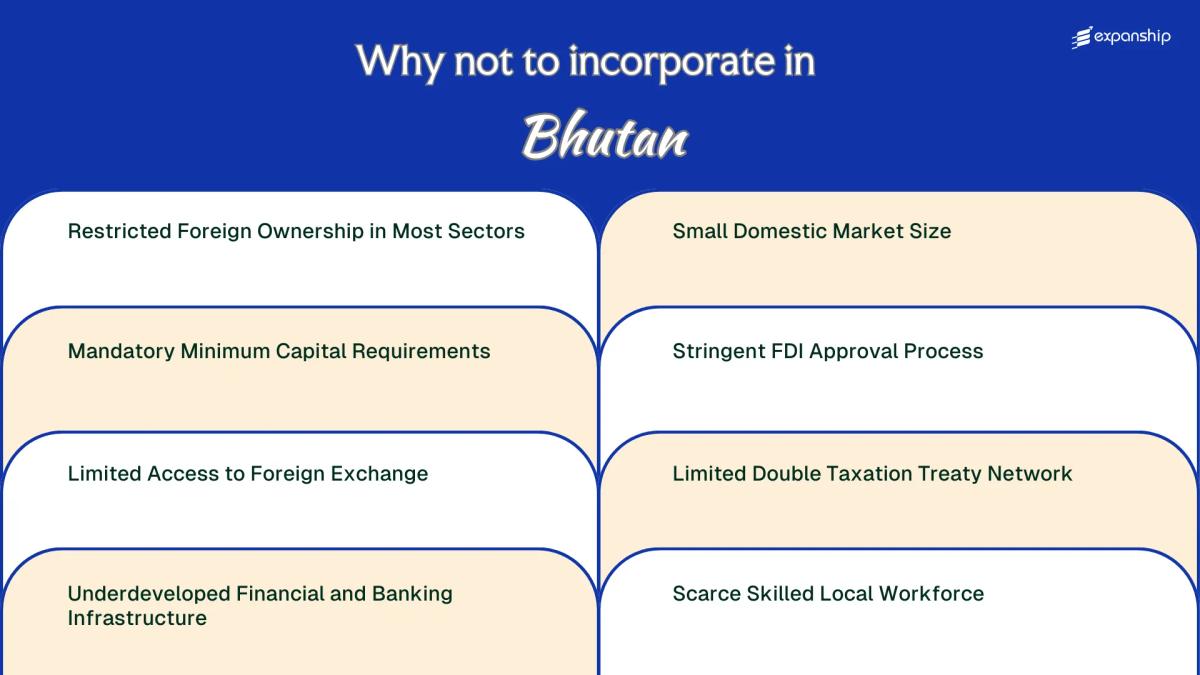
Restricted Foreign Ownership in Most Sectors
Bhutan foreign ownership restrictions affect virtually every commercially viable sector, leaving foreign investors with few unencumbered entry points.
Sector-Level Equity Caps Under the FDI Policy
The Foreign Direct Investment Policy of Bhutan, administered by the Department of Industry under the Ministry of Economic Affairs, reserves numerous sectors exclusively for Bhutanese nationals. Retail trade, small-scale manufacturing, and several service industries are outright closed to foreign equity participation, meaning your business cannot legally operate in those areas regardless of capital commitment.
Even in sectors technically open to foreign participation, joint venture structures are often required, diluting your ownership stake and reducing operational control over strategic decisions.
Structural Limits on Foreign Control
The restricted industries for foreign investors in Bhutan extend beyond a single prohibited list; approvals are granted selectively, with foreign equity ownership rules setting ceilings that can fall well below majority control in certain categories. This forces dependency on local partners whose interests may not align with yours.
Foreign investors cannot simply substitute capital for ownership rights, as the regulatory framework explicitly prioritizes Bhutanese participation over foreign control in most productive sectors.
Your firm may find that the sector you intend to enter is either fully reserved for Bhutanese nationals or subject to equity caps that legally prevent you from holding a controlling interest.
Mandatory Minimum Capital Requirements
Bhutan minimum capital requirements drawbacks are most apparent when foreign investors encounter the capital thresholds set under the Foreign Direct Investment Policy and related regulations administered by the Department of Industry. Foreign firms are generally required to meet a minimum investment threshold that can reach into the millions of Ngultrum, with the exact figure varying by sector.
This upfront capital obligation affects your firm before it generates a single unit of revenue. For early-stage businesses or those testing market viability, committing substantial paid-up capital to a small, constrained economy carries disproportionate financial exposure.
The practical burdens this creates include:
- Tying up working capital in a statutory deposit rather than operational expenses, reducing your firm's liquidity from day one
- Forcing smaller foreign entities to either over-capitalize or abandon market entry entirely
- Requiring proof of capital remittance through local banking channels, which adds documentation friction given limited correspondent banking relationships
- Exposing your business to currency conversion costs when transferring funds into Ngultrum to satisfy compliance thresholds
Sectoral exceptions exist, but they are narrow and inconsistently applied across approval processes.

Company Incorporation in Bhutan
Understand the capital requirements and regulatory steps involved in setting up a company in Bhutan.
Limited Access to Foreign Exchange
Bhutan foreign exchange access limitations represent one of the most tangible operational constraints for foreign-owned businesses. The Royal Monetary Authority (RMA) governs all foreign exchange transactions, and the ngultrum is pegged to the Indian rupee at a 1:1 ratio. This peg effectively ties your firm's currency exposure to Indian monetary policy, over which you have no influence.
Converting business revenues into freely convertible currencies requires RMA approval. That approval process is neither automatic nor fast, and delays in repatriation can disrupt cash flow planning across your global operations.
| Restriction Type | Regulatory Requirement | Practical Burden |
|---|---|---|
| Currency repatriation | RMA prior approval required | Delays profit transfers to parent company |
| Convertible currency access | Limited to approved transactions | Restricts USD/EUR procurement abroad |
| Ngultrum convertibility | Not freely convertible outside India-Bhutan corridor | Exposure stranded in non-tradable currency |
| Foreign currency accounts | Subject to RMA conditions | Cannot hold USD or EUR balances freely |
Outside of the India-Bhutan trade corridor, the ngultrum holds no meaningful convertibility. If your business sources inputs from non-Indian markets or pays international contractors, accessing hard currency involves a separate approval layer that adds time and administrative cost.
Convertible currency problems in Bhutan are compounded for businesses with frequent cross-border payments. There is no interbank forex market of meaningful depth, so large transactions cannot be executed at competitive rates through standard commercial banking channels.
Underdeveloped Financial and Banking Infrastructure
Bhutan banking infrastructure limitations create immediate operational friction for foreign businesses. The country's financial sector is supervised by the Royal Monetary Authority (RMA), but the number of licensed commercial banks remains small, with institutions such as Bank of Bhutan, Bhutan National Bank, and a few others serving a population under 800,000. That concentration means fewer competitive options for corporate accounts, credit facilities, or trade finance products.
Access to structured banking products that multinationals rely on elsewhere is largely absent. Letters of credit, syndicated loans, and multi-currency treasury services are not readily available through local banks.
Correspondent banking relationships between Bhutanese banks and global financial institutions are limited, which creates delays in cross-border settlements. Your firm's payment cycles lengthen as a direct consequence.
Digital banking infrastructure for corporate clients remains underdeveloped by regional standards. This affects day-to-day operational efficiency for any entity managing payroll, vendor payments, or intercompany transfers.
- Corporate banking services are restricted to a small pool of licensed institutions under RMA oversight
- Trade finance instruments standard in other markets may not be available locally
- Cross-border wire transfers face correspondent banking delays
- Multi-currency account facilities for businesses are not widely offered
Bhutan's entire commercial banking sector holds fewer licensed banks than most single cities in neighbouring India, making it one of the most concentrated banking systems in South Asia relative to GDP.
Small Domestic Market Size
Bhutan small market size drawbacks extend beyond simple revenue ceilings — the country's population of approximately 800,000 people means the total addressable consumer base is structurally constrained from the outset.
Scale Limitations Within the Domestic Economy
Gross national income per capita remains modest, which directly compresses consumer purchasing power and limits viable price points across most product categories. For businesses that require domestic sales volume to recover setup costs, this creates a fundamental unit-economics problem that cannot be resolved through operational efficiency alone.
Sectoral Concentration and Demand Ceiling
The limited consumer base in Bhutan concentrates viable commercial activity within a narrow band of sectors, primarily tourism-adjacent services, construction inputs, and basic consumer goods. Businesses operating outside these categories face demand ceilings that make achieving minimum viable scale unlikely, particularly given that export-led models face separate logistical constraints from the country's landlocked geography.
Any foreign entity banking on domestic market growth to justify incorporation costs will find that population growth projections do not materially alter this structural ceiling within standard investment horizons.
Assessing Market Viability Before Incorporating in Bhutan
Speak with our team about the structural market constraints in Bhutan and whether your business model can accommodate them before committing to incorporation.
Stringent FDI Approval Process
The Bhutan FDI approval process restrictions add a procedural layer that few other small-economy jurisdictions impose with comparable formality. Foreign investment proposals must pass through the Department of Industry, Trade and Tourism (DITT) under the framework established by the Foreign Direct Investment Policy, a review process with no guaranteed timeline.
- DITT retains discretionary authority to approve or reject foreign investment applications, meaning your entry into the market depends on administrative judgement rather than a transparent, rules-based criteria system.
- Sector-specific clearances may require sign-off from multiple ministries beyond DITT, multiplying approval delays before your firm can legally operate.
- The absence of a statutory deadline for FDI application decisions forces your business to carry unresolved incorporation costs and deferred operational planning indefinitely.
- Applications must demonstrate economic benefit to Bhutan, an obligation that shifts the burden of justification onto you rather than placing it on regulators to prove grounds for rejection.
- Investment approvals granted under the policy can be subject to conditions or revisions, creating post-entry regulatory exposure that is difficult to price into initial investment decisions.
Limited Double Taxation Treaty Network
Bhutan's double taxation treaty limitations present a concrete structural problem for foreign businesses. The country has signed very few bilateral tax treaties, meaning income earned by your company may face taxation in both the home country and in Bhutan without any formal mechanism for relief or credit offset.
For holding structures, regional headquarters, or businesses with cross-border revenue flows, this absence of treaty coverage significantly increases the effective tax burden. A firm repatriating dividends or royalties to a parent entity in Europe or North America, for example, will find no treaty-based withholding rate reductions available.
The limited DTT coverage in Bhutan contrasts sharply with regional peers like India or Singapore, both of which maintain extensive treaty networks that reduce withholding rates and provide dispute resolution procedures. Without equivalent protections, your tax exposure is governed entirely by domestic legislation under the Income Tax Act of Bhutan 2001 and its subsequent amendments.
Treaty absence also affects transfer pricing arrangements and permanent establishment determinations, as there is no agreed framework to resolve conflicting interpretations between jurisdictions.
A foreign company repatriating USD 500,000 in annual dividends to a parent entity in Germany, with no applicable tax treaty, could face full domestic withholding rates with zero credit entitlement under German domestic rules, resulting in a higher combined effective tax rate than equivalent structures operating through treaty-covered jurisdictions.
Scarce Skilled Local Workforce
Bhutan skilled workforce scarcity directly constrains what a foreign business can realistically build there. With a total population under 800,000, the domestic talent pool is structurally limited across nearly every technical and professional discipline.
Tertiary enrollment rates remain low by regional standards, and the Royal University of Bhutan graduates a relatively small number of specialists annually. For sectors requiring expertise in finance, engineering, IT, or advanced manufacturing, your firm is unlikely to source qualified candidates locally in meaningful volume.
Where local hiring falls short, businesses turn to expatriate recruitment, which triggers additional regulatory steps. Work permit approvals under the Ministry of Labour and Human Resources add time and cost to every senior hire.
The labor market limitations for business go beyond volume. Sector-specific skills gaps mean even well-funded firms often cannot staff key roles without significant investment in training or reliance on foreign staff, both of which increase operational costs and extend the timeline before a new entity can function at full capacity.
Foreign businesses are generally required to prioritize local hiring under Bhutan's labor regulations, meaning you cannot default to an expatriate-heavy staffing model without regulatory justification and approval from the Ministry of Labour and Human Resources.
Overcoming Incorporation Challenges in Bhutan
Overcoming incorporation challenges in Bhutan requires structural preparation before submitting any application to the Bhutan Investment Board. The country's regulatory framework does not accommodate informal workarounds, so alignment with formal processes is the only viable path.
- Identify your sector's FDI eligibility under the Foreign Direct Investment Policy before committing to a legal structure.
- Secure the minimum paid-up capital requirement applicable to your entity type prior to initiating registration with the Registrar of Companies.
- Apply for foreign currency accounts through the Royal Monetary Authority's authorised banking channels to address exchange access constraints.
- Engage a locally resident director or nominee to satisfy domestic representation requirements tied to restricted ownership rules.
- File for any applicable tax clearances through the Bhutan Revenue and Customs Commission to address gaps created by the limited treaty network.
These steps operate within a tightly administered approval system where procedural sequence matters. Skipping any stage typically results in application rejection rather than a request for supplementary documentation.
Bhutan's Business Viability Despite Drawbacks
Assessing Bhutan's business viability despite drawbacks requires weighing genuine structural constraints against the country's stable governance, low corruption levels, and selective approach to economic development. The Ministry of Industry, Commerce and Employment continues to accept foreign investment applications, and the regulatory framework, while restrictive, is transparent in its requirements. For businesses aligned with Bhutan's permitted sectors and development priorities, incorporation remains a credible option.
| Pros | Cons |
|---|---|
| Low corruption and stable political environment support predictable regulatory outcomes | Foreign ownership is capped or excluded in most sectors under the Foreign Direct Investment Policy |
| The government actively promotes investment in tourism, hydropower, and ICT through defined channels | Minimum capital thresholds under the FDI rules create a high financial barrier to entry |
| A clearly structured approval process through DITT provides a single regulatory pathway | Foreign exchange access is restricted, limiting the ability to repatriate profits freely |
| Bhutan's GNH-aligned development model offers reputational value in sustainability-focused industries | The domestic market of under 800,000 people limits viable revenue scale for most business models |
| Bhutan's limited double taxation treaty network increases cross-border tax exposure for foreign investors |
Businesses that proceed without accounting for the FDI approval timeline, capital requirements, and sector restrictions face compounding delays. Your operational planning should reflect the actual pace of regulatory review, not an optimistic estimate.
Compliance Services for Companies in Bhutan
Maintain your Bhutan-registered entity in good standing with ongoing compliance support covering annual filings, regulatory reporting, and local statutory obligations.
Conclusion
A Bhutan company incorporation cons summary reveals a market shaped by structural constraints that go beyond surface-level regulatory friction. Foreign ownership ceilings under the Foreign Direct Investment Policy, the FDI approval process administered through the Department of Industry, and the country's limited double taxation treaty coverage collectively create a demanding environment for foreign investors. The domestic market remains small, and skilled labour availability is constrained. For businesses weighing entry, professional guidance through each regulatory layer will directly affect how efficiently your firm moves from approval to operation.
Expanship's Support for Your Bhutan Expansion
Addressing Bhutan expansion challenges support starts with understanding the specific regulatory environment your business will enter. Expanship works with the requirements set by the Ministry of Economic Affairs and the FDI Division, helping you manage the approval processes, ownership restrictions, and capital obligations this blog has outlined. Our role is to reduce the operational burden of meeting those requirements, not to change what they are.
Expanship offers a defined range of corporate services for businesses setting up in Bhutan:
- Preparing and submitting company registration documents with the relevant authorities.
- Providing a registered agent and local office address for your entity.
- Handling government filings and liaising directly with regulatory bodies on your behalf.
- Managing post-incorporation compliance obligations as your business operates.
- Introducing your company to banking institutions suited to foreign-owned firms.
- Registering your business for applicable taxes and coordinating with local authorities.
Reach out to Expanship Bhutan to discuss how we can support your setup process.
Frequently Asked Questions (FAQ)
All foreign-invested entities in Bhutan must obtain approval through the Department of Industry under the Foreign Direct Investment Policy framework, regardless of company size. There is no de minimis threshold that exempts smaller firms from this process, and the review timeline can extend the incorporation period considerably compared to more open jurisdictions.
Foreign investors are generally required to meet minimum capital thresholds set under Bhutan's FDI Policy, which have historically been set at levels that exceed what many comparable developing-economy jurisdictions require. The specific floor varies by sector, but the requirement applies from the point of registration and cannot be deferred post-incorporation.
Bhutan has one of the smallest tax treaty networks in South Asia, with very few bilateral agreements in force compared to India, which has treaties with over 90 countries, or Nepal, which maintains a broader network than Bhutan. For a foreign business routing income through a Bhutanese entity, this means withholding taxes and cross-border income flows face higher friction with no treaty relief available in most cases.
Repatriating profits from Bhutan requires approval from the Royal Monetary Authority, and the process is subject to foreign exchange availability and regulatory clearance rather than being freely executable at the company's discretion. This creates timing uncertainty for parent companies expecting predictable dividend flows, and the Ngultrum's peg to the Indian Rupee adds a further layer of dependency on India's monetary conditions.
For most technical, managerial, and specialist roles, reliance on expatriate staff is a practical reality in Bhutan given the country's small population and limited pool of professionally trained workers. Hiring expatriates requires separate work permit approvals, which adds administrative cost and processing time, and does not resolve the underlying scarcity of locally available talent at scale.
Failure to maintain the required capital levels can trigger compliance action by the Office of the Companies Registrar under the Companies Act of Bhutan 2016, including potential penalties or restrictions on continued operations. The Act places ongoing obligations on directors to ensure the firm remains solvent and compliant with its registered capital structure, meaning this is not a one-time registration formality but a continuing obligation.
Legal Disclaimer
The information provided in this article is for general informational purposes only and does not constitute legal, tax, or professional advice. While we strive to ensure the accuracy and timeliness of the content, laws and regulations are subject to change, and the application of laws can vary widely based on specific facts and circumstances.
Readers should not act upon this information without seeking professional counsel tailored to their individual situation. Expanship and its authors disclaim any liability for actions taken or not taken based on the content of this article.
For specific advice regarding your business setup, compliance requirements, or any legal matters, please consult with qualified legal and tax professionals in the relevant jurisdiction.