

Key Takeaways
- Bhutan's Income Tax Act establishes corporate rates that remain below regional norms, giving incorporated businesses a structurally lower tax burden than many comparable South Asian jurisdictions.
- Foreign investors benefit from an FDI Policy framework administered by the Ministry of Economic Affairs that provides a defined legal basis for foreign ownership and profit repatriation, reducing regulatory uncertainty at the point of entity structuring.
- Companies operating in hydropower, renewable energy, or regionally oriented trade gain access to priority sectors where ongoing FDI liberalization creates expanding ownership and operational rights not yet fully available in more restricted industries.
- Membership in SAARC positions Bhutan-registered entities to leverage regional trade arrangements that can reduce friction for businesses whose target markets span South Asia.
Bhutan is a sovereign constitutional monarchy situated in the Eastern Himalayas, bordered by India and China. Company registration is governed by the Ministry of Economic Affairs, which oversees business licensing and foreign investment approvals under the Foreign Direct Investment Policy. Foreign businesses incorporating in the country most commonly do so through a Private Limited Company.
The tax structure is generally low-rate and territorially oriented, with corporate income subject to rates that remain modest by regional standards. Openness to foreign ownership has increased progressively, though certain sectors retain restrictions under the FDI Policy framework, meaning the degree of foreign participation varies by industry.
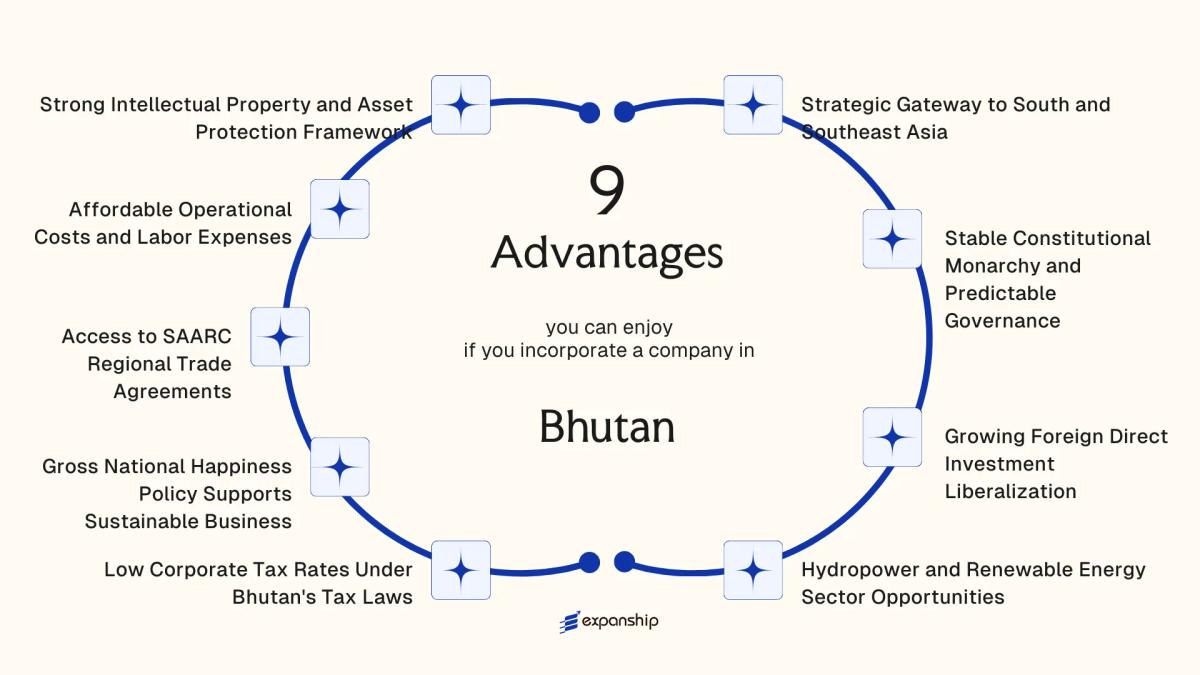
Exploring the benefits of incorporating in Bhutan requires understanding how its regulatory environment, geographic position, and economic policies interact. This article examines the key advantages that make Bhutan company formation a consideration for businesses seeking a South Asian base — from trade access to sector-specific opportunities.
Strategic Gateway to South and Southeast Asia
Bhutan's strategic location in South Asia places it at a geographic junction between India and China, two of the world's largest economies. For foreign businesses, this positioning translates into proximity to a combined consumer base that exceeds three billion people.
Land Connectivity Through India
Bhutan's primary land trade corridor runs through India under the India-Bhutan Friendship Treaty, which governs bilateral trade and transit arrangements. Goods originating from a company registered in Bhutan can move overland into Indian markets without the customs friction that applies to most third-country exporters, a practical cost and time advantage that affects logistics planning from the outset.
Proximity to Southeast Asian Supply Chains
The distance from Bhutan's southern border to Bangladesh and the broader Bay of Bengal trade corridor is operationally short. Entities incorporated here can position themselves within reach of the BIMSTEC regional framework, which connects South and Southeast Asian economies through trade facilitation agreements.
Your firm gains overland access to the Indian market and proximity to Southeast Asian supply chains under treaty arrangements that are not available to most third-country incorporations.
Stable Constitutional Monarchy and Predictable Governance
Bhutan's constitutional monarchy has remained politically uninterrupted since the promulgation of the Constitution of the Kingdom of Bhutan in 2008, which formally transitioned the country from an absolute to a constitutional monarchy. For foreign businesses, this continuity means the legal and regulatory conditions under which your entity was established are unlikely to shift due to electoral cycles or political upheaval.
The Royal Civil Service Commission and line ministries operate within a codified institutional structure, which reduces the risk of arbitrary policy reversals. Regulatory decisions follow defined administrative channels, giving your business a reasonable basis for forecasting compliance obligations over a multi-year horizon.
Bhutan stable governance benefits for businesses become particularly tangible when compared to neighboring markets where policy environments can shift sharply between administrations. Consistent governance also supports long-term contract enforceability, which matters when structuring joint ventures or licensing agreements with local partners.
Several structural features reinforce this predictability for foreign firms:
- The constitutional framework limits executive discretion over commercial legislation
- Licensing and approval processes are administered through the Ministry of Economic Affairs under published procedures
- The judiciary operates independently from executive influence under the 2008 Constitution

Company Incorporation in Bhutan
Establish your business entity in Bhutan through a structured, compliant formation process supported by Expanship's in-country expertise.
Growing Foreign Direct Investment Liberalization
Bhutan FDI liberalization benefits foreign investors through a regulatory framework that has shifted meaningfully since the Foreign Direct Investment Policy of 2019 and the subsequent updates aligned with the Economic Development Policy. The Department of Industry under the Ministry of Industry, Commerce and Employment serves as the primary approval body, and its mandate now permits foreign equity ownership of up to 100% in a defined set of priority sectors. That ceiling matters because it removes the structural requirement for a local joint venture partner, which historically added both cost and complexity to market entry.
| Sector Category | Maximum Foreign Equity Permitted | Joint Venture Requirement |
|---|---|---|
| Priority / Promoted Sectors | Up to 100% | Not required |
| General Permitted Sectors | Up to 70% | Local partner required for remainder |
| Reserved / Restricted Sectors | Not open to FDI | N/A |
Minimum capital thresholds apply depending on the sector and the nationality of the investor, which means your entry cost can vary based on the specific activity your firm intends to conduct. Under the Companies Act of Bhutan 2016, foreign-incorporated entities may also establish subsidiary structures, giving holding companies a recognized legal pathway without requiring full domestic re-incorporation.
The Bhutan foreign investment liberalization trajectory reflects a deliberate policy choice to attract capital in sectors where domestic capacity is limited, such as technology services and agro-processing. For your business, this means sector-specific access is increasingly available through a documented, rules-based process rather than discretionary negotiation.
Hydropower and Renewable Energy Sector Opportunities
Bhutan hydropower sector investment opportunities are among the most structurally defined in South Asia. The country holds an estimated 30,000 MW of hydropower potential, of which only a fraction has been developed. Electricity exports to India have historically constituted a significant share of national revenue, giving foreign investors a clear view of where commercial demand already exists.
The Bhutan Electricity Authority (BEA) regulates generation, transmission, and distribution under the Electricity Act of Bhutan 2001. This statutory framework defines licensing conditions and grid access rules, which means your business enters a sector governed by documented procedures rather than informal arrangements.
Under the Renewable Energy Policy 2023, the government has actively sought private participation in small and medium hydropower projects, solar, and wind development. Foreign entities can participate through joint ventures with Bhutanese partners, and concession agreements are issued under terms that define revenue-sharing and offtake obligations in advance.
Keep these points in mind:
- Licensing is administered by the BEA; confirm your project category before structuring the entity
- Joint venture requirements apply to foreign participation in most generation projects
- Power purchase agreements with Druk Green Power Corporation set the offtake terms
- Projects above a certain installed capacity require environmental clearance from the National Environment Commission
The predictability of offtake through existing agreements with Indian utilities reduces revenue uncertainty considerably for project developers.
Bhutan's per-capita hydropower export earnings consistently rank it among the highest electricity-exporting nations relative to population size, making it an outlier by global comparison.
Low Corporate Tax Rates Under Bhutan's Tax Laws
Bhutan low corporate tax rate advantages are grounded in the Income Tax Act of Bhutan 2001 and its subsequent amendments, which establish a corporate income tax (CIT) rate of 30% on taxable profits for most companies. While that headline figure requires context, the practical tax burden for qualifying businesses is considerably lower once sector-specific exemptions and incentives are factored in.
Reduced Rates and Sector-Based Exemptions
Under the Income Tax Act, small and medium enterprises meeting prescribed thresholds are taxed at a reduced flat rate, and businesses operating in priority sectors identified by the Foreign Direct Investment Policy can access additional relief through the Department of Revenue and Customs. For a foreign-owned entity structured appropriately under these provisions, the effective rate can diverge significantly from the standard 30% ceiling.
Tax holidays are available for new industrial enterprises, with eligible firms receiving full or partial exemptions for a defined initial period following commencement of operations. This directly reduces cash outflow during the capital-intensive early years of a business, when reinvestment capacity matters most.
Dividend and Reinvestment Treatment
Retained earnings reinvested into qualifying productive activities may attract further concessions, reducing the cost of scaling operations inside the country. Dividend distributions are subject to withholding tax under the Act, but the rates remain comparatively contained, which preserves more post-tax value for foreign shareholders repatriating income.
The absence of a capital gains tax on most asset classes under current Bhutanese tax law adds a structural efficiency that benefits investors with long-horizon exit strategies.
Maximize Your Tax Position When Incorporating in Bhutan
Speak with Expanship's corporate services team to understand which tax exemptions, sector incentives, and structuring options apply to your business under Bhutan's Income Tax Act.
Gross National Happiness Policy Supports Sustainable Business
Bhutan's Gross National Happiness sustainable business benefits extend well beyond philosophy. The GNH framework, enshrined as a constitutional directive under Article 9 of the Constitution of Bhutan (2008), requires the state to promote conditions that enable the pursuit of Gross National Happiness. For foreign investors, this translates into concrete policy architecture that consistently prioritizes environmental sustainability, social equity, and measured economic growth over unchecked industrial expansion.
- Environmental standards are embedded in national policy rather than enforced reactively, so businesses operating here face fewer abrupt regulatory reversals triggered by environmental backlash.
- The GNH framework actively attracts impact-driven capital. If your firm operates in sectors such as ecotourism, organic agriculture, or clean technology, alignment with GNH policy signals credibility to ESG-focused institutional investors without requiring additional certification overhead.
- Bhutan maintains a constitutional mandate to preserve at least 60% forest cover in perpetuity. For businesses in renewable resources or carbon credit markets, this legal guarantee creates a stable, verifiable environmental baseline that underpins long-term project planning.
- Government procurement and licensing decisions consider GNH indicators alongside financial metrics, which means enterprises structured around sustainable practices gain a procedural advantage when seeking operating approvals through the Ministry of Economic Affairs.
Access to SAARC Regional Trade Agreements
Bhutan SAARC trade agreement benefits for businesses center on preferential market access under the South Asian Free Trade Area (SAFTA), which came into force in 2006. Under SAFTA, member states apply reduced tariff rates on traded goods, giving a Bhutan-incorporated entity a structural cost advantage when supplying to markets across India, Bangladesh, Nepal, Sri Lanka, Pakistan, Maldives, and Afghanistan.
For a foreign investor, this is not simply a tariff reduction. It means a firm registered in Bhutan can price competitively into a combined regional population exceeding 1.9 billion people, without the standard import duties that non-SAARC origin goods would attract.
Beyond SAFTA, Bhutan maintains a bilateral trade and transit treaty with India, which governs the movement of goods, currency, and services between the two countries. This treaty operates separately from SAARC membership benefits, extending additional preferential terms unavailable to most other foreign firms attempting Indian market entry.
A product exported from a Bhutan-registered company to India under SAFTA preferential origin rules may attract a tariff rate as low as 0-5%, compared to the standard MFN (Most Favoured Nation) applied rate that non-SAARC exporters face, which can range from 7.5% to over 20% depending on the product category.
Affordable Operational Costs and Labor Expenses
Bhutan affordable operational costs for businesses stem from a combination of government-controlled utility pricing and a relatively low general wage baseline. The Royal Government subsidizes electricity rates for industrial and commercial users, a direct outcome of the country's hydropower surplus. For a foreign-owned entity, this translates to predictably low energy expenditure, which carries particular weight for manufacturing or processing operations.
Monthly wages in Bhutan remain modest by regional standards. The minimum wage, periodically revised under labor policy frameworks overseen by the Ministry of Labour and Human Resources, supports manageable payroll obligations for small to mid-sized firms.
Low labor costs in Bhutan business operations are further supported by:
- A workforce with a functional literacy rate that reduces training overhead for entry-level roles
- Urban centers like Thimphu and Phuentsholing offering office space at rates substantially below comparable South Asian commercial hubs
- No mandatory employer contribution to a private pension scheme beyond the statutory requirements under the Labor and Employment Act of Bhutan 2007
The affordable workforce benefits for companies extend to professional services as well. Local accounting, legal advisory, and administrative support are available at rates that keep overhead contained during early-stage operations.
Expatriate hiring for senior roles requires work permit approval through the Department of Immigration, and foreign staff compensation packages are typically benchmarked above local wage norms, which affects overall labor cost calculations.
Strong Intellectual Property and Asset Protection Framework
Bhutan intellectual property protection for businesses is governed primarily under the Industrial Property Act of Bhutan 2001 and the Copyright Act of Bhutan 2001, both administered by the Intellectual Property Division under the Ministry of Economic Affairs. These statutes establish formal registration rights for trademarks, patents, industrial designs, and copyrights, giving your business a legally enforceable claim over its intangible assets.
Statutory Protection for Registered IP
Trademark registration in the country grants exclusive use rights for ten years, renewable indefinitely. For companies whose primary value sits in a brand, a method, or a proprietary design, this long-term exclusivity reduces the risk of unauthorized reproduction by local or regional competitors. Patents filed under the Industrial Property Act similarly restrict third-party exploitation of protected inventions within the jurisdiction.
Asset Segregation Through Corporate Structure
Incorporating a separate legal entity creates a structural boundary between business assets and personal liability. Under Bhutanese company law, a registered firm holds assets in its own name, which means intellectual property assigned to that entity is shielded from claims directed at individual shareholders. This separation is particularly relevant for foreign investors who hold IP portfolios across multiple jurisdictions and need a contained legal vehicle to hold specific rights.
Membership in WIPO Treaties
The country is a member of the World Intellectual Property Organization, which means IP rights registered domestically can connect to international protection mechanisms. Foreign businesses with globally filed patents or trademarks gain a recognized entry point for asserting those rights across treaty member states.
Why Bhutan Stands Out Among Regional Incorporation Hubs
Comparing Bhutan against its South Asian peers reveals a specific positioning: a small, politically stable economy with a tightly regulated business environment, low headline tax rates, and a constitutional framework that has remained consistent since 2008. The jurisdictions most relevant for this comparison are India, Nepal, and Sri Lanka, as each competes for similar categories of foreign investment in the region and represents realistic alternatives a prospective investor would weigh when evaluating a Bhutan top incorporation hub South Asia advantages argument.
What the table below does not capture is structural context. Unlike India, where regulatory complexity and state-level variation can significantly affect operational timelines, or Nepal, where foreign ownership restrictions remain sector-specific and frequently amended, Bhutan's Foreign Direct Investment Policy applies a more consolidated approval framework through the Ministry of Economic Affairs. Sri Lanka offers a comparable geographic footprint but carries a higher sovereign risk profile following its 2022 economic crisis. These distinctions matter when assessing long-term operational predictability, not just entry conditions.
| Parameter | Bhutan | India | Nepal | Sri Lanka |
|---|---|---|---|---|
| Corporate Tax Rate (standard) | 25% | 25–30% | 25% | 30% |
| Foreign Ownership (general) | Up to 100% (FDI-eligible sectors) | Up to 100% (sector-dependent) | Up to 100% (restricted sectors apply) | Up to 100% (BOI-approved) |
| Political Stability Index | High (constitutional monarchy since 2008) | Moderate | Moderate | Low–Moderate (post-2022) |
| Governing FDI Framework | MoEA FDI Policy | FEMA / DPIIT | Foreign Investment Policy | BOI Act / FIDA |
| Environmental Compliance Requirement | Mandatory (GNH-aligned) | Moderate | Moderate | Moderate |
Compliance Services for Companies in Bhutan
Understand your ongoing regulatory obligations under Bhutanese law, including annual filings, licensing renewals, and statutory reporting requirements.
Conclusion
Bhutan's position as an incorporation destination is grounded in a specific combination of structural factors: a constitutional framework that insulates policy from political volatility, a tax regime governed by the Income Tax Act of Bhutan that keeps corporate rates below regional norms, and a Gross National Happiness policy that formally aligns regulatory priorities with long-term economic sustainability rather than short-term extraction.
The benefits of incorporating in Bhutan are most pronounced for businesses operating in sectors the government actively prioritizes. Hydropower-linked industries, renewable energy ventures, and regionally oriented trading firms gain access to a jurisdiction where FDI liberalization is ongoing and the Foreign Direct Investment Policy provides a structured basis for foreign ownership and profit repatriation. These are not incidental advantages; they are built into the regulatory architecture.
Fit still matters. A firm's industry classification, ownership structure, and target markets will determine how fully your business can utilize what this jurisdiction offers. Bhutan company formation advantages apply most directly where your operational model aligns with its priority sectors and its SAARC trade position. For businesses where that alignment exists, the Bhutan business registration process sits within a regulatory environment that is both governable and increasingly open. The next step is translating that fit into a properly structured entity under the laws administered by the Registrar of Companies.
Start Your Bhutan Company Formation With Expanship
Bhutan company formation with Expanship connects foreign investors to a structured, hands-on service covering the full incorporation process under the jurisdiction's regulatory framework. The Ministry of Economic Affairs, which oversees company registration through the Department of Industry, applies specific requirements around foreign equity participation, sector licensing, and minimum capital thresholds. Expanship manages these requirements directly, from initial entity selection through to post-registration compliance obligations.
Across the incorporation and maintenance lifecycle, Expanship's service scope includes:
- Preparation and legalization of constitutional documents, including the Memorandum and Articles of Association
- Provision of a registered agent and local office address as required under Bhutanese company law
- Filing coordination with the Department of Industry and relevant licensing authorities
- Ongoing compliance management covering annual returns and statutory reporting
- Banking introduction assistance to support account opening with licensed financial institutions in Bhutan
For questions about your specific circumstances or to begin the registration process, contact Expanship Bhutan.
Frequently Asked Questions (FAQ)
Corporate income tax is levied at a flat rate of 30% under the Income Tax Act of Bhutan 2001, applicable to business income earned within the country. Small and cottage industries may qualify for concessional treatment, but the standard rate applies to most incorporated entities. Tax obligations are administered by the Department of Revenue and Customs under the Ministry of Finance.
Registration timelines through the Office of the Bhutan Registry of Companies (OBREC) can generally be completed within a few weeks, provided all required documentation is submitted in order. Delays most commonly arise from incomplete incorporation filings or pending sector-specific approvals from line ministries. Foreign investors should factor in additional time if their proposed activity requires a Foreign Direct Investment approval from relevant authorities.
Bhutanese company law requires at least one director to be ordinarily resident in Bhutan for certain entity types, though the specific requirement varies by company structure. Consulting the Companies Act of Bhutan 2016 directly, or engaging a registered agent familiar with OBREC requirements, will clarify obligations for your intended structure. Non-compliance with directorship requirements can delay registration or result in the rejection of incorporation filings.
SAARC membership gives companies registered in Bhutan access to the South Asian Free Trade Area (SAFTA) framework, which provides preferential tariff treatment on goods traded among member states. The practical benefit depends on the nature of your business activity and the specific tariff lines covered under SAFTA schedules. Exporters in eligible product categories can reduce duty burdens when trading with India, Bangladesh, Sri Lanka, and other member economies.
Reclassification of a sector post-incorporation does not automatically dissolve an existing company, but it may impose new conditions on continued operations or ownership thresholds. The Foreign Direct Investment Policy is subject to periodic revision by the government, and investors should monitor policy updates issued by the Ministry of Industry, Commerce and Employment. Existing entities are typically subject to transitional provisions, though the specific treatment depends on the terms of any policy amendment.
The GNH framework is embedded in national planning and policy, meaning that environmental and social impact considerations carry formal weight in approvals for foreign investment projects. The National Environment Commission reviews projects that may have environmental implications, and certain industries face additional scrutiny under this policy orientation. Businesses in sectors with high environmental footprints should anticipate more detailed compliance requirements than might apply in comparable regional jurisdictions.
Legal Disclaimer
The information provided in this article is for general informational purposes only and does not constitute legal, tax, or professional advice. While we strive to ensure the accuracy and timeliness of the content, laws and regulations are subject to change, and the application of laws can vary widely based on specific facts and circumstances.
Readers should not act upon this information without seeking professional counsel tailored to their individual situation. Expanship and its authors disclaim any liability for actions taken or not taken based on the content of this article.
For specific advice regarding your business setup, compliance requirements, or any legal matters, please consult with qualified legal and tax professionals in the relevant jurisdiction.