

Key Takeaways
- Brazil's three-tier corporate tax regime — Simples Nacional, Lucro Presumido, and Lucro Real — forces businesses to navigate materially different calculation methods, compliance calendars, and eligibility thresholds depending on annual revenue and corporate structure.
- Foreign-owned entities must appoint a resident legal representative in Brazil, creating an ongoing dependency on a locally domiciled individual who carries formal legal accountability under Brazilian corporate law.
- The employment cost burden in Brazil extends well beyond base salaries, with mandatory contributions to FGTS, INSS, and statutory benefits collectively adding a substantial percentage to total workforce expenditure.
- Under Lei das Sociedades Anônimas (Law 6,404/1976) and the broader regulatory framework administered by the Junta Comercial and Receita Federal, company registration and ongoing reporting obligations involve multiple federal and state-level filings that extend incorporation timelines and increase administrative overhead compared to most OECD jurisdictions.
Brazil operates under a heavily regulated corporate framework, administered through multiple federal bodies including the Junta Comercial, Receita Federal, and the Banco Central do Brasil. For foreign investors and business owners evaluating the disadvantages of incorporating in Brazil, this regulatory density has direct practical consequences across tax, labor, foreign exchange, and compliance obligations.
The specific drawbacks covered in this article span several distinct categories, each shaped by Brazilian federal law and regulatory practice.
How severely these disadvantages affect your business depends on the entity type you choose, the industry you operate in, and whether your structure involves foreign shareholding. A technology startup operating domestically faces a different set of constraints than a foreign-owned holding company or a manufacturing firm with cross-border transactions.
The primary legislation governing corporate formation and structure is the Lei das Sociedades Anônimas (Law 6,404/1976), as amended. This article is most relevant to foreign nationals and multinational entities seeking to establish or acquire a legal presence in the Brazilian market.
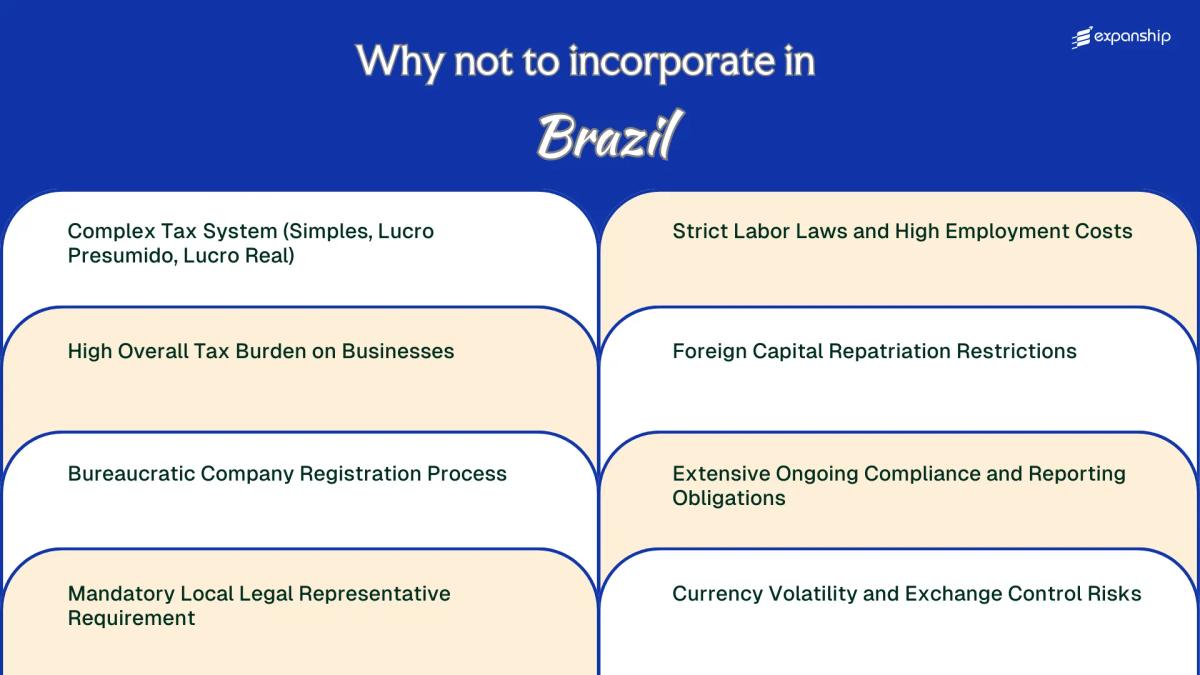
Complex Tax System (Simples, Lucro Presumido, Lucro Real)
Brazil's complex tax system challenges go beyond mere paperwork. Three distinct corporate tax regimes exist simultaneously, and choosing the wrong one can cost your business significantly more than necessary.
Regime Selection Locks You Into Costly Structures
Simples Nacional applies only to firms with annual gross revenue below R$4.8 million, consolidating federal, state, and municipal taxes into a single payment. Above that threshold, your entity must elect either Lucro Presumido or Lucro Real, each carrying different taxable base calculations and compliance obligations. Lucro Presumido drawbacks include presumed profit margins that may overstate your actual profitability, resulting in higher IRPJ and CSLL payments than your real earnings would justify.
Lucro Real Compliance Burden Compounds Operational Costs
Lucro Real requires full bookkeeping under the SPED digital accounting system, with real-time fiscal records submitted to Receita Federal. For foreign-owned entities without established local accounting infrastructure, maintaining SPED compliance demands dedicated fiscal teams or expensive third-party support.
Misclassifying your entity under the wrong tax regime at incorporation cannot always be corrected mid-year, meaning an incorrect election can lock your business into excess tax liability for an entire fiscal year.
High Overall Tax Burden on Businesses
The high tax burden Brazil businesses face is not simply a matter of headline rates. Brazil's total tax-to-GDP ratio has historically exceeded 33%, placing it among the most heavily taxed economies in Latin America and well above comparable emerging markets.
Corporate Income Tax (IRPJ) is levied at 15%, with a surtax of 10% on annual taxable profits exceeding BRL 240,000. A separate Social Contribution on Net Income (CSLL) adds another 9% for most entities. Combined, your effective federal tax on profits can reach 34% before state and municipal levies apply.
The Contribuição Social sobre o Faturamento (COFINS) and PIS taxes apply to gross revenue, not profit, meaning your firm pays regardless of whether it earns a margin. This structure penalizes early-stage operations and capital-intensive businesses disproportionately.
Known locally as the "Custo Brasil," the cumulative tax cost creates specific operational friction:
- Gross revenue taxes like PIS and COFINS erode margins on high-volume, low-margin business models before any profit is calculated
- Cascading tax effects across supply chains force foreign-owned distributors and manufacturers to absorb costs that local competitors may offset through regime-specific credits
- The CSLL obligation persists even in years of reduced profitability, creating a fixed-cost burden that cannot be managed through profit planning alone
- State-level ICMS rates vary by jurisdiction within the country, requiring your entity to maintain separate compliance positions depending on where goods move
Businesses opting for the Lucro Real regime can access certain deductions, but this does not reduce the structural weight of revenue-based contributions that apply across all regimes.

Company Incorporation in Brazil
Set up your business entity in Brazil with full support on tax regime selection, registration, and federal compliance requirements.
Bureaucratic Company Registration Process
The bureaucratic company registration Brazil imposes on foreign founders is not a single obstacle but an accumulation of sequential dependencies, each controlled by a different authority. Before your entity can operate, it must pass through federal, state, and municipal layers simultaneously, and a delay at any one point stalls the entire chain.
Registering a Limitada or S.A. requires filing with the Junta Comercial of the relevant state, such as JUCEB in Bahia or JUCESP in São Paulo. While some states have digitized portions of this process, inconsistencies between state boards mean timelines vary significantly and unpredictably. Even after Junta Comercial approval, your business must separately obtain a CNPJ from the Receita Federal, register with the municipal authority for an Alvará de Funcionamento, and in many cases register with the state tax authority for an Inscrição Estadual.
| Registration Step | Issuing Authority | Typical Processing Time |
|---|---|---|
| Articles of Incorporation | State Junta Comercial | 5 to 30 business days |
| Tax Identification Number (CNPJ) | Receita Federal | 1 to 5 business days |
| Operating License (Alvará) | Municipal Secretariat | 15 to 60+ business days |
| State Tax Registration (Inscrição Estadual) | State Revenue Authority | 10 to 30 business days |
The Alvará de Funcionamento is the stage most likely to cause serious delay. Municipal authorities set their own requirements for fire safety inspections, zoning compliance, and environmental clearances, and these conditions are not standardized across Brazil's 5,570 municipalities.
For a foreign investor accustomed to single-window registration systems, the total elapsed time from document preparation to a fully licensed, operational entity can exceed three to four months. That timeline assumes no document rejections, which are common when foreign corporate documents require notarization, apostille, and sworn translation before any authority will accept them.
Mandatory Local Legal Representative Requirement
The Brazil local legal representative requirement applies to any foreign national who holds a quota or share in a Brazilian entity. Under Brazilian corporate law, every foreign partner or shareholder must appoint a resident attorney-in-fact, known as a procurador, who holds a registered power of attorney and maintains a permanent address in the country. Without this appointment, the entity cannot be validly incorporated or maintained.
This obligation is not administrative formality. Your procurador holds legal authority to receive judicial notifications, respond to regulatory agencies, and bind the company in certain official proceedings, which means the firm's legal exposure is partially held by a third party you must continuously trust and supervise.
The power of attorney granted to the procurador must be notarized and, for documents originating abroad, apostilled under the Hague Convention before submission to the Junta Comercial (Board of Trade). Any lapse in this appointment leaves the company without a valid legal representative, which can trigger penalties and procedural blocks on filings.
- A resident procurador must be appointed before or at the time of incorporation
- The power of attorney must be apostilled if executed outside Brazil
- The procurador's mandate must remain active for the full duration of the company's existence
- Any change in procurador requires formal re-registration with the relevant Junta Comercial
- The procurador's liability exposure creates a direct ongoing cost, as qualified attorneys typically charge recurring fees for maintaining this role
A foreign shareholder who fails to maintain a valid procurador appointment can face suspension of their voting rights within the Brazilian entity, even if they hold a majority stake.
Strict Labor Laws and High Employment Costs
Brazil labor law risks for employers stem primarily from the Consolidação das Leis do Trabalho (CLT), a labor code that mandates extensive employer obligations and significantly raises the true cost of each hire.
Statutory Obligations Under the CLT
Every formal employment contract triggers mandatory contributions including FGTS (Fundo de Garantia do Tempo de Serviço) at 8% of gross salary, plus employer-side INSS contributions that can reach 20% of payroll, along with compulsory benefits such as 13th-month salary and 30 days of paid annual leave. For a foreign firm unaccustomed to these layered obligations, the gap between a worker's gross salary and total employment cost frequently exceeds 70%, straining payroll budgets that were modeled on home-country benchmarks.
Consequences for Workforce Planning
Terminating employees without just cause triggers a 40% penalty on the employee's FGTS balance, a cost that has no equivalent in many OECD jurisdictions. This exit cost discourages flexible workforce scaling, effectively locking your business into headcount decisions that carry long-term financial exposure. CLT protections apply regardless of company size, so even a newly registered Sociedade Limitada faces the same obligations as a large domestic conglomerate.
Managing Labor Compliance Challenges in Brazil
Understand the full cost implications of CLT obligations before your first hire in Brazil. Our team provides structured guidance on employment structuring and compliance requirements for foreign-owned entities.
Foreign Capital Repatriation Restrictions
Brazil foreign capital repatriation restrictions create measurable friction for foreign investors seeking to move profits, dividends, or recovered capital out of the country. Repatriation is legally permitted but is conditioned on prior registration of the original investment with the Banco Central do Brasil through the RDE-IED module of the SISBACEN system.
- All foreign direct investment must be registered in SISBACEN before any repatriation is legally recognized, meaning unregistered capital cannot be formally remitted abroad regardless of its legitimacy.
- The Imposto sobre Operações Financeiras (IOF) applies to foreign exchange transactions, and the applicable rate varies by transaction type, directly increasing the cost of moving capital across borders.
- Profit repatriation risks Brazil companies face are compounded by BRL volatility, since the converted value at remittance may differ substantially from the original invested amount.
- Repatriation of amounts exceeding the registered capital base can trigger additional scrutiny from the Receita Federal, creating compliance exposure for firms that have reinvested earnings locally.
Extensive Ongoing Compliance and Reporting Obligations
Brazil's compliance and reporting obligations burden is among the heaviest for any incorporated entity globally. The SPED system (Sistema Público de Escrituração Digital), administered by the Receita Federal, requires businesses to submit a continuous stream of digital fiscal and accounting records, including the ECD (Escrituração Contábil Digital), ECF (Escrituração Contábil Fiscal), and EFD-Contribuições.
Each of these modules has its own submission calendar, technical specifications, and validation rules. Missing a deadline or submitting incorrect data triggers automatic fines.
The SPED filing requirements create a structural dependency on specialized local accountants and tax software, which is an ongoing operational cost rather than a one-time setup expense. For a foreign-owned entity with no prior presence in the country, building this infrastructure from scratch adds measurable recurring overhead.
Accessory obligations extend beyond SPED. Your firm must also file the DIRF (income tax withholding declaration), RAIS (annual labor information report), and DCTF (federal tax debts and credits declaration), each on separate schedules enforced by different federal bodies.
A mid-sized foreign-owned Ltda. operating under Lucro Real, filing all mandatory SPED modules plus ancillary declarations, can expect to spend between BRL 80,000 and BRL 150,000 annually on accounting and compliance services alone, before any tax advisory or legal retainer costs are factored in.
Currency Volatility and Exchange Control Risks
Brazil currency volatility business risks are not merely a market inconvenience — they directly erode the predictability of your revenue, cost base, and investment returns. The Brazilian real (BRL) has historically experienced significant depreciation cycles, and for a foreign-owned entity pricing contracts in BRL while servicing obligations in a hard currency, that gap compounds quickly.
The Banco Central do Brasil (BCB) oversees foreign exchange operations under a framework that, while nominally a floating rate system, subjects cross-border financial flows to registration and reporting requirements under Resolution BCB No. 277/2022. Every foreign capital entry and exit must be registered in the BCB's electronic declaratory registration system (RDE), and delays or errors in that process can freeze your ability to repatriate funds on schedule.
BRL volatility also distorts transfer pricing calculations and intercompany loan structures, since Brazilian tax authorities require loan interest rates to align with approved parameters — meaning exchange losses cannot simply be offset through informal internal adjustments.
- Foreign exchange contracts must be settled through authorized financial institutions only
- Unregistered foreign capital has no legal right to repatriation
- Exchange variation on foreign loans is subject to IOF (Imposto sobre Operações Financeiras) tax at rates that vary by transaction type and tenor
Any foreign capital introduced into a Brazilian entity that is not registered in the BCB's RDE system at the time of entry loses its legal basis for repatriation, regardless of the amount or the legitimacy of the underlying transaction.
Strategies to Overcome These Challenges
Overcoming Brazil incorporation challenges requires structural decisions made before the entity is registered, not after problems surface. The regulatory framework here does not reward reactive compliance.
- Select the appropriate tax regime at registration by evaluating projected revenue against the thresholds for Simples Nacional, Lucro Presumido, and Lucro Real, since reclassification mid-year is restricted.
- Appoint a qualified Brazilian resident to serve as the mandatory legal representative (administrador) and ensure their powers are formally defined in the company's Articles of Association (Contrato Social).
- Register your entity with the Junta Comercial of the relevant state before initiating federal enrollment with the Receita Federal do Brasil.
- Pre-structure foreign capital as registered investment through the Banco Central (BCB) to preserve your legal right to repatriate funds.
- Establish a payroll compliance process aligned with the Consolidação das Leis do Trabalho (CLT) from the first hire to avoid retroactive labor liabilities.
Each of these steps addresses a distinct layer of the country's regulatory structure. No single measure resolves the cumulative burden; the challenges documented in this blog operate across federal, state, and municipal jurisdictions simultaneously.
Brazil's Value for International Investors
The Brazil risks vs opportunities foreign investors must weigh are genuinely mixed. The regulatory burdens documented throughout this blog are structural, not incidental, and they affect cost, speed, and operational flexibility in measurable ways. That said, the country's domestic market size, demographic profile, and regional trade position make it a credible destination for foreign entities with the resources and timeline to absorb those costs.
| Pros | Cons |
|---|---|
| Access to one of the largest consumer markets in Latin America by population and GDP | Three-tier tax regime (Simples Nacional, Lucro Presumido, Lucro Real) creates significant classification and compliance complexity |
| Established legal framework for foreign capital registration through the Banco Central do Brasil (BCB) | Total tax burden on business income ranks among the highest globally, compressing net margins |
| Multiple corporate structures available, including Sociedade Limitada (Ltda.) and Sociedade Anônima (S.A.) | Company registration through the Junta Comercial and federal bodies involves multi-agency coordination and extended timelines |
| Regional gateway for Mercosur trade relations | A mandatory resident legal representative (administrador) is required for foreign-owned entities |
| Formal labor law system provides defined contractual standards | Consolidação das Leis do Trabalho (CLT) obligations and mandatory benefits substantially increase per-employee costs |
Currency exposure under the Brazilian real adds a further layer of financial risk that compounds the compliance overhead described above.
Compliance Services for Companies in Brazil
Ongoing compliance obligations for Brazilian entities span federal, state, and municipal levels. This service covers statutory filing, tax reporting, and regulatory maintenance for foreign-owned businesses operating under Brazilian corporate law.
Conclusion
The cons of incorporating in Brazil summary point to a jurisdiction with genuine commercial scale, but one that imposes real structural costs on foreign-owned entities. Tax regime selection alone, across Simples Nacional, Lucro Presumido, and Lucro Real, carries lasting financial consequences. Foreign exchange controls administered by the Banco Central do Brasil add friction to capital repatriation. Ongoing obligations under the SPED system demand consistent, accurate reporting throughout the entity's life. Structural support from advisors with direct experience in Brazilian corporate and tax law remains a practical requirement, not an optional consideration.
Expanship's Brazil Expansion Services
Brazil's tax regime, Receita Federal registration requirements, and CLT-governed employment rules create a dense compliance environment that demands ongoing attention. Expanship's Brazil expansion compliance services are structured to reduce the administrative burden these obligations place on your business, from initial CNPJ registration through to recurring ancillary and accessory obligations. Our role is to manage the process efficiently, not to change what Brazilian law requires.
Beyond setup, we support the full operational lifecycle of your entity in Brazil:
- We prepare and file all company registration documents with the relevant Junta Comercial and federal authorities.
- Our team provides registered agent and office services to satisfy local domicile requirements.
- We handle government filings and liaise directly with Receita Federal and municipal bodies on your behalf.
- Post-incorporation compliance management covers your ongoing reporting obligations.
- We facilitate introductions to local banking partners to support your entity's financial setup.
- Tax regime registration and coordination with local fiscal authorities is managed end to end.
Reach out to Expanship Brazil to discuss your incorporation requirements.
Frequently Asked Questions (FAQ)
Yes, any foreign individual or entity holding equity in a Brazilian company must appoint a Brazilian-resident legal representative. This requirement is established under Brazilian corporate law and applies regardless of the company type, whether a Sociedade Limitada or a Sociedade Anônima. The representative carries legal liability for the entity's compliance with Brazilian law, which makes finding a willing and qualified individual a genuine operational challenge.
Penalties vary by obligation but can include substantial fines, suspension of the company's CNPJ registration, and personal liability for directors. The Receita Federal, Brazil's federal tax authority, enforces strict filing deadlines, and late submission of ancillary obligations such as SPED filings can trigger automatic fines calculated per missing record. Repeated non-compliance can result in the business being barred from participating in government contracts or obtaining regulatory certifications.
Beyond the base salary, Brazilian employers face a total employment cost that can reach 70 to 80 percent above gross wages when accounting for mandatory contributions to FGTS, INSS, and statutory benefits such as the 13th-month salary and vacation bonuses. These obligations apply from the first hire and cannot be contractually waived. For foreign companies accustomed to leaner labor cost structures, the financial gap is immediate and significant.
Brazil's real has historically shown higher volatility than currencies in Chile or Uruguay, two frequently compared regional alternatives. The Banco Central do Brasil maintains exchange controls that require registration of foreign capital inflows and impose procedural requirements on profit remittances abroad, adding cost and delay on top of the underlying currency risk. Sudden depreciation events, such as those seen in 2015 and 2020, can materially erode the value of locally held assets when measured in foreign currency terms.
Unregistered remittances can be blocked or reversed, and the company may face fines and reputational consequences with Brazilian financial institutions. All foreign capital must be registered in the Banco Central's RDE-IED system before remittance of profits or return of capital is permitted. Failure to maintain accurate registration records creates cumulative compliance gaps that become increasingly difficult and expensive to rectify over time.
Acquisition reduces some incorporation steps but does not eliminate regulatory burden. The transaction requires approval from CADE, Brazil's antitrust authority, if it meets the relevant revenue thresholds under Law 12,529/2011, and the acquired entity's prior compliance history transfers with it. Due diligence costs and post-acquisition regularization of any inherited liabilities can make this route comparably demanding to a greenfield incorporation.
Registration friction exists at all three levels of government. Federal registration with the CNPJ through the Receita Federal is only one step, and your business also requires state-level registration for ICMS purposes and a municipal business license, the Alvará de Funcionamento, issued by the local Prefeitura. Each authority operates on its own timeline, and delays at any single level block the company from commencing lawful operations.
Legal Disclaimer
The information provided in this article is for general informational purposes only and does not constitute legal, tax, or professional advice. While we strive to ensure the accuracy and timeliness of the content, laws and regulations are subject to change, and the application of laws can vary widely based on specific facts and circumstances.
Readers should not act upon this information without seeking professional counsel tailored to their individual situation. Expanship and its authors disclaim any liability for actions taken or not taken based on the content of this article.
For specific advice regarding your business setup, compliance requirements, or any legal matters, please consult with qualified legal and tax professionals in the relevant jurisdiction.