

Key Takeaways
- Foreign-owned companies qualifying for the Simples Nacional regime benefit from a simplified, unified tax collection system that consolidates multiple federal, state, and municipal obligations into a single payment, materially reducing compliance overhead for smaller operators.
- Brazil's Zona Franca de Manaus delivers documented fiscal advantages — including IPI, ICMS, and import duty reductions — that directly improve unit economics for manufacturing and distribution operations established within the free trade zone.
- The Lei do Bem provides technology and innovation-focused entities with R&D tax incentives that are structurally inaccessible in most comparable Latin American jurisdictions, creating a measurable advantage for firms with active product development programs.
- Registering through the DREI-coordinated national business registry network under a Sociedade Limitada structure gives foreign investors a limited-liability vehicle governed by the Código Civil, with ownership rights that are broadly protected under Brazil's federal foreign investment framework.
Incorporating a business in Brazil — South America's largest sovereign nation by both area and population — presents a structurally distinct opportunity for foreign investors. Company registration is overseen by the DREI (Departamento de Registro Empresarial e Integração), the federal body responsible for coordinating the national business registry network. Foreign businesses most commonly establish a presence through a Sociedade Limitada.
Brazil operates a residence-based tax system, meaning entities registered and operating there are taxed on worldwide income, with treaty arrangements governing cross-border obligations. Foreign ownership of Brazilian companies is broadly permitted under federal law, though certain sectors carry specific restrictions that vary by regulatory framework.
The benefits of incorporating in Brazil extend across multiple dimensions, from market access to sector-specific incentives. This article examines the key advantages of registering a company there, drawing on the legal and regulatory structures that shape the operating environment for foreign-owned entities. Whether you're a multinational expanding operations or a founder targeting regional markets, the considerations are substantial enough to warrant careful review.
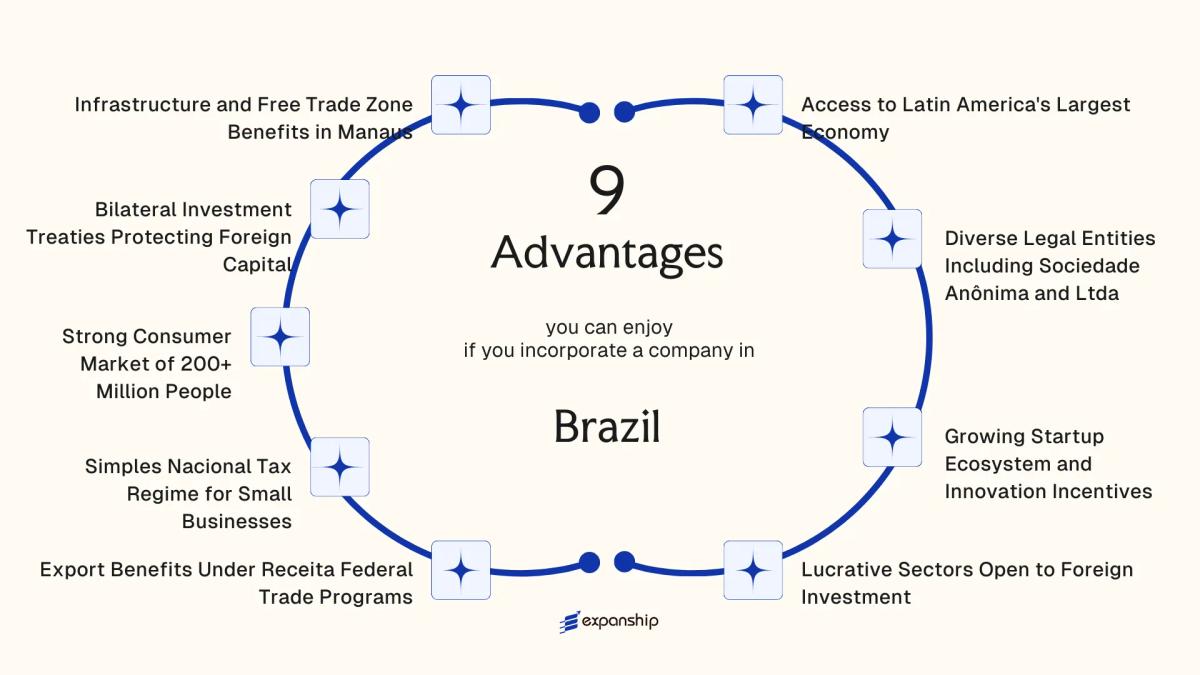
Access to Latin America's Largest Economy
Brazil holds the largest GDP in Latin America, accounting for roughly 40% of the region's total economic output — a concentration that gives any foreign firm incorporated here a structural advantage in accessing Latin American market through Brazil before expanding further across the continent.
Scale That Converts Directly Into Commercial Opportunity
Incorporating in Brazil means your entity operates under the jurisdiction of the Receita Federal do Brasil and is recognized as a locally established legal person, which removes the commercial friction that foreign-registered companies encounter when contracting with Brazilian buyers or public entities. That domestic standing matters because many procurement processes and distribution agreements in the country require a locally registered CNPJ-holding business as a counterparty.
Regional Trade Position and Physical Connectivity
Brazil shares land borders with ten South American countries, meaning a firm based here can reach most of the continent overland. Membership in Mercosul gives your business preferential trade terms with Argentina, Paraguay, and Uruguay under a single customs framework, reducing cross-border transaction costs in a way that an entity registered solely in a smaller neighboring market cannot replicate.
A CNPJ-registered entity in Brazil unlocks both Mercosul preferential trade access and direct participation in domestic procurement — two channels unavailable to foreign-registered firms.
Diverse Legal Entities Including Sociedade Anônima and Ltda
Brazil offers two principal corporate structures that carry distinct advantages depending on how your business is organized and financed. Understanding the Brazil Sociedade Anônima and Ltda benefits helps foreign investors match the right structure to their operational needs from the outset.
The Sociedade Limitada (Ltda), governed by the Código Civil (Law 10.406/2002), limits each partner's liability to their subscribed capital. For a foreign investor entering a new market, this containment of personal exposure is meaningful, particularly when testing a business model before committing to full-scale operations.
The Sociedade Anônima (S.A.), regulated by Law 6.404/1976, suits businesses that anticipate external capital or eventual public listing. Shares can be transferred without amending the articles of association, which simplifies ownership restructuring when bringing in new investors or exiting positions.
Choosing between these structures carries practical weight:
- An Ltda can be formed with a single quotaholder, removing the need for a local partner
- An S.A. can issue different share classes, giving you control over voting and economic rights separately
- Both entities allow 100% foreign ownership under current regulations
- Neither structure imposes a statutory minimum capital requirement that creates a financial barrier to entry

Company Incorporation in Brazil
Incorporate a Sociedade Limitada or Sociedade Anônima in Brazil with full support on registration, documentation, and compliance requirements.
Growing Startup Ecosystem and Innovation Incentives
Brazil startup ecosystem incentives for businesses have become a formal pillar of federal economic policy, not simply a set of informal advantages. Two legislative frameworks define this space: Lei do Bem (Law No. 11,196/2005) and the Brazilian Startups Act (Law No. 182/2021). Together, they create a structured environment where qualifying firms access tax relief and public procurement pathways unavailable in many other markets of comparable size.
Under Lei do Bem, companies taxed under the Lucro Real regime can deduct between 60% and 80% of research and development expenditures from taxable income, with the percentage varying based on headcount growth in technical roles. For a foreign-owned entity running R&D operations locally, this directly reduces the effective corporate tax burden without requiring government pre-approval, which distinguishes it from grant-based models.
| Framework | Primary Benefit | Eligibility Condition |
|---|---|---|
| Lei do Bem (Law 11,196/2005) | R&D expense deduction of 60-80% | Lucro Real tax regime required |
| Brazilian Startups Act (Law 182/2021) | Simplified public procurement access | Company must qualify as an innovative startup |
| EMBRAPII Partnerships | Co-funded applied research programs | Project must involve accredited research institution |
The Startups Act formally defines an innovative startup as a firm with annual gross revenue below BRL 16 million, enabling access to differentiated public contracting rules. Your business can enter federal procurement processes under simplified bidding, which opens a direct revenue channel that typically requires years of local market presence to access through conventional means.
Lucrative Sectors Open to Foreign Investment
Several Brazil sectors open to foreign investment carry few restrictions under Lei nº 4.131/1962, which governs foreign capital and broadly grants foreign investors the same rights as domestic ones. That legal equivalence means your firm competes on the same footing from day one.
Agribusiness generates roughly 25% of GDP. Foreign-owned entities can participate through processing, logistics, and export operations, where margins often exceed primary production. The food processing sector alone connects directly to over 150 export markets.
Renewable energy is another area attracting foreign capital. Brazil holds some of the world's largest hydroelectric capacity, and the ANEEL regulatory framework governs wind, solar, and biomass concessions that foreign firms can bid on directly.
Healthcare, financial technology, and digital infrastructure have all seen increased foreign participation following regulatory modernization through the Banco Central do Brasil's open finance rules and ANVISA's updated medical device approval pathways.
Keep these points in mind:
- Foreign equity in rural land-holding companies is subject to additional restrictions under Lei nº 5.709/1971
- Regulated sectors such as banking require prior Banco Central do Brasil authorization
- Repatriation of profits is permitted but must be registered with BACEN's electronic system (RDE-IED)
- Mining concessions require approval from the Agência Nacional de Mineração before operations begin
Foreign investors in Brazil's oil and gas sector can hold 100% equity in upstream exploration companies — there is no mandatory state participation requirement outside of pre-salt blocks designated for Petrobras.
Export Benefits Under Receita Federal Trade Programs
Brazil Receita Federal export program benefits give exporters meaningful cost advantages by removing or suspending federal taxes on inputs used in production for foreign markets. These mechanisms are grounded in federal legislation and administered by the Receita Federal do Brasil, the federal tax authority responsible for customs and trade compliance.
Drawback Suspensão and Its Financial Impact
Under the Drawback Suspensão regime, governed by Law No. 11,945/2009 and further regulated by the Secretaria de Comércio Exterior (SECEX), a company can import raw materials and intermediate goods with suspension of Import Tax (II), IPI, PIS, COFINS, and AFRMM. Suspending these taxes at the input stage means your business avoids tying up working capital in tax payments that would otherwise require recovery later through administrative processes.
The benefit applies to goods that are incorporated into exported products, which makes it directly relevant to manufacturers, processors, and trading companies sourcing internationally. Approval requires registration with the Siscomex trade system and adherence to the export commitment established at the time of the regime's authorization.
RECOF and Sector-Specific Advantages
The Regime Aduaneiro Especial de Entreposto Industrial sob Controle Aduaneiro Informatizado (RECOF) extends similar logic to industrial bonded warehouses, permitting suspension of federal taxes on imported inputs with stricter output tracking through Receita Federal's automated customs systems. This is particularly relevant to firms in the automotive, aerospace, and electronics sectors with high import-to-export ratios.
Qualifying under RECOF requires minimum annual export thresholds and an integrated fiscal bookkeeping system, but the result is a measurable reduction in the effective cost base for export-oriented production.
Maximize Your Export Tax Benefits in Brazil
Understand which Receita Federal trade regimes your business qualifies for and how to structure your operations to access Drawback, RECOF, and related suspensions from day one.
Simples Nacional Tax Regime for Small Businesses
Simples Nacional, established under Complementary Law 123/2006, consolidates federal, state, and municipal taxes into a single monthly payment calculated against gross revenue. For a foreign-owned small business, this means one filing replaces obligations that would otherwise span the Receita Federal, state ICMS authorities, and municipal ISS offices simultaneously.
- Eligible entities with annual gross revenue up to BRL 4.8 million pay a unified rate that begins as low as 4% depending on the activity annexe under which the business is classified, which is substantially lower than the standard Lucro Real or Lucro Presumido regimes.
- The regime covers IRPJ, CSLL, PIS, COFINS, IPI, ICMS, ISS, and CPP contributions within one payment document (DAS), reducing the administrative burden that typically accompanies multi-jurisdiction tax compliance in Brazil.
- Foreign-owned Ltda entities are eligible provided a Brazilian resident partner holds the qualified management role, making the structure accessible to international investors who appoint a local administrator.
- Payroll cost reductions under the CPP component can be significant for service-sector firms, since the employer social security contribution is embedded in the unified rate rather than calculated separately at 20% on the payroll base.
Strong Consumer Market of 200+ Million People
Brazil consumer market advantages for businesses begin with sheer demographic scale. With a population exceeding 213 million, the domestic market generates sustained demand across consumer goods, financial services, healthcare, and digital products — independent of export performance. Your business is not reliant on cross-border sales to reach volume.
Middle-class expansion has deepened purchasing power across urban centers outside São Paulo and Rio de Janeiro. Cities like Fortaleza, Recife, and Porto Alegre represent distinct regional markets, each with different consumption patterns. A locally incorporated entity positions your firm to serve these markets directly, without the margin erosion of distributor arrangements.
Retail and e-commerce consumption data reinforces the scale of this opportunity. Brazil ranked as the largest e-commerce market in Latin America, with revenues exceeding USD 40 billion annually in recent years, according to Statista.
A foreign firm selling a mid-range consumer product at BRL 150 per unit, capturing just 0.01% of Brazil's adult consumer base, reaches roughly 16,000 buyers — generating approximately BRL 2.4 million in gross revenue from a fraction of one percent market penetration.
Operating through a registered Sociedade Limitada (Ltda) also allows your business to issue Brazilian fiscal documents (Notas Fiscais), which are legally required for domestic commerce and build credibility with local retail and wholesale partners.
Bilateral Investment Treaties Protecting Foreign Capital
Brazil bilateral investment treaties for foreign capital protection take a distinct form compared to traditional BIT frameworks used by most OECD nations. Instead of standard bilateral investment treaties, the country negotiated a set of Cooperation and Facilitation Investment Agreements, known as ACFIs (Acordos de Cooperação e Facilitação de Investimentos). These are currently in force with several partners including Chile, Colombia, Ethiopia, Mozambique, Angola, and the UAE, among others.
ACFIs differ from conventional treaties in meaningful ways for your business:
- Dispute resolution is handled through state-to-state ombudsman channels (the "Focal Points" mechanism) rather than investor-state arbitration, reducing litigation costs for covered investors.
- The agreements include explicit commitments on transparency, regulatory environment, and treatment of invested capital.
- Coverage under an ACFI can provide your firm with a defined institutional channel if a dispute with local authorities arises.
Outside the ACFI framework, foreign capital is also protected under Law No. 4,131/1962 (the Foreign Capital Law), which governs the registration, remittance, and repatriation of foreign investment through the Banco Central do Brasil's electronic system, SISBACEN.
ACFI protections apply based on the nationality of the investing entity, so the jurisdiction where your holding company is registered directly determines whether treaty coverage applies to your investment.
Infrastructure and Free Trade Zone Benefits in Manaus
Established by Federal Law No. 3,173/1957 and later restructured under Decree-Law No. 288/1967, the Zona Franca de Manaus (ZFM) remains one of the most significant Manaus free trade zone benefits for businesses seeking a manufacturing or distribution base in South America. The zone operates under the administration of SUFRAMA (Superintendência da Zona Franca de Manaus), the federal authority responsible for approving projects and granting fiscal incentives.
Tax Incentives Within the ZFM
Companies approved by SUFRAMA can access reductions of up to 88% on the Industrialized Products Tax (IPI), full exemption from the Import Tax on inputs destined for approved manufacturing processes, and reduced rates on PIS/COFINS contributions. These exemptions are not automatic. Your business must submit a Basic Productive Process (PPB) compliance plan demonstrating that a defined minimum of manufacturing activity occurs within the zone.
Approved entities also benefit from ICMS incentives negotiated under Amazonas state legislation, which can further reduce the tax burden on goods distributed to other Brazilian states.
Strategic Logistics Position
Manaus sits at the confluence of the Rio Negro and Amazon River system, giving manufacturers direct waterway access to Atlantic export routes. The Manaus port infrastructure connects to the Port of Belém and onward to international shipping lanes, which reduces inland freight dependency for export-oriented firms.
- Approved ZFM manufacturers can sell into the rest of Brazil while retaining federal tax exemptions on qualifying inputs
- Foreign investors may hold 100% equity in a ZFM-registered entity without a local partner requirement
- SUFRAMA approval is required before fiscal benefits take effect
Why Brazil Stands Out Against Regional Competitors
Comparing Brazil vs Latin America business advantages reveals a consistent pattern: the country's institutional depth and market scale create conditions that smaller regional economies structurally cannot replicate. Colombia and Mexico are the most realistic alternatives a foreign investor evaluates at this stage, given that both offer relatively open foreign ownership rules, active FDI inflows, and established incorporation frameworks. The comparison is instructive not because one jurisdiction dominates on every measure, but because the gap in specific parameters, particularly treaty coverage, market size, and free zone infrastructure, is substantial enough to affect long-term operational planning.
Where Mexico offers maquiladora manufacturing zones and Colombia provides free trade zone regimes under Law 1004 of 2005, neither presents a domestic consumer base approaching the scale available within a single national market here. Operated under SUFRAMA's oversight, the Zona Franca de Manaus functions under a federal decree framework that has remained structurally stable for decades, providing a degree of policy continuity that matters when you are planning capital-intensive operations.
| Parameter | Brazil | Colombia | Mexico |
|---|---|---|---|
| Domestic population | 215+ million | 52 million | 130 million |
| Bilateral investment treaties (active) | 15+ | 12+ | 30+ |
| Dedicated free trade zone with federal tax incentives | Yes (Manaus / SUFRAMA) | Yes (multiple zones) | Yes (maquiladora model) |
| Simplified SME tax regime | Simples Nacional | Simple Régimen | RESICO (introduced 2022) |
| Foreign ownership restriction (general commerce) | None | None | Sector-specific restrictions apply |
| Corporate income tax rate | 15% base + surtax | 35% | 30% |
Compliance Services for Companies in Brazil
Maintain good standing with Receita Federal, JUCESP, and other Brazilian regulatory bodies. Expanship manages your ongoing compliance obligations so your entity remains active and in order.
Conclusion
The benefits of incorporating in Brazil rest on structural foundations that few markets in the Western Hemisphere can replicate. Direct access to a consumer base exceeding 200 million people, combined with preferential tax treatment under Simples Nacional for qualifying firms, creates operating conditions that reduce both market-entry barriers and ongoing fiscal obligations in material terms.
Entities such as the Sociedade Limitada offer foreign investors a familiar limited-liability framework that aligns with international standards while remaining governed by the Código Civil and supervised through the Junta Comercial registration process. For capital-intensive operations, the Zona Franca de Manaus provides documented fiscal incentives that directly affect unit economics, particularly in manufacturing and distribution.
Your specific industry, ownership structure, and intended revenue model will determine which of these advantages applies most directly to your situation. A technology firm pursuing Lei do Bem incentives operates under different conditions than a manufacturing entity seeking Manaus free zone benefits. Understanding which framework aligns with your business objectives is the necessary first step before any formation decision is made.
Start Your Brazil Company Formation With Expanship Today
Expanship supports foreign investors pursuing Brazil company formation with Expanship from the earliest structural decisions through to ongoing compliance. Whether your preferred vehicle is the Sociedade Limitada or a Sociedade Anônima governed under Law 6.404/1976, the firm coordinates with the Junta Comercial, Receita Federal, and the DREI to manage each stage of the registration process correctly.
To incorporate in Brazil with Expanship, the services available to your business include:
- Document preparation, notarization, and consular legalization for foreign shareholder materials
- Registered agent and registered office provision to satisfy DREI requirements
- Government filing and liaison with the Junta Comercial and Receita Federal for CNPJ registration
- Post-incorporation compliance management, including annual filings and corporate book maintenance
- Banking introduction assistance to support your firm's operational account setup with local institutions
- Ongoing registered capital and corporate governance support under Brazilian corporate law
Reach out to Expanship Brazil to discuss your incorporation requirements.
Frequently Asked Questions (FAQ)
Incorporation timelines vary depending on the entity type and the state in which registration occurs. A Sociedade Limitada registered through the Junta Comercial typically takes between four and twelve weeks, accounting for federal tax registration with the Receita Federal and municipal licensing. A Sociedade Anônima, which requires additional steps including the drafting of bylaws and publication of notices, generally takes longer.
Foreign-owned companies are not automatically disqualified from Simples Nacional, but eligibility depends on the company's annual gross revenue staying within the R$4.8 million ceiling and the business activity falling within permitted categories under Lei Complementar nº 123/2006. Certain corporate structures and activities are expressly excluded. A company with foreign legal entity shareholders may face additional scrutiny during enrollment review by the Receita Federal.
Profit distributions remitted abroad are generally exempt from withholding income tax in Brazil, provided the distributing entity has properly accounted for those profits in its books. This exemption derives from provisions under Lei nº 9.249/1995. Where distributions exceed documented retained earnings, the excess may be reclassified and subjected to withholding tax at rates set by the Receita Federal.
Foreign-owned companies can establish operations within the Zona Franca de Manaus (ZFM), subject to approval by the Superintendência da Zona Franca de Manaus (SUFRAMA). Approved entities may access federal tax exemptions including reduced IPI rates and ICMS incentives granted by the state of Amazonas. The benefits are contingent on meeting minimum production process requirements and maintaining compliance with SUFRAMA's periodic reporting obligations.
Foreign capital invested in a Brazilian company must be registered through the Banco Central do Brasil's electronic system, currently the Sistema de Registro de Operações Financeiras (ROF) or the relevant module within the BCB's registration platform. Failure to register prevents the investor from legally repatriating profits or capital abroad, as the registration record is required to authorize outward remittances. Unregistered capital may also create complications during Receita Federal audits of the entity's financial records.
Yes, certain sectors impose ownership or participation limits on foreign investors regardless of whether the entity is structured as an Ltda or S.A. These include rural land acquisition, which is governed by Lei nº 5.709/1971 and subsequent regulations, as well as broadcasting and certain financial services activities. Healthcare and aviation sectors also carry specific restrictions or conditions under applicable federal legislation.
Legal Disclaimer
The information provided in this article is for general informational purposes only and does not constitute legal, tax, or professional advice. While we strive to ensure the accuracy and timeliness of the content, laws and regulations are subject to change, and the application of laws can vary widely based on specific facts and circumstances.
Readers should not act upon this information without seeking professional counsel tailored to their individual situation. Expanship and its authors disclaim any liability for actions taken or not taken based on the content of this article.
For specific advice regarding your business setup, compliance requirements, or any legal matters, please consult with qualified legal and tax professionals in the relevant jurisdiction.