
Key Takeaways
- The BES Tax Act (introduced following the 2010 dissolution of the Netherlands Antilles) creates a compliance environment distinct from both mainland Dutch and standard Caribbean frameworks, requiring specialized legal and tax expertise that is difficult to source locally.
- Despite their Dutch public entity status, the BES islands remain outside the EU Single Market, meaning companies incorporated in BQ cannot access EU passporting rights or the regulatory equivalence benefits available to entities in the European Netherlands.
- The islands' small combined population and reliance on imported goods and services drive operational costs significantly higher than comparable jurisdictions, particularly for businesses requiring physical infrastructure or local staffing.
- The absence of a developed local banking sector and limited pool of qualified directors forces BQ-incorporated entities to rely on offshore service providers, adding cost, administrative complexity, and counterparty dependency to routine corporate governance functions.
Bonaire, Sint Eustatius, and Saba operate under a regulatory framework that blends Dutch administrative law with Caribbean-specific fiscal legislation, including the BES Tax Act introduced following the 2010 dissolution of the Netherlands Antilles. This creates a distinct compliance environment that differs from both the European Netherlands and other Caribbean territories.
The drawbacks of BQ company formation span structural, operational, financial, and legal dimensions, each examined separately in the sections that follow.
Not every disadvantage applies equally across all business types. A firm conducting purely digital services faces different constraints than one requiring local staffing, physical infrastructure, or access to Dutch or EU financial systems.
This article is most relevant to foreign investors and holding company operators who are evaluating the BES islands as a base for regional operations, asset structuring, or trade-oriented entities and need a clear picture of where friction points arise.
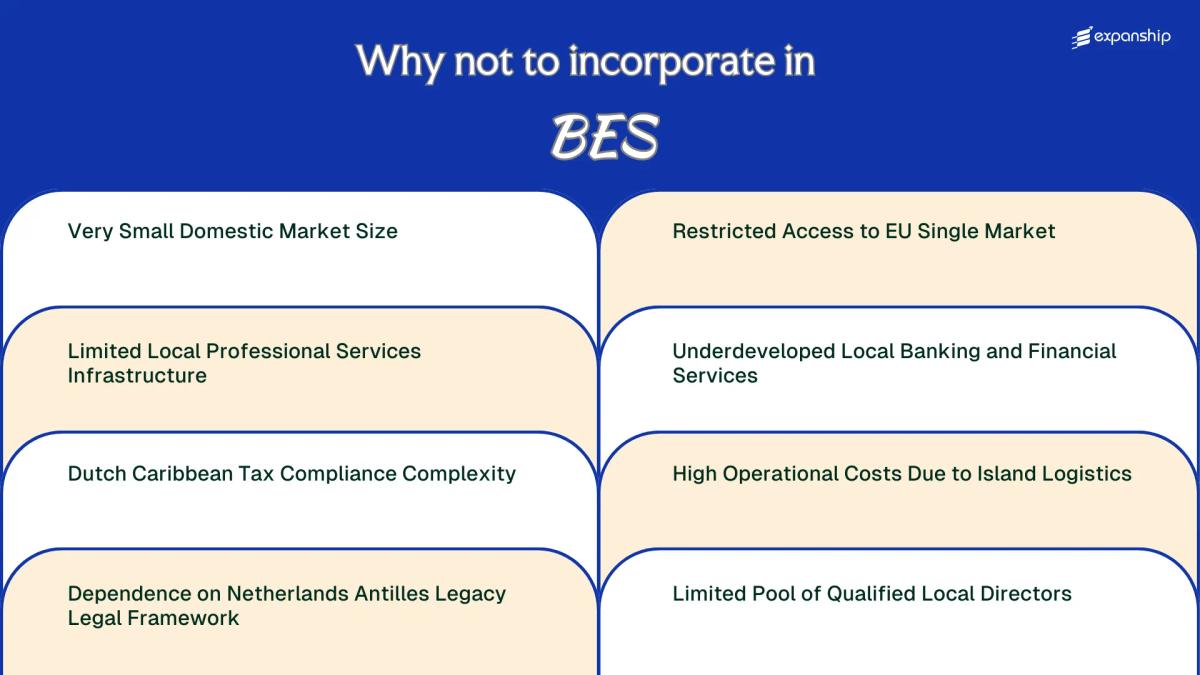
Very Small Domestic Market Size
The three islands that make up the BES islands collectively hold a registered population of roughly 25,000 people, a figure that directly shapes the ceiling for domestic revenue. BES islands small market size limitations mean that any business oriented toward local consumers faces a structurally constrained demand base from the moment of incorporation.
Consumer Base Too Thin to Sustain Most Business Models
Bonaire, the largest of the three, accounts for approximately 20,000 residents, while Sint Eustatius and Saba together contribute fewer than 5,000. A restricted consumer base of this scale cannot generate sufficient transaction volume to recover setup costs, regulatory fees, or staffing overhead for most product or service categories.
Revenue Dependency Forces External Market Exposure
Your entity cannot realistically depend on local sales to reach viability thresholds that justify the administrative costs of maintaining a BQ-registered firm. Because domestic purchasing power is thin and geographically fragmented across three separate islands, revenue projections tied to local demand consistently underperform against incorporation costs.
A business incorporated in BQ without a confirmed external revenue stream faces a near-certain structural deficit, as the domestic market cannot independently support most commercially viable operating models.
Limited Local Professional Services Infrastructure
The limited professional services infrastructure in the BES islands creates immediate sourcing problems for foreign incorporators. Bonaire, Sint Eustatius, and Saba collectively have a population under 25,000, which directly constrains the number of licensed notaries, tax advisors, and corporate service providers operating locally.
Under Dutch Caribbean law, incorporating a legal entity requires notarial deed execution. With only a handful of notaries active across all three islands, scheduling delays are common and fees are elevated due to limited competition.
Gaps in the BQ lack of corporate service providers translate into real operational friction:
- Sourcing a local registered agent often requires engaging firms based in Curaçao or the Netherlands, adding cross-border coordination costs to routine compliance tasks
- Annual filing obligations with the BES Tax Office (Belastingdienst CN) may require hiring specialized advisors with BES-specific knowledge, who charge a premium precisely because demand is thin
- Due diligence and corporate secretarial work frequently depend on professionals with limited BES caseloads, lengthening turnaround times for time-sensitive transactions
Dutch-trained professionals familiar with Netherlands Antilles legacy statutes are not always physically present on-island, so even basic corporate maintenance can require remote engagement at additional cost.

Company Incorporation in Bonaire Sint Eustatius and Saba
Understand the full process and requirements for setting up a legal entity in the BES islands with support from Expanship's incorporation specialists.
Dutch Caribbean Tax Compliance Complexity
Dutch Caribbean tax compliance challenges in BQ stem from a fiscal system that is structurally separate from both the Netherlands and the European Union, yet still administratively linked to Dutch institutional frameworks. This creates a layered compliance burden that most foreign business owners do not anticipate before incorporating.
The BES islands operate under the Wet fiscale stelsels BES (Fiscal Systems BES Act), which introduced a distinct tax regime when the islands became Dutch public bodies in 2010. Corporate income tax is levied at a flat rate of 25.5%, which is not offset by EU parent-subsidiary directive benefits since BES entities fall outside EU fiscal directives.
| Compliance Factor | Applicable Rate / Requirement | Implication for Foreign Firms |
|---|---|---|
| Corporate income tax rate | 25.5% flat | No tiered relief or EU directive offset available |
| General Expenditure Tax (ABB) | 8% on most goods and services | Applies to operational costs, not a VAT with recoverable input credits |
| Revenue tax threshold | Applicable to certain turnovers | No pan-EU VAT registration reciprocity |
| Tax filing authority | Belastingdienst CN (Caribbean Netherlands) | Separate authority from Dutch mainland tax administration |
The General Expenditure Tax (Algemene Bestedingsbelasting, or ABB) does not function like EU VAT. Input tax recovery is not available in the same way, meaning your firm absorbs ABB as a hard cost rather than reclaiming it through standard credit mechanisms.
Belastingdienst Caribisch Nederland administers tax compliance for BES entities, but its limited physical presence across three islands creates practical delays in rulings and correspondence. Foreign directors managing entities remotely face added difficulty obtaining timely administrative responses.
Transfer pricing rules and thin capitalisation provisions apply under the BES framework, though regulatory guidance remains less developed than in OECD-standard jurisdictions. Your tax advisors will need specific BES expertise, which is scarce outside a narrow group of Dutch Caribbean specialists.
Dependence on Netherlands Antilles Legacy Legal Framework
The Netherlands Antilles legal framework risks BQ businesses face are structural, not incidental. When the Netherlands Antilles dissolved on 10 October 2010, the BES islands became special municipalities of the Netherlands, but the legal transition was incomplete. Much of the pre-existing corporate law was retained in modified form rather than replaced, leaving gaps that create genuine uncertainty for foreign entities operating there.
Corporate law in the BES islands continues to draw from transitional legislation rather than a fully modernised statutory code. The BES civil code reflects adaptations of older Netherlands Antilles law, which means certain provisions have not kept pace with contemporary international corporate governance standards. For your business, this translates into legal ambiguity around matters such as fiduciary duties and minority shareholder protections.
Relying on legacy structures also means local legal precedent is thin. Courts have limited case history under the current BES framework, so dispute resolution outcomes are harder to predict than in mature jurisdictions.
- Corporate acts must conform to the transitional BES civil code, not Dutch mainland company law
- Certain legal concepts from the Netherlands Antilles dissolution period remain unresolved in statute
- BES islands legacy corporate law limitations affect the enforceability of some standard contract structures
- Dutch Caribbean legal counsel familiar with both the old and current framework is a practical necessity, not optional
The BES islands are not governed by the Dutch Civil Code that applies in the European Netherlands — meaning standard Dutch legal templates your advisors may already use are not automatically valid here.
Restricted Access to EU Single Market
BES islands restricted EU single market access is one of the more consequential structural constraints for foreign businesses registered here. The BES islands hold Overseas Country and Territory (OCT) status under EU law, not the status of an EU outermost region.
The Structural Basis of the Restriction
OCT status, governed by the EU's Overseas Association Decision, means that goods and services originating in the BES islands do not automatically benefit from the EU's internal market rules on free movement. Your business cannot treat a BES-registered entity as an EU-based company for purposes of passporting financial services, accessing EU procurement frameworks, or invoking EU trade agreements with third countries.
Practical Consequences for Foreign-Owned Entities
A firm incorporated here that targets European customers or partners faces the same third-country barriers that apply to non-EU jurisdictions in many regulated sectors. This distinction carries particular weight in financial services, where EU passporting rights are unavailable to BES-registered entities, requiring a separate EU-domiciled structure to access those markets. This limitation applies regardless of the Dutch nationality of the islands, since the Netherlands' EU membership does not extend market access rights to its Caribbean public bodies.
Addressing Market Access Constraints for Your BES Islands Entity
Understand how your BES-registered company is positioned relative to EU market requirements and what structural considerations apply to your sector.
Underdeveloped Local Banking and Financial Services
Underdeveloped banking and financial services in the BES islands create friction that most incorporated entities in larger jurisdictions simply do not encounter. The number of licensed commercial banks operating across all three islands remains limited, and none function as global financial centres.
- Your business account opening process is subject to strict Customer Due Diligence requirements under the Dutch Anti-Money Laundering and Anti-Terrorist Financing Act (Wwft), which applies in the BES islands and imposes documentation burdens that can delay account activation by weeks.
- Correspondent banking relationships between BES-based institutions and international banks are sparse, forcing your firm to route cross-border transactions through intermediary banks and incur additional fees and processing delays.
- Access to trade finance instruments, credit facilities, and structured lending products is constrained by the shallow local banking market, leaving foreign-owned entities with fewer financing options than comparable entities incorporated in metropolitan Netherlands.
- The De Nederlandsche Bank (DNB) supervises financial institutions operating in the BES, but its regulatory perimeter does not eliminate the service gaps created by low commercial banking competition on each island.
High Operational Costs Due to Island Logistics
High operational costs from BES islands incorporation are not an abstraction — they are a direct consequence of geography. Each island is a small, isolated landmass in the Caribbean with no domestic manufacturing base, meaning virtually all goods, equipment, and business inputs must be imported by sea or air.
Freight transit times are long, and shipping connections to Bonaire, Sint Eustatius, and Saba are infrequent compared to larger Caribbean hubs. Your supply chain depends on multi-leg routes, often via Curaçao or the United States, adding both cost and unpredictability to inventory planning.
Perishables, specialist equipment, and office infrastructure all carry elevated landed costs once import duties, handling fees, and local transport are factored in. For service firms, even routine IT hardware replacements become logistical events rather than administrative tasks.
- Port infrastructure on Sint Eustatius and Saba is limited, restricting vessel size and cargo volume per shipment.
- Emergency procurement has no practical local alternative, forcing expensive air freight from the mainland.
A business setting up a small office on Saba requiring two workstations, a server unit, and standard office furniture could reasonably face freight and import-related costs exceeding USD 3,000 to USD 5,000 above the base equipment price, depending on routing through St. Maarten and local delivery surcharges — before a single operational day begins.
Limited Pool of Qualified Local Directors
The limited qualified directors BES islands can supply is a structural constraint, not a temporary gap. Each of the three islands has a small permanent population, with Bonaire being the largest at roughly 22,000 residents. That demographic ceiling directly restricts how many individuals with the professional background required for corporate directorship are available at any given time.
Dutch corporate law, applied to BES entities through the BES Civil Code (Burgerlijk Wetboek BES), does not mandate a locally resident director for most company types. However, many banks, counterparties, and regulatory bodies in practice expect at least one director with demonstrable ties to or knowledge of the jurisdiction. That expectation narrows your pool further.
Sourcing a qualified director locally often means competing with other foreign-owned entities for the same small group of professionals. Scarcity drives up fees and reduces your negotiating position on governance terms.
- Qualified candidates with relevant financial or legal credentials are concentrated primarily on Bonaire
- Sint Eustatius and Saba face more acute shortages due to even smaller resident populations
- Availability of experienced corporate directors with Dutch Caribbean regulatory familiarity is particularly thin
If your entity's activity requires oversight from the Dutch Caribbean financial regulator, De Nederlandsche Bank (DNB) or the Authority for the Financial Markets (AFM), fit-and-proper requirements for directors may apply, significantly limiting the already narrow pool of eligible candidates.
Overcoming Incorporation Challenges in BQ
Overcoming BQ incorporation challenges requires structural planning rather than reactive fixes. The disadvantages covered in this blog — from banking access gaps to legacy legal frameworks — each trace back to the jurisdiction's scale and its unique position within the Dutch constitutional order.
- Appoint a director with demonstrable ties to the BES islands or relevant Dutch Caribbean experience to satisfy local directorship expectations under the applicable civil law framework.
- Open correspondent or non-resident business accounts early in the formation process to work around the limited local banking infrastructure on the islands.
- Register your entity under the correct legal form within the RCN business register to ensure compliance with the Netherlands Antilles-derived civil code still governing commercial entities.
- Engage a local notary for deed of incorporation, as notarial involvement remains a mandatory procedural step under the applicable civil law tradition.
- Structure your tax position accounting for the BES fiscal regime administered by the Belastingdienst/CN, which operates separately from the European Netherlands tax authority.
Mitigation steps of this kind operate within a constitutional framework where the Netherlands retains legislative authority over key regulatory matters affecting these public bodies. Structural decisions made at incorporation have downstream consequences that are difficult to reverse given the limited local legal and administrative infrastructure.
BQ's Overall Business Viability
BQ business viability despite drawbacks is a reasonable framing for any foreign founder reviewing this jurisdiction. The structural limitations are real and documented, yet the BES islands maintain a legitimate legal foundation under Dutch public law, with direct ties to the Netherlands and a stable, if narrow, regulatory environment.
| Pro | Con |
|---|---|
| Dutch public law governs the islands, providing a familiar and stable legal base | The legal framework retains legacy Netherlands Antilles structures that have not been fully modernised |
| USD is the official currency on all three islands, removing exchange rate exposure | Banking options are limited, with few institutions offering full corporate financial services |
| No participation in the EU single market despite Dutch constitutional ties | Access to EU trade arrangements and passporting rights is restricted |
| Physical infrastructure supports niche sectors such as tourism and marine trade | Island logistics drive operational costs significantly above continental benchmarks |
| Corporate compliance is overseen by established Dutch Caribbean regulatory processes | Tax compliance requires navigating both local and Dutch fiscal obligations simultaneously |
Qualified local directors are scarce across all three islands, which complicates governance structuring for foreign-owned entities. The domestic market is too small to sustain most businesses without a clear external revenue model.
Corporate Compliance Services in Bonaire, Sint Eustatius and Saba
Stay aligned with BES islands regulatory requirements, from annual filings to director obligations under Dutch Caribbean corporate law.
Conclusion
The cons of BQ company registration summary points toward a jurisdiction with genuine structural constraints rather than regulatory failures. As a special municipality under direct Dutch administration, the BES islands operate within a tax and legal framework that lacks the full integration of either EU membership or a sovereign offshore regime. The underdeveloped local banking infrastructure and the limited pool of qualified directors present tangible operational barriers. For businesses requiring scalable financial services or local governance capacity, those gaps carry real cost. Specialist guidance specific to BES regulations remains a practical prerequisite before committing to formation here.
Expanship's BQ Business Setup Support
Expanship's BQ business setup support is designed to reduce the operational weight of incorporating in BES, where obligations span the RCN tax framework, legacy Netherlands Antilles civil law, and Dutch Caribbean compliance requirements that few advisors handle with consistency. Your entity still faces these structural realities, but working with a firm that knows the local regulatory environment means fewer delays and missteps during setup and beyond.
Expanship offers a defined range of corporate services for BES-based businesses.
- Your company registration is handled from document preparation through to submission with the relevant Bonaire, Sint Eustatius, or Saba authorities.
- A registered agent and local office address are provided to satisfy BES presence requirements.
- Government filings and regulatory body correspondence are managed on your behalf.
- Post-incorporation compliance obligations are tracked and maintained over time.
- Banking introductions are facilitated to help your business establish local financial relationships.
- Tax registration with local RCN authorities is coordinated alongside ongoing liaison support.
Reach out to Expanship BQ to discuss how we can support your incorporation.
Frequently Asked Questions (FAQ)
Yes, all registered entities in BES are subject to the Dutch Caribbean tax framework, which operates under rules distinct from both the Netherlands and the former Netherlands Antilles regime. The transition away from the Netherlands Antilles legal structure, dissolved in 2010, created a layered compliance environment where businesses must account for local island ordinances alongside Dutch public entity regulations. There is no simplified regime available to small or newly formed entities that removes this compliance burden.
Non-compliance with BES tax obligations can result in penalties and interest charges administered through the Dutch Tax and Customs Administration (Belastingdienst), which has jurisdiction over the islands as special municipalities of the Netherlands. Because BES operates under a separate tax regime from the European Netherlands, errors often arise from misapplying mainland Dutch rules to island-specific requirements. These mistakes can trigger retroactive assessments that carry both financial penalties and reputational consequences with Dutch regulatory bodies.
The problem is more acute in BES than in many Caribbean jurisdictions of similar size because the combined population of Bonaire, Sint Eustatius, and Saba is under 30,000. That demographic ceiling limits the available talent pool regardless of sector, meaning businesses requiring locally resident directors for substance purposes face a structurally constrained market. In jurisdictions like the Cayman Islands or BVI, professional director services are well established; BES has not developed an equivalent industry at scale.
There is no single fixed figure, but businesses consistently report that freight, warehousing, and basic office infrastructure costs run materially higher than mainland equivalents due to the islands' remote locations and reliance on imported goods. Bonaire, Sint Eustatius, and Saba have no land borders and limited port capacity, which means supply chain delays compound cost increases. For capital-intensive businesses or those requiring regular physical imports, this logistical premium can represent a meaningful share of annual operating overhead.
No. Despite being special municipalities of the Netherlands, the BES islands are designated as Overseas Countries and Territories (OCTs) under EU law, which explicitly excludes them from the EU single market. A company incorporated in BES cannot passport financial services into the EU, benefit from EU free trade agreements as a matter of right, or rely on the CE marking framework for goods sold across Europe without additional regulatory steps. This distinction is material for any business model that depends on frictionless EU market access.
Penalties vary depending on the specific obligation involved, but the transition legislation established that existing corporate obligations under the former Netherlands Antilles Civil Code were absorbed into BES law, meaning gaps in compliance do not disappear simply because the original issuing jurisdiction no longer exists. The Belastingdienst and relevant Dutch supervisory bodies retain enforcement authority over these carried-over obligations. Businesses that assumed the 2010 dissolution nullified prior obligations have faced enforcement actions and financial penalties as a result.
It is a structural constraint tied directly to the islands' population size and geographic isolation. The qualified accountants, corporate lawyers, and compliance professionals available on-island are few, and demand from existing businesses already absorbs much of that capacity. Remote engagement of Netherlands-based or international professionals is possible but adds cost and coordination complexity, and it does not always satisfy substance requirements that regulators may expect to be met locally.
Legal Disclaimer
The information provided in this article is for general informational purposes only and does not constitute legal, tax, or professional advice. While we strive to ensure the accuracy and timeliness of the content, laws and regulations are subject to change, and the application of laws can vary widely based on specific facts and circumstances.
Readers should not act upon this information without seeking professional counsel tailored to their individual situation. Expanship and its authors disclaim any liability for actions taken or not taken based on the content of this article.
For specific advice regarding your business setup, compliance requirements, or any legal matters, please consult with qualified legal and tax professionals in the relevant jurisdiction.